


Iranians Vote to Replace President Killed In a Helicopter Crash, But Apathy Remains High

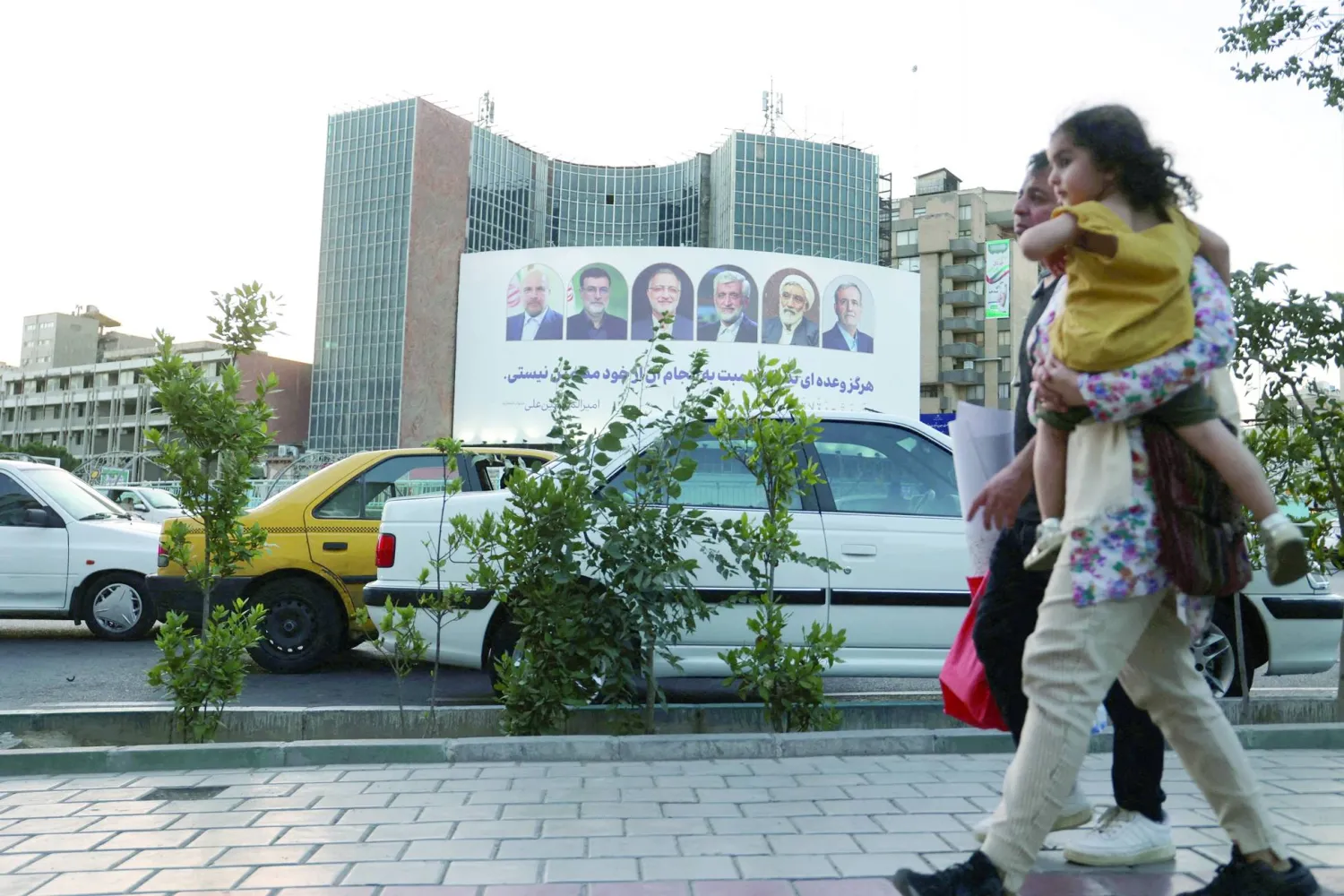
A billboard with a picture of the presidential candidates is displayed on a street in Tehran, Iran, June 17, 2024. Majid Asgaripour/WANA (West Asia News Agency) via REUTER/File Photo
TT

Iranians Vote to Replace President Killed In a Helicopter Crash, But Apathy Remains High

A billboard with a picture of the presidential candidates is displayed on a street in Tehran, Iran, June 17, 2024. Majid Asgaripour/WANA (West Asia News Agency) via REUTER/File Photo

Iranians were voting Friday in a snap election to replace the late President Ebrahim Raisi, killed in a helicopter crash last month, as public apathy has become pervasive in Iran after years of economic woes, mass protests and tensions in the Middle East.
Voters face a choice between hard-line candidates and a little-known politician who belongs to Iran's reformist movement that seeks to change its Shiite theocracy from within. As has been the case since the 1979 Iranian Revolution, women and those calling for radical change have been barred from the ballot while the vote itself will have no oversight from internationally recognized monitors, The Associated Press said.
The voting comes as wider tensions have gripped the Middle East over the Israel-Hamas war in the Gaza Strip. In April, Iran launched its first-ever direct attack on Israel over the war in Gaza, while militia groups that Tehran arms in the region — such as the Lebanese Hezbollah and Yemen's Houthi extremists— are engaged in the fighting and have escalated their attacks.
Meanwhile, Iran continues to enrich uranium at near weapons-grade levels and maintains a stockpile large enough to build — should it choose to do so — several nuclear weapons.
While Iran's 85-year-old Supreme Leader Ali Khamenei has the final say on all matters of state, presidents can bend the country's policies toward confrontation or negotiation with the West.
However, given the record-low turnout in recent elections, it remains unclear just how many Iranians will take part in Friday's poll.
Interior Minister Ahmad Vahidi, who is in charge of overseeing the election, announced all the polls had opened just at 8 a.m. local time. Khamenei cast one of the election's first votes, urging the public to turn out. State television later broadcast images of polling places across the country with modest lines.
Analysts broadly describe the race as a three-way contest. There are two hard-liners, former nuclear negotiator Saeed Jalili and the parliament speaker, Mohammad Bagher Qalibaf. Then there’s the reformist candidate Masoud Pezeshkian, who has aligned himself with figures such as former President Hassan Rouhani under whose administration Tehran struck the landmark 2015 nuclear deal with world powers.
The nuclear deal eventually collapsed and hard-liners were back firmly at the helm.
A higher turnout could boost the chances of Pezeshkian, a 69-year-old heart surgeon who seeks a return to the atomic accord and better relations with the West. But it remains unclear if Pezeshkian could gain the momentum needed to draw voters to the ballot. There have been calls for a boycott, including from imprisoned Nobel Peace Prize laureate Narges Mohammadi.
More than 61 million Iranians over the age of 18 are eligible to vote, with about 18 million of them between 18 to 30.
Iranian law requires that a winner gets more than 50% of all votes cast. If that doesn't happen, the race's top two candidates will advance to a runoff a week later. There's been only one runoff presidential election in Iran's history, in 2005, when hard-liner Mahmoud Ahmadinejad bested former President Akbar Hashemi Rafsanjani.
The 63-year-old Raisi died in the May 19 helicopter crash that also killed the country's foreign minister and others. He was seen as a protégé of Khamenei and a potential successor as supreme leader. Still, many knew him for his involvement in the mass executions that Iran conducted in 1988, and for his role in the bloody crackdowns on dissent that followed protests over the 2022 death of Mahsa Amini, a young woman detained by police over allegedly improperly wearing the mandatory headscarf.



Australian Police Investigate Threatening Letter to Country's Largest Mosque

FILE PHOTO: A security guard stands outside the Lakemba Imam Ali bin Abi Talib Mosque as people arrive for Friday prayers in Sydney, Australia, December 19, 2025. REUTERS/Hollie Adams/File Photo
TT

Australian Police Investigate Threatening Letter to Country's Largest Mosque

FILE PHOTO: A security guard stands outside the Lakemba Imam Ali bin Abi Talib Mosque as people arrive for Friday prayers in Sydney, Australia, December 19, 2025. REUTERS/Hollie Adams/File Photo

Australian police said on Thursday they had launched an investigation after a threatening letter was sent to the country’s largest mosque, the third such incident in the lead-up to the Muslim fasting month of Ramadan.

The letter sent to Lakemba Mosque in Sydney’s west on Wednesday contained a drawing of a pig and a threat to kill the "Muslim race", local media reported. Police said they had taken the letter for forensic testing, and would continue to patrol ‌religious sites including ‌the mosque, as well as community events.

The latest letter ‌comes ⁠weeks after a ⁠similar message was mailed to the mosque, depicting Muslim people inside a mosque on fire.

Police have also arrested and charged a 70-year-old man in connection with a third threatening letter sent to Lakemba Mosque's staff in January.

The Lebanese Muslim Association, which runs the mosque, told the Australian Broadcasting Corp (ABC) it had written to the government to request more funding for additional security guards and ⁠CCTV cameras.

Some 5,000 people are expected to attend ‌the mosque each night during Ramadan. More ‌than 60% of residents in the suburb of Lakemba identify as Muslim, according to ‌the Australian Bureau of Statistics.

Bilal El-Hayek, mayor of Canterbury-Bankstown council, where Lakemba ‌is located, said the community was feeling "very anxious".

"I've heard first-hand from people saying that they won't be sending their kids to practice this Ramadan because they're very concerned about things that might happen in local mosques," AFP quoted him as saying.

Prime Minister Anthony Albanese ‌condemned the recent string of threats.

"It is outrageous that people just going about commemorating their faith, particularly during the ⁠holy month ⁠for Muslims of Ramadan, are subject to this sort of intimidation," he told ABC radio.

"I have said repeatedly we need to turn down the temperature of political discourse in this country, and we certainly need to do that."

Anti-Muslim sentiment has been growing in Australia since the war in Gaza War in late 2023, according to a recent report commissioned by the government.

The Islamophobia Register Australia has also documented a 740% rise in reports following the Bondi mass shooting on December 14, where authorities allege two gunmen inspired by ISIS killed 15 people attending a Jewish holiday celebration.

"There's been a massive increase post-Bondi," Mayor El-Hayek said. "Without a doubt, this is the worst I have ever seen it. There's a lot of tension out there."


Russia's Lavrov Warns against Any New US Strike on Iran

FILE PHOTO: Russia's Foreign Minister Sergei Lavrov speaks during an annual press conference in Moscow, Russia, January 14, 2025. REUTERS/Evgenia Novozhenina/File Photo
TT

Russia's Lavrov Warns against Any New US Strike on Iran

FILE PHOTO: Russia's Foreign Minister Sergei Lavrov speaks during an annual press conference in Moscow, Russia, January 14, 2025. REUTERS/Evgenia Novozhenina/File Photo

Russian Foreign Minister Sergei Lavrov, in ‌an interview made public on Wednesday, said that any new US strike on Iran would have serious consequences and called for restraint to find a solution to enable Iran to pursue a peaceful nuclear program.

Lavrov's interview with Saudi Arabia's Al-Arabiya television was aired a day after US and Iranian negotiators held indirect talks in Geneva to head off a new mounting crisis between Washington and Tehran, Reuters said.

"The consequences are not good. There have already been strikes on Iran on ‌nuclear sites ‌under the control of the International Atomic ‌Energy ⁠Agency. From what ⁠we can judge there were real risks of a nuclear incident," Lavrov said in the interview, which was posted on his ministry's website.

"I am carefully watching reactions in the region from Arab countries, Gulf monarchies. No one wants an increase in tension. Everyone understands this is playing with fire."

Boosting ⁠tensions, he said, could undo the ‌positive steps of recent years, including ‌improved relations between Iran and nearby countries, notably Saudi Arabia.

A senior ‌US official told Reuters on Wednesday that Iran was ‌expected to submit a written proposal on how to resolve its standoff with the United States after the talks in Geneva.

US national security advisers met in the White House on Wednesday and ‌were told all US military forces deployed to the region should be in place ⁠by mid-March, ⁠the official said.

The United States wants Iran to give up its nuclear program, and Iran has adamantly refused and denied it is trying to develop an atomic weapon.

Lavrov said Arab countries were sending signals to Washington "clearly calling for restraint and a search for an agreement that will not infringe on Iran's lawful rights and ... guarantee that Iran has a purely peaceful nuclear enrichment program".

Russia, he said, remained in close, regular contact with Iran's leaders "and we have no reason to doubt that Iran sincerely wants to resolve this problem on the basis of observing the Nuclear Non-Proliferation Treaty".


AI Cannot Be Left to 'Whims of a Few Billionaires', UN Chief Says

India's Prime Minister Narendra Modi speaks with United Nations Secretary-General Antonio Guterres during a welcoming ceremony at AI Impact Summit, in New Delhi, India, February 18, 2026. India's Press Information Bureau/Handout via REUTERS
TT

AI Cannot Be Left to 'Whims of a Few Billionaires', UN Chief Says

India's Prime Minister Narendra Modi speaks with United Nations Secretary-General Antonio Guterres during a welcoming ceremony at AI Impact Summit, in New Delhi, India, February 18, 2026. India's Press Information Bureau/Handout via REUTERS

UN chief Antonio Guterres warned technology leaders Thursday of the risks of artificial intelligence, saying its future cannot be left to "the whims of a few billionaires".

Speaking at a global AI summit in India, the UN chief called on tech tycoons to support a $3 billion global fund to ensure open access to the fast-advancing technology for all.

"AI must belong to everyone," he said.

"The future of AI cannot be decided by a handful of countries -- or left to the whims of a few billionaires," he added, warning the world risked deepening inequality unless urgent steps were taken.

"Done right, AI can... accelerate breakthroughs in medicine, expand learning opportunities, strengthen food security, bolster climate action and disaster preparedness and improve access to vital public services," he said.

"But it can also deepen inequality, amplify bias and fuel harm."

The UN has set up an AI scientific advisory body to help countries make decisions about the revolutionary technology.

Guterres warned that people must be protected from exploitation, and that "no child should be a test subject for unregulated AI".

He pressed for global guardrails to ensure oversight and accountability, and the creation of "Global Fund on AI" to build basic capacity.

"Our target is $3 billion," he told the conference, which includes national leaders as well as tech CEOs, including Sam Altman of OpenAI and Google's Sundar Pichai.

"That's less than one percent of the annual revenue of a single tech company. A small price for AI diffusion that benefits all, including the businesses building AI."

Without investment, "many countries will be logged out of the AI age", exacerbating global divides, he said.

He also cautioned that as AI's energy and water demands soar, data centers must switch to clean power, rather than "shift costs to vulnerable communities".