Satellite Photos Show Iran Expanding Missile Production

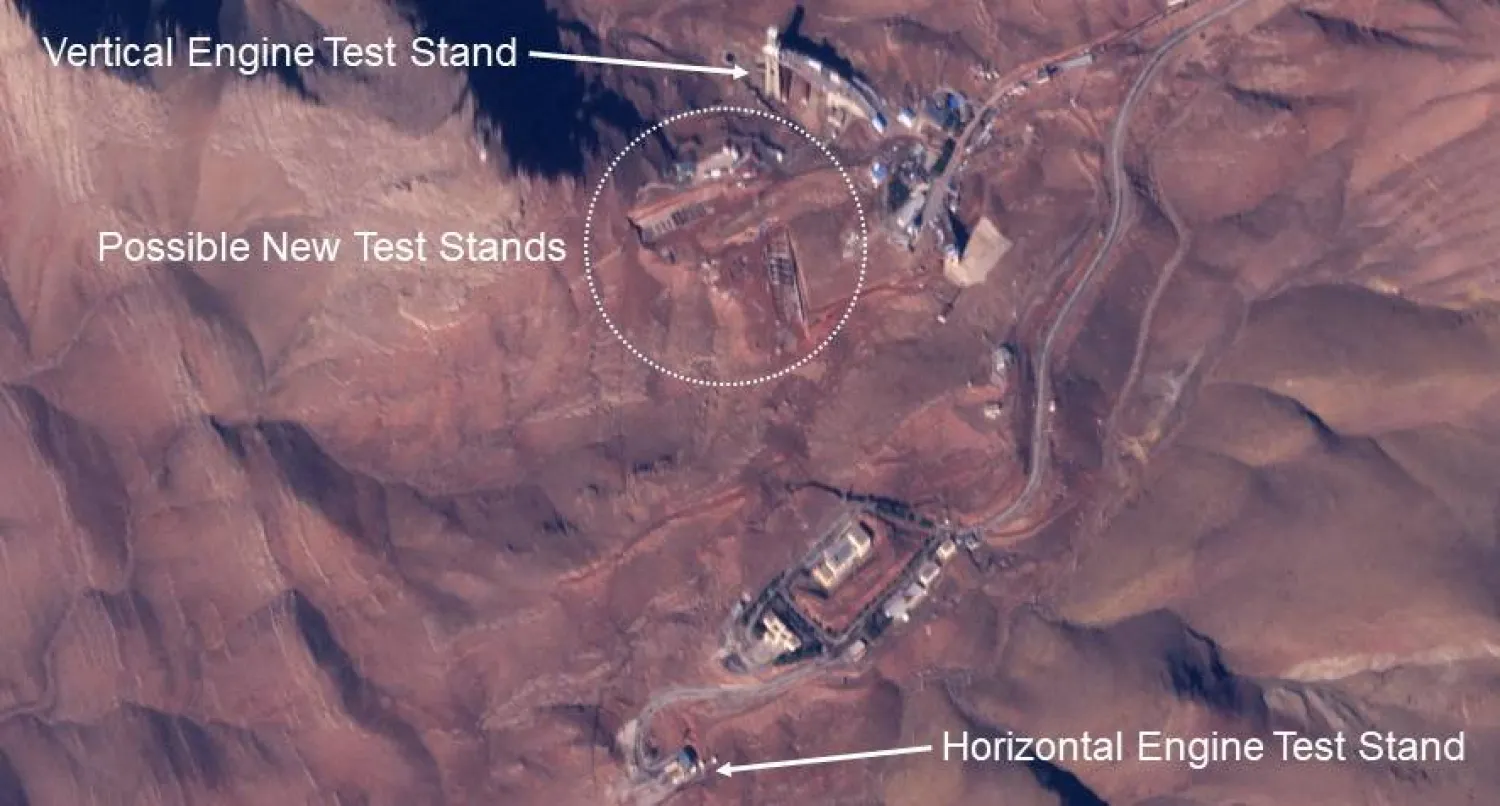
A satellite photo shows the suspected expansion of missile facilities at Shahid Modarres Garrison, near Tehran, Iran, in this handout image obtained by Reuters on July 5, 2024.
TT

Satellite Photos Show Iran Expanding Missile Production

A satellite photo shows the suspected expansion of missile facilities at Shahid Modarres Garrison, near Tehran, Iran, in this handout image obtained by Reuters on July 5, 2024.

Recent satellite imagery shows major expansions at two key Iranian ballistic missile facilities that two American researchers assessed are for boosting missile production, a conclusion confirmed by three senior Iranian officials.
The enlargement of the sites follows an October 2022 deal in which Iran agreed to provide missiles to Russia, which has been seeking them for its war against Ukraine. Tehran also supplies missiles to Yemen's Houthi militants and the Lebanese militia Hezbollah, both members of the Iran-backed Axis of Resistance against Israel, according to US officials.
Images taken by commercial satellite firm Planet Labs of the Modarres military base in March and the Khojir missile production complex in April show more than 30 new buildings at the two sites, both of which are located near Tehran.
The images, reviewed by Reuters, show many of the structures are surrounded by large dirt berms. Such earthworks are associated with missile production and are designed to stop a blast in one building from detonating highly combustible materials in nearby structures, said Jeffrey Lewis of the Middlebury Institute of International Studies at Monterey.
The expansions began at Khojir in August last year and at Modarres in October, Lewis said, based on images of the sites.
Iran's arsenal is already the largest in the Middle East, estimated at more than 3,000 missiles, including models designed to carry conventional and nuclear warheads, experts say.
Three Iranian officials, who asked not to be identified because they were not authorized to speak publicly, confirmed that Modarres and Khojir are being expanded to boost production of conventional ballistic missiles.
"Why shouldn't we?" said one official.
A second Iranian official said some of the new buildings would also allow a doubling of drone manufacturing. Drones and missile components would be sold to Russia, drones would be provided to the Houthis and missiles to Hezbollah, the source added.
Reuters was unable independently to confirm the Iranian officials' comments. Iran's mission to the United Nations did not respond to a Reuters request for comment on the expansion of the complexes. Tehran has previously denied providing drones and missiles to Russia and the Houthis. Hezbollah's media office did not immediately respond to requests for comment.
Houthi spokesperson Mohammed Abdulsalam said a boost in Iran's weapons manufacturing would not have any impact in Yemen because the Houthis develop and manufacture aircraft independent of Iran.
Lewis analyzed the Planet Labs imagery with Decker Eveleth, an associate research analyst at CNA, a Washington thinktank, as part of a Middlebury project that monitors Iranian missile infrastructure.
"We know that Russia is on the hunt for low-cost missile capabilities, and it has gone to Iran and North Korea," said Lewis.
Moscow and Pyongyang have denied the transfer of North Korean missiles to Russia. The Russian embassy in Washington and North Korea's mission to the United Nations did not immediately respond to requests for comment for this story.
The two US researchers said in separate interviews that it was not clear from the photos what kinds of missiles would be produced at the new facilities, which still appeared to be under construction.
Any increase in Tehran's missile or drone production would be concerning to the United States, which has said that Iranian drones help sustain Russia's assault on Ukrainian cities, and to Israel as it fends off attacks from Iran-backed groups, including Hezbollah.
The US Office of the Director of National Intelligence declined to comment on the researchers' analysis.
A US National Security Council spokesperson declined to confirm their assessment, adding that the United States has implemented various measures, including sanctions, intended to constrain Iranian missile and drone production and exports. Reuters in February reported that Iran had sent surface-to-surface ballistic missiles to Russia for use against Ukraine. Iran denied providing the weapons. Washington said it could not confirm the transfers but it assumed Tehran intended to provide missiles to Moscow.
NEW BUILDINGS, DIRT BERMS
Shahid Modarres and Khojir are overseen by the Iranian Revolutionary Guard Corps (IRGC), the elite paramilitary organization that plays a central role in Iran's missile and nuclear programs. It controls large segments of the Iranian economy and answers directly to Iran’s supreme leader, Ali Khamenei.
The complexes have long been associated with the development and production of Iran's short- and medium-range ballistic missiles and rockets for the country's space program. On Nov. 12, 2011, a massive explosion destroyed a large swath of Shadid Modarres associated with solid fuel missiles, killing 17 IRGC officers. They included Gen. Hassan Moqaddam, regarded by Iran as the "architect" of its ballistic missile program.
Construction at Shahid Modarres, which began again after the 2011 explosion, accelerated last year, the second Iranian official said.
"I think the Iranians may have chosen not to berm the buildings (before the explosion) because they didn’t want to draw attention to them," said Lewis. "They learned the hard way."
Eveleth and Lewis said the sites' long history with Iran's missile program – Shahid Modarres is considered by some experts as its birthplace - and the numerous dirt berms support their assessment that Tehran is expanding ballistic missile production.
"When we see where you basically have an entire production line that is bermed like that, that's usually missiles," said Eveleth.



Andrew Mountbatten-Windsor Arrested on Suspicion of Misconduct in Public Office

FILE - Britain’s Andrew Mountbatten-Windsor, formerly known as Prince Andrew, looks round as he leaves after attending the Easter Matins Service at St. George's Chapel, Windsor Castle, England, April 20, 2025. (AP Photo/Kirsty Wigglesworth, File)
TT

Andrew Mountbatten-Windsor Arrested on Suspicion of Misconduct in Public Office

FILE - Britain’s Andrew Mountbatten-Windsor, formerly known as Prince Andrew, looks round as he leaves after attending the Easter Matins Service at St. George's Chapel, Windsor Castle, England, April 20, 2025. (AP Photo/Kirsty Wigglesworth, File)

UK police arrested Andrew Mountbatten-Windsor on Thursday on suspicion of misconduct in public office.

The Thames Valley Police, an agency that covers areas west of London, including Mountbatten-Windsor’s former home, said it was “assessing” reports that the former Prince Andrew sent trade reports to convicted sex offender Jeffrey Epstein in 2010. The assessment followed the release of millions of pages of documents connected to a US investigation of Epstein.

The police force did not name Mountbatten-Windsor, as is normal under UK law. But when asked if he had been arrested, the force pointed to a statement saying that they had arrested a man in his 60s. Mountbatten-Windsor is 66.

“Following a thorough assessment, we have now opened an investigation into this allegation of misconduct in public office,’’ the statement said. “It is important that we protect the integrity and objectivity of our investigation as we work with our partners to investigate this alleged offence."

“We understand the significant public interest in this case, and we will provide updates at the appropriate time,” the statement added.

Pictures circulated online appearing to show unmarked police cars at Wood Farm on the Sandringham Estate in Norfolk, with plainclothes officers appearing to gather outside the home of Mountbatten-Windsor.


Georgia Arrests Two Foreigners Trying to Purchase Uranium

FILE PHOTO: A block with the symbol, atomic number and mass number of Uranium (U) element, in this illustration taken January 21, 2026. REUTERS/Dado Ruvic/Illustration/File Photo
TT

Georgia Arrests Two Foreigners Trying to Purchase Uranium

FILE PHOTO: A block with the symbol, atomic number and mass number of Uranium (U) element, in this illustration taken January 21, 2026. REUTERS/Dado Ruvic/Illustration/File Photo

Georgia has ‌detained two people who attempted to purchase $3 million worth of uranium and a cache of a radioactive isotope found in nuclear weapons testing programs, the national security service said on Thursday.

Two foreign nationals from unspecified countries were arrested in the city of Kutaisi, the State Security Service said in a statement.

"They were planning to ‌illegally purchase ‌nuclear material uranium and radioactive ‌substance ⁠Cesium 137 for $3 ⁠million and illegally transport it to the territory of another country," Reuters quoted it as saying.

It said other foreigners had been arriving in Georgia in recent weeks with the aim of purchasing and transporting the nuclear and ⁠radioactive materials, without elaborating further.

The ‌statement did ‌not specify the quantity of materials the individuals were ‌attempting to procure. There were ‌no details on the substances' origin or potential destination.

Cesium 137 is a radioactive isotope present primarily in the aftermath of nuclear weapons testing ‌and nuclear power plant accidents such as the Chernobyl disaster in ⁠then-Soviet ⁠Ukraine in 1986.

The security of nuclear materials was one of the biggest concerns after the 1991 fall of the Soviet Union, of which Georgia was part. There have been several serious incidents involving the illicit trade in nuclear materials in Georgia over recent decades.

Most recently, three Chinese citizens were arrested in the capital Tbilisi for attempting to purchase two kilograms of "nuclear material" uranium.


Former South Korean President Yoon Receives Life Sentence for Imposing Martial Law

FILE PHOTO: South Korea’s impeached President Yoon Suk Yeol attends the fourth hearing of his impeachment trial over his short-lived imposition of martial law at the Constitutional Court in Seoul, South Korea, 23 January 2025. JEON HEON-KYUN/Pool via REUTERS/File Photo
TT

Former South Korean President Yoon Receives Life Sentence for Imposing Martial Law

FILE PHOTO: South Korea’s impeached President Yoon Suk Yeol attends the fourth hearing of his impeachment trial over his short-lived imposition of martial law at the Constitutional Court in Seoul, South Korea, 23 January 2025. JEON HEON-KYUN/Pool via REUTERS/File Photo

Former South Korean President Yoon Suk Yeol was sentenced to life in prison for his brief imposition of martial law in a dramatic culmination to the country’s biggest political crisis in decades.

Yoon was ousted from office after a baffling attempt to overcome an opposition-controlled legislature by declaring martial law and sending troops to surround the National Assembly on Dec. 3, 2024, The Associated Press said.

Judge Jee Kui-youn of the Seoul Central District Court said he found Yoon guilty of rebellion for mobilizing military and police forces in an illegal attempt to seize the liberal-led Assembly, arrest politicians and establish unchecked power for a “considerable” time.

Martial law crisis recalled dictatorial past Yoon’s martial law imposition, the first of its kind in more than four decades, harkened back to South Korea’s past military-backed governments when authorities occasionally proclaimed emergency decrees that allowed them to station soldiers, tanks and armored vehicles on streets or at public places such as schools to prevent anti-government demonstrations.

As lawmakers rushed to the National Assembly, Yoon’s martial law command issued a proclamation declaring sweeping powers, including suspending political activities, controlling the media and publications, and allowing arrests without warrants.

The decree lasted about six hours before being lifted after a quorum of lawmakers managed to break through a military blockade and unanimously voted to lift the measure.

Yoon was suspended from office on Dec. 14, 2024, after being impeached by lawmakers and was formally removed by the Constitutional Court in April 2025. He has been under arrest since last July while facing multiple criminal trials, with the rebellion charge carrying the most severe punishment.

Yoon's lawyers reject conviction Yoon Kap-keun, one of the former president’s lawyers, accused Jee of issuing a “predetermined verdict” based solely on prosecutors’ arguments and said the “rule of law” had collapsed. He said he would discuss whether to appeal with his client and the rest of the legal team.

Yoon Suk Yeol told the court the martial law decree was only meant to raise public awareness of how the liberals were paralyzing state affairs, and that he was prepared to respect lawmakers if they voted against the measure.

Prosecutors said it was clear Yoon was attempting to disable the legislature and prevent lawmakers from lifting the measure through voting, actions that exceeded his constitutional authority even under martial law.

In announcing Yoon and Kim’s verdicts, Jee said the decision to send troops to the National Assembly was key to his determination that the imposition of martial law amounted to rebellion.

“This court finds that the purpose of (Yoon’s) actions was to send troops to the National Assembly, block the Assembly building and arrest key figures, including the National Assembly speaker and the leaders of both the ruling and opposition parties, in order to prevent lawmakers from gathering to deliberate or vote,” Jee said. “It’s sufficiently established that he intended to obstruct or paralyze the Assembly’s activities so that it would be unable to properly perform its functions for a considerable period of time.”

Protesters rally outside court

As Yoon arrived in court, hundreds of police officers watched closely as Yoon supporters rallied outside a judicial complex, their cries rising as the prison bus transporting him drove past. Yoon’s critics gathered nearby, demanding the death penalty.

There were no immediate reports of major clashes following the verdict.

A special prosecutor had demanded the death penalty for Yoon Suk Yeol, saying his actions posed a threat to the country’s democracy and deserved the most serious punishment available, but most analysts expected a life sentence since the poorly-planned power grab did not result in casualties.

South Korea has not executed a death row inmate since 1997, in what is widely seen as a de facto moratorium on capital punishment amid calls for its abolition.

Other officials sentenced for enforcing martial law

The court also convicted and sentenced several former military and police officials involved in enforcing Yoon’s martial law decree, including ex-Defense Minister Kim Yong Hyun, who received a 30-year jail term for his central role in planning the measure and mobilizing the military.

Last month, Yoon was sentenced to five years in prison for resisting arrest, fabricating the martial law proclamation and sidestepping a legally mandated full Cabinet meeting before declaring the measure.

The Seoul Central Court has also convicted two members of Yoon’s Cabinet in other cases. That includes Prime Minister Han Duck-soo, who received a 23-year prison sentence for attempting to legitimize the decree by forcing it through a Cabinet Council meeting, falsifying records and lying under oath. Han has appealed the verdict.

Yoon is the first former South Korean president to receive a life sentence since former military dictator Chun Doo-hwan, who was sentenced to death in 1996 for his 1979 coup, a bloody 1980 crackdown on pro-democracy protesters in Gwangju that left more than 200 people dead or missing, and corruption.

The Supreme Court later reduced his sentence to life imprisonment, and he was released in late 1997 under a special presidential pardon. He died in 2021.