

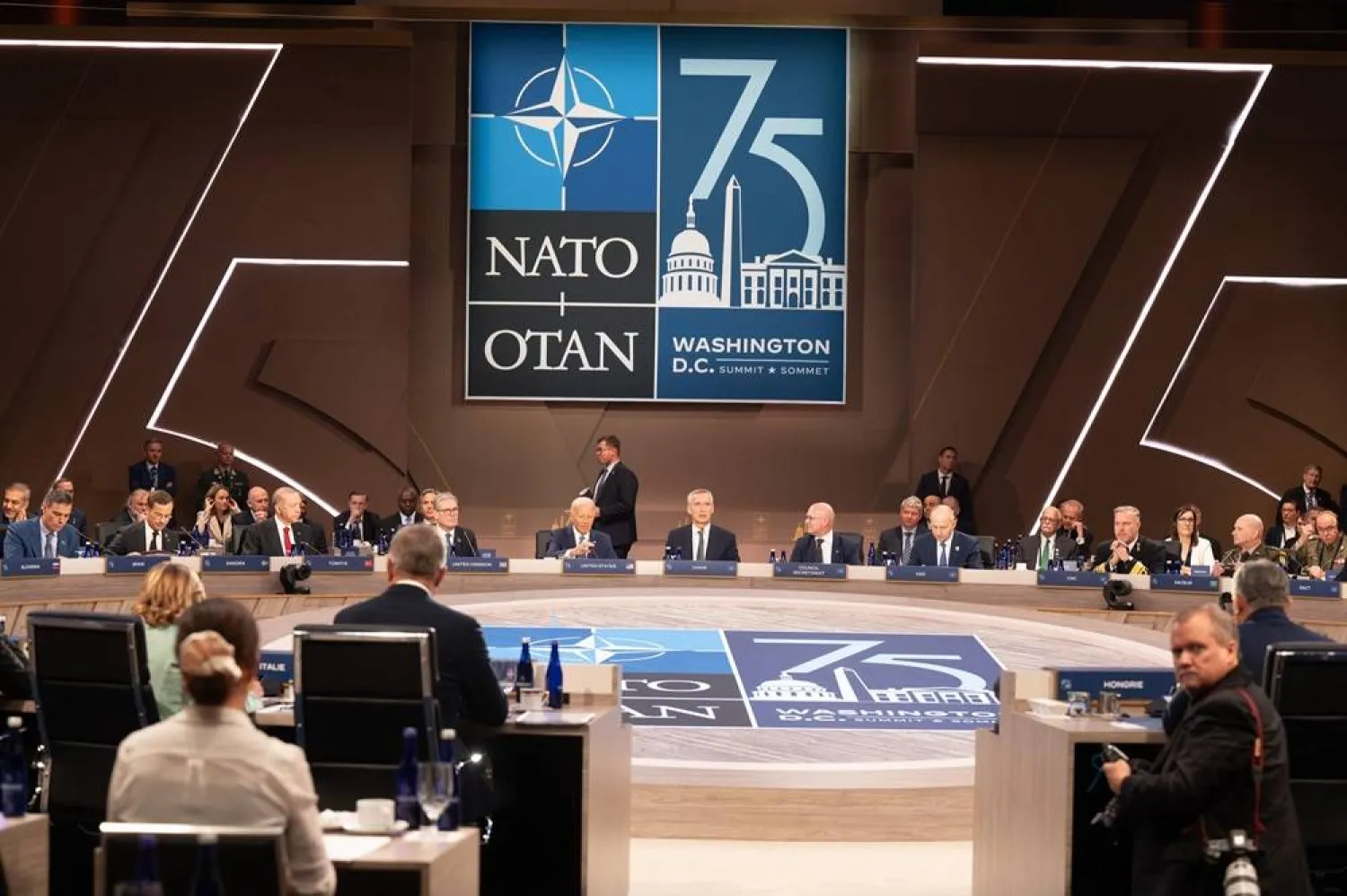

At NATO Summit, Allies Move to Counter Russia, Bolster Ukraine

 10 July 2024, US, Washington: General view of the meeting of Heads of State and Government of the North Atlantic Treaty Organization (NATO). Photo: Moncloa/EUROPA PRESS/dpa
10 July 2024, US, Washington: General view of the meeting of Heads of State and Government of the North Atlantic Treaty Organization (NATO). Photo: Moncloa/EUROPA PRESS/dpa
TT

At NATO Summit, Allies Move to Counter Russia, Bolster Ukraine

 10 July 2024, US, Washington: General view of the meeting of Heads of State and Government of the North Atlantic Treaty Organization (NATO). Photo: Moncloa/EUROPA PRESS/dpa
10 July 2024, US, Washington: General view of the meeting of Heads of State and Government of the North Atlantic Treaty Organization (NATO). Photo: Moncloa/EUROPA PRESS/dpa

The United States will start deploying longer range missiles in Germany in 2026, the two countries announced at a meeting of the NATO alliance on Tuesday, a major step aimed at countering what the allies say is a growing threat Russia poses to Europe.

The decision will send Germany the most potent US weapons to be based on the European continent since the Cold War, in a clear warning to Russian President Vladimir Putin.

A US-German statement said the "episodic deployments" were in preparation for longer-term stationing in Europe of capabilities that would include SM-6, Tomahawk and developmental hypersonic weapons with greater range.

The move would have been banned under the Intermediate-Range Nuclear Forces Treaty signed by the US and the Soviet Union in 1987 but that collapsed in 2019.

"We cannot discount the possibility of an attack against Allies’ sovereignty and territorial integrity," the allies said in a communique released on Wednesday.

More aid was headed to Ukraine as the allies bolster Ukrainian President Volodymyr Zelenskiy.

A communique said the allies intend to provide Ukraine with at least 40 billion euros ($43.28 billion) in military aid within the next year, but stopped short of the multi-year commitment NATO Secretary General Jens Stoltenberg had sought.

The document also strengthened past NATO language on China, calling it a "decisive enabler" of Russia's war effort in Ukraine and saying Beijing continues to pose systemic challenges to Euro-Atlantic security.

Stoltenberg told reporters it was the first time the 32 allies had jointly labeled China a decisive enabler of Russia’s war and called it an important message.

He said NATO was not an organization that imposes sanctions, but added: “At the end of the day, this will be for individual allies to make decisions, but I think the message we send from NATO from this summit is very clear.”

Biden said in a speech on Tuesday that NATO was "stronger than it's ever been" and that Ukraine can and will stop Russian President Vladimir Putin "with our full, collective support."

On Wednesday, he said he was pleased all NATO members were pledging to expand their industrial bases and to develop plans for defense production at home.

"We cannot allow the alliance to fall behind," Biden said. "We can and will defend every inch of NATO territory and we'll do it together."

At the White House, Biden and new British Prime Minister Keir Starmer had a back-and-forth exchange and shared laughs and congratulations over England's 2-1 win over the Netherlands in the Euro 2024 soccer tournament.

Biden described the United Kingdom as the "knot" tying together the trans-Atlantic NATO alliance and said that the two countries must continue to cooperate.

Biden, 81, has faced questions about his fitness for office after fumbling a June 27 debate and hopes the NATO spotlight will help him stage a comeback of sorts, surrounded by allied leaders he has spent his three years in office cultivating.

However, November's US presidential election could presage a sharp change in Washington's support for Ukraine and NATO. Republican candidate Donald Trump, 78, has questioned the amount of aid given to Ukraine to fight Russia's invasion and US support for allies generally.

TRUMP WEIGHS IN

On Wednesday, Trump told Fox News Radio he would not pull the US out of NATO but reiterated that he wanted members to pay more. "I just want them to pay their bills. We're protecting Europe. They take advantage of us very badly," he said.

Trump had pressed congressional Republicans to stall military aid for Ukraine before later reversing course.

Uncertainty about US leadership has unsettled NATO allies.

"If there’s one thing that I’m concerned about with the United States, it’s the polarization of the political climate - it is, I have to admit, very toxic," Alexander Stubb, president of NATO member Finland, told reporters.

While Biden has been seeking to rally allies and domestic support, several high-ranking European officials met a top foreign policy adviser to Trump during the summit.

The communique says the alliance will continue to support Ukraine "on its irreversible path to full Euro-Atlantic integration, including NATO membership". That language had been a major point of contention among the allies.

The communique also called on China to cease material and political support for Russia's war effort. It expressed concern about China's space capabilities, referenced rapid expansion of its nuclear arsenal, and urged Beijing to engage in strategic risk reduction talks.



Iran Says Redirects US-sanctioned Oil Tanker to Its Shores

FILE PHOTO: An aerial view of the Iranian shores and the island of Qeshm in the strait of Hormuz, December 10, 2023. REUTERS/Stringer/File Photo
TT

Iran Says Redirects US-sanctioned Oil Tanker to Its Shores

FILE PHOTO: An aerial view of the Iranian shores and the island of Qeshm in the strait of Hormuz, December 10, 2023. REUTERS/Stringer/File Photo

Iran said on Friday it redirected a US-sanctioned oil tanker carrying Iranian oil back to its shores, though it was unclear from its statement why it would have returned it, reported AFP.

"The Islamic Republic of Iran's navy, through a specially planned operation in the Sea of Oman, seized the offending tanker Ocean Koi," the army said in a statement carried by state television, adding that the oil belonged to Iran.

It said the ship was redirected to Iran's southern shores after it sought "to damage and disrupt Iran's oil exports," without elaborating.


Meloni Meets Rubio as Iran War Strains Italy-US Ties

US Secretary of State Marco Rubio leaves the San Damaso courtyard after meeting Pope Leo XIV at the Vatican, May 7, 2026. REUTERS/Yara Nardi
TT

Meloni Meets Rubio as Iran War Strains Italy-US Ties

US Secretary of State Marco Rubio leaves the San Damaso courtyard after meeting Pope Leo XIV at the Vatican, May 7, 2026. REUTERS/Yara Nardi

Italian Prime Minister Giorgia Meloni met US Secretary of State Marco Rubio on Friday at a moment of unusual strain between her government and President Donald Trump's administration, driven largely by the war with Iran.

Rubio is in Italy for a two-day trip aimed at easing ties with Pope Leo after unprecedented attacks on the pontiff by Trump, while also addressing Washington's frustration over Italy's refusal to support the US-Israeli war on Iran.

Meloni had been one of Trump's firmest supporters in Europe, cultivating close ties with him and presenting herself as a natural ‌bridge between Washington ‌and other EU states that had no natural political ‌affinity ⁠with the Republican ⁠US leader.

But that alignment has come under increasing strain in recent months, as the Iran war has forced her to balance loyalty to the United States against Italian public animosity to the war and the growing economic cost of the conflict.

Before heading to the prime minister's office, Rubio met Italy's Foreign Minister Antonio Tajani, who said the talks had been positive.

"I am convinced ⁠that Europe needs America, Italy needs America, but the United ‌States also needs Europe and Italy," Tajani ‌told reporters.

Meloni and Rubio were expected to discuss the situation in the Gulf, as ‌well as Russia's war on Ukraine, US tariffs on European goods and ‌the outlook for Cuba, which Washington is seeking to isolate both diplomatically and economically.

TRUMP'S ATTACKS ON POPE

The Italians will also be keen for a readout on Rubio's meetings at the Vatican. Trump's recent attacks on Pope Leo crossed a sensitive ‌line in overwhelmingly Catholic Italy and prompted Meloni to call them "unacceptable."

Her criticism in turn drew a sharp rebuke ⁠from Trump, who said ⁠she lacked courage and had let Washington down. He subsequently threatened to withdraw US troops from Italy.

Meloni said on Monday she would not support such a move, but acknowledged that the decision "doesn't depend on me".

Italy last month refused to allow US aircraft to use the Sigonella air base in Sicily for combat operations linked to the Iran conflict. Italian officials have said Washington had not sought prior authorization from Rome for the use of the site.

Defense Minister Guido Crosetto, a close Meloni ally, later warned that the Iran war was putting US global leadership at risk and said he feared the "madness" of nuclear escalation.

Pollsters say Meloni's ties to Trump could prove a potential liability with voters ahead of national elections due next year.


Trump Says Ceasefire Still Holds after Fighting Between the US and Iran Flares

US President Donald Trump looks on as he speaks to reporters near the Lincoln Memorial Reflecting Pool as it undergoes renovations, in Washington, D.C., US, May 7, 2026. REUTERS/Kylie Cooper
TT

Trump Says Ceasefire Still Holds after Fighting Between the US and Iran Flares

US President Donald Trump looks on as he speaks to reporters near the Lincoln Memorial Reflecting Pool as it undergoes renovations, in Washington, D.C., US, May 7, 2026. REUTERS/Kylie Cooper

US and Iranian forces clashed in the Gulf, but President Donald Trump said a ceasefire was still holding despite the flare-up, which dented hopes for a swift diplomatic resolution to the crisis.

The escalation came as Washington awaited Tehran's response to a US proposal to end the war, which began on February 28 when the US and Israel launched airstrikes on Iran.

Trump said on Thursday three US Navy destroyers were attacked as they moved through the Strait of Hormuz, a conduit for around a fifth of the world's oil and liquefied natural gas flows that Iran has all but closed since the conflict began.

"Three World Class American Destroyers just transited, very successfully, out of the Strait of Hormuz, under fire. There was no damage done to the three Destroyers, but great damage done to the Iranian attackers," Trump wrote on Truth Social.

He later told reporters the ceasefire remained in effect and played down the exchange.

"They trifled with us today. We blew them away," Trump said in Washington.

Iran, however, accused the United ⁠States of breaching ⁠the ceasefire, an agreement that has been punctuated by intermittent clashes since it was announced on April 7.

Iran's top joint military command said US forces had targeted an Iranian oil tanker and another ship, and carried out air attacks on civilian areas on Qeshm Island in the Strait of Hormuz and nearby coastal areas. It said Iranian forces responded by attacking US military vessels east of the strait and south of the port of Chabahar.

A spokesperson for Iran's Khatam al-Anbiya Central Headquarters said the Iranian strikes inflicted "significant damage," but US Central Command said none of its assets were hit.

Iranian state media later signaled a de-escalation, with Press TV reporting that, after several hours of exchanges, "the situation on Iranian islands and coastal cities by the Strait of Hormuz is back to normal now."