


Biden Ends Failing Reelection Campaign, Backs Harris as Nominee

US President Joe Biden looks down as he participates in the first presidential debate of the 2024 elections with former US President and Republican presidential candidate Donald Trump at CNN's studios in Atlanta, Georgia, on June 27, 2024. (AFP)
TT

Biden Ends Failing Reelection Campaign, Backs Harris as Nominee

US President Joe Biden looks down as he participates in the first presidential debate of the 2024 elections with former US President and Republican presidential candidate Donald Trump at CNN's studios in Atlanta, Georgia, on June 27, 2024. (AFP)

US President Joe Biden abandoned his floundering reelection bid on Sunday under growing pressure from his fellow Democrats and endorsed Vice President Kamala Harris to replace him as the party's candidate to face Republican Donald Trump in the November election.

Biden, who at 81 is the oldest person ever to have occupied the Oval Office, said he will remain in his role as president until his term ends on Jan. 20, 2025, and will address the nation this week. He has not been seen in public since testing positive for COVID-19 last week and is isolating at his home in Rehoboth Beach, Delaware.

"While it has been my intention to seek reelection, I believe it is in the best interest of my party and the country for me to stand down and to focus solely on fulfilling my duties as President for the remainder of my term," Biden wrote on X.

The move dramatically reshapes a White House contest that has been shaken repeatedly in the last month, including by Biden's disastrous June 27 debate performance - which drove his fellow Democrats to urge him to drop out - the July 13 attempted assassination of former President Trump, 78, and Trump's naming last week of hardline Republican US Senator J.D. Vance, 39, to serve as his vice presidential running mate.

In opinion polls, Americans had expressed widespread dissatisfaction over a potential Biden-Trump rematch.

If Harris emerges as the nominee, the move would represent an unprecedented gamble by the Democratic Party: its first Black and Asian American woman to run for the White House in a country that has elected one Black president and never a woman president in more than two centuries.

Democratic National Committee Chair Jaime Harrison said the American people will soon hear from the party on next steps and the path forward for the nomination process. It was the first time in over a half-century that an incumbent US president gave up his party's nomination.

If officially nominated, Harris, 59, would become the first Black woman to lead a major-party ticket in US history. A former attorney general of California and former US senator, she ran unsuccessfully for president against Biden in 2020.

"My intention is to earn and win this nomination," Harris said in a statement. "I will do everything in my power to unite the Democratic Party — and unite our nation — to defeat Donald Trump."

Harris campaign officials, allies and supporters have started making calls to secure the support of delegates for her nomination ahead of the Democratic National Convention in Chicago from Aug. 19-22, multiple sources said.

Opposition to Biden's continued campaign from within his party gained steam over the past week with 36 congressional Democrats - more than one in eight - publicly calling on him to drop out, driven by concerns over his mental acuity.

Lawmakers said they feared he could cost them not only the White House but also the chance to control either chamber of Congress next year, which would leave Democrats with no meaningful grasp on power in Washington.

That stood in sharp contrast to what played out in Milwaukee last week, when Republican convention delegates united around Trump, whose refusal to acknowledge his 2020 loss to Biden sparked the Jan. 6, 2021, assault on the US Capitol.

Other prominent Democrats seen as potential vice presidential material include Governors Gavin Newsom of California, Gretchen Whitmer of Michigan, Josh Shapiro of Pennsylvania and Andy Beshear of Kentucky.

In statements, each praised Biden and vowed to fight for a Democratic win on Nov. 5, without specifically mentioning their ambitions or endorsing Harris as Biden's successor. Each has been mentioned as a potential replacement for Biden and could be among the candidates Harris would consider in choosing her own running mate.

Trump told CNN on Sunday that he believed Harris would be easier to defeat.

LAST-MINUTE SHIFT

Biden had a last-minute change of heart, said a source familiar with the matter. The president told allies that as of Saturday night he planned to stay in the race before changing his mind on Sunday afternoon.

"At around 1:45 p.m. today: the president told his senior team that he had changed his mind," the source told Reuters, speaking on condition of anonymity. Biden announced his decision on social media within minutes after that.

It was unclear whether other senior Democrats would challenge Harris for the nomination - she was widely seen as the pick for many party officials - or whether the party itself would choose to open the field for nominations.

Polling shows that Harris performs no better statistically than Biden against Trump.

In a hypothetical head-to-head matchup, Harris and Trump were tied with 44% support each in a July 15-16 Reuters/Ipsos poll conducted immediately after the July 13 assassination attempt on Trump. Trump led Biden 43% to 41% in that same poll, though the 2 percentage point difference was not meaningful considering the poll's 3-point margin of error.

Congressional Republicans argued that Biden should resign the office immediately, which would turn the White House over to Harris and put House of Representatives Speaker Mike Johnson, a Republican, next in line in succession.

"If he's incapable of running for president, how is he capable of governing right now? I mean, there is five months left in this administration. It's a real concern, and it's a danger to the country," Johnson told CNN on Sunday before Biden's announcement.

Johnson in a separate interview on ABC signaled that Republicans would likely try to mount legal challenges to Democrats' move to replace Biden on the ballot.

FIRST SINCE LBJ

Biden's historic move - the first sitting president to give up his party's nomination for reelection since President Lyndon B. Johnson during the Vietnam War in March 1968 - leaves his replacement with less than four months to wage a campaign.

Biden was the oldest US president ever elected when he beat Trump in 2020. During that campaign, Biden described himself as a bridge to the next generation. Some interpreted that to mean he would serve one term, a transitional figure who beat Trump and brought his party back to power.

But he set his sights on a second term in the belief that he was the only Democrat who could beat Trump again amid questions about Harris's experience and popularity. In recent times, though, his advanced age began to show through more. His gait became stilted and his childhood stutter occasionally returned.

Donors began to revolt and supporters of Harris began to coalesce around her. Top Democrats, including former House of Representatives Speaker Nancy Pelosi, a longtime ally, told Biden he cannot win the election.

Harris is a former prosecutor, and Trump, who is two decades her senior, faces two outstanding criminal prosecutions related to his attempts to overturn the 2020 election result. He is due to be sentenced in New York in September, having been convicted of trying to cover up a hush-money payment to a porn star.

He has pleaded not guilty to all charges and claims all are politically motivated attempts to block him from returning to power.

Earlier this year, facing little opposition, Biden easily won the Democratic primary race to pick its presidential candidate, despite voter concerns about his age and health.

His staunch support for Israel's military campaign in Gaza eroded support among some in his own party, particularly young, more liberal Democrats and voters of color.

Many Black voters say Biden has not done enough for them, and enthusiasm among Democrats overall for a second Biden term had been low. Even before the debate with Trump, Biden was trailing the Republican in some national polls and in the battleground states he would have needed to win to prevail on Nov. 5.
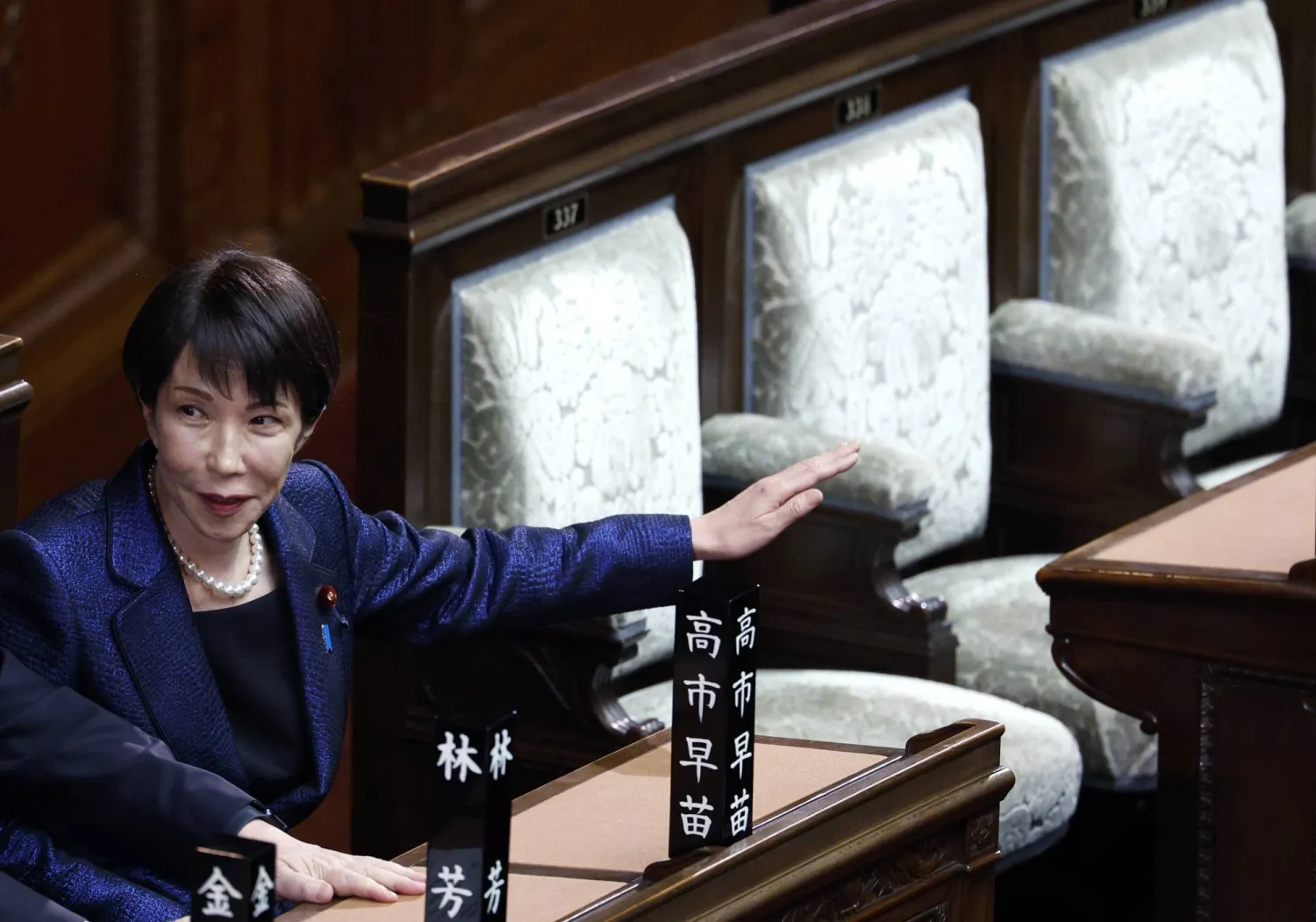



Japan PM Takaichi Reappointed Following Election

Sanae Takaichi gestures at the Lower House of the Parliament in Tokyo, Japan, 18 February 2026. EPA/FRANCK ROBICHON
TT

Japan PM Takaichi Reappointed Following Election

Sanae Takaichi gestures at the Lower House of the Parliament in Tokyo, Japan, 18 February 2026. EPA/FRANCK ROBICHON

Japan's lower house formally reappointed Sanae Takaichi as prime minister on Wednesday, 10 days after her historic landslide election victory.

Takaichi, 64, became Japan's first woman premier in October and won a two-thirds majority for her party in the snap lower house elections on February 8.

She has pledged to bolster Japan's defenses to protect its territory and waters, likely further straining relations with Beijing, and to boost the flagging economy.

Takaichi suggested in November that Japan could intervene militarily if Beijing sought to take Taiwan by force.

China, which regards the democratic island as part of its territory and has not ruled out force to annex it, was furious.

Beijing's top diplomat Wang Yi told the Munich Security Conference on Saturday that forces in Japan were seeking to "revive militarism".

In a policy speech expected for Friday, Takaichi will pledge to update Japan's "Free and Open Indo-Pacific" strategic framework, local media reported.

"Compared with when FOIP was first proposed, the international situation and security environment surrounding Japan have become significantly more severe," chief government spokesman Minoru Kihara said Monday.

In practice this will likely mean strengthening supply chains and promoting free trade through the Trans-Pacific Partnership (CPTPP) that Britain joined in 2024.

Takaichi's government also plans to pass legislation to establish a National Intelligence Agency and to begin concrete discussions towards an anti-espionage law, the reports said.

Takaichi has promised too to tighten rules surrounding immigration, even though Asia's number two economy is struggling with labor shortages and a falling population.

On Friday Takaichi will repeat her campaign pledge to suspend consumption tax on food for two years in order to ease inflationary pressures on households, local media said, according to AFP.

This promise has exacerbated market worries about Japan's colossal debt, with yields on long-dated government bonds hitting record highs last month.

Rahul Anand, the International Monetary Fund chief of mission in Japan, said Wednesday that debt interest payments would double between 2025 and 2031.

"Removing the consumption tax (on food) would weaken the tax revenue base, since the consumption tax is an important way to raise revenues without creating distortions in the economy," Anand said.

To ease such concerns, Takaichi will on Friday repeat her mantra of having a "responsible, proactive" fiscal policy and set a target on reducing government debt, the reports said.

She will also announce the creation of a cross-party "national council" to discuss taxation and how to fund ageing Japan's ballooning social security bill.

But Takaichi's first order of business will be obtaining approval for Japan's budget for the fiscal year beginning on April 1 after the process was delayed by the election.

The ruling coalition also wants to pass legislation that will outlaw destroying the Japanese flag, according to the media reports.

It wants too to accelerate debate on changing the constitution and on revising the imperial family's rules to ease a looming succession crisis.

Takaichi and many within her Liberal Democratic Party (LDP) oppose making it possible for a woman to become emperor, but rules could be changed to "adopt" new male members.


Türkiye: Ocalan Announces ‘Integration Phase’

Members of the Kurdish community take part in a protest calling for the release of convicted Kurdistan Worker's Party (PKK) leader Abdullah Ocalan in Diyarbakir on February 15, 2026. (Photo by Ilyas AKENGIN / AFP)
TT

Türkiye: Ocalan Announces ‘Integration Phase’

Members of the Kurdish community take part in a protest calling for the release of convicted Kurdistan Worker's Party (PKK) leader Abdullah Ocalan in Diyarbakir on February 15, 2026. (Photo by Ilyas AKENGIN / AFP)

The jailed leader of the Kurdistan Workers Party, Abdullah Ocalan, has said that the Ankara-PKK peace process has entered its “second phase,” as the Turkish parliament sets the stage to vote on a draft report proposing legal reforms tied to peace efforts.

A delegation from the pro-Kurdish Peoples' Equality and Democracy Party (DEM Party), including lawmakers Pervin Buldan, Mithat Sancar, and Ocalan’s lawyer Ozgur Faik, met with the jailed PKK leader on Monday on the secluded Imrali island.

Sancar said that the second phase will be focused on democratic integration into
Türkiye’s political system.

According to the lawmaker, the PKK leader considered the first phase the “negative dimension” concerned with ending the decades-old conflict between the armed group and Ankara.

“Now we are facing the positive phase,” Ocalan said, “the integration phase is the positive phase; it is the phase of construction.”

For the second phase to be implemented, Ocalan called on Turkish authorities to provide conditions that would allow him to put his “theoretical and practical capacity” to work.

The 60-page draft report on peace with the PKK was completed by a five-member writing team, which is chaired by Parliament Speaker Numan Kurtulmuş, and is scheduled for a vote on Wednesday.

The report is organized into seven sections.

In July last year, Ocalan said the group's armed struggle against Türkiye has ended and called for a full shift to democratic politics.


Iranians Chant Slogans Against Supreme Leader at Memorials for Slain Protesters

An Iranian man holds the Iranian national flag during a memorial ceremony for those killed in anti-government protests earlier last month, at the Mosalla mosque in Tehran, Iran, 17 February 2026. (EPA)
TT

Iranians Chant Slogans Against Supreme Leader at Memorials for Slain Protesters

An Iranian man holds the Iranian national flag during a memorial ceremony for those killed in anti-government protests earlier last month, at the Mosalla mosque in Tehran, Iran, 17 February 2026. (EPA)

Iranians shouted slogans against Supreme Leader Ali Khamenei on Tuesday as they gathered to commemorate protesters killed in a crackdown on nationwide demonstrations that rights groups said left thousands dead, according to videos verified by AFP.

The country's clerical authorities also staged a commemoration in the capital Tehran to mark the 40th day since the deaths at the peak of the protests on January 8 and 9.

Officials acknowledge more than 3,000 people died during the unrest, but attribute the violence to "terrorist acts", while rights groups say many more thousands of people were killed, shot dead by security forces in a violent crackdown.

The protests, sparked by anger over the rising cost of living before exploding in size and anti-government fervor, subsided after the crackdown, but in recent days Iranians have chanted slogans from the relative safety of homes and rooftops at night.

On Tuesday, videos verified by AFP showed crowds gathering at memorials for some of those killed again shouting slogans against the theocratic government in place since the 1979 revolution.

In videos geolocated by AFP shared on social media, a crowd in Abadan in western Iran holds up flowers and commemorative photos of a young man as they shout "death to Khamenei" and "long live the shah", in support of the ousted monarchy.

Another video from the same city shows people running in panic from the sounds of shots, though it wasn't immediately clear if they were from live fire.

In the northeastern city of Mashhad a crowd in the street chanted, "One person killed, thousands have his back", another verified video showed.

Gatherings also took place in other parts of the country, according to videos shared by rights groups.

- Official commemorations -

At the government-organized memorial in Tehran crowds carried Iranian flags and portraits of those killed as nationalist songs played and chants of "Death to America" and "Death to Israel" echoed through the Khomeini Grand Mosalla mosque.

Iranian President Masoud Pezeshkian attended a similar event at the Imam Reza shrine in Mashhad.

Authorities have accused sworn enemies the United States and Israel of fueling "foreign-instigated riots", saying they hijacked peaceful protests with killings and vandalism.

Senior officials, including First Vice President Mohammad Reza Aref and Revolutionary Guards commander Esmail Qaani, attended the ceremony.

"Those who supported rioters and terrorists are criminals and will face the consequences," Qaani said, according to Tasnim news agency.

International organizations have said evidence shows Iranian security forces targeted protesters with live fire under the cover of an internet blackout.

The US-based Human Rights Activists News Agency (HRANA) has recorded more than 7,000 killings in the crackdown, the vast majority protesters, though rights groups warn the toll is likely far higher.

More than 53,500 people have been arrested in the ongoing crackdown, HRANA added, with rights groups warning protesters could face execution.

Tuesday's gatherings coincided with a second round of nuclear negotiations between Iran and the United States in Geneva, amid heightened tensions after Washington deployed an aircraft carrier group to the Middle East following Iran's crackdown on the protests.