


Anti-Maduro Protests Spread as Venezuelan Opposition Claims Victory

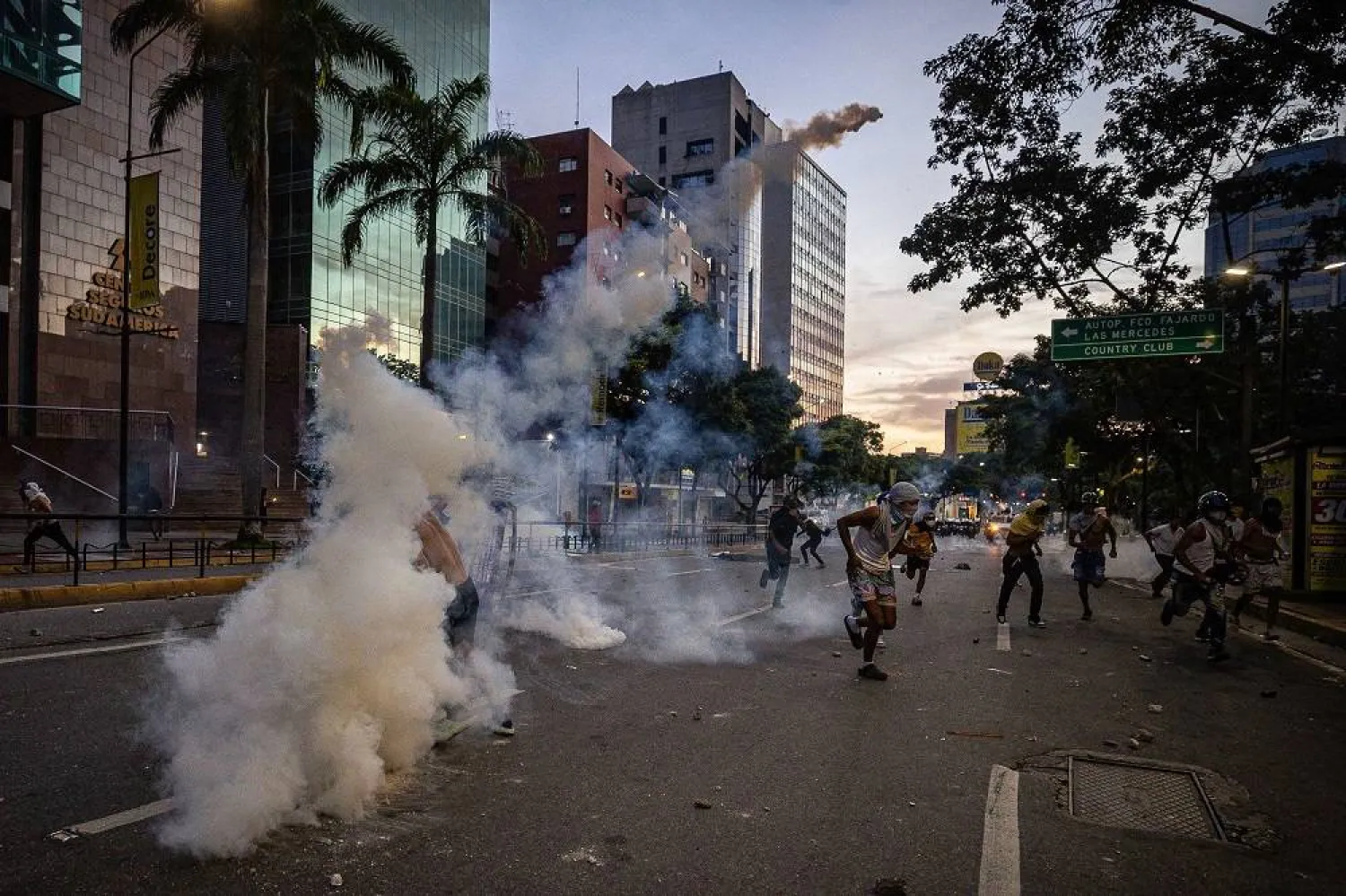
Protesters clash with the Bolivarian National Guard (GNB) over the results of the presidential elections in Caracas, Venezuela, 29 July 2024. (EPA)
TT

Anti-Maduro Protests Spread as Venezuelan Opposition Claims Victory

Protesters clash with the Bolivarian National Guard (GNB) over the results of the presidential elections in Caracas, Venezuela, 29 July 2024. (EPA)

Opponents and supporters of Venezuela's President Nicolas Maduro planned to rally on Tuesday as protests and clashes spread after a weekend election was awarded to the long-ruling socialist despite opposition claims of a landslide victory.

The renewed instability brought divided international reaction: the United States said Maduro's reelection had no credibility and was mulling more sanctions, while China and Russia congratulated him.

Protests began after the election board declared on Monday that Maduro had won a third term with 51% of votes to extend his "Chavista" movement's quarter-century rule.

The opposition, which considers the election body in the pockets of a dictatorial government, said the 73% of vote tallies to which it has access showed its candidate Edmundo Gonzalez had more than twice as many votes as Maduro.

Venezuela opposition party Voluntad Popular said on Tuesday on X that its national coordinator Freddy Superlano had been detained.

The party posted and then deleted a video showing Superlano and two others being stopped outside a gated building and hustled into a car by armed men clad in black as neighbors screamed for them to stop.

The video was also posted by local media.

The attorney general Tarek Saab did not immediately respond to a request for comment about whether Superlano was detained and on what charges.

At least six people have been killed around the country in incidents related to the election count or associated protests, according to rights group Foro Penal.

Some protesters blocked roads, lit fires and threw petrol bombs at police, including near the Miraflores presidential palace in Caracas.

"We are tired of this government, we want a change. We want to be free in Venezuela. We want our families to return here," said one masked protester, referring to the exodus of about a third of Venezuelans in recent years.

"I'll fight for my country's democracy. They stole the election from us," said another.

Police with shields and batons in Caracas and the city of Maracay fired tear gas to disperse some protests.

Many demonstrators rode motorbikes and jammed streets or draped themselves in the Venezuelan flag. Some covered their faces with scarves as protection against tear gas.

The government calls them violent agitators.

"We've seen this movie before," said Maduro from the presidential palace, pledging that security forces would keep the peace. "We have been following all of the acts of violence promoted by the extreme right."

The armed forces have long supported him and there were no signs generals were breaking from the government.

Defense Minister General Vladimir Padrino described the protests as a "coup."

"There is a coup in progress so President Nicolas Maduro has stepped up to stop it again and with him the people who elected him president, all the institutions, the Bolivarian armed forces and the democratic institutions," Padrino said on state television on Tuesday. "We will defeat the coup."

In Coro, capital of Falcon state, protesters cheered and danced when they tore down a statue depicting former President Hugo Chavez, Maduro's mentor who ruled from 1999-2013.

A local monitoring group, the Venezuelan Conflict Observatory, said it had registered 187 protests in 20 states by 6 p.m. on Monday with "numerous acts of repression and violence" carried out by paramilitary groups and security forces.

Saab said on state TV there had been 749 arrests and two deaths of security force members in Aragua state.

INTERNATIONAL DIVISION

Maduro, a 61-year-old former union leader and foreign minister, won election after Chavez's death in 2013 and was re-elected in 2018. The opposition said both votes were rigged.

He has presided over an economic collapse, mass migration, and deteriorating relations with the West, including US and EU sanctions that have crippled an already struggling oil industry.

Independent pollsters called Maduro's victory implausible, while governments in Washington and around Latin America questioned the results and urged a full tabulation of votes.

"Not even (Maduro) believes the electoral scam he is celebrating," said Argentina's President Javier Milei.

Peru ordered Venezuelan diplomats to leave within 72 hours, citing "serious and arbitrary decisions made today by the Venezuelan regime."

But in a familiar global division, allies including Russia, China and some leftist-led Latin American nations backed Maduro.

"China will, as always, firmly support Venezuela's efforts to safeguard national sovereignty, national dignity and social stability, and firmly support Venezuela's just cause of opposing external interference," President Xi Jinping said in a message.

Venezuelan opposition leader Maria Corina Machado, who was barred from running in the poll but has spearheaded the campaign for Gonzalez, called for marches on Tuesday.

"My dear Venezuelans, tomorrow we meet; as a family, organized, demonstrating the determination we have to make every vote count and defend the truth," she said.

The government is also planning pro-Maduro rallies. Many Venezuelans fear another bout of violence and bloodshed similar to others in its turbulent recent history.



Australian Police Investigate Threatening Letter to Country's Largest Mosque

FILE PHOTO: A security guard stands outside the Lakemba Imam Ali bin Abi Talib Mosque as people arrive for Friday prayers in Sydney, Australia, December 19, 2025. REUTERS/Hollie Adams/File Photo
TT

Australian Police Investigate Threatening Letter to Country's Largest Mosque

FILE PHOTO: A security guard stands outside the Lakemba Imam Ali bin Abi Talib Mosque as people arrive for Friday prayers in Sydney, Australia, December 19, 2025. REUTERS/Hollie Adams/File Photo

Australian police said on Thursday they had launched an investigation after a threatening letter was sent to the country’s largest mosque, the third such incident in the lead-up to the Muslim fasting month of Ramadan.

The letter sent to Lakemba Mosque in Sydney’s west on Wednesday contained a drawing of a pig and a threat to kill the "Muslim race", local media reported. Police said they had taken the letter for forensic testing, and would continue to patrol ‌religious sites including ‌the mosque, as well as community events.

The latest letter ‌comes ⁠weeks after a ⁠similar message was mailed to the mosque, depicting Muslim people inside a mosque on fire.

Police have also arrested and charged a 70-year-old man in connection with a third threatening letter sent to Lakemba Mosque's staff in January.

The Lebanese Muslim Association, which runs the mosque, told the Australian Broadcasting Corp (ABC) it had written to the government to request more funding for additional security guards and ⁠CCTV cameras.

Some 5,000 people are expected to attend ‌the mosque each night during Ramadan. More ‌than 60% of residents in the suburb of Lakemba identify as Muslim, according to ‌the Australian Bureau of Statistics.

Bilal El-Hayek, mayor of Canterbury-Bankstown council, where Lakemba ‌is located, said the community was feeling "very anxious".

"I've heard first-hand from people saying that they won't be sending their kids to practice this Ramadan because they're very concerned about things that might happen in local mosques," AFP quoted him as saying.

Prime Minister Anthony Albanese ‌condemned the recent string of threats.

"It is outrageous that people just going about commemorating their faith, particularly during the ⁠holy month ⁠for Muslims of Ramadan, are subject to this sort of intimidation," he told ABC radio.

"I have said repeatedly we need to turn down the temperature of political discourse in this country, and we certainly need to do that."

Anti-Muslim sentiment has been growing in Australia since the war in Gaza War in late 2023, according to a recent report commissioned by the government.

The Islamophobia Register Australia has also documented a 740% rise in reports following the Bondi mass shooting on December 14, where authorities allege two gunmen inspired by ISIS killed 15 people attending a Jewish holiday celebration.

"There's been a massive increase post-Bondi," Mayor El-Hayek said. "Without a doubt, this is the worst I have ever seen it. There's a lot of tension out there."


Russia's Lavrov Warns against Any New US Strike on Iran

FILE PHOTO: Russia's Foreign Minister Sergei Lavrov speaks during an annual press conference in Moscow, Russia, January 14, 2025. REUTERS/Evgenia Novozhenina/File Photo
TT

Russia's Lavrov Warns against Any New US Strike on Iran

FILE PHOTO: Russia's Foreign Minister Sergei Lavrov speaks during an annual press conference in Moscow, Russia, January 14, 2025. REUTERS/Evgenia Novozhenina/File Photo

Russian Foreign Minister Sergei Lavrov, in ‌an interview made public on Wednesday, said that any new US strike on Iran would have serious consequences and called for restraint to find a solution to enable Iran to pursue a peaceful nuclear program.

Lavrov's interview with Saudi Arabia's Al-Arabiya television was aired a day after US and Iranian negotiators held indirect talks in Geneva to head off a new mounting crisis between Washington and Tehran, Reuters said.

"The consequences are not good. There have already been strikes on Iran on ‌nuclear sites ‌under the control of the International Atomic ‌Energy ⁠Agency. From what ⁠we can judge there were real risks of a nuclear incident," Lavrov said in the interview, which was posted on his ministry's website.

"I am carefully watching reactions in the region from Arab countries, Gulf monarchies. No one wants an increase in tension. Everyone understands this is playing with fire."

Boosting ⁠tensions, he said, could undo the ‌positive steps of recent years, including ‌improved relations between Iran and nearby countries, notably Saudi Arabia.

A senior ‌US official told Reuters on Wednesday that Iran was ‌expected to submit a written proposal on how to resolve its standoff with the United States after the talks in Geneva.

US national security advisers met in the White House on Wednesday and ‌were told all US military forces deployed to the region should be in place ⁠by mid-March, ⁠the official said.

The United States wants Iran to give up its nuclear program, and Iran has adamantly refused and denied it is trying to develop an atomic weapon.

Lavrov said Arab countries were sending signals to Washington "clearly calling for restraint and a search for an agreement that will not infringe on Iran's lawful rights and ... guarantee that Iran has a purely peaceful nuclear enrichment program".

Russia, he said, remained in close, regular contact with Iran's leaders "and we have no reason to doubt that Iran sincerely wants to resolve this problem on the basis of observing the Nuclear Non-Proliferation Treaty".


AI Cannot Be Left to 'Whims of a Few Billionaires', UN Chief Says

India's Prime Minister Narendra Modi speaks with United Nations Secretary-General Antonio Guterres during a welcoming ceremony at AI Impact Summit, in New Delhi, India, February 18, 2026. India's Press Information Bureau/Handout via REUTERS
TT

AI Cannot Be Left to 'Whims of a Few Billionaires', UN Chief Says

India's Prime Minister Narendra Modi speaks with United Nations Secretary-General Antonio Guterres during a welcoming ceremony at AI Impact Summit, in New Delhi, India, February 18, 2026. India's Press Information Bureau/Handout via REUTERS

UN chief Antonio Guterres warned technology leaders Thursday of the risks of artificial intelligence, saying its future cannot be left to "the whims of a few billionaires".

Speaking at a global AI summit in India, the UN chief called on tech tycoons to support a $3 billion global fund to ensure open access to the fast-advancing technology for all.

"AI must belong to everyone," he said.

"The future of AI cannot be decided by a handful of countries -- or left to the whims of a few billionaires," he added, warning the world risked deepening inequality unless urgent steps were taken.

"Done right, AI can... accelerate breakthroughs in medicine, expand learning opportunities, strengthen food security, bolster climate action and disaster preparedness and improve access to vital public services," he said.

"But it can also deepen inequality, amplify bias and fuel harm."

The UN has set up an AI scientific advisory body to help countries make decisions about the revolutionary technology.

Guterres warned that people must be protected from exploitation, and that "no child should be a test subject for unregulated AI".

He pressed for global guardrails to ensure oversight and accountability, and the creation of "Global Fund on AI" to build basic capacity.

"Our target is $3 billion," he told the conference, which includes national leaders as well as tech CEOs, including Sam Altman of OpenAI and Google's Sundar Pichai.

"That's less than one percent of the annual revenue of a single tech company. A small price for AI diffusion that benefits all, including the businesses building AI."

Without investment, "many countries will be logged out of the AI age", exacerbating global divides, he said.

He also cautioned that as AI's energy and water demands soar, data centers must switch to clean power, rather than "shift costs to vulnerable communities".