


Recent Rains in North Korea Flooded Thousands of Houses and Vast Farmland, State Media Says 

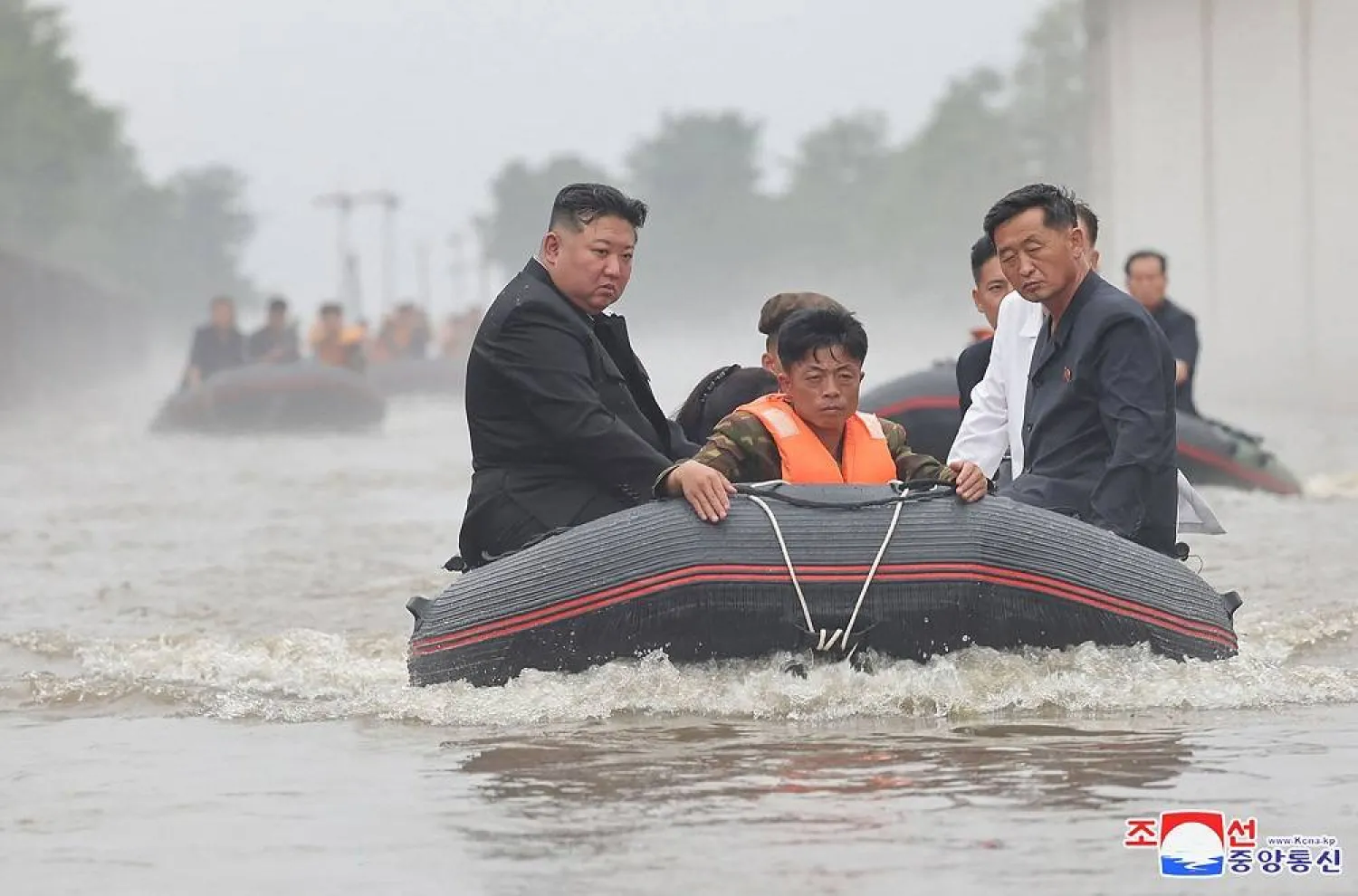
 This recent undated photo released by North Korea's official Korean Central News Agency (KCNA) via KNS on July 31, 2024 shows North Korea's leader Kim Jong Un (L) riding in a dingy through flood waters as he inspects the area for damage after record-breaking heavy rains on July 29 in the city of Sinuiju in North Pyongan Province. (Photo by KCNA VIA KNS / AFP)
This recent undated photo released by North Korea's official Korean Central News Agency (KCNA) via KNS on July 31, 2024 shows North Korea's leader Kim Jong Un (L) riding in a dingy through flood waters as he inspects the area for damage after record-breaking heavy rains on July 29 in the city of Sinuiju in North Pyongan Province. (Photo by KCNA VIA KNS / AFP)
TT

Recent Rains in North Korea Flooded Thousands of Houses and Vast Farmland, State Media Says 

 This recent undated photo released by North Korea's official Korean Central News Agency (KCNA) via KNS on July 31, 2024 shows North Korea's leader Kim Jong Un (L) riding in a dingy through flood waters as he inspects the area for damage after record-breaking heavy rains on July 29 in the city of Sinuiju in North Pyongan Province. (Photo by KCNA VIA KNS / AFP)
This recent undated photo released by North Korea's official Korean Central News Agency (KCNA) via KNS on July 31, 2024 shows North Korea's leader Kim Jong Un (L) riding in a dingy through flood waters as he inspects the area for damage after record-breaking heavy rains on July 29 in the city of Sinuiju in North Pyongan Province. (Photo by KCNA VIA KNS / AFP)

The recent heavy rains in northwestern North Korea flooded thousands of houses and a vast extent of farmland and left many residents homeless and living in makeshift tents, North Korea’s state media reported Wednesday.

North Korea earlier said more than 5,000 people stranded in Sinuiju city and Uiju town were rescued by airlift and other evacuation work after Saturday’s rains caused a river on the Chinese border to swell. But it hadn’t mentioned any specific damage, or said if there were any casualties.

North Korea is prone to flooding from heavy summer rains because of poor drainage, deforestation and dilapidated infrastructure.

The official Korean Central News Agency said Wednesday that about 4,100 houses, 3,000 hectares (about 7,410 acres) of agricultural fields and numerous public buildings, roads and railways in Sinuiju and Uiju were flooded.

It said about 150 people in nearby Jagang province had also been isolated due to a separate river flooding there, but they were all evacuated to safety by military helicopters.

In an emergency Politiburo meeting presided in Sinuiju, leader Kim Jong Un asked authorities to “strictly punish” those who he said neglected their responsibilities for disaster prevention and caused “even the casualty that cannot be allowed,” according to KCNA.

The report didn't say whether "the casualty” involved just a single person as it was written literally or multiple people. It also didn't say whether any death has been reported.

KCNA said Politburo members later approved the appointments of new Workers’ Party secretaries in the flood-hit regions and a new public security minister. Kim earlier said North Korea’s emergency response agency and the Ministry of Public Security didn’t know the exact populations of the flood-battered areas, so the number of people rescued was much larger than expected.

In the Politburo meeting, officials decided to build 4,400 new houses and strengthen embankments in Sinuiju and Uiju and restore damaged facilities in Jagang province, KCNA said.

Kim ordered urgent steps to supply flood victims with materials stockpiled for disaster relief and asked Politburo members to visit displaced people living in tents to console them and observe their living conditions, KCNA said.

State TV aired footage showing Kim and other officials riding on rubber boats to examine the scales of damages in the flood-ravaged areas. The footage showed many houses submerged in muddy waters, only their roofs visible.



First Ukrainian Military Plant Starts Operations in Britain, Ukraine’s Ambassador Says 

Valeriy Zaluzhnyi, Ukraine's Ambassador to the United Kingdom, speaks on stage as people gather in Trafalgar Square to mark the fourth anniversary of Russia's full-scale invasion of Ukraine, in London, Britain, February 24, 2026. (Reuters) 
TT

First Ukrainian Military Plant Starts Operations in Britain, Ukraine’s Ambassador Says 

Valeriy Zaluzhnyi, Ukraine's Ambassador to the United Kingdom, speaks on stage as people gather in Trafalgar Square to mark the fourth anniversary of Russia's full-scale invasion of Ukraine, in London, Britain, February 24, 2026. (Reuters) 

The first Ukrainian drone production plant has started its operations in Britain, Ukraine's ambassador Valeriy Zaluzhnyi said on Wednesday.

"Ukraine is ‌fighting a ‌war amid ‌constant ⁠missile strikes, infrastructure destruction ⁠and threats to production facilities. Therefore, the launch of production in the ⁠UK has a ‌deep strategic ‌logic," Zaluzhnyi ‌said on the ‌Telegram app.

"This is not a shift of the center ‌of gravity away from Ukraine. It ⁠is ⁠an expansion of our joint capabilities and the creation of a second line of defense that guarantees continuity of production."


Ukrainian Attack on Russian Fertilizer Plant Kills Seven 

Local residents walk past heated tents during a power outage in Odesa on February 18, 2026, amid the Russian invasion of Ukraine. (AFP)
TT

Ukrainian Attack on Russian Fertilizer Plant Kills Seven 

Local residents walk past heated tents during a power outage in Odesa on February 18, 2026, amid the Russian invasion of Ukraine. (AFP)

A Ukrainian drone attack on a fertilizer plant in Russia's western Smolensk region killed seven people and wounded 10 others, Russian officials said Wednesday.

The plant, just outside the Russian town of Dorogobuzh, lies around 290 kilometers (180 miles) from the Ukrainian border.

Unverified images published on social media purported to show the plant in flames early Wednesday, with columns of smoke billowing into the night sky.

"The enemy struck PJSC Dorogobuzh, a civilian plant producing nitrogen fertilizer," Smolensk region governor Vasily Anokhin said in a post on Telegram.

Russia's Investigative Committee, which probes major crimes, said later seven people were killed, updating a previous toll, in what would be one of the deadliest attacks on a Russian industrial site of the four-year war.

Ukraine fired "at least 30 drones equipped with explosive devices," causing "significant damage" it said in a statement.

Rescuers had on Wednesday morning contained the fires, while authorities were considering evacuating residents from the neighboring village for their safety, governor Anokhin added.

The plant was also attacked in December last year, according to Russian media reports.

Ukraine, which denies targeting civilians, did not immediately comment.

Ukraine has fired thousands of drones over the Russian border since Moscow launched its Ukraine offensive in 2022, some of which have landed hundreds of kilometers from the front line.

The strikes often target Russia's oil and gas industry and other industrial sites and have caused billions of dollars of damage.

Kyiv says the attacks are fair retaliation for Russian strikes on its own civilians that have killed hundreds and crippled Ukrainian energy infrastructure.


Pope Leo to Tour Four African Countries in First Major Overseas Trip of 2026 

Pope Leo XIV waves to the crowd during the weekly general audience at St Peter's Square in The Vatican on February 18, 2026. (AFP)
TT

Pope Leo to Tour Four African Countries in First Major Overseas Trip of 2026 

Pope Leo XIV waves to the crowd during the weekly general audience at St Peter's Square in The Vatican on February 18, 2026. (AFP)

Pope Leo will visit four countries across Africa from April 13-23, the Vatican announced on Wednesday, with the pontiff making his first major overseas trip in 2026. 

The pope will also make a one-day visit on March 28 to Monaco, the microstate on the French Riviera, and will visit Spain from ‌June 6-12, ‌the Vatican said. 

In Africa, Leo ‌will ⁠visit Algeria, Angola, ⁠Equatorial Guinea and Cameroon. He is expected to draw large crowds, urge world leaders to support development on the continent, and highlight efforts at Catholic-Muslim dialogue. 

Leo, elected in May to succeed the late Pope Francis as head of the 1.4-billion-member Church, has made ⁠only one overseas trip so far, visiting ‌Türkiye and Lebanon in ‌November and December on a visit originally organized for ‌Francis. 

Vatican officials and African Church leaders say the upcoming ‌papal tour in Africa is a sign of the priority the Church places on the continent. 

About 20% of the world's 1.4 billion Catholics live on the continent, according to Vatican statistics. 

Wednesday's Vatican announcement did not give full programs for the pope's upcoming trips, only naming the countries he will be visiting. 

As part of the trip to Spain, Leo is expected to visit the Canary Islands, which has become a major point of entry for migrants trying to get to Europe.