


Donald Trump Suggests Kamala Harris Misled Voters about Her Race

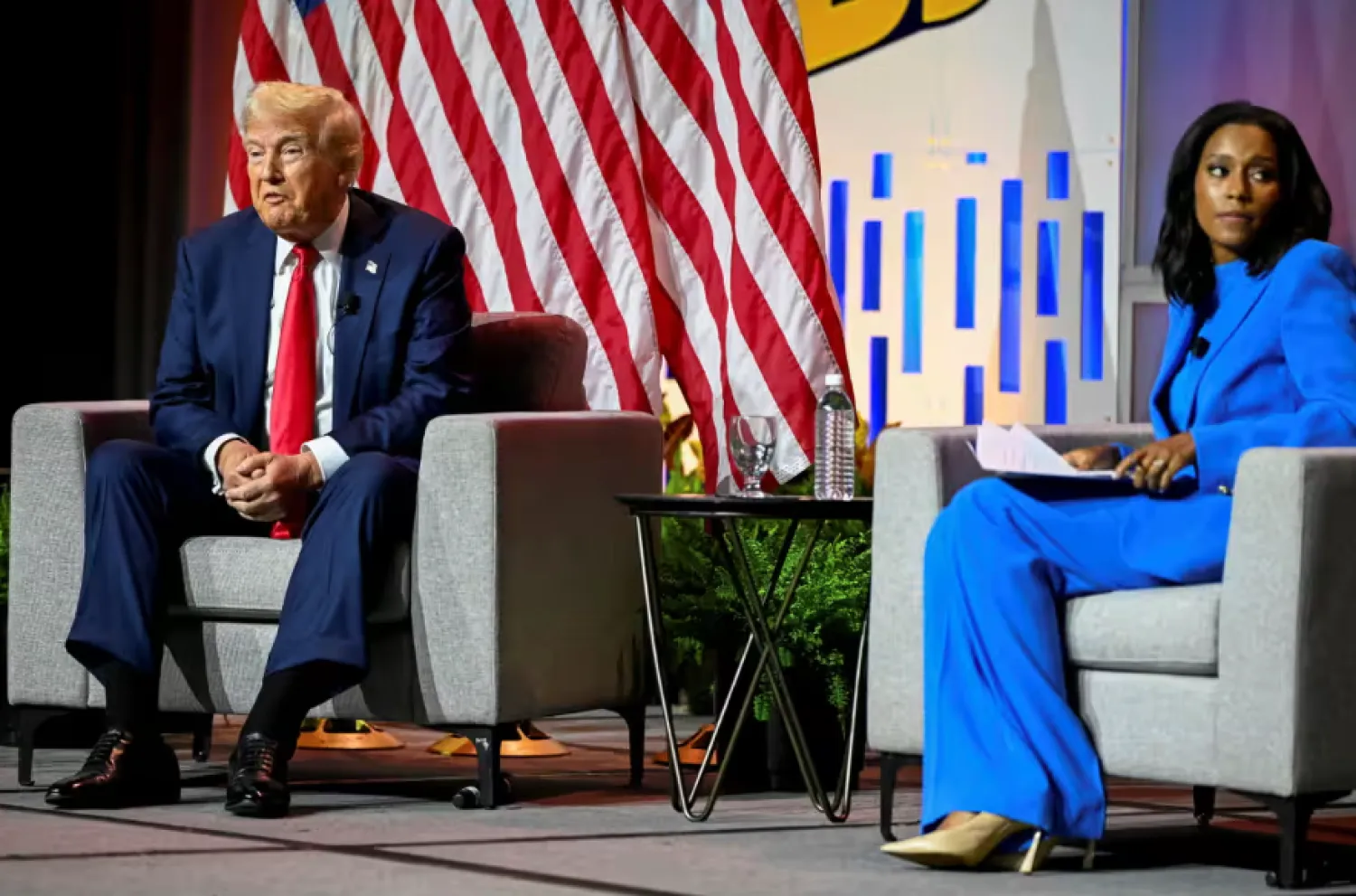
Donald Trump speaks at an NABJ panel beside Rachel Scott of ABC News, in Chicago, Illinois, on 31 July 2024. Photograph: Vincent Alban/Reuters
TT

Donald Trump Suggests Kamala Harris Misled Voters about Her Race

Donald Trump speaks at an NABJ panel beside Rachel Scott of ABC News, in Chicago, Illinois, on 31 July 2024. Photograph: Vincent Alban/Reuters

Donald Trump suggested Kamala Harris had misled voters about her race as the former president appeared before the National Association of Black Journalists in Chicago Wednesday in an interview that quickly turned hostile.

The Republican former president wrongly claimed that Harris, the first Black woman and Asian American to serve as vice president, had in the past only promoted her Indian heritage, The AP reported.

“I didn’t know she was Black until a number of years ago when she happened to turn Black and now she wants to be known as Black. So, I don’t know, is she Indian or is she Black?” Trump said while addressing the group's annual convention.

Harris is the daughter of a Jamaican father and an Indian mother, both immigrants to the US. As an undergraduate, Harris attended Howard University, one of the nation’s most prominent historically Black colleges and universities, where she also pledged the historically Black sorority Alpha Kappa Alpha. As a US senator, Harris was a member of the Congressional Black Caucus, supporting her colleagues’ legislation to strengthen voting rights and reforming policing.

Trump has leveled a wide range of criticism at Harris since she replaced President Joe Biden atop the likely Democratic ticket last week. Throughout his political career, the former president has repeatedly questioned the backgrounds of opponents who are racial minorities.

The day before Trump's latest comments, Trump campaign spokesperson Katrina Pierson offered a new piece of evidence to push back against accusations of racism: Trump had previously given money to Harris.

“The president, as a private businessman, donated to candidates across all aisles. And I’ll note that Kamala Harris is a Black woman and he donated to her campaign, so I hope we can squash this racism argument now," Pierson said.

Michael Tyler, the communications director for Harris' campaign, said in a statement that “the hostility Donald Trump showed on stage today is the same hostility he has shown throughout his life, throughout his term in office, and throughout his campaign for president as he seeks to regain power.”

“Trump lobbed personal attacks and insults at Black journalists the same way he did throughout his presidency — while he failed Black families and left the entire country digging out of the ditch he left us in," Tyler said. "Donald Trump has already proven he cannot unite America, so he attempts to divide us.

White House press secretary Karine Jean-Pierre was asked during her briefing with reporters on Wednesday about Trump's remarks and responded with disbelief, initially murmuring, “Wow.”

Jean-Pierre, who is Black, called what Trump said “repulsive” and said, “It’s insulting and no one has any right to tell someone who they are how they identify.”

Trump has repeatedly attacked his opponents and critics on the basis of race. He rose to prominence in Republican politics by propagating false theories that President Barack Obama, the nation’s first Black president, was not born in the United States. “Birtherism,” as it became known, was just the start of Trump’s history of questioning the credentials and qualifications of Black politicians.

During this year’s Republican primary, he once referred to former UN Ambassador Nikki Haley, the daughter of Indian immigrants, as “Nimbra.”

Trump's appearance Wednesday at the annual gathering of Black journalists immediately became heated, with the former president sparring with interviewer Rachel Scott of ABC News and accusing her of giving him a “very rude introduction” with a tough first question about his past criticism of Black people and Black journalists, his attack on Black prosecutors who have pursued cases against him and the dinner he had at his Florida club with a white supremacist.

“I think it’s disgraceful," Trump said. "I came here in good spirit. I love the Black population of this country. I’ve done so much for the Black population of this country."

Trump continued his attacks on Scott's network, ABC News, which he has been arguing should not host the next presidential debate, despite his earlier agreement with the Biden campaign. He also several times described her tone and questions as “nasty,” a word he used in the past when describing women, including Hillary Clinton and Meghan the Duchess of Sussex.

The Republican also repeated his false claim that immigrants in the country illegally are “taking Black jobs.” When pushed by Scott on what constituted a “Black job,” Trump responded by saying "a Black job is anybody that has a job," drawing groans from the room.

At one point, he said, "I have been the best president for the Black population since Abraham Lincoln.”

The audience responded with a mix of boos and some applause.

Scott asked Trump about his pledge to pardon people convicted for their roles in the Jan. 6, 2021, riot at the US Capitol and specifically whether he would pardon those who assaulted police officers.

Trump said, “Oh, absolutely I would,” and said, “If they’re innocent, I would pardon them.”

Scott pointed out they have been convicted and therefore are not innocent.

“Well, they were convicted by a very, very tough system,” he said.

At one point, when he was defending his supporters who entered the Capitol on Jan. 6, he said, “Nothing is perfect in life.”

He compared the 2021 insurrection to the protests in Minneapolis and other cities in 2020 following the death of George Floyd by Minneapolis police and to more recent protests at the Capitol last week by demonstrators opposed to the war in Gaza. Trump falsely claimed that no one was arrested in those other demonstrations and that only his supporters were targeted.

As Trump made the comparison, a man in the back of the room shouted out, “Sir, have you no shame?”

The former president’s invitation to address the organization sparked an intense internal debate among NABJ that spilled online. Organizations for journalists of color typically invite presidential candidates to speak at their summer gatherings in election years.

As he campaigns for the White House a third time, Trump has sought to appear outside his traditional strongholds of support and his campaign has touted his efforts to try to win over Black Americans, who have been Democrats’ most committed voting bloc.

His campaign has emphasized his messages on the economy and immigration as part of his appeal, but some of his outreach has played on racial stereotypes, including the suggestion that African Americans would empathize with the criminal charges he has faced and his promotion of branded sneakers.



Georgia Arrests Two Foreigners Trying to Purchase Uranium

FILE PHOTO: A block with the symbol, atomic number and mass number of Uranium (U) element, in this illustration taken January 21, 2026. REUTERS/Dado Ruvic/Illustration/File Photo
TT

Georgia Arrests Two Foreigners Trying to Purchase Uranium

FILE PHOTO: A block with the symbol, atomic number and mass number of Uranium (U) element, in this illustration taken January 21, 2026. REUTERS/Dado Ruvic/Illustration/File Photo

Georgia has ‌detained two people who attempted to purchase $3 million worth of uranium and a cache of a radioactive isotope found in nuclear weapons testing programs, the national security service said on Thursday.

Two foreign nationals from unspecified countries were arrested in the city of Kutaisi, the State Security Service said in a statement.

"They were planning to ‌illegally purchase ‌nuclear material uranium and radioactive ‌substance ⁠Cesium 137 for $3 ⁠million and illegally transport it to the territory of another country," Reuters quoted it as saying.

It said other foreigners had been arriving in Georgia in recent weeks with the aim of purchasing and transporting the nuclear and ⁠radioactive materials, without elaborating further.

The ‌statement did ‌not specify the quantity of materials the individuals were ‌attempting to procure. There were ‌no details on the substances' origin or potential destination.

Cesium 137 is a radioactive isotope present primarily in the aftermath of nuclear weapons testing ‌and nuclear power plant accidents such as the Chernobyl disaster in ⁠then-Soviet ⁠Ukraine in 1986.

The security of nuclear materials was one of the biggest concerns after the 1991 fall of the Soviet Union, of which Georgia was part. There have been several serious incidents involving the illicit trade in nuclear materials in Georgia over recent decades.

Most recently, three Chinese citizens were arrested in the capital Tbilisi for attempting to purchase two kilograms of "nuclear material" uranium.


Former South Korean President Yoon Receives Life Sentence for Imposing Martial Law

FILE PHOTO: South Korea’s impeached President Yoon Suk Yeol attends the fourth hearing of his impeachment trial over his short-lived imposition of martial law at the Constitutional Court in Seoul, South Korea, 23 January 2025. JEON HEON-KYUN/Pool via REUTERS/File Photo
TT

Former South Korean President Yoon Receives Life Sentence for Imposing Martial Law

FILE PHOTO: South Korea’s impeached President Yoon Suk Yeol attends the fourth hearing of his impeachment trial over his short-lived imposition of martial law at the Constitutional Court in Seoul, South Korea, 23 January 2025. JEON HEON-KYUN/Pool via REUTERS/File Photo

Former South Korean President Yoon Suk Yeol was sentenced to life in prison for his brief imposition of martial law in a dramatic culmination to the country’s biggest political crisis in decades.

Yoon was ousted from office after a baffling attempt to overcome an opposition-controlled legislature by declaring martial law and sending troops to surround the National Assembly on Dec. 3, 2024, The Associated Press said.

Judge Jee Kui-youn of the Seoul Central District Court said he found Yoon guilty of rebellion for mobilizing military and police forces in an illegal attempt to seize the liberal-led Assembly, arrest politicians and establish unchecked power for a “considerable” time.

Martial law crisis recalled dictatorial past Yoon’s martial law imposition, the first of its kind in more than four decades, harkened back to South Korea’s past military-backed governments when authorities occasionally proclaimed emergency decrees that allowed them to station soldiers, tanks and armored vehicles on streets or at public places such as schools to prevent anti-government demonstrations.

As lawmakers rushed to the National Assembly, Yoon’s martial law command issued a proclamation declaring sweeping powers, including suspending political activities, controlling the media and publications, and allowing arrests without warrants.

The decree lasted about six hours before being lifted after a quorum of lawmakers managed to break through a military blockade and unanimously voted to lift the measure.

Yoon was suspended from office on Dec. 14, 2024, after being impeached by lawmakers and was formally removed by the Constitutional Court in April 2025. He has been under arrest since last July while facing multiple criminal trials, with the rebellion charge carrying the most severe punishment.

Yoon's lawyers reject conviction Yoon Kap-keun, one of the former president’s lawyers, accused Jee of issuing a “predetermined verdict” based solely on prosecutors’ arguments and said the “rule of law” had collapsed. He said he would discuss whether to appeal with his client and the rest of the legal team.

Yoon Suk Yeol told the court the martial law decree was only meant to raise public awareness of how the liberals were paralyzing state affairs, and that he was prepared to respect lawmakers if they voted against the measure.

Prosecutors said it was clear Yoon was attempting to disable the legislature and prevent lawmakers from lifting the measure through voting, actions that exceeded his constitutional authority even under martial law.

In announcing Yoon and Kim’s verdicts, Jee said the decision to send troops to the National Assembly was key to his determination that the imposition of martial law amounted to rebellion.

“This court finds that the purpose of (Yoon’s) actions was to send troops to the National Assembly, block the Assembly building and arrest key figures, including the National Assembly speaker and the leaders of both the ruling and opposition parties, in order to prevent lawmakers from gathering to deliberate or vote,” Jee said. “It’s sufficiently established that he intended to obstruct or paralyze the Assembly’s activities so that it would be unable to properly perform its functions for a considerable period of time.”

Protesters rally outside court

As Yoon arrived in court, hundreds of police officers watched closely as Yoon supporters rallied outside a judicial complex, their cries rising as the prison bus transporting him drove past. Yoon’s critics gathered nearby, demanding the death penalty.

There were no immediate reports of major clashes following the verdict.

A special prosecutor had demanded the death penalty for Yoon Suk Yeol, saying his actions posed a threat to the country’s democracy and deserved the most serious punishment available, but most analysts expected a life sentence since the poorly-planned power grab did not result in casualties.

South Korea has not executed a death row inmate since 1997, in what is widely seen as a de facto moratorium on capital punishment amid calls for its abolition.

Other officials sentenced for enforcing martial law

The court also convicted and sentenced several former military and police officials involved in enforcing Yoon’s martial law decree, including ex-Defense Minister Kim Yong Hyun, who received a 30-year jail term for his central role in planning the measure and mobilizing the military.

Last month, Yoon was sentenced to five years in prison for resisting arrest, fabricating the martial law proclamation and sidestepping a legally mandated full Cabinet meeting before declaring the measure.

The Seoul Central Court has also convicted two members of Yoon’s Cabinet in other cases. That includes Prime Minister Han Duck-soo, who received a 23-year prison sentence for attempting to legitimize the decree by forcing it through a Cabinet Council meeting, falsifying records and lying under oath. Han has appealed the verdict.

Yoon is the first former South Korean president to receive a life sentence since former military dictator Chun Doo-hwan, who was sentenced to death in 1996 for his 1979 coup, a bloody 1980 crackdown on pro-democracy protesters in Gwangju that left more than 200 people dead or missing, and corruption.

The Supreme Court later reduced his sentence to life imprisonment, and he was released in late 1997 under a special presidential pardon. He died in 2021.


UK Condemns 10-year Sentence for British Couple in Iran

(FILES) A handout photograph released in London on August 4, 2025 by the family of Craig and Lindsay Foreman, shows Craig and Lindsay at Naqsh-e Jahan Square, or Shah Square, with the Shah Mosque in the background, in Isfahan, Iran, at an undated time. (Photo by FAMILY HANDOUT / AFP)
TT

UK Condemns 10-year Sentence for British Couple in Iran

(FILES) A handout photograph released in London on August 4, 2025 by the family of Craig and Lindsay Foreman, shows Craig and Lindsay at Naqsh-e Jahan Square, or Shah Square, with the Shah Mosque in the background, in Isfahan, Iran, at an undated time. (Photo by FAMILY HANDOUT / AFP)

British foreign minister Yvette Cooper on Thursday condemned as "totally unjustifiable" the 10-year sentence given to a British couple in Iran for spying, saying the government would continue to press for their release.

Craig and Lindsay Foreman had been charged with espionage after Iran accused them of gathering information in several parts of the country.

"We will pursue this case relentlessly with the Iranian government until we see ‌Craig and Lindsay ‌Foreman safely returned to the UK and reunited with ‌their ⁠family," Reuters quoted Cooper as saying in ⁠a statement.

The Foremans were arrested on January 3 of last year while travelling through Iran on a global motorcycle journey. Iranian state media announced their detention the following month over espionage charges and they have now been held for more than 13 months.

Joe Bennett, Lindsay's son, said in a separate statement the couple had appeared at a three-hour trial ⁠on October 27, in which they were not allowed to ‌present a defense.

"We have seen no ‌evidence to support the charge of espionage," he said, adding that the family ‌was deeply concerned about the couple's welfare and the lack of transparency ‌in the judicial process.

Bennett called on the British government to "act decisively and use every available avenue" to secure their release.

The Iranian embassy in London did not immediately respond to a request for comment on the sentencing.

According to a family ‌statement, the couple have been held for extended periods without being able to communicate. They have had limited or ⁠delayed access ⁠to legal representation, periods of solitary confinement and delays in receiving funds for basic necessities. They also reported disrupted or cancelled consular visits.

Cooper, whose office did not comment on the disruption, said they would continue to provide consular assistance.

Lindsay Foreman has been held in the women's section of Tehran's Evin Prison, while her husband Craig has been held in its political wing.

Iran's Revolutionary Guards have in recent years detained foreign and dual nationals, typically on espionage or national security charges.

Human rights organizations say the authorities use such arrests as leverage in disputes with other countries, a practice they describe as part of a broader pattern of politically motivated detentions. Tehran has rejected those accusations and said the cases involved legitimate security concerns.