What's Next after Protests Forced Bangladesh's Prime Minister to Quit and Flee the Country?

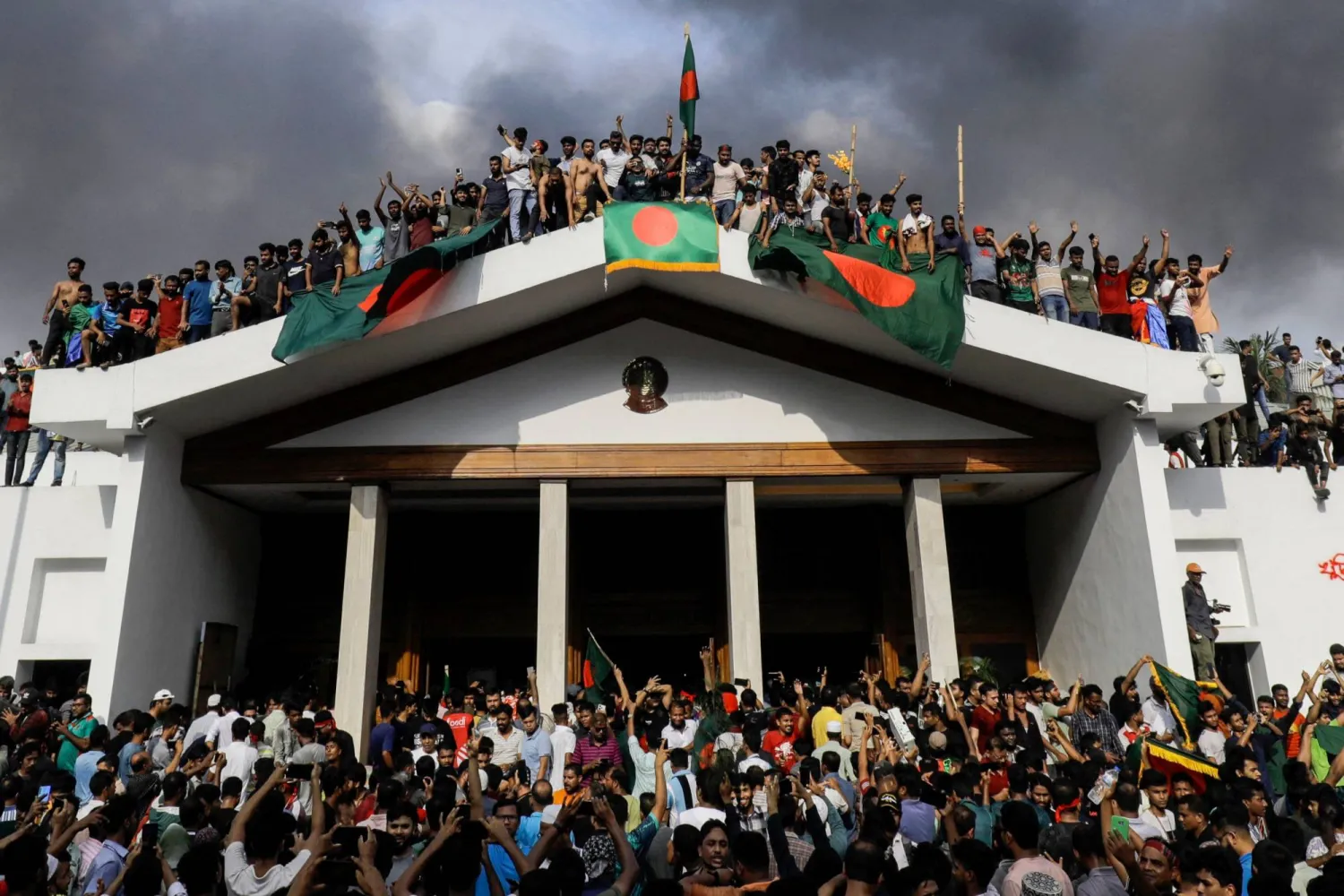
Anti-government protestors display Bangladesh's national flag as they storm Prime Minister Sheikh Hasina's palace in Dhaka on August 5, 2024. (Photo by K M ASAD / AFP)
TT

What's Next after Protests Forced Bangladesh's Prime Minister to Quit and Flee the Country?

Anti-government protestors display Bangladesh's national flag as they storm Prime Minister Sheikh Hasina's palace in Dhaka on August 5, 2024. (Photo by K M ASAD / AFP)

What began as peaceful protests by students in Bangladesh against a quota system for government jobs eventually turned into an uprising that forced Prime Minister Sheikh Hasina to resign and flee the country by helicopter.
Now, opposition leaders and the country's military are talking about appointing an interim government that is expected to organize new elections in what critics of Hasina say is a restoration of democracy, The Associated Press said.
The end to Hasina's 15 years in power came after weeks of violent unrest during which nearly 300 people died, according to local media reports.
The government repeatedly tried to quell demonstrations they blamed on sabotage and opposition parties with bullets, curfews and internet outages, but these heavy-handed moves backfired, fueling outrage and further protests.
On Monday, protesters defied a military curfew to march into the capital's center, following a weekend of violence left dozens of people dead. As troops pulled back and internet access was restored, tens of thousands of people began to celebrate in the streets, and thousands stormed the leader's official residence.
Here’s what we know:
Who will lead the next government? Shortly after Hasina resigned, the country's military chief said the army would seek the figurehead president's guidance to appoint an interim government.
President Mohammed Shahabuddin announced late Monday after meeting with Gen. Waker-uz-Zamam and opposition politicians that Parliament would be dissolved as soon as possible, leading to fresh elections.
The next day, a key student leader said that the movement wanted Nobel Peace Prize laureate Muhammad Yunus to head the interim government.
Nahid Islam said in a video posted on social media that student protest leaders had already talked with Yunus, who consented to take over considering the present situation of the country.
Yunus faced a number of corruption accusations and was put on trial during Hasina’s rule. He received the Nobel in 2006 after he pioneered microlending, and he said the corruption charges against him were motivated by vengeance.
Gen. Waker-uz-Zaman also promised to launch an investigation into the deadly crackdowns that fueled outrage against the government.
“Keep faith in the military, we will investigate all the killings and punish the responsible,” he said. “I have ordered that no army and police will indulge in any kind of firing.”
He asked for patience as a new government is formed.
“Now, the students’ duty is to stay calm and help us,” he added.
How did the protests start? The protests, which have drawn hundreds of thousands, began in July with students demonstrating against a controversial quota system that allocated government jobs.
It turned violent on July 15 as student protesters clashed with security officials and pro-government activists, prompting authorities to disperse tear gas, fire rubber bullets and to close schools and impose a curfew with a shoot-on-sight order. The internet and mobile data were also turned off.
The government says nearly 150 people died last month, while local media have reported that more than 200 were killed.
Why were they protesting? At first, the demonstrations were against a quota system that set aside up to 30% of government jobs for family members of veterans who fought in Bangladesh’s 1971 war of independence against Pakistan.
Protesters said the system was discriminatory and benefited supporters of Prime Minister Sheikh Hasina’s Awami League party, which led the independence movement.
The furor highlighted the extent of economic distress in Bangladesh, where exports have fallen and foreign exchange reserves are running low. There’s a lack of quality jobs for young graduates, who increasingly seek the more stable and lucrative government jobs.
As the violence crested, the Supreme Court last month ruled that the veterans’ quota must be cut to 5%, with 93% of jobs to be allocated on merit. The remaining 2% will be set aside for members of ethnic minorities and transgender and disabled people.
The government accepted the decision, and restored the internet thinking that the situation would ease. But the protests grew, with new demands for investigations into the deadly crackdowns, and eventually for Hasina and her cabinet to step down.



Türkiye Says Greece-Chevron Activity off Crete Unlawful 

A Chevron gas station sign is pictured at one of their retain gas stations in Cardiff, California October 9, 2013. REUTERS/Mike Blake/File Photo
TT

Türkiye Says Greece-Chevron Activity off Crete Unlawful 

A Chevron gas station sign is pictured at one of their retain gas stations in Cardiff, California October 9, 2013. REUTERS/Mike Blake/File Photo

Türkiye said on Thursday it opposed Greece's "unilateral activities" in energy fields south of Crete with a consortium led by US major Chevron as a violation of international law and good neighbourly relations.

Athens responded that its policies abide international law.

The Chevron-led consortium signed exclusive lease agreements on Monday to look for natural gas off southern Greece, expanding US presence in the eastern Mediterranean.

"We oppose this unlawful activity, which is being attempted in violation of the 2019 Memorandum of Understanding on Maritime Jurisdiction between Libya and our country," the Turkish Defense Ministry said at a press briefing.

It said the activity, while not directly impacting Türkiye's continental shelf, also violated Libya's maritime jurisdiction that was declared to the United Nations in May last year.

"We continue to provide the necessary support to the Libyan authorities to take action against these unilateral and unlawful activities by Greece," the ministry said.

A 2019 agreement signed by Türkiye and Libya set out maritime boundaries in the Mediterranean Sea. It was rejected by Greece as it ignored the presence of the Greek island of Crete between the coasts of Türkiye and Libya. The Chevron deal doubles the amount of Greek maritime acreage available for exploration and is the second in months involving a US energy major, as the European Union seeks to phase out supplies from Russia and the US seeks to replace them.

Asked about the Turkish objections later on Thursday, Greek government spokesman Pavlos Marinakis told a press briefing that Athens followed an "active policy" and "exercises its rights in accordance with international law and respects international law steadfastly - and I think no one questions that, period."

There was no immediate comment from Chevron.

Neighbors and NATO members Türkiye and Greece have been at odds over a range of issues for decades, primarily maritime boundaries and rights in the Aegean, an area widely believed to hold energy resources and with key implications for airspace and military activity.

A 2023 declaration on friendly relations prompted a thaw between the sides and leaders have voiced a desire to address remaining issues.


Andrew Mountbatten-Windsor Arrested on Suspicion of Misconduct in Public Office

FILE - Britain’s Andrew Mountbatten-Windsor, formerly known as Prince Andrew, looks round as he leaves after attending the Easter Matins Service at St. George's Chapel, Windsor Castle, England, April 20, 2025. (AP Photo/Kirsty Wigglesworth, File)
TT

Andrew Mountbatten-Windsor Arrested on Suspicion of Misconduct in Public Office

FILE - Britain’s Andrew Mountbatten-Windsor, formerly known as Prince Andrew, looks round as he leaves after attending the Easter Matins Service at St. George's Chapel, Windsor Castle, England, April 20, 2025. (AP Photo/Kirsty Wigglesworth, File)

UK police arrested Andrew Mountbatten-Windsor on Thursday on suspicion of misconduct in public office.

The Thames Valley Police, an agency that covers areas west of London, including Mountbatten-Windsor’s former home, said it was “assessing” reports that the former Prince Andrew sent trade reports to convicted sex offender Jeffrey Epstein in 2010. The assessment followed the release of millions of pages of documents connected to a US investigation of Epstein.

The police force did not name Mountbatten-Windsor, as is normal under UK law. But when asked if he had been arrested, the force pointed to a statement saying that they had arrested a man in his 60s. Mountbatten-Windsor is 66.

“Following a thorough assessment, we have now opened an investigation into this allegation of misconduct in public office,’’ the statement said. “It is important that we protect the integrity and objectivity of our investigation as we work with our partners to investigate this alleged offence."

“We understand the significant public interest in this case, and we will provide updates at the appropriate time,” the statement added.

Pictures circulated online appearing to show unmarked police cars at Wood Farm on the Sandringham Estate in Norfolk, with plainclothes officers appearing to gather outside the home of Mountbatten-Windsor.


Georgia Arrests Two Foreigners Trying to Purchase Uranium

FILE PHOTO: A block with the symbol, atomic number and mass number of Uranium (U) element, in this illustration taken January 21, 2026. REUTERS/Dado Ruvic/Illustration/File Photo
TT

Georgia Arrests Two Foreigners Trying to Purchase Uranium

FILE PHOTO: A block with the symbol, atomic number and mass number of Uranium (U) element, in this illustration taken January 21, 2026. REUTERS/Dado Ruvic/Illustration/File Photo

Georgia has ‌detained two people who attempted to purchase $3 million worth of uranium and a cache of a radioactive isotope found in nuclear weapons testing programs, the national security service said on Thursday.

Two foreign nationals from unspecified countries were arrested in the city of Kutaisi, the State Security Service said in a statement.

"They were planning to ‌illegally purchase ‌nuclear material uranium and radioactive ‌substance ⁠Cesium 137 for $3 ⁠million and illegally transport it to the territory of another country," Reuters quoted it as saying.

It said other foreigners had been arriving in Georgia in recent weeks with the aim of purchasing and transporting the nuclear and ⁠radioactive materials, without elaborating further.

The ‌statement did ‌not specify the quantity of materials the individuals were ‌attempting to procure. There were ‌no details on the substances' origin or potential destination.

Cesium 137 is a radioactive isotope present primarily in the aftermath of nuclear weapons testing ‌and nuclear power plant accidents such as the Chernobyl disaster in ⁠then-Soviet ⁠Ukraine in 1986.

The security of nuclear materials was one of the biggest concerns after the 1991 fall of the Soviet Union, of which Georgia was part. There have been several serious incidents involving the illicit trade in nuclear materials in Georgia over recent decades.

Most recently, three Chinese citizens were arrested in the capital Tbilisi for attempting to purchase two kilograms of "nuclear material" uranium.