


UN Refugee Agency Accuses Cyprus of Pushing Asylum Seekers into a UN Buffer Zone

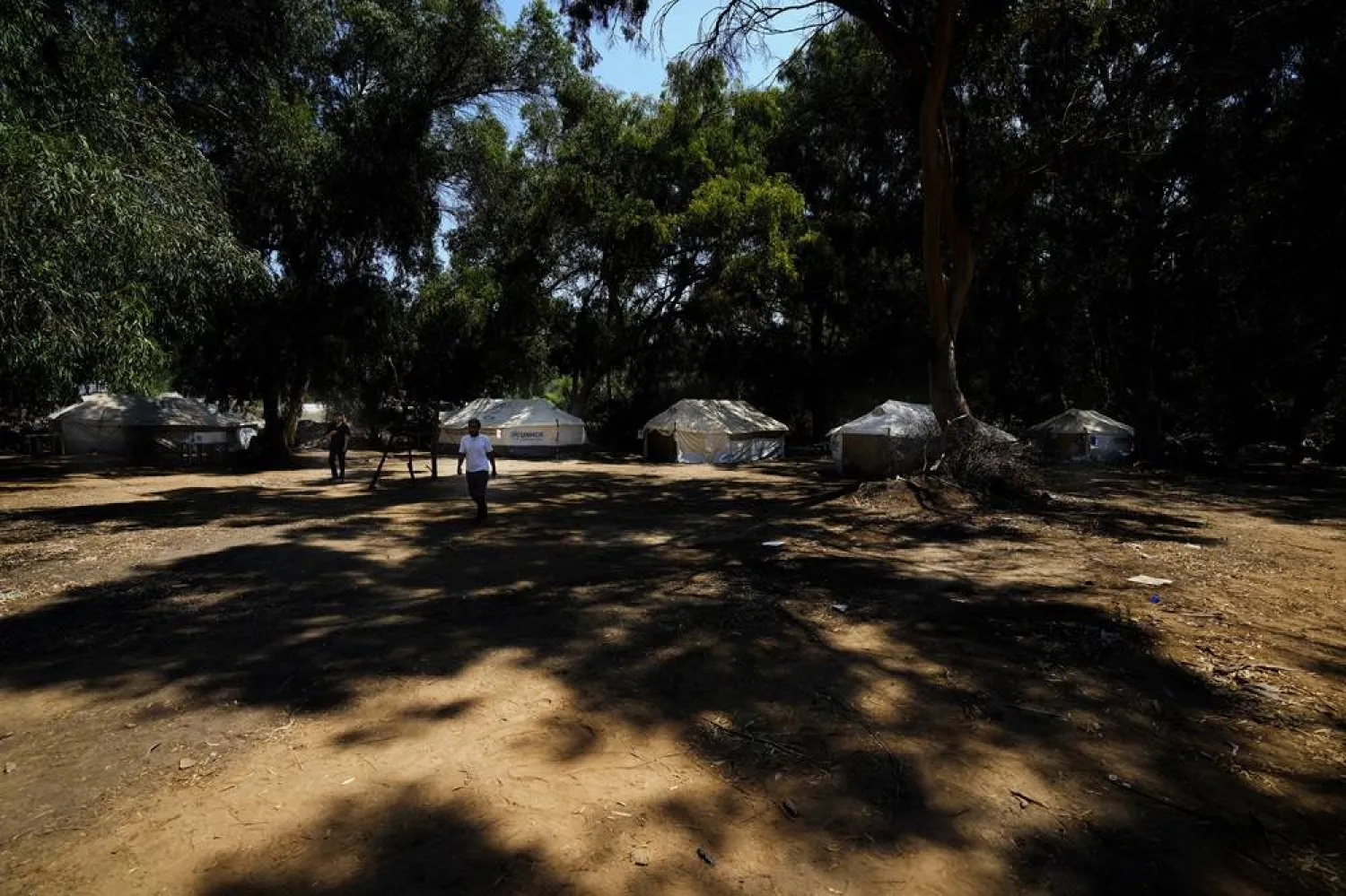
 Men walk at a camp inside the UN controlled buffer zone that divide the north part of the Turkish occupied area from the south Greek Cypriots at Aglantzia area in the divided capital Nicosia, Cyprus, Friday, Aug, 9, 2024. (AP)
Men walk at a camp inside the UN controlled buffer zone that divide the north part of the Turkish occupied area from the south Greek Cypriots at Aglantzia area in the divided capital Nicosia, Cyprus, Friday, Aug, 9, 2024. (AP)
TT

UN Refugee Agency Accuses Cyprus of Pushing Asylum Seekers into a UN Buffer Zone

 Men walk at a camp inside the UN controlled buffer zone that divide the north part of the Turkish occupied area from the south Greek Cypriots at Aglantzia area in the divided capital Nicosia, Cyprus, Friday, Aug, 9, 2024. (AP)
Men walk at a camp inside the UN controlled buffer zone that divide the north part of the Turkish occupied area from the south Greek Cypriots at Aglantzia area in the divided capital Nicosia, Cyprus, Friday, Aug, 9, 2024. (AP)

The United Nations refugee agency on Friday accused government authorities in ethnically divided Cyprus of rounding up dozens of migrants and forcing them back inside a UN-controlled buffer zone that they crossed to seek asylum.

UNHCR spokeswoman Emilia Strovolidou said that as many as 99 asylum seekers were “pushed back” into the buffer zone between mid-May and Aug. 8.

The asylum seekers entered the European Union member country from the breakaway Turkish Cypriot north and crossed the buffer zone into the south where they could file their applications with the internationally recognized government.

Of those 99 migrants, 76 people from countries including Syria, Iran, Afghanistan, Nigeria, Somalia, Bangladesh, Sudan, Iraq and Gaza remain stranded in two locations inside the buffer zone, to the west and east of the capital Nicosia. They include 18 minors, six of whom are unaccompanied.

Strovolidou said although the UN has supplied the asylum seekers with military food rations, tents, blankets, toilets and washing facilities, they remain exposed to extreme heat, dust and humidity.

“Their humanitarian needs are increasing, and their physical and psychological condition is deteriorating as they continue to remain in these conditions, some for nearly three months,” Strovolidou told The Associated Press.

She said some are survivors of gender-based violence and trafficking and people suffering from serious illnesses such as cancer, asthma and serious mental health issues.

Cyprus was split in 1974 when Türkiye invaded after supporters of a union with Greece mounted a coup with the backing of the junta then ruling Greece. Cyprus joined the EU in 2004, but only the south enjoys full membership benefits.

Aleem Siddique, spokesman for the UN peacekeeping force in Cyprus, urged an immediate end to the “pushbacks” and for Cypriot authorities to live up to their obligations under international and EU law.

“In nearly all instances, the asylum seekers found their way into government-controlled areas from where they were intercepted by the Cyprus Police and forcibly dumped into the buffer zone after having their passports and mobile phones confiscated,” Siddique told AP.

He said the UN has shared video evidence of the “pushback operations” with Cypriot authorities.

“The buffer zone in not a refugee camp,” Siddique said.

The Cyprus government has taken a tough line with migrant crossings along the 180-kilometer (120 mile) length of the buffer zone, insisting that it would not permit it to become a gateway for illegal migration.

Deputy Minister for Migration Nicholas Ioannides said earlier this week that the government doesn’t want to be at odds with the UN and is in talks with the UNHCR to resolve the issue.

What complicates the issue are the peculiarities of the buffer zone itself, which isn’t a formal border and as such. Cypriot authorities say the UN is mistaken when it speaks about pushbacks that specifically pertain to “expulsions at recognized sea or land borders.”

In a written statement to AP, the ministry said migrants who cross the buffer zone arrive on the island’s north from Türkiye — a safe country — and then cross southward along remote stretches of the porous buffer zone where there are no physical barriers preventing crossings.

According to an established legal framework, Cypriot police and other authorities are lawfully empowered to conduct “effective surveillance” of the buffer zone in order to combat illegal migration by “discouraging people from circumventing checks” at all eight lawful crossing points.

The ministry said given the “tremendous migratory pressures” Cyprus is under, the government has adopted a “principled stance” to avoid turning the buffer zone into a “route for irregular migration” while offering humanitarian assistance to stranded migrants.

Human rights lawyer Nicoletta Charalambidou is contesting the Cypriot government’s claim that it’s acting in line with international and EU law.

She has launched legal action on behalf of 46 stranded migrants to get Cypriot authorities to allow them to submit asylum applications.

“The government has an obligation to allow these people to file asylum claims,” she told AP. She added that asylum applications should be assessed individually to determine if conditions of safety exist in Türkiye for each applicant.



Iran Rejects Curbs on Its Uranium Enrichment Program

FILE - This satellite image provided by Vantor shows the Natanz nuclear complex in Iran on March 7, 2026, with no new damage seen at the facility or the tunnels. (Satellite image ©2026 Vantor via AP, file)
TT

Iran Rejects Curbs on Its Uranium Enrichment Program

FILE - This satellite image provided by Vantor shows the Natanz nuclear complex in Iran on March 7, 2026, with no new damage seen at the facility or the tunnels. (Satellite image ©2026 Vantor via AP, file)

The head of Iran’s Atomic Energy Organization, Mohammad Eslami, on Thursday ruled out accepting any restrictions on the country’s uranium enrichment program, as demanded by the United States and Israel.

In an interview with the ISNA news agency, Eslami said: “The demands and conditions set by our enemies to restrict Iran’s enrichment program are nothing but daydreams that will be buried,” AFP reported.

The remarks come as talks between Washington and Tehran are expected to be held at the end of the week under Islamabad’s auspices, as part of a ceasefire agreement brokered by Pakistan. The discussions are expected to address Tehran’s nuclear program.

Western powers accuse Iran of seeking to acquire a nuclear weapon and have worked to prevent it from doing so, while Tehran has consistently denied the allegations.

During his first term, US President Donald Trump withdrew from the landmark 2015 agreement that had placed limits on Iran’s nuclear enrichment activities in exchange for sanctions relief, a deal opposed by Israel.


Germany's Merz: We Do Not Want NATO to Split over US-Iran War

Commemorative photo of NATO leaders in The Hague in 2025 (Turkish Presidency).
TT

Germany's Merz: We Do Not Want NATO to Split over US-Iran War

Commemorative photo of NATO leaders in The Hague in 2025 (Turkish Presidency).

German Chancellor Friedrich Merz said on Thursday he did not want US-Iran war to place any further strain on relations between the United States and its European NATO partners.

"We do not want – I do not want – NATO to split. NATO is a guarantor of our security, including and above all in Europe," he said, speaking to journalists.

He added he had encouraged US President Donald Trump in a call to pursue negotiations with Iran with urgency.

Germany was resuming direct talks with Iranian leadership in Tehran, Merz said in Berlin.


Pentagon Leaders Assert Destruction of Iran’s Military Capabilities, Threaten to Resume Operations

Defense Secretary Pete Hegseth speaks to members of the media during a press briefing at the Pentagon in Washington, Wednesday, April 8, 2026. (AP Photo/Manuel Balce Ceneta)
TT

Pentagon Leaders Assert Destruction of Iran’s Military Capabilities, Threaten to Resume Operations

Defense Secretary Pete Hegseth speaks to members of the media during a press briefing at the Pentagon in Washington, Wednesday, April 8, 2026. (AP Photo/Manuel Balce Ceneta)

The US war against Iran has "completely" destroyed the country's ability to build missiles or other sophisticated weaponry, Defense Secretary Pete Hegseth said Wednesday

"We finished completely destroying Iran's defense-industrial base, a core pillar of our mission," Hegseth told reporters.

"They can no longer build missiles."

For his part, Chairman of the Joint Chiefs of Staff Dan Caine said: “We attacked, along with our partners, approximately 90 percent of their weapons factories,” including facilities producing Shahed-type drones, as well as facilities manufacturing guidance systems used by these drones.

Regarding the naval fleet, Caine said that it will take years before Iran can rebuild its surface combatant capabilities.

The general added that approximately 80 percent of Iran’s nuclear industrial base was targeted, significantly undermining its nuclear weapons development efforts.

He warned that US forces remain ready to resume fighting with Iran if the ceasefire ends, stating: “Let’s be clear: the ceasefire is just a temporary pause. The armed forces remain ready, if ordered, to resume combat operations with the same speed and precision demonstrated over the past 38 days.”

Statements by Dan Caine, and his warning about a possible resumption of fighting, suggest that the announcement of a suspension of the war came under US pressure, according to Michael Rubin, a researcher at the American Enterprise Institute.

As for the restoration of freedom of navigation, military officials’ statements did not indicate that it has been fully secured, instead emphasizing the need to “ensure Iran’s compliance” and the safe passage of vessels.

At the same time, there were continued indications that ships received messages from Iranian forces stating that they require permission to transit the strait, suggesting that Tehran is seeking to establish a new equation: keeping Hormuz open on the condition of recognizing a supervisory or sovereign role for itself.

If that is the case, the region and the global economy would be entering a phase that goes beyond a mere ceasefire, as the risk shifts from missiles to the rules governing transit, insurance, pricing, and maritime fees.

Statements by Pentagon leaders, followed by remarks from Donald Trump, reveal that the real dispute is not over the ceasefire itself, but over what comes after it. Washington rejects the continuation of Iranian uranium enrichment and is demanding that the stockpile of highly enriched uranium be handed over, or “taken” by force if necessary.

By contrast, narratives circulating in Iranian media about the “ten points” of the ceasefire agreement point in a completely different direction: recognition of Iran’s right to enrich, the lifting of sanctions, and no clear position on the fate of the enriched stockpile.

This is precisely where the structural contradiction lies, one that could undermine the negotiating round from its very first day, according to Michael Rubin.

The second aspect of the dispute concerns the scope of de-escalation. The United States and Israel have made clear that a ceasefire with Iran does not mean a halt to Israeli operations in Lebanon against Hezbollah, while reports continued of missile and drone attacks on Gulf states in the hours following the truce. This suggests that the region is facing a form of “selective de-escalation,” according to observers: a direct easing between Washington and Tehran, while proxy arenas and exchanges of messages remain active.

Remarks by Hegseth that Washington had been prepared, just hours earlier, to strike power stations, bridges, and oil and energy infrastructure “that Iran cannot rebuild” indicate that the decision to halt hostilities did not stem from a fully realized settlement, but rather from the suspension of a massive escalatory strike against Tehran.

Accordingly, the ceasefire appears more like a testing window: if Tehran complies with conditions related to navigation and the transfer of uranium, the truce could hold and pave the way toward a definitive end to the war. If not, the United States may return to the option of large-scale destruction of infrastructure.