Bangladeshi Protesters Attack Supporters of Ex-Premier Hasina and Harass Journalists

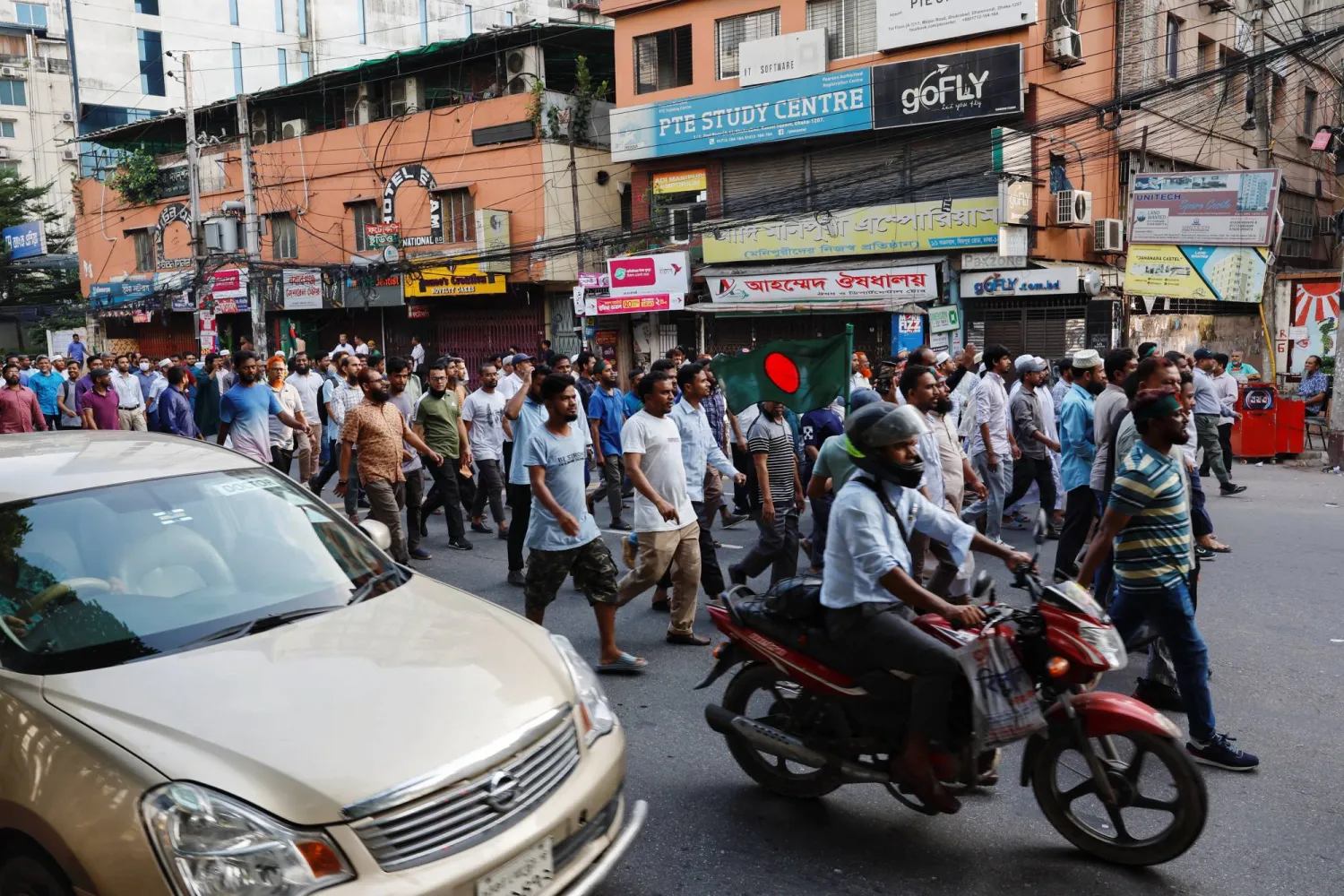
Protesters march on the street of Dhanmondi in front of Bangabandhu Sheikh Mujibur Rahman Memorial Museum in Dhaka, Bangladesh, August 15, 2024. REUTERS/Mohammad Ponir Hossain
TT

Bangladeshi Protesters Attack Supporters of Ex-Premier Hasina and Harass Journalists

Protesters march on the street of Dhanmondi in front of Bangabandhu Sheikh Mujibur Rahman Memorial Museum in Dhaka, Bangladesh, August 15, 2024. REUTERS/Mohammad Ponir Hossain

Hundreds of student protesters and political activists in Bangladesh, armed with bamboo sticks, iron rods and pipes, on Thursday, assaulted supporters of the ousted Prime Minister Sheikh Hasina and prevented them from reaching the previous house of her father and assassinated independence leader Sheikh Mujibur Rahman in the capital.
The house in Dhaka’s Dhanmondi area was turned into a museum to showcase narratives and other objects about a military coup on Aug. 15, 1975, when Rahman was assassinated along with most of his family members. The house, now called Bangabandhu Memorial Museum, was torched by the protesters hours after Hasina’s downfall on Aug. 5 following an uprising during which more than three hundred people were killed, The Associated Press said.
Thursday is the anniversary of Rahman’s death, and Hasina, now self-exiled in India, urged her supporters to commemorate the day by paying respect to Rahman. Previously, Aug. 15 was a public holiday and was observed as a national mourning day by Hasina’s administration. But that has been canceled by an interim government led by Nobel laureate Muhammad Yunus following the ouster of Hasina, who survived in 1975 along with her younger sister because they were visiting Germany in 1975.
On Thursday, the protesters attacked Hasina’s supporters who attempted to get to the site. They manhandled many and checked the visitors’ phones and identity cards while threatening journalists for filming the incidents at the scene, witnesses said.
Another group of protesters on Thursday marched through streets in the area where the museum site remained blocked with barbed-wire fences.
The protesters, who arrived at Rahman's house first on Wednesday, attacked a prominent actress, as she along with dozens of Hasina’s supporters reached there to light candles as part of the commemoration.
Overnight, they held a party using loudspeakers and playing songs as they danced outside the museum, which was set on fire during the anti-government demonstrations earlier this month. Videos of the party went viral on social media.
The protesters said they were out to stop the gathering of Hasina’s supporters as they could attempt to create chaos in the name of commemoration.
Sarjis Alam, a key organizer of the student protests, said Thursday that they would continue to demand the trial of Hasina as he led a rally in Dhaka's Shahbagh area.
Asked about the harassment of journalists by the students and other activists outside the museum, he said he would inquire about that but gave no details.
In the past, big gatherings took place on the premises of the museum, seen by many as a source of inspiration.
Hasina had asked supporters earlier this week to “pray for the salvation of all souls by offering floral garlands and praying” outside the museum, in her first public statement since her fall.
With no police in sight, the chaos remained in Bangladesh's capital throughout Thursday.
Sam Jahan, a video journalist for Reuters, protested against the harassment by the protesters, in a Facebook post.
“It is fair enough what you, the political activists, student protesters want to achieve, politically. But when you try to stop my rolling camera, resisting the freedom of the press and when you manhandle my colleagues, I will speak up,” Jahan wrote in the post.
The country's leading English-language Daily Star newspaper reported that their journalists faced trouble at the scene, and they were forced to delete photos and videos.
Mujib Mashal, South Asian bureau chief of The New York Times, in a video post on social media platform X said that it was a “complete mob rule.”
“The victims of yesterday are perpetrators of today; men armed with clubs and pipes (many identified themselves as BNP and Jamaat) thrashing and chasing away anyone they suspect of being Awami League,” he said.
The protesters have been demanding trial of Hasina for the killings during weeks-long violence and cases have already been filed against her and other close party colleagues and top police officials.
More than 300 people were killed in unrest that started in July with protests against a quota system for government jobs that later morphed into a movement against what was considered Hasina’s increasingly autocratic administration. The uprising eventually forced Hasina to leave office and flee to India, ending her 15-year rule.
Yunus took over as the interim leader. Sixteen people, including two student protest leaders and others, drawn mainly from civil society, have been included in the interim Cabinet.
He chose the new Cabinet members after talks between student leaders, civil society representatives and the military.



US Judge Blocks Deportation of Columbia University Palestinian Activist

Mohsen Mahdawi at a press conference in Vermont last year - Photo by Alex Driehaus/AP
TT

US Judge Blocks Deportation of Columbia University Palestinian Activist

Mohsen Mahdawi at a press conference in Vermont last year - Photo by Alex Driehaus/AP

A US immigration judge has blocked the deportation of a Palestinian graduate student who helped organize protests at Columbia University against Israel's war in Gaza, according to US media reports.

Mohsen Mahdawi was arrested by immigration agents last year as he was attending an interview to become a US citizen.

Mahdawi had been involved in a wave of demonstrations that gripped several major US university campuses since Israel began a massive military campaign in the Gaza Strip.

A Palestinian born in the occupied West Bank, Mahdawi has been a legal US permanent resident since 2015 and graduated from the prestigious New York university in May. He has been free from federal custody since April.

In an order made public on Tuesday, Judge Nina Froes said that President Donald Trump's administration did not provide sufficient evidence that Mahdawi could be legally removed from the United States, multiple media outlets reported.

Froes reportedly questioned the authenticity of a copy of a document purportedly signed by Secretary of State Marco Rubio that said Mahdawi's activism "could undermine the Middle East peace process by reinforcing antisemitic sentiment," according to the New York Times.

Rubio has argued that federal law grants him the authority to summarily revoke visas and deport migrants who pose threats to US foreign policy.

The Trump administration can still appeal the decision, which marked a setback in the Republican president's efforts to crack down on pro-Palestinian campus activists.

The administration has also attempted to deport Mahmoud Khalil, another student activist who co-founded a Palestinian student group at Columbia, alongside Mahdawi.

"I am grateful to the court for honoring the rule of law and holding the line against the government's attempts to trample on due process," Mahdawi said in a statement released by his attorneys and published Tuesday by several media outlets.

"This decision is an important step towards upholding what fear tried to destroy: the right to speak for peace and justice."


Fire Breaks out Near Iran's Capital Tehran, State Media Says

Smoke rises from a fire caused by an explosion in Tehran (File photo - Reuters)
TT

Fire Breaks out Near Iran's Capital Tehran, State Media Says

Smoke rises from a fire caused by an explosion in Tehran (File photo - Reuters)

A fire broke out in Iran's Parand near the capital city Tehran, state media reported on Wednesday, publishing videos of smoke rising over the area which is close to several military and strategic sites in the country's Tehran province, Reuters reported.

"The black smoke seen near the city of Parand is the result of a fire in the reeds around the Parand river bank... fire fighters are on site and the fire extinguishing operation is underway", state media cited the Parand fire department as saying.


Pakistan PM Sharif to Seek Clarity on Troops for Gaza in US Visit

US President Donald Trump looks at Pakistan's Prime Minister Shehbaz Sharif speaking following the official signing of the first phase of the Gaza ceasefire agreement between Israel and Hamas, during a world leaders' summit on ending the Gaza war, in Sharm El-Sheikh, Egypt, October 13, 2025. REUTERS/Evelyn Hockstein/File Photo
TT

Pakistan PM Sharif to Seek Clarity on Troops for Gaza in US Visit

US President Donald Trump looks at Pakistan's Prime Minister Shehbaz Sharif speaking following the official signing of the first phase of the Gaza ceasefire agreement between Israel and Hamas, during a world leaders' summit on ending the Gaza war, in Sharm El-Sheikh, Egypt, October 13, 2025. REUTERS/Evelyn Hockstein/File Photo

Before Pakistan commits to sending troops to Gaza as part of the International Stabilization Force it wants assurances from the United States that it will be a peacekeeping mission rather than tasked with disarming Hamas, three sources told Reuters.

Pakistan's Prime Minister Shehbaz Sharif is set to attend the first formal meeting of President Donald Trump's Board of Peace in Washington on Thursday, alongside delegations from at least 20 countries.

Trump, who will chair the meeting, is expected to announce a multi-billion dollar reconstruction plan for Gaza and detail plans for a UN-authorized stabilization force for the Palestinian enclave.

Three government sources said during the Washington visit Sharif wanted to better understand the goal of the ISF, what authority they were operating under and what the chain of command was before making a decision on deploying troops.

"We are ready to send troops. Let me make it clear that our troops could only be part of a peace mission in Gaza," said one of the sources, a close aide of Sharif.

"We will not be part of any other role, such as disarming Hamas. It is out of the question," he said.

Analysts say Pakistan would be an asset to the multinational force, with its experienced military that has gone to war with arch-rival India and tackled insurgencies.

"We can send initially a couple of thousand troops anytime, but we need to know what role they are going to play," the source added.

Two of the sources said it was likely Sharif, who has met Trump earlier this year in Davos and late last year at the White House, would either have an audience with him on the sidelines of the meeting or the following day at the White House.

Initially designed to cement Gaza's ceasefire, Trump sees the Board of Peace, launched in late January, taking a wider role in resolving global conflicts. Some countries have reacted cautiously, fearing it could become a rival to the United Nations.

While Pakistan has supported the establishment of the board, it has voiced concerns against the mission to demilitarize Gaza's militant group Hamas.