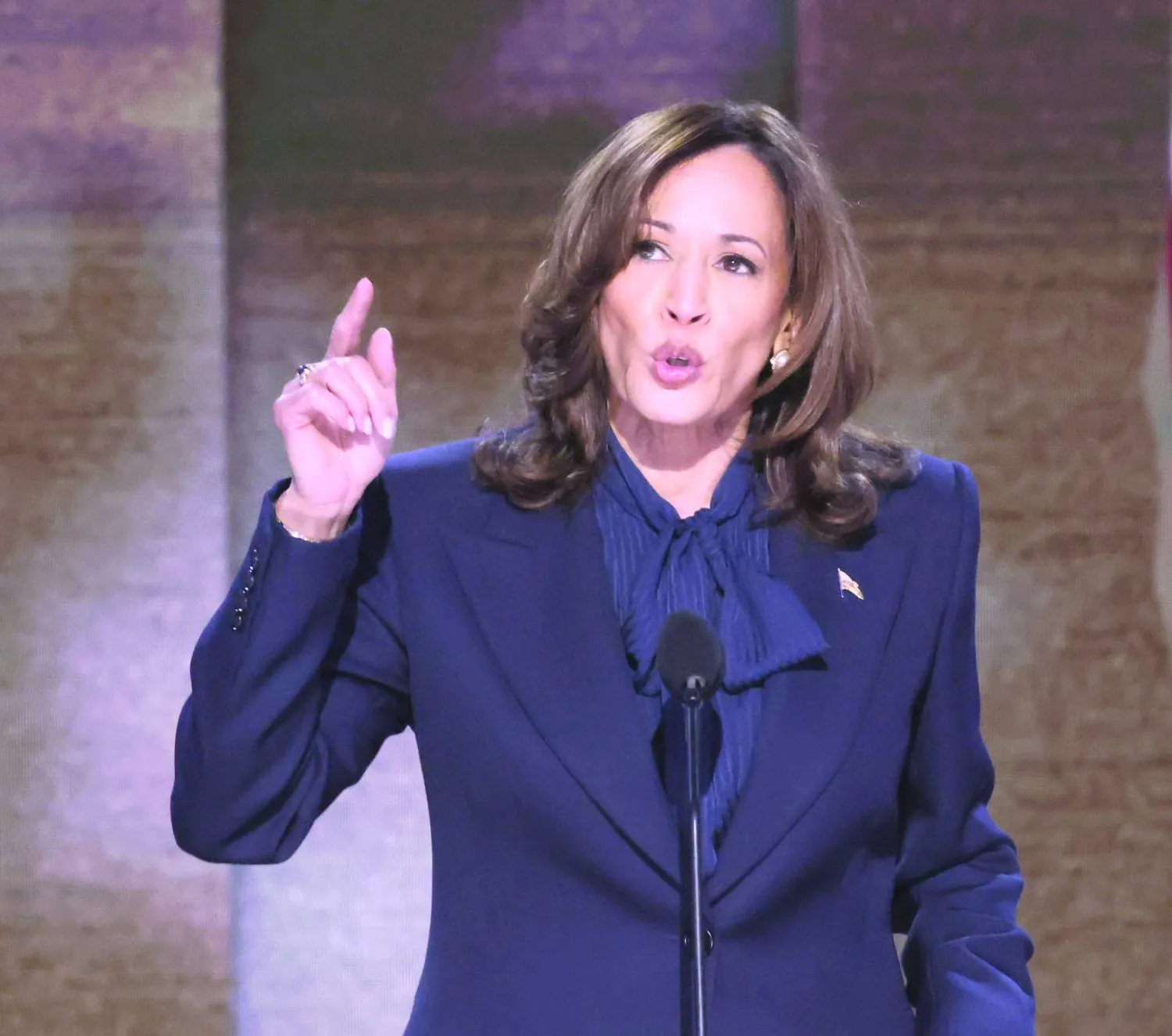
Harris isn’t Backing Away from Biden’s Democracy Focus. But She’s Putting Her Own Spin on It

Democratic presidential candidate Kamala Harris gives her keynote address on the final night of the Democratic National Convention (DNC) at the United Center in Chicago, Illinois, USA, 22 August 2024. EPA/MICHAEL REYNOLDS
TT

Harris isn’t Backing Away from Biden’s Democracy Focus. But She’s Putting Her Own Spin on It

Democratic presidential candidate Kamala Harris gives her keynote address on the final night of the Democratic National Convention (DNC) at the United Center in Chicago, Illinois, USA, 22 August 2024. EPA/MICHAEL REYNOLDS

Before dropping his bid for reelection, President Joe Biden framed voters’ choice in November in dark and ominous terms, painting Republican nominee Donald Trump as a menace to American democracy and questioning whether the country could survive if he won.
The Democratic Party’s new nominee, Vice President Kamala Harris, isn’t exactly shrinking from that message, warning in her Thursday night acceptance speech of “extremely serious” consequences of Trump returning to the White House.
But Harris is putting her own spin on what has been a central messaging strategy for Democrats. Rather than focusing on the existential threat a second Trump term could pose to the country's foundational institutions and traditions, she is expanding Democrats' definition of what's at stake in this election: It's about preserving personal freedoms.
The fresh frame was on full display this week at the Democratic National Convention in Chicago, where attendees wrote their own definitions of freedom on handmade posters and Beyoncé’s anthem “Freedom” boomed through the loudspeakers. The convention dedicated a day’s theme to “fighting for our freedoms,” with special guest Oprah Winfrey suggesting those working to preserve reproductive rights are “the new freedom fighters.”
Harris drove the point home over and over as she summarized her promises to American voters, The Associated Press said.
“The freedom to live safe from gun violence in our schools, communities and places of worship,” Harris said Thursday. “The freedom to love who you love openly and with pride. The freedom to breathe clean air, and drink clean water and live free from the pollution that fuels the climate crisis. And the freedom that unlocks all the others: the freedom to vote.”
Experts say the Democrats’ more positive, personal appeal signals that the party is trying to boost morale and reclaim terms such as freedom and liberty — ideas that Republicans have spent years branding as their own.
“I think everybody on the Democratic progressive side is hungry and was just ready for that positive vision," said Lauren Groh-Wargo, CEO of national voting rights organization Fair Fight Action.
A word like freedom is “abstract enough” that people can project their own aspirations for the best version of American society on it, said Matthew Delmont, professor of history at Dartmouth College. He said it’s a smart strategy for Democrats to use phrases that Republicans have long deployed, though it doesn’t stop Republicans from defining the term in their own way.
Democrats at the convention said they understood why Biden had focused on the threat-to-democracy narrative. After all, it was his presidency that was jeopardized by Trump's lies about the 2020 election that led to the violent assault on the US Capitol in an attempt to halt the transfer of power.
“But Kamala is all about the future and she can do that,” said Holly Sargent, a 68-year-old delegate from York, Maine. “She can accept that he was a warrior who got us to where we are, and now we need to focus on the future.”
Biden, who dropped out of the race last month after urgent pleas from within his party, seemed to accept his duty as a messenger of the campaign’s new theme. In his Monday convention speech, he said this election’s results will determine “whether democracy and freedom will prevail.”
Even as newly energized Democrats lean into personal freedom as a pillar of their campaign, the Trump camp isn’t willing to cede the messaging ground on that word, liberty or any other patriotic themes.
“It’s always good to see Americans express a love of our nation,” Trump senior adviser Brian Hughes said. “But a party that has opened our borders to drugs and crime, diminished our standing as a force for global peace and made it difficult for fellow Americans to afford the basics of life seems the exact opposite of patriotic.”
Shortly after Harris' acceptance speech, Trump sought to poke holes in the idea that she could provide positive changes for the country. He argued if she wanted change, she could have achieved it already in her current role as vice president.
"Why didn’t she do the things that she is complaining about?” he told Fox News shortly after her acceptance speech. “She could have done it three-and-a-half years ago. She could do it tonight by leaving the auditorium and going to Washington, D.C., and closing the border.”
Harris has particularly leaned into abortion access and reproductive issues as a main talking point since launching her campaign last month. Democrats see focusing on the freedom for people to make their own health care decisions as a winning play up and down the ballot, as they target Trump for boasting about nominating three Supreme Court justices who helped overturn the constitutional right to abortion two years ago.
The “freedom” narrative also has allowed Democrats to create a more expansive campaign message that includes an issue they often have struggled to address nationally — gun control.
In a solemn moment at the convention Thursday, five people whose lives had been touched by gun violence — including a teacher and a parent who spoke about the Sandy Hook and Uvalde school massacres — stood onstage together and shared their stories. Behind them, the words “FREEDOM FROM GUN VIOLENCE” stood out on the convention center's main screen.
“In pushing for freedom from gun violence, Vice President Harris is illustrating how dramatically the calculus has changed on this issue. What was once a political third rail is now being framed as an inalienable right,” said John Feinblatt, president of Everytown for Gun Safety, a national advocacy group that works to fight gun violence.
To be sure, the Democrats’ national gathering did not represent a full pivot from their warning that American democracy is on the line in November. Several speakers, including former House Speaker Nancy Pelosi and former Republican Rep. Adam Kinzinger, pointed to the need to guard American and distinctly democratic institutions. They also issued stark reminders of the Jan. 6, 2021, Capitol riot in which Trump supporters stormed the Capitol, attacked police officers and sought to halt the certification of the 2020 election.
The bustling convention hall shared a rare quiet moment as video showing footage of the attack played onscreen.
Still, mentions of freedom outstripped those of threats to democracy, and “Freedom” signs often filled the area where the thousand of delegates were gathered. Harris' running mate, Minnesota Gov. Tim Walz, never used the word “democracy” in his speech to the delegates on Wednesday while using “freedom” eight times.
As the race enters its final months, Democratic pollster Cornell Belcher said Republicans are likely to focus on “darkness and danger, and we're going to be invaded on the border, and you can't afford groceries.”
Harris, meanwhile, wants voters to see the stakes of the election in terms of "the future and freedoms and not going backwards,” he said, adding that it taps into American ideals of optimism that often carry the day in elections.
Liz Shuler, president of the AFL-CIO and a delegate at the Democratic convention, said Harris has been successful at outlining the stakes for voters in November while also maintaining that sense of hope and optimism.
“This isn’t some esoteric democracy kind of thing,” Shuler said. “It’s bringing it down to the ground, showing people how it relates to them and them seeing themselves in it.”



UK Condemns 10-year Sentence for British Couple in Iran

(FILES) A handout photograph released in London on August 4, 2025 by the family of Craig and Lindsay Foreman, shows Craig and Lindsay at Naqsh-e Jahan Square, or Shah Square, with the Shah Mosque in the background, in Isfahan, Iran, at an undated time. (Photo by FAMILY HANDOUT / AFP)
TT

UK Condemns 10-year Sentence for British Couple in Iran

(FILES) A handout photograph released in London on August 4, 2025 by the family of Craig and Lindsay Foreman, shows Craig and Lindsay at Naqsh-e Jahan Square, or Shah Square, with the Shah Mosque in the background, in Isfahan, Iran, at an undated time. (Photo by FAMILY HANDOUT / AFP)

British foreign minister Yvette Cooper on Thursday condemned as "totally unjustifiable" the 10-year sentence given to a British couple in Iran for spying, saying the government would continue to press for their release.

Craig and Lindsay Foreman had been charged with espionage after Iran accused them of gathering information in several parts of the country.

"We will pursue this case relentlessly with the Iranian government until we see ‌Craig and Lindsay ‌Foreman safely returned to the UK and reunited with ‌their ⁠family," Reuters quoted Cooper as saying in ⁠a statement.

The Foremans were arrested on January 3 of last year while travelling through Iran on a global motorcycle journey. Iranian state media announced their detention the following month over espionage charges and they have now been held for more than 13 months.

Joe Bennett, Lindsay's son, said in a separate statement the couple had appeared at a three-hour trial ⁠on October 27, in which they were not allowed to ‌present a defense.

"We have seen no ‌evidence to support the charge of espionage," he said, adding that the family ‌was deeply concerned about the couple's welfare and the lack of transparency ‌in the judicial process.

Bennett called on the British government to "act decisively and use every available avenue" to secure their release.

The Iranian embassy in London did not immediately respond to a request for comment on the sentencing.

According to a family ‌statement, the couple have been held for extended periods without being able to communicate. They have had limited or ⁠delayed access ⁠to legal representation, periods of solitary confinement and delays in receiving funds for basic necessities. They also reported disrupted or cancelled consular visits.

Cooper, whose office did not comment on the disruption, said they would continue to provide consular assistance.

Lindsay Foreman has been held in the women's section of Tehran's Evin Prison, while her husband Craig has been held in its political wing.

Iran's Revolutionary Guards have in recent years detained foreign and dual nationals, typically on espionage or national security charges.

Human rights organizations say the authorities use such arrests as leverage in disputes with other countries, a practice they describe as part of a broader pattern of politically motivated detentions. Tehran has rejected those accusations and said the cases involved legitimate security concerns.


N. Korea Flexes Nuclear-capable Rocket Launcher Ahead of Key Congress

A photo released by the official Korean Central News Agency (KCNA) shows North Korean leader Kim Jong Un (C), accompanied by his daughter Kim Ju Ae (R), overseeing a test-fire of a large-caliber multiple-rocket launcher system at an unknown location in North Korea, 27 January 2026 (issued 28 January 2026). EPA/KCNA  EDITORIAL USE ONLY
A photo released by the official Korean Central News Agency (KCNA) shows North Korean leader Kim Jong Un (C), accompanied by his daughter Kim Ju Ae (R), overseeing a test-fire of a large-caliber multiple-rocket launcher system at an unknown location in North Korea, 27 January 2026 (issued 28 January 2026). EPA/KCNA EDITORIAL USE ONLY
TT

N. Korea Flexes Nuclear-capable Rocket Launcher Ahead of Key Congress

A photo released by the official Korean Central News Agency (KCNA) shows North Korean leader Kim Jong Un (C), accompanied by his daughter Kim Ju Ae (R), overseeing a test-fire of a large-caliber multiple-rocket launcher system at an unknown location in North Korea, 27 January 2026 (issued 28 January 2026). EPA/KCNA  EDITORIAL USE ONLY
A photo released by the official Korean Central News Agency (KCNA) shows North Korean leader Kim Jong Un (C), accompanied by his daughter Kim Ju Ae (R), overseeing a test-fire of a large-caliber multiple-rocket launcher system at an unknown location in North Korea, 27 January 2026 (issued 28 January 2026). EPA/KCNA EDITORIAL USE ONLY

North Korean leader Kim Jong Un has unveiled a battery of huge nuclear-capable rocket launchers ahead of a key congress of the nation's ruling party, state media said Thursday.

Kim is expected to detail the next phase in North Korea's nuclear weapons program when he opens a rare congress of the ruling Workers' Party in coming days.

The 600-mm multiple launch rocket system was front and center as preparations ramped up for the once-in-five-years gathering, widely viewed as North Korea's most important political event.

"When this weapon is used actually, no force would be able to expect God's protection," Kim said, according to the Korean Central News Agency.

"It is really a wonderful and attractive weapon."

Photos released by state media showed dozens of launch vehicles parked in neat rows on the plaza of Pyongyang's House of Culture, which will host the congress.

The weapon was "appropriate for a special attack, that is, for accomplishing a strategic mission", Kim told a ceremony on Wednesday, using a common euphemism for nuclear weapons.

He said the weapons system -- which was presented to the congress as a gift from munitions workers -- would deter unnamed enemies.

"There is no need to further explain about its destructive power and military value," AFP quoted Kim as saying.

"This is because it can reduce the aimed target to ashes through surprise and simultaneous attack by focusing its destructive energy."

The launch system could fire rockets with an estimated range of 400 kilometers (250 miles), covering all of South Korea, said analyst Hong Min from the Korea Institute for National Unification.

"Its primary purpose is to neutralize the combined air power of South Korea and the United States," he told AFP.

"If equipped with tactical nuclear warheads, a single battery firing four to five rounds could devastate an entire airbase."

South Korea's capital Seoul is less than 50 kilometers (30 miles) from the border at its nearest point.

Analysts believe North Korea would use its vast artillery arsenal to launch saturation strikes on the South should fighting break out.

Kim ordered the expansion and modernization of missile production in the months leading up to the Workers' Party congress.

Pyongyang has also significantly stepped up missile testing.


Iran Says No Country Can Deprive it of Enrichment Rights

A handout photo made available by Iran's Revolutionary Guard Corps (IRGC)'s official website Sepahnews on 17 February 2026 shows IRGC conducting a military drill in the Strait of Hormuz, in the Arabian gulf, southern Iran. EPA/SEPAHNEWS HANDOUT
TT

Iran Says No Country Can Deprive it of Enrichment Rights

A handout photo made available by Iran's Revolutionary Guard Corps (IRGC)'s official website Sepahnews on 17 February 2026 shows IRGC conducting a military drill in the Strait of Hormuz, in the Arabian gulf, southern Iran. EPA/SEPAHNEWS HANDOUT

Iran's atomic energy chief Mohammad Eslami said no country can deprive the Iranian republic of its right to nuclear enrichment, after US President Donald Trump again hinted at military action following talks in Geneva.

"The basis of the nuclear industry is enrichment. Whatever you want to do in the nuclear process, you need nuclear fuel," said Eslami, according to a video published by Etemad daily on Thursday.

"Iran's nuclear program is proceeding according to the rules of the International Atomic Energy Agency, and no country can deprive Iran of the right to peacefully benefit from this technology."

The comments follow the second round of Oman-mediated talks between Tehran and Washington in Geneva on Tuesday.

The two foes had held an initial round of discussions on February 6 in Oman, the first since previous talks collapsed during the 12-day Iran-Israel war in June.

The United States briefly joined the war alongside Israel, striking Iranian nuclear facilities.

On Wednesday, Trump again suggested the United States might strike Iran in a post on his Truth Social site.

He warned Britain against giving up sovereignty over the Chagos Islands in the Indian Ocean, saying that the archipelago's Diego Garcia airbase might be needed were Iran not to agree a deal, "in order to eradicate a potential attack by a highly unstable and dangerous regime".

Washington has repeatedly called for zero enrichment, but has also sought to address Iran's ballistic missile program and its support for militant groups in the region -- issues which Israel has pushed to include in the talks.

Western countries accuse the Iranian republic of seeking to acquire nuclear weapons.

Tehran denies having such military ambitions but insists on its right to this technology for civilian purposes.

Trump, who has ratcheted up pressure on Iran to reach an agreement, has deployed a significant naval force to the region, which he has described as an "armada".

After sending the aircraft carrier USS Abraham Lincoln and escort battleships to the Gulf in January, he recently indicated that a second aircraft carrier, the Gerald Ford, would depart "very soon" for the Middle East.

Separately, the Iranian and Russian navies were conducting joint drills in the Sea of Oman and the northern Indian Ocean on Thursday.