Why Russia Has Struggled to Halt Ukraine's Incursion in the Kursk Region

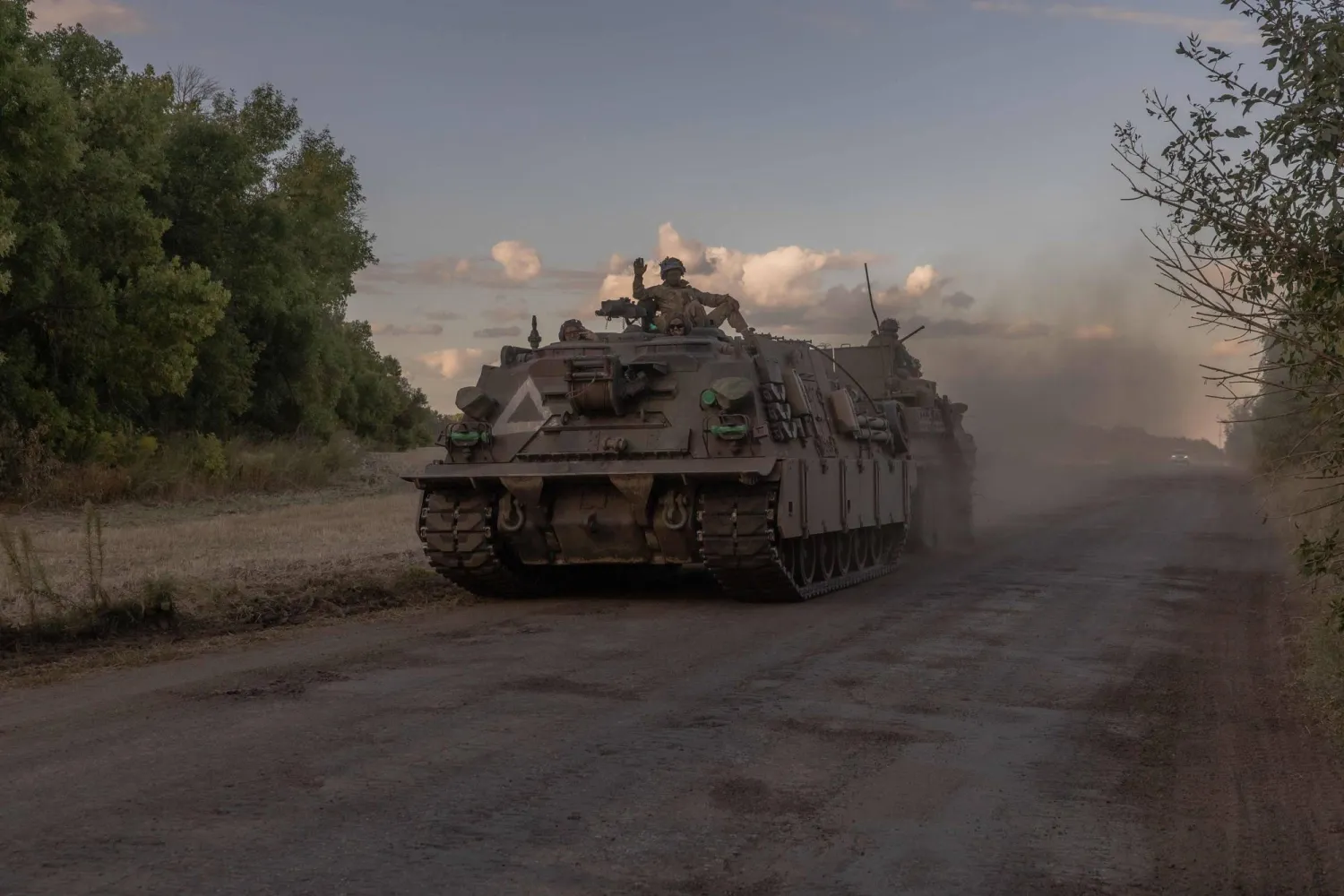
Ukrainian servicemen operate an armored military vehicle in the Sumy region, near the border with Russia, on August 12, 2024, amid the Russian invasion of Ukraine. (Photo by Roman PILIPEY / AFP)
TT

Why Russia Has Struggled to Halt Ukraine's Incursion in the Kursk Region

Ukrainian servicemen operate an armored military vehicle in the Sumy region, near the border with Russia, on August 12, 2024, amid the Russian invasion of Ukraine. (Photo by Roman PILIPEY / AFP)

After three weeks of fighting, Russia is still struggling to dislodge Ukrainian forces from the Kursk region, a surprisingly slow and low-key response to the first occupation of its territory since World War II.
It all comes down to Russian manpower and Russian priorities.
With the bulk of its military pressing offensives inside Ukraine, the Kremlin appears to lack enough reserves for now to drive out Kyiv's forces, Reuters said.
President Vladimir Putin doesn’t seem to view the attack — or at least, give the impression that he views it — as a grave enough threat to warrant pulling troops from eastern Ukraine's Donbas region, his priority target.
“Putin’s focus is on the collapse of the Ukrainian state, which he believes will automatically render any territorial control irrelevant,” wrote Tatiana Stanovaya, senior fellow at the Carnegie Russia Eurasia Center.
Putin's priorities Months after launching the full-scale invasion in 2022, Putin illegally annexed the Ukrainian regions of Donetsk, Luhansk, Zaporizhzhia and Kherson as part of Russian territory, and their full capture has been a top priority. He declared in June that Kyiv must withdraw its forces from parts of those regions it controls as a condition for peace talks, a demand that Ukraine rejects.
“In marshaling forces to meet Ukraine’s incursion, Russia is doing all it can to avoid drawing units from its own offensive in the Donbas,” said Nigel Gould-Davies of the International Institute of Strategic Studies. “Russia currently judges that it can contain the threat on its own soil without compromising its most important goal in Ukraine."
Even as Ukrainian forces pushed into Kursk on Aug. 6, Russian troops continued their slow advance around the strategic city of Pokrovsk and other parts of the Donetsk area.
“Russia is very keen on continuing the attacks toward Pokrovsk and not taking resources away from Pokrovsk to Kursk,” said Nico Lange, senior fellow at the Washington-based Center for European Policy Analysis.
Unlike Pokrovsk, where Ukrainian forces have built extensive fortifications, other parts of Donetsk still under Ukrainian control are less protected and could be significantly more vulnerable to the Russian onslaught if Pokrovsk falls.
Speaking about Kursk in televised meetings with officials, Putin described the incursion as an attempt by Kyiv to slow the Russian campaign in Donetsk. He said the Russian advance there only has accelerated despite events in Kursk.
In pressuring Ukraine to meet his demands, Russia also has launched a steady barrage of long-range strikes on the power grid. An attack Monday on energy facilities was one of the largest and most devastating of the war, involving over 200 missiles and drones and causing widespread blackouts. It highlighted loopholes in Ukraine’s air defenses that are stretched between protecting front-line troops as well as infrastructure.
Playing down the incursion Focused on capturing Ukraine's four regions, Putin has sought to attach little importance to Kyiv's foray into Kursk.
“Rather than rallying the population against a threat to the motherland, the Kremlin is anxious to downplay the incursion,” said Gould-Davies of the London-based IISS.
Faced with the reality of the occupation of Russia’s territory, the state propaganda machine has sought to distract attention from the obvious military failure by focusing on government efforts to help over 130,000 residents displaced from their homes.
State-controlled media cast the attack on Kursk as evidence of Kyiv’s aggressive intentions and more proof that Russia was justified in invading Ukraine on Feb. 24, 2022.
Stanovaya noted that while many Kursk residents could be angry at the Kremlin, the overall nationwide sentiment could actually favor the authorities.
“While it’s certainly a blow to the Kremlin’s reputation, it is unlikely to spark a significant rise in social or political discontent among the population,” she said. “The Ukrainian attack might actually lead to a rallying around the flag and a rise in anti-Ukrainian and anti-Western sentiments.”
A limited Kremlin response Ukraine’s chief military officer, Gen. Oleksandr Syrskyi, said his forces control nearly 1,300 square kilometers (about 500 square miles) and about 100 settlements in the Kursk region, a claim that couldn’t be independently verified.
With the combat situation in Kursk in flux, unlike the static front lines in Donetsk, Ukrainian units could roam the region without establishing a lasting presence in many of the settlements they claim.
Observers say Russia does not have enough well-coordinated resources to chase the Ukrainian forces in Kursk.
“Moscow’s efforts to counter the new Ukrainian offensive appear limited to sending units from all over Russia, including a proportion of militia and irregular forces,” said Ben Barry, senior fellow for land warfare at the IISS, in a commentary.
Until the Kursk incursion, Putin has refrained from using conscripts in the war to avoid a public backlash. Young conscripts drafted for a compulsory one-year tour of duty have served away from the front, and those deployed to protect the border in the Kursk region became easy prey for Ukraine’s battle-hardened mechanized infantry units. Hundreds were captured, and 115 were exchanged for Ukrainian troops over the weekend.
Commentators observed that Putin also is reluctant to call up more reservists, fearing domestic destabilization like what happened when he ordered a highly unpopular mobilization of 300,000 in response to a Ukrainian counteroffensive in 2022. Hundreds of thousands fled Russia to avoid being sent to combat.
Since then, the Kremlin has bolstered its forces in Ukraine with volunteers attracted by relatively high wages, but that flow has ebbed in recent months.
It would take tens of thousands of troops to fully dislodge the Ukrainian force, estimated at 10,000, that used the region’s dense forests as cover.
Clearly lacking resources for such a massive operation, Russia for now has focused on stemming deeper Ukrainian advances by sealing roads and targeting Kyiv’s reserves — tactics that have been partially successful.
Ukraine, meanwhile, has confounded the Russian military by destroying bridges across the Seym River, disrupting logistics for some Russian units in the region and creating conditions for establishing a pocket of control.
Lange predicted Ukrainian troops could use the river to carve out a buffer zone.
“I would expect the Ukrainians to find some few more choke points for Russian logistics and infrastructure, not necessarily only bridges, and take them under control,” he said.
The risks for Ukraine By capturing a chunk of Russian territory, Ukraine has embarrassed the Kremlin and reshaped the battlefield. But diverting some of the country's most capable forces from the east is a gamble for Kyiv.
“This all carries considerable risk, particularly if an effort to over-stretch Russian forces results in overstretching the smaller Ukrainian forces,” according to Barry of the IISS.
An attempt to create a foothold in Kursk would further extend the more than 1,000-kilometer (over 600-mile) front line, adding to the challenges faced by the undermanned and outgunned Ukrainian forces. Defending positions inside Russia would raise serious logistical problems, with the extended supply lines becoming easy targets.
“The Russian system is very hierarchical and stiff, so it always takes them a significant amount of time to adapt to a new situation," Lange said, "but we will have to see how Ukraine can sustain there, once Russia has adapted and comes with full force.”



Iran Says No Country Can Deprive it of Enrichment Rights

A handout photo made available by Iran's Revolutionary Guard Corps (IRGC)'s official website Sepahnews on 17 February 2026 shows IRGC conducting a military drill in the Strait of Hormuz, in the Arabian gulf, southern Iran. EPA/SEPAHNEWS HANDOUT
TT

Iran Says No Country Can Deprive it of Enrichment Rights

A handout photo made available by Iran's Revolutionary Guard Corps (IRGC)'s official website Sepahnews on 17 February 2026 shows IRGC conducting a military drill in the Strait of Hormuz, in the Arabian gulf, southern Iran. EPA/SEPAHNEWS HANDOUT

Iran's atomic energy chief Mohammad Eslami said no country can deprive the Iranian republic of its right to nuclear enrichment, after US President Donald Trump again hinted at military action following talks in Geneva.

"The basis of the nuclear industry is enrichment. Whatever you want to do in the nuclear process, you need nuclear fuel," said Eslami, according to a video published by Etemad daily on Thursday.

"Iran's nuclear program is proceeding according to the rules of the International Atomic Energy Agency, and no country can deprive Iran of the right to peacefully benefit from this technology."

The comments follow the second round of Oman-mediated talks between Tehran and Washington in Geneva on Tuesday.

The two foes had held an initial round of discussions on February 6 in Oman, the first since previous talks collapsed during the 12-day Iran-Israel war in June.

The United States briefly joined the war alongside Israel, striking Iranian nuclear facilities.

On Wednesday, Trump again suggested the United States might strike Iran in a post on his Truth Social site.

He warned Britain against giving up sovereignty over the Chagos Islands in the Indian Ocean, saying that the archipelago's Diego Garcia airbase might be needed were Iran not to agree a deal, "in order to eradicate a potential attack by a highly unstable and dangerous regime".

Washington has repeatedly called for zero enrichment, but has also sought to address Iran's ballistic missile program and its support for militant groups in the region -- issues which Israel has pushed to include in the talks.

Western countries accuse the Iranian republic of seeking to acquire nuclear weapons.

Tehran denies having such military ambitions but insists on its right to this technology for civilian purposes.

Trump, who has ratcheted up pressure on Iran to reach an agreement, has deployed a significant naval force to the region, which he has described as an "armada".

After sending the aircraft carrier USS Abraham Lincoln and escort battleships to the Gulf in January, he recently indicated that a second aircraft carrier, the Gerald Ford, would depart "very soon" for the Middle East.

Separately, the Iranian and Russian navies were conducting joint drills in the Sea of Oman and the northern Indian Ocean on Thursday.


Karachi Building Collapse after Blast Kills 16

Rescue workers and people gather at the site of a residential compound following a suspected gas leakage blast in Karachi, Pakistan, 19 February 2026. EPA/REHAN KHAN
TT

Karachi Building Collapse after Blast Kills 16

Rescue workers and people gather at the site of a residential compound following a suspected gas leakage blast in Karachi, Pakistan, 19 February 2026. EPA/REHAN KHAN

A building collapse caused by an explosion in Pakistan's southern megacity of Karachi killed at least 16 people on Thursday, including children, officials said.

More than a dozen people were injured in the incident in the Soldier Bazaar neighborhood of Karachi at around 4:00 am, when Muslim families start preparing Sehri, the pre-sunrise meal eaten during Ramadan.


Australian Police Investigate Threatening Letter to Country's Largest Mosque

FILE PHOTO: A security guard stands outside the Lakemba Imam Ali bin Abi Talib Mosque as people arrive for Friday prayers in Sydney, Australia, December 19, 2025. REUTERS/Hollie Adams/File Photo
TT

Australian Police Investigate Threatening Letter to Country's Largest Mosque

FILE PHOTO: A security guard stands outside the Lakemba Imam Ali bin Abi Talib Mosque as people arrive for Friday prayers in Sydney, Australia, December 19, 2025. REUTERS/Hollie Adams/File Photo

Australian police said on Thursday they had launched an investigation after a threatening letter was sent to the country’s largest mosque, the third such incident in the lead-up to the Muslim fasting month of Ramadan.

The letter sent to Lakemba Mosque in Sydney’s west on Wednesday contained a drawing of a pig and a threat to kill the "Muslim race", local media reported. Police said they had taken the letter for forensic testing, and would continue to patrol ‌religious sites including ‌the mosque, as well as community events.

The latest letter ‌comes ⁠weeks after a ⁠similar message was mailed to the mosque, depicting Muslim people inside a mosque on fire.

Police have also arrested and charged a 70-year-old man in connection with a third threatening letter sent to Lakemba Mosque's staff in January.

The Lebanese Muslim Association, which runs the mosque, told the Australian Broadcasting Corp (ABC) it had written to the government to request more funding for additional security guards and ⁠CCTV cameras.

Some 5,000 people are expected to attend ‌the mosque each night during Ramadan. More ‌than 60% of residents in the suburb of Lakemba identify as Muslim, according to ‌the Australian Bureau of Statistics.

Bilal El-Hayek, mayor of Canterbury-Bankstown council, where Lakemba ‌is located, said the community was feeling "very anxious".

"I've heard first-hand from people saying that they won't be sending their kids to practice this Ramadan because they're very concerned about things that might happen in local mosques," AFP quoted him as saying.

Prime Minister Anthony Albanese ‌condemned the recent string of threats.

"It is outrageous that people just going about commemorating their faith, particularly during the ⁠holy month ⁠for Muslims of Ramadan, are subject to this sort of intimidation," he told ABC radio.

"I have said repeatedly we need to turn down the temperature of political discourse in this country, and we certainly need to do that."

Anti-Muslim sentiment has been growing in Australia since the war in Gaza War in late 2023, according to a recent report commissioned by the government.

The Islamophobia Register Australia has also documented a 740% rise in reports following the Bondi mass shooting on December 14, where authorities allege two gunmen inspired by ISIS killed 15 people attending a Jewish holiday celebration.

"There's been a massive increase post-Bondi," Mayor El-Hayek said. "Without a doubt, this is the worst I have ever seen it. There's a lot of tension out there."