


Iran Summons 4 European Envoys Over Accusations It Supplied Ballistic Missiles to Russia 

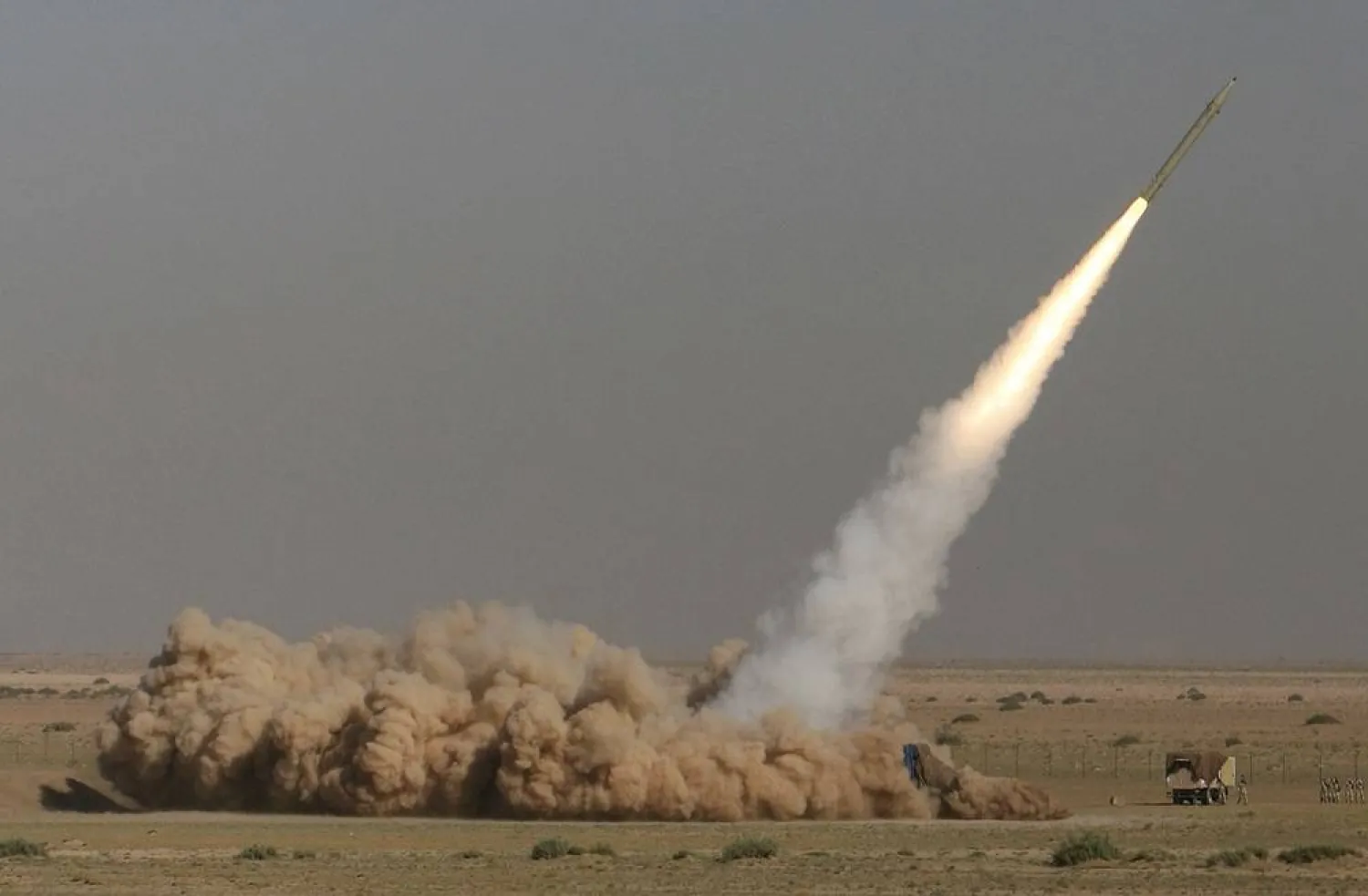
In this photo released by the Iranian semi-official Fars News Agency, Revolutionary Guard's Fateh missile is launched in a drill near the city of Qom, 80 miles (130 kilometers) south of the capital Tehran, Iran, Sept. 27, 2009. (Ali Shaigan/Fars News Agency via AP File)
TT

Iran Summons 4 European Envoys Over Accusations It Supplied Ballistic Missiles to Russia 

In this photo released by the Iranian semi-official Fars News Agency, Revolutionary Guard's Fateh missile is launched in a drill near the city of Qom, 80 miles (130 kilometers) south of the capital Tehran, Iran, Sept. 27, 2009. (Ali Shaigan/Fars News Agency via AP File)

Iran's government on Thursday summoned the envoys of Britain, France, Germany and the Netherlands over their accusations that Tehran supplied short-range ballistic missiles to Russia to use against Ukraine.

State-run IRNA news agency reported that the country’s foreign ministry summoned the envoys separately on Thursday to strongly condemn the accusations.

IRNA said the ministry also condemned Britain, France, and Germany for issuing a joint statement against Iran and called it an "unconventional and non-constructive statement."

The joint statement, issued Tuesday, condemned the alleged transfer of missiles, calling it "an escalation by both Iran and Russia" and "a direct threat to European security."

The three countries also announced new sanctions against Iran, including the cancellation of air services agreements with Iran, which will restrict Iran Air’s ability to fly to the UK and Europe.

IRNA said that Iran’s foreign ministry told the envoys that their insistence on taking such positions is seen as part of the West’s ongoing hostile policy against the Iranian people. The actions will "be met with an appropriate response from the Islamic Republic of Iran."

US Secretary of State Antony Blinken said this week that Iran had ignored warnings that the transfer of such weapons would be a profound escalation of the conflict.

He told reporters during a trip to London that dozens of Russian military personnel had been trained in Iran to use the Fath-360 close-range ballistic missile system, which has a maximum range of 75 miles (120 kilometers).


Trump Says Lawmakers Omar, Tlaib Should be Removed from US

(L/R) US Representatives Ilhan Omar, Democrat from Minnesota, and Rashida Tlaib, Democrat from Michigan, look on as President Donald Trump delivers the State of the Union address in the House Chamber of the US Capitol in Washington, DC, on February 24, 2026. (Photo by Mandel NGAN / AFP)
TT

Trump Says Lawmakers Omar, Tlaib Should be Removed from US

(L/R) US Representatives Ilhan Omar, Democrat from Minnesota, and Rashida Tlaib, Democrat from Michigan, look on as President Donald Trump delivers the State of the Union address in the House Chamber of the US Capitol in Washington, DC, on February 24, 2026. (Photo by Mandel NGAN / AFP)

President Donald Trump said Wednesday that two Muslim Democratic US Representatives, Ilhan Omar of Minnesota and Rashida Tlaib of Michigan, should be "institutionalized" and sent back to "where they came from," a day after they had a heated exchange with him during his State of the Union address.

During Trump's speech on Tuesday, Tlaib, a Palestinian American, and Omar, a Somali American, criticized Trump as he touted his administration's hard-line immigration crackdown and its immigration enforcement actions.

Both Omar and Tlaib shouted "you're killing Americans" at Trump during his speech, with Omar also calling him ‌a "liar."

In a Truth ‌Social post on Wednesday, Trump said the two lawmakers "had ‌the ⁠bulging, bloodshot eyes ⁠of crazy people, LUNATICS, mentally deranged and sick who, frankly, look like they should be institutionalized."

"We should send them back from where they came — as fast as possible," Trump added. Both Omar and Tlaib are US citizens.

House of Representatives Minority Leader Hakeem Jeffries cast Trump's rhetoric against Tlaib and Omar as "xenophobic" and "disgraceful." According to Reuters, Tlaib said on X that Trump's comments showed "he is crashing out."

Muslim advocacy group Council on American-Islamic Relations also ⁠said Trump's comments were racist.

"It's racist and bigoted to say ‌two Muslim US lawmakers should be sent to ‌the country they were born in or where their ancestors came from based on ‌their criticism of the gunning down of Americans by ICE," CAIR National Deputy ‌Director Edward Ahmed Mitchell said.

The White House did not immediately respond to a request for comment. White House press secretary Karoline Leavitt said last week that members of the media have "smeared" the president as a racist.


CIA Launches Fresh Social Media Push to Recruit Iranians

FILE PHOTO: The seal of the Central Intelligence Agency is shown at the entrance of the CIA headquarters in McLean, Virginia, US, September 24, 2022. REUTERS/Evelyn Hockstein/File Photo
TT

CIA Launches Fresh Social Media Push to Recruit Iranians

FILE PHOTO: The seal of the Central Intelligence Agency is shown at the entrance of the CIA headquarters in McLean, Virginia, US, September 24, 2022. REUTERS/Evelyn Hockstein/File Photo

The US Central Intelligence Agency ‌has posted on social media new Farsi-language instructions for Iranians wishing to securely contact the spy service.

The CIA recruitment effort comes amid a massive buildup of US military forces in the Middle East that President Donald Trump could order to attack Iran if talks with the US set for Thursday fail to reach a deal on Tehran's nuclear program.

Trump began laying out the case for a possible US operation in his State of the Union speech on Tuesday, saying he would not allow Iran, which ‌he called ‌the world's biggest sponsor of terrorism, to have ‌a ⁠nuclear weapon.

The CIA posted its Farsi-language message on Tuesday on its X, Instagram, Facebook, Telegram and YouTube accounts.

The message is the latest in a series by the CIA aimed at enlisting sources in Iran, China, North Korea and Russia, Reuters reported.

The agency urged Iranians wishing to make contact to "take appropriate action" to ⁠protect themselves before doing so and avoid using work ‌computers or their phones.

"Use a ‌new, disposable device, if possible" and "be aware of your surroundings and who ‌may be able to see your screen or activity," continued ‌the message, adding that those who make contact, provide their locations, names, job titles and "access to information or skills of interest to our agency."

Those individuals, said the message, should use a trusted Virtual Private Network "not headquartered ‌in Russia, Iran or China," or the Tor Network, which encrypts data and hides the user's IP ⁠address.


NKorea Warns it Could Destroy South if Threatened, Leaves Door Open for US Dialogue

25 February 2026, North Korea, Pyongyang: North Korean leader Kim Jong-un (R), alongside his daughter, Ju-ae, attend a military parade at Kim Il Sung Square in Pyongyang, to mark the ninth congress of the ruling Workers' Party, in this photo released by Korean Central News Agency the next day. Photo: -/YNA/dpa
TT

NKorea Warns it Could Destroy South if Threatened, Leaves Door Open for US Dialogue

25 February 2026, North Korea, Pyongyang: North Korean leader Kim Jong-un (R), alongside his daughter, Ju-ae, attend a military parade at Kim Il Sung Square in Pyongyang, to mark the ninth congress of the ruling Workers' Party, in this photo released by Korean Central News Agency the next day. Photo: -/YNA/dpa

North Korean leader Kim Jong Un claimed his nuclear-armed country could “completely destroy” South Korea if its security were threatened, reiterating his refusal to engage with Seoul, state media said Thursday. However, he left the door open to dialogue with Washington as he concluded a ruling party congress outlining his policy goals for the next five years.

The official Korean Central News Agency said that Kim also called for developing new weapons systems to bolster his nuclear-armed military, including intercontinental ballistic missiles that could be launched from underwater and an expanded arsenal of tactical nuclear weapons, such as artillery and short-range missiles, targeting South Korea.

He said the accelerated development of his nuclear and missile program in recent years “permanently cemented” the country’s status as a nuclear weapons state, and called for the United States to discard what he perceives as “hostile” policies toward the North if it wants to resume long-stalled dialogue.

South Korea’s Unification Ministry said it was regrettable that the North continues to define inter-Korean relations as hostile and that Seoul will “patiently” pursue efforts to stabilize peace.

The Workers’ Party congress, which began last Thursday in Pyongyang, is the country's most important political event. KCNA said the North staged a military parade in the capital Wednesday as it wrapped up the congress, previously held in 2016 and 2021.

Watching the parade with his increasingly prominent daughter — believed to be around 13 years old and named Kim Ju Ae — Kim Jong Un in a speech said his forces were capable of “immediately and thoroughly retaliating” against any hostile threat. But the state outlet did not immediately say whether he showcased his largest weapons, including ICBMs potentially capable of reaching the US mainland.

Kim’s comments at the congress were widely anticipated as he has been issuing increasingly hard-line views toward South Korea since 2024, when he discarded the North’s long-standing goal of a peaceful reunification between the war-divided Koreas and declared the South as a permanent enemy. But analysts expected Kim to take a more measured approach toward Washington to preserve the possibility of future dialogue, with the long-term aim of securing US sanctions relief and tacit recognition as a nuclear state.

Kim has recently been prioritizing Russia in his foreign policy, sending thousands of troops and large amounts of military equipment to support Moscow’s war in Ukraine, possibly in exchange for aid and military technology.

But it would make sense to keep his options open as the war in Ukraine could wind down, potentially making North Korea less valuable to Moscow, experts say.

In a report wrapping up the congress, Kim said his government was maintaining the “toughest stance” against Washington, but added there was “no reason we cannot get along” with the Americans if they withdrew their supposedly “hostile policy” toward the North. North Korea often uses the term to describe US-led pressure and sanctions over Kim’s nuclear ambitions. His comments aligned with North Korea’s previous position calling for Washington to abandon its demands for the North’s denuclearization as a precondition for reviving talks, The Associated Press reported.

North Korea has repeatedly rejected Washington and Seoul’s calls to resume diplomacy aimed at winding down its nuclear program, which derailed in 2019 following the collapse of Kim’s second summit with US President Donald Trump during his first term.

The prospects of US-North Korea relations “depends entirely on the US attitude,” Kim said. “Whether it’s peaceful coexistence or permanent confrontation, we are ready for either, and the choice is not ours to make.”

At the congress, Kim derided liberal South Korean President Lee Jae Myung’s calls for engagement as a deception, accusing successive governments in Seoul of seeking the North’s collapse. He said there is “absolutely nothing to discuss” with an enemy state and that the North would “permanently exclude” the South from the notion of a shared nation.

“As long as the Republic of Korea cannot escape its geopolitical condition of sharing a border with us, the only way it can live safely is to abandon all ties with us and refrain from provoking us,” he said, disdainfully referring to South Korea’s formal name.

Tensions could further rise next month when South Korea stages its annual military exercises with the United States. North Korea portrays the allies' joint exercises as invasion rehearsals and often uses them as a pretext to dial up its own military demonstrations.

Kim set new goals to advance his nuclear forces in the next five years while calling for faster production of nuclear warheads and a broader range of delivery systems.

Emphasizing naval capabilities, Kim called for ICBMs that could be fired from underwater platforms, indicating potential plans to fit those weapons on the nuclear-propelled submarine being built. He called for developing artificial intelligence-equipped attack drones, stronger electronic warfare capabilities to disable enemy command centers, more advanced reconnaissance satellites and unspecified weapons to strike enemy satellites.

He also said the military will deploy more nuclear-capable artillery systems against South Korea in phases each year while speeding up efforts to “fortify” the inter-Korean border.
