Rescue Workers Search For at Least 6 People Missing after Heavy Rain Pounds Japan’s Noto Region

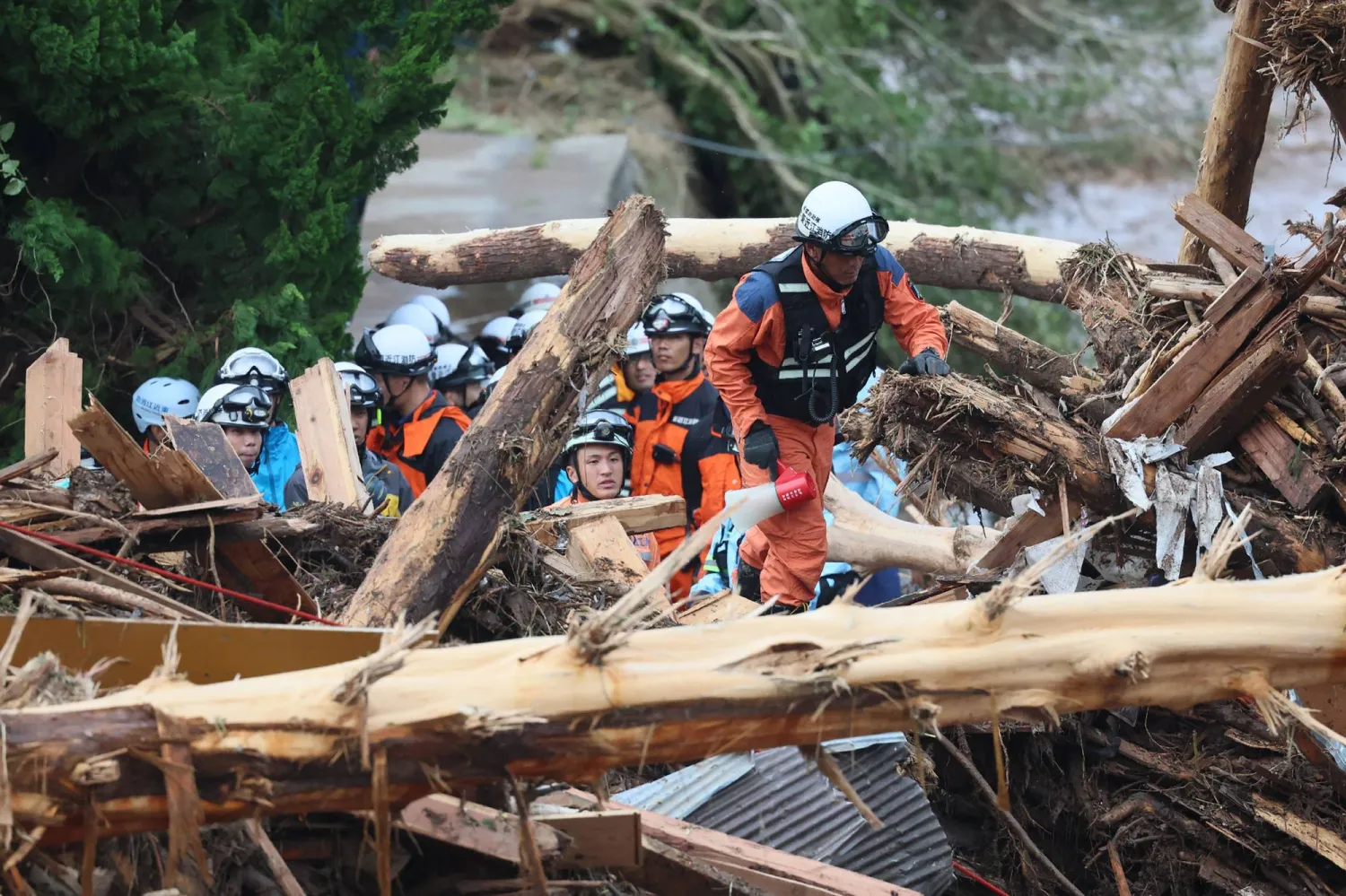
Firefighters search for missing people, through debris washed up after heavy rains caused flooding, in the city of Wajima, Ishikawa prefecture, on September 22, 2024.(Photo by JIJI Press / AFP)
TT

Rescue Workers Search For at Least 6 People Missing after Heavy Rain Pounds Japan’s Noto Region

Firefighters search for missing people, through debris washed up after heavy rains caused flooding, in the city of Wajima, Ishikawa prefecture, on September 22, 2024.(Photo by JIJI Press / AFP)

Rescue workers searched for at least six people missing Sunday after heavy rain pounded Japan’s northcentral region of Noto, triggering landslides and floods and leaving one person dead in a region still recovering from a deadly Jan. 1 earthquake.
The Japan Meteorological Agency on Saturday issued the highest alert level for heavy rain across several cities in the Ishikawa prefecture, including hard-hit cities Suzu and Wajima on the northern coast of the Noto peninsula.
The agency has since downgraded the heavy rain alert, and kept landslide and flooding warnings in place, The Associated Press said.
In Suzu, one person died and another was missing after being swept in floodwaters. Another went missing in the nearby town of Noto, according to the prefecture.
In Wajima, rescue workers were searching for four people missing following a landslide at a construction site. They were among 60 construction workers repairing a tunnel damaged by January's quake.
The FDMA said another person was missing due to floods at a different location in the city.
NHK footage at a coastal area of Wajima showed a wooden house torn and tilted after it was apparently hit by a landslide. No injuries were reported from the site.
In Noto town, two people were seriously injured by a landslide while visiting their quake-damaged home.
At least 16 rivers in Ishikawa breached their banks as of Saturday afternoon, according to the Land and Infrastructure Ministry. Residents were urged to use maximum caution against possible mudslides and building damage.
By late afternoon Saturday, about 1,350 residents were taking shelter at designated community centers, school gymnasiums and other town facilities, authorities said.
About 50 centimeters (20 inches) of rain has fallen in the region over the last three days, due to the rainbands that cause torrential rain above the Hokuriku region, JMA said.
“Heavy rain is hitting the region that had been badly damaged by the Noto earthquake, and I believe many people are feeling very uneasy," said Chief Cabinet Secretary Yoshimasa Hayashi.
Hayashi said the government “puts people's lives first” and its priority was search and rescue operations. He also called on the residents to pay close attention to the latest weather and evacuation advisories and take precautions early, adding that the Self Defense Force troops have been dispatched to Ishikawa to join rescue efforts.
A resident in Wajima told NHK that he has just finished cleaning his house from the quake damage and it was depressing to now see it flooded by muddy water.
A number of roads flooded by muddy water were also blocked. Hokuriku Electric Power Co. said more than 5,000 homes were still without power Sunday. Traffic lights were out in the affected areas. Many homes were also without water supply.
Heavy rain also fell in nearby northern prefectures of Niigata and Yamagata, threatening flooding and other damages and suspending train operations, including the Yamagata Shinkansen bullet trains, officials said.
A 7.6 magnitude earthquake struck the region on Jan. 1, killing more than 370 people and damaging roads and other key infrastructure. Its aftermath still affects the local industry, economy and daily lives.


Netanyahu Vows to Eliminate Iran Threat ‘Once and for All’

10 November 2026, Israel, Jerusalem: Caretaker Israeli Prime Minister Benjamin Netanyahu delivers a speech on the sidelines of the opening session of the new Knesset. (dpa)
TT

Netanyahu Vows to Eliminate Iran Threat ‘Once and for All’

10 November 2026, Israel, Jerusalem: Caretaker Israeli Prime Minister Benjamin Netanyahu delivers a speech on the sidelines of the opening session of the new Knesset. (dpa)

Israel's caretaker prime minister Benjamin Netanyahu on Saturday reiterated his calls for a national unity government with his opponent Gadi Eisenkot, as well as his vow to eliminate the threat from Iran.

A meeting with Eisenkot on Thursday "only strengthened the conviction that it is essential to form a national unity government" to guarantee Israel's security, Netanyahu said in a video statement, adding that such a government could "eliminate the Iranian threat once and for all".


Ukraine’s Zelenskiy Escalates Criticism of SpaceX Over Speed Caps

Ukraine's President Volodymyr Zelenskiy holds a press briefing in Copenhagen November 10, 2026. (AFP)
TT

Ukraine’s Zelenskiy Escalates Criticism of SpaceX Over Speed Caps

Ukraine's President Volodymyr Zelenskiy holds a press briefing in Copenhagen November 10, 2026. (AFP)

Ukraine's President Volodymyr Zelenskiy ‌escalated his criticism of SpaceX on Saturday, saying speed restrictions on its military-grade Starshield satellite terminals had dangerous political implications and undermined critical air defenses.

Zelenskiy said Starshield terminals operating in temporarily Russian-occupied territories of Ukraine had been limited to a maximum speed of 161 kph for the past five days, hampering Ukraine's military capabilities.

The Ukrainian Defense Ministry has raised the issue with SpaceX at the ‌institutional level, ‌Zelenskiy said.

"The restrictions have now ‌been ⁠in place for ⁠five days. They say it is some kind of technical issue. We do not believe that is the case," Zelenskiy told reporters in remarks released by his office on Saturday.

"If you impose restrictions there, you are already partially recognizing the temporarily ⁠occupied territories as not ours. And ‌that is why I ‌believe we have the right to raise this ‌issue and restore the speed – so that there ‌are no restrictions at all."

Zelenskiy said the speed restrictions made it more difficult for Ukrainian air defense units to intercept Russian jet-powered drones and made Ukrainian cities ‌more vulnerable. He said he had ordered his top military and foreign ministry ⁠officials ⁠to address the issue and seek clarification.

SpaceX has pushed back against the allegations, denying that it introduced new restrictions or made any changes to its satellite operations.

It is the second such outage in recent weeks. In mid-October, Ukrainian officials said that SpaceX limited the speed of Starlink and its Starshield communication systems to about 160 kph (100 mph) amid tensions with US President Donald Trump's administration over Ukrainian attacks on Russian oil refineries. Service was then restored on October 24.


UN Official Urges Iran, US to Let Fertilizers Through Hormuz Strait

Jorge Moreira da Silva, Executive Director of UNOPS (United Nations Office for Project Services), and coordinator of the UN Strait of Hormuz Task Force established by the UN Secretary-General, speaks during an interview with AFP on the sidelines of the 31st United Climate Change Conference (COP31), at the media center located on the Antalya Expo Center in Antalya on November 14, 2026. (AFP)
TT

UN Official Urges Iran, US to Let Fertilizers Through Hormuz Strait

Jorge Moreira da Silva, Executive Director of UNOPS (United Nations Office for Project Services), and coordinator of the UN Strait of Hormuz Task Force established by the UN Secretary-General, speaks during an interview with AFP on the sidelines of the 31st United Climate Change Conference (COP31), at the media center located on the Antalya Expo Center in Antalya on November 14, 2026. (AFP)

Iran and the United States should "immediately" allow fertilizer shipments through the Strait of Hormuz to ease the crisis in some of the most vulnerable countries, a senior UN official said Saturday.

Jorge Moreira da Silva, head of the UN Office for Project Services, told the COP31 climate talks in the Turkish resort city of Antalya that the lack of fertilizers could push millions into poverty.

The Iranian blockade of the vital waterway, which started after the joint US-Israeli attack against Iran in late February, has choked shipping in the region and beyond. The US blockade of Iranian ports has further complicated matters.

While Iran and the United States are still trying to negotiate an end to the conflict, Moreira da Silva said he had the same message for both countries.

"They should continue their negotiations about the comprehensive deal -- but that deal should not avoid an immediate, exceptional, limited, and time-bound solution for the fertilizers," he said.

"Basically, what we need is five vessels a day with fertilizers," he added.

- Millions at risk -

Moreira da Silva heads up the UN task force dedicated to facilitating the safe passage of fertilizers during the crisis.

Before the conflict, a third of the world's fertilizers passed through the Strait of Hormuz, and since the blockades, their prices had risen by 30 percent, he said.

"But what I think is not sufficiently recognized is the disproportionate impact on the most vulnerable countries," he added.

Sudan's finance minister recently told him that the price of food there had doubled in six months, he added. In Nepal, they had told him that farmers could no longer afford to buy fertilizers.

"So, it's very important that we are aware that countries such as Mozambique, Kenya, Sudan, Somalia, Nepal, Bangladesh, Sri Lanka are facing very significant impact."

The effects of this shortage could be catastrophic, he warned.

"If we continue missing the planting seasons in different parts of the world we may have 45 million people facing severe and acute food insecurity," he said.

"We may have 30 million people being forced into poverty."

The UN had a system ready to get fertilizer shipments moving within seven to 10 days, he said.