Israel-UN Relations Sink to New Depths

Netanyahu addressed the United Nations General Assembly on September 27. Charly TRIBALLEAU / AFP
TT

Israel-UN Relations Sink to New Depths

Netanyahu addressed the United Nations General Assembly on September 27. Charly TRIBALLEAU / AFP

Israel's long-contentious relationship with the United Nations has since October 7 spiraled to new depths, amid insults and accusations and even a questioning of the country's continued UN membership.
Addressing the UN General Assembly on Friday, Israeli Prime Minister Benjamin Netanyahu accused the world body of treating his country unfairly, AFP said.
"Until this anti-Semitic swamp is drained, the UN will be viewed by fair-minded people everywhere as nothing more than a contemptuous farce," he thundered.
The past year has seen repeated accusations from within the UN system that Israel is committing "genocide" in its war in Gaza, while Israeli officials have made charges of bias and have even accused the UN chief of being "an accomplice to terror".
The heat has been turned way up in a war of words that has raged between Israel and various UN bodies for decades.
And temperatures have risen further in recent days amid Israel's escalating strikes on Hezbollah in Lebanon.
"There has been a great deterioration" in the relationship, said Cyrus Schayegh, an international history and politics professor at the Geneva Graduate Institute.
"It has gone from fairly bad to really bad."
UN 'betrayal'
Since Hamas's deadly attack inside Israel nearly a year ago, UN-linked courts, councils, agencies and staff have unleashed a barrage of condemnation and criticism of Israel's devastating retaliatory operation in Gaza.
"We feel the UN has betrayed Israel," the country's ambassador to the UN in Geneva Daniel Meron told AFP.
Hamas's October 7 attack on Israel resulted in the deaths of 1,205 people, mostly civilians, according to an AFP tally based on Israeli official figures that include hostages killed in captivity.
Of the 251 hostages seized by militants, 97 are still held in Gaza, including 33 the Israeli military says are dead.
Israel's retaliatory military offensive has killed more than 41,500 people in Gaza, most of them civilians, according to the Hamas-run territory's health ministry. The UN has described the figures as reliable.
Israel has especially taken aim at UNRWA, the UN agency supporting Palestinian refugees, but its ire has been felt across the UN system, and up to the UN chief.
Israeli calls for UN Secretary-General Antonio Guterres to resign began just weeks after October 7, when he asserted that the attack "did not happen in a vacuum. The Palestinian people have been subjected to 56 years of suffocating occupation".
'Above international law'
Even before October 7, Israel complained of UN bias, pointing for instance to the towering number of resolutions targeting the country.
Since the creation of the UN Human Rights Council in 2006, more than a third of the over 300 condemnatory resolutions have targeted Israel, Meron pointed out, describing this as "mind-boggling".
Critics meanwhile highlight that from the time a General Assembly vote paved the way for Israel's establishment in 1948, the country has ignored numerous UN resolutions and international court rulings, without consequences.
Israel has always snubbed resolution 194, which guarantees the Palestinians expelled in 1948 from the territory Israel conquered the right to return or to compensation.
It has also ignored rulings condemning its forceful acquisition of territory and the annexation of East Jerusalem after the 1967 Arab-Israeli war, and the continuing and expanding settlement policy in the West Bank, among others.
By allowing Israel to remain in "non-compliance with international law, the West has been basically making the Israelis believe that they are above international law", Geneva Graduate Institute political sociology professor Riccardo Bocco told AFP.
'Impunity reigns'
Ravina Shamdasani, spokeswoman for the UN rights office, also said a lack of accountability in the Middle East crisis appeared to have made "the parties to the conflict more brazen".
"We rang the alarm bells multiple times and now there is the impression that impunity reigns," she told AFP, lamenting increasing attacks on UN bodies and staff expressing concern over the situation.
"This is unacceptable."
UNRWA has faced the harshest attacks.
It saw a series of funding cuts after Israel accused more than a dozen of its 13,000 Gaza employees of involvement in the October 7 attack.
Agency chief Philippe Lazzarini has accused Israel of conducting "a concerted effort to dismantle UNRWA", which has suffered dramatic human and material losses in Gaza, with more than 220 staff killed.
Netanyahu demanded earlier this year that UNRWA, which he said "perpetuates the Palestinian refugee problem (and) whose schools indoctrinate Palestinian children with genocide and terror ... be replaced by responsible aid agencies".
‘Pariah'
Francesca Albanese, the UN independent rights expert on the Palestinian territories, who has faced harsh criticism and calls for her ousting from Israel amid her repeated accusation it is committing "genocide" in Gaza, recently suggested the country was becoming a "pariah".
"Should there be a consideration of its membership as part of this organization, which Israel seems to have zero respect for?" she rhetorically asked journalists last week.
Meron slammed Albanese as "anti-Semitic and really an embarrassment to the UN".
Other experts warned that Israel's disregard for the UN was threatening the broader respect for the organization.
Pedro Arrojo-Agudo, the UN expert on the right to drinking water, warned of the consequences when UN bodies "make decisions and nothing is respected".
"We are blowing up the United Nations if we don't react."



Japan PM Takaichi Reappointed Following Election

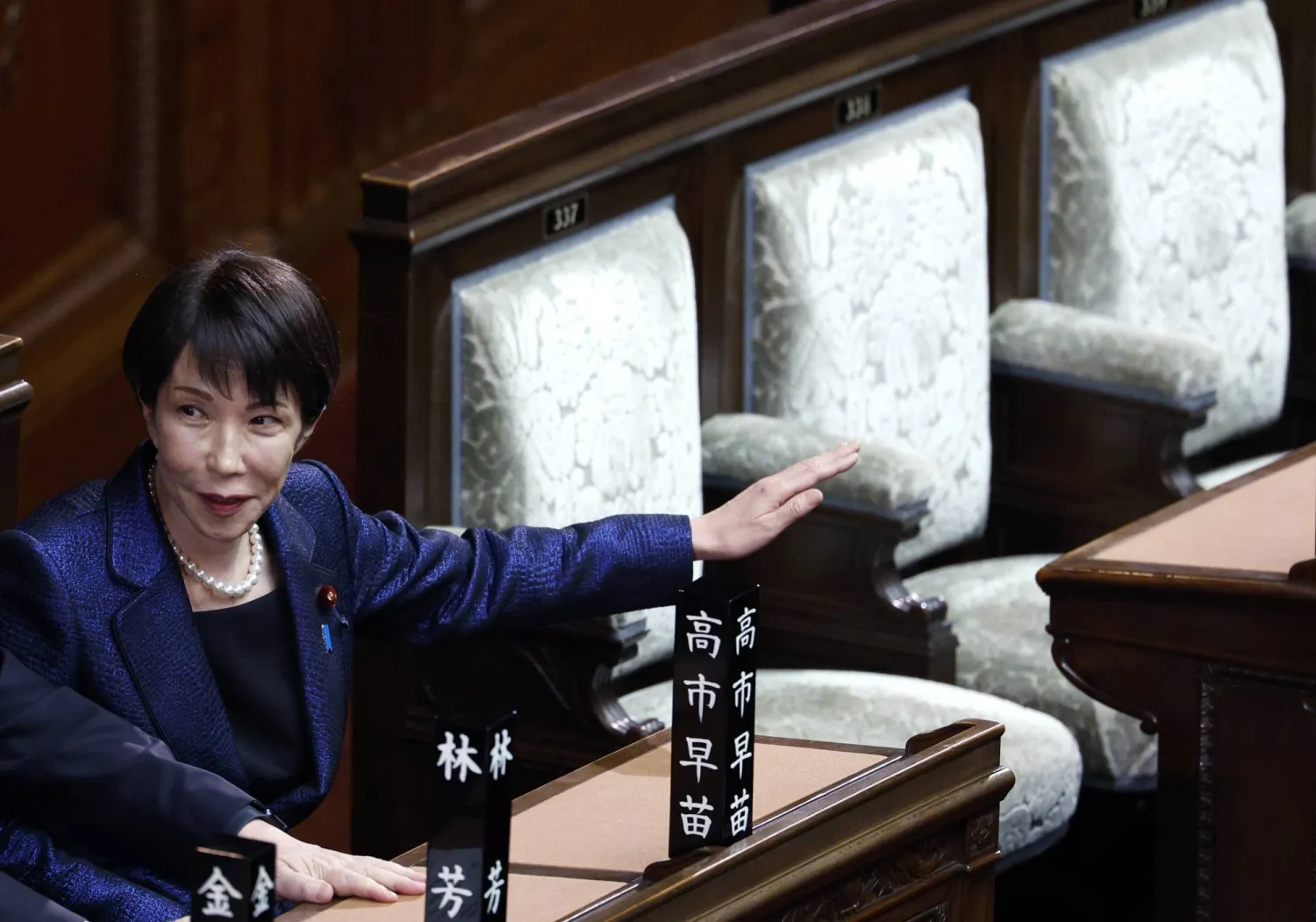
Sanae Takaichi gestures at the Lower House of the Parliament in Tokyo, Japan, 18 February 2026. EPA/FRANCK ROBICHON
TT

Japan PM Takaichi Reappointed Following Election

Sanae Takaichi gestures at the Lower House of the Parliament in Tokyo, Japan, 18 February 2026. EPA/FRANCK ROBICHON

Japan's lower house formally reappointed Sanae Takaichi as prime minister on Wednesday, 10 days after her historic landslide election victory.

Takaichi, 64, became Japan's first woman premier in October and won a two-thirds majority for her party in the snap lower house elections on February 8.

She has pledged to bolster Japan's defenses to protect its territory and waters, likely further straining relations with Beijing, and to boost the flagging economy.

Takaichi suggested in November that Japan could intervene militarily if Beijing sought to take Taiwan by force.

China, which regards the democratic island as part of its territory and has not ruled out force to annex it, was furious.

Beijing's top diplomat Wang Yi told the Munich Security Conference on Saturday that forces in Japan were seeking to "revive militarism".

In a policy speech expected for Friday, Takaichi will pledge to update Japan's "Free and Open Indo-Pacific" strategic framework, local media reported.

"Compared with when FOIP was first proposed, the international situation and security environment surrounding Japan have become significantly more severe," chief government spokesman Minoru Kihara said Monday.

In practice this will likely mean strengthening supply chains and promoting free trade through the Trans-Pacific Partnership (CPTPP) that Britain joined in 2024.

Takaichi's government also plans to pass legislation to establish a National Intelligence Agency and to begin concrete discussions towards an anti-espionage law, the reports said.

Takaichi has promised too to tighten rules surrounding immigration, even though Asia's number two economy is struggling with labor shortages and a falling population.

On Friday Takaichi will repeat her campaign pledge to suspend consumption tax on food for two years in order to ease inflationary pressures on households, local media said, according to AFP.

This promise has exacerbated market worries about Japan's colossal debt, with yields on long-dated government bonds hitting record highs last month.

Rahul Anand, the International Monetary Fund chief of mission in Japan, said Wednesday that debt interest payments would double between 2025 and 2031.

"Removing the consumption tax (on food) would weaken the tax revenue base, since the consumption tax is an important way to raise revenues without creating distortions in the economy," Anand said.

To ease such concerns, Takaichi will on Friday repeat her mantra of having a "responsible, proactive" fiscal policy and set a target on reducing government debt, the reports said.

She will also announce the creation of a cross-party "national council" to discuss taxation and how to fund ageing Japan's ballooning social security bill.

But Takaichi's first order of business will be obtaining approval for Japan's budget for the fiscal year beginning on April 1 after the process was delayed by the election.

The ruling coalition also wants to pass legislation that will outlaw destroying the Japanese flag, according to the media reports.

It wants too to accelerate debate on changing the constitution and on revising the imperial family's rules to ease a looming succession crisis.

Takaichi and many within her Liberal Democratic Party (LDP) oppose making it possible for a woman to become emperor, but rules could be changed to "adopt" new male members.


Türkiye: Ocalan Announces ‘Integration Phase’

Members of the Kurdish community take part in a protest calling for the release of convicted Kurdistan Worker's Party (PKK) leader Abdullah Ocalan in Diyarbakir on February 15, 2026. (Photo by Ilyas AKENGIN / AFP)
TT

Türkiye: Ocalan Announces ‘Integration Phase’

Members of the Kurdish community take part in a protest calling for the release of convicted Kurdistan Worker's Party (PKK) leader Abdullah Ocalan in Diyarbakir on February 15, 2026. (Photo by Ilyas AKENGIN / AFP)

The jailed leader of the Kurdistan Workers Party, Abdullah Ocalan, has said that the Ankara-PKK peace process has entered its “second phase,” as the Turkish parliament sets the stage to vote on a draft report proposing legal reforms tied to peace efforts.

A delegation from the pro-Kurdish Peoples' Equality and Democracy Party (DEM Party), including lawmakers Pervin Buldan, Mithat Sancar, and Ocalan’s lawyer Ozgur Faik, met with the jailed PKK leader on Monday on the secluded Imrali island.

Sancar said that the second phase will be focused on democratic integration into
Türkiye’s political system.

According to the lawmaker, the PKK leader considered the first phase the “negative dimension” concerned with ending the decades-old conflict between the armed group and Ankara.

“Now we are facing the positive phase,” Ocalan said, “the integration phase is the positive phase; it is the phase of construction.”

For the second phase to be implemented, Ocalan called on Turkish authorities to provide conditions that would allow him to put his “theoretical and practical capacity” to work.

The 60-page draft report on peace with the PKK was completed by a five-member writing team, which is chaired by Parliament Speaker Numan Kurtulmuş, and is scheduled for a vote on Wednesday.

The report is organized into seven sections.

In July last year, Ocalan said the group's armed struggle against Türkiye has ended and called for a full shift to democratic politics.


Iranians Chant Slogans Against Supreme Leader at Memorials for Slain Protesters

An Iranian man holds the Iranian national flag during a memorial ceremony for those killed in anti-government protests earlier last month, at the Mosalla mosque in Tehran, Iran, 17 February 2026. (EPA)
TT

Iranians Chant Slogans Against Supreme Leader at Memorials for Slain Protesters

An Iranian man holds the Iranian national flag during a memorial ceremony for those killed in anti-government protests earlier last month, at the Mosalla mosque in Tehran, Iran, 17 February 2026. (EPA)

Iranians shouted slogans against Supreme Leader Ali Khamenei on Tuesday as they gathered to commemorate protesters killed in a crackdown on nationwide demonstrations that rights groups said left thousands dead, according to videos verified by AFP.

The country's clerical authorities also staged a commemoration in the capital Tehran to mark the 40th day since the deaths at the peak of the protests on January 8 and 9.

Officials acknowledge more than 3,000 people died during the unrest, but attribute the violence to "terrorist acts", while rights groups say many more thousands of people were killed, shot dead by security forces in a violent crackdown.

The protests, sparked by anger over the rising cost of living before exploding in size and anti-government fervor, subsided after the crackdown, but in recent days Iranians have chanted slogans from the relative safety of homes and rooftops at night.

On Tuesday, videos verified by AFP showed crowds gathering at memorials for some of those killed again shouting slogans against the theocratic government in place since the 1979 revolution.

In videos geolocated by AFP shared on social media, a crowd in Abadan in western Iran holds up flowers and commemorative photos of a young man as they shout "death to Khamenei" and "long live the shah", in support of the ousted monarchy.

Another video from the same city shows people running in panic from the sounds of shots, though it wasn't immediately clear if they were from live fire.

In the northeastern city of Mashhad a crowd in the street chanted, "One person killed, thousands have his back", another verified video showed.

Gatherings also took place in other parts of the country, according to videos shared by rights groups.

- Official commemorations -

At the government-organized memorial in Tehran crowds carried Iranian flags and portraits of those killed as nationalist songs played and chants of "Death to America" and "Death to Israel" echoed through the Khomeini Grand Mosalla mosque.

Iranian President Masoud Pezeshkian attended a similar event at the Imam Reza shrine in Mashhad.

Authorities have accused sworn enemies the United States and Israel of fueling "foreign-instigated riots", saying they hijacked peaceful protests with killings and vandalism.

Senior officials, including First Vice President Mohammad Reza Aref and Revolutionary Guards commander Esmail Qaani, attended the ceremony.

"Those who supported rioters and terrorists are criminals and will face the consequences," Qaani said, according to Tasnim news agency.

International organizations have said evidence shows Iranian security forces targeted protesters with live fire under the cover of an internet blackout.

The US-based Human Rights Activists News Agency (HRANA) has recorded more than 7,000 killings in the crackdown, the vast majority protesters, though rights groups warn the toll is likely far higher.

More than 53,500 people have been arrested in the ongoing crackdown, HRANA added, with rights groups warning protesters could face execution.

Tuesday's gatherings coincided with a second round of nuclear negotiations between Iran and the United States in Geneva, amid heightened tensions after Washington deployed an aircraft carrier group to the Middle East following Iran's crackdown on the protests.