


Israel Reinforces Ban on UN Chief Entering Country over Iran Attack Comments

United Nations Secretary-General Antonio Guterres addresses the 79th United Nations General Assembly at the UN headquarters in New York, US, September 24, 2024. REUTERS/Mike Segar/File Photo
TT

Israel Reinforces Ban on UN Chief Entering Country over Iran Attack Comments

United Nations Secretary-General Antonio Guterres addresses the 79th United Nations General Assembly at the UN headquarters in New York, US, September 24, 2024. REUTERS/Mike Segar/File Photo

Israeli Foreign Minister Israel Katz reinforced on Sunday his decision to declare UN Secretary-General Antonio Guterres persona non grata over what he described as a failure to condemn Iran's missile attack and antisemitic and anti-Israel conduct.  

On Oct. 2, Katz said that he was barring Guterres from entering Israel. He posted on X on Sunday that "Guterres can continue seeking support from UN member states, but the decision will not change."

UN spokesperson Stephane Dujarric described the initial announcement on Oct. 2 as political and "just one more attack, so to speak, on UN staff that we've seen from the government of Israel."

He said the UN traditionally does not recognize the concept of persona non grata as applying to UN staff.

When asked to respond to Katz's remarks on Sunday, a UN spokesperson referred to Dujarric's earlier comments.

Dujarric also said last week that the UN had not received any formal communication from Israel on the matter.

On Oct. 3, the UN Security Council expressed its full support for Guterres, saying in a statement that "any decision not to engage with the UN Secretary-General or the United Nations is counterproductive, especially in the context of escalating tensions in the Middle East."

When asked last week if Guterres had been made persona non grata by Israel, Israel's UN Ambassador Danny Danon told reporters: "There was a statement made ... we will evaluate the relationship. We are here at the UN, we work with the UN agencies, but we were disappointed."

Iran fired more than 180 ballistic missiles at Israel on Oct. 1 amid an escalation in fighting between Israel and its proxy in Lebanon, Hezbollah. Many were intercepted in flight but some penetrated missile defenses.

Guterres condemned the missile attack and "the broadening of the Middle East conflict, with escalation after escalation." Earlier the same day, Israel had sent troops into southern Lebanon.

During a Security Council meeting a day later, Guterres said: "As I did in relation to the Iranian attack in April - and as should have been obvious yesterday in the context of the condemnation I expressed - I again strongly condemn yesterday’s massive missile attack by Iran on Israel."
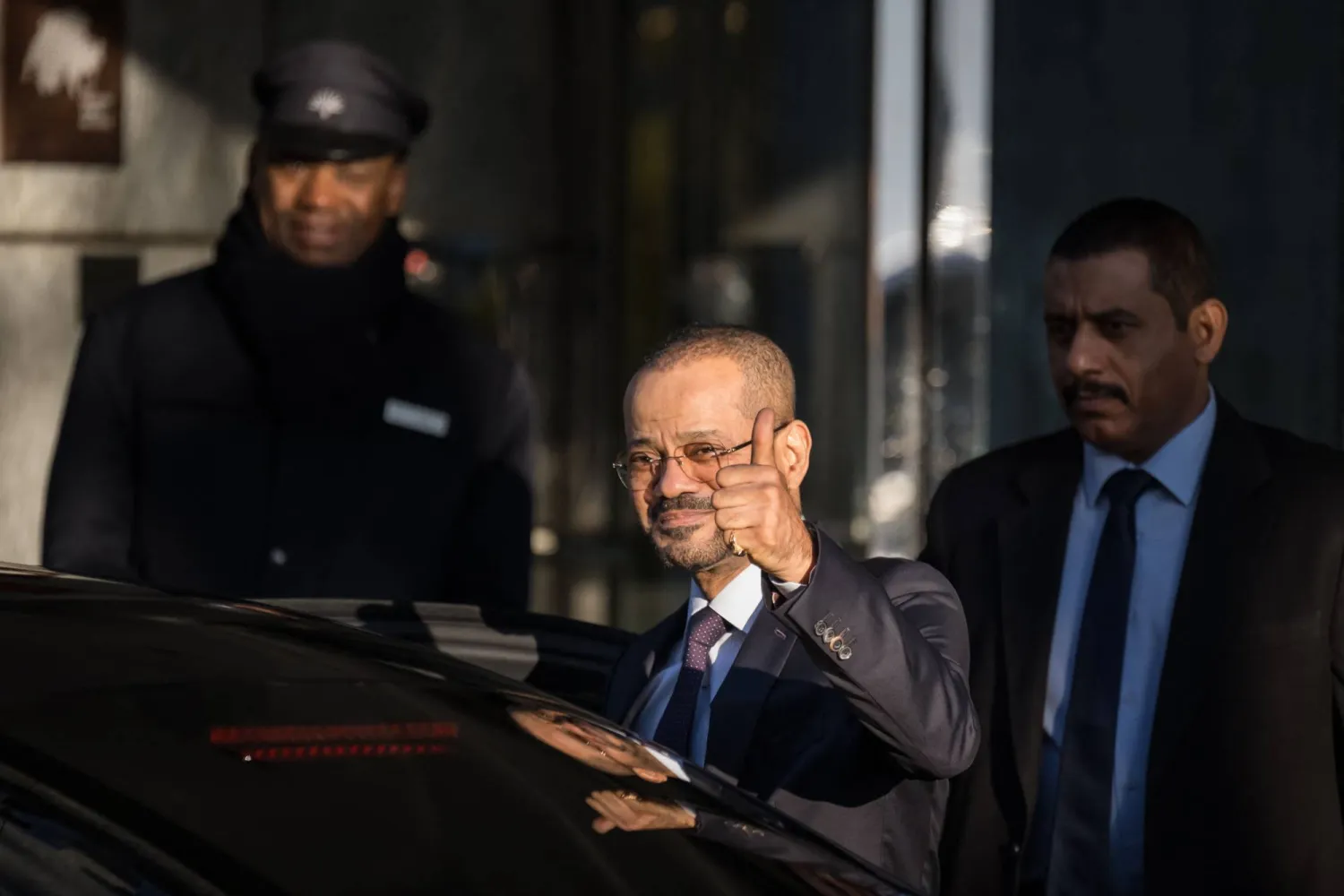



US and Iran Hold 3rd Round of Nuclear Talks

Oman's Foreign Affairs Minister Badr bin Hamad al-Busaidi gives a thumbs up as he leaves his hotel to reach Oman's ambassador residency for new round of talks between the United States and Iran to address Iran's nuclear program, in Geneva on February 26, 2026. (Photo by Fabrice COFFRINI / AFP)
TT

US and Iran Hold 3rd Round of Nuclear Talks

Oman's Foreign Affairs Minister Badr bin Hamad al-Busaidi gives a thumbs up as he leaves his hotel to reach Oman's ambassador residency for new round of talks between the United States and Iran to address Iran's nuclear program, in Geneva on February 26, 2026. (Photo by Fabrice COFFRINI / AFP)

Iran and the United States met on Thursday in Geneva for nuclear negotiations viewed as a last chance for diplomacy.

US President Donald Trump wants a deal to constrain Iran’s nuclear program, and he sees an opportunity while the country is struggling at home with growing dissent following nationwide protests last month. Iran meanwhile has maintained it wants to continue to enrich uranium even as its program sits in ruins, following Trump ordering an attack in June on three of Iran's nuclear sites, part of a bruising 12-day war last year.

The nuclear talks are viewed as a last chance for diplomacy as America has gathered a fleet of aircraft and warships to the Middle East to pressure Tehran into a deal.

If an American attack happens, Iran has said all US military bases in the Mideast would be considered legitimate targets, putting at risk tens of thousands of American service members. Iran has also threatened to attack Israel, meaning a regional war again could erupt across the Middle East.

“There would be no victory for anybody — it would be a devastating war,” Iranian Foreign Minister Abbas Araghchi told India Today in an interview filmed Wednesday just before he flew to Geneva.

“Since the Americans' bases are scattered through different places in the region, then unfortunately perhaps the whole region would be engaged and be involved, so it is a very terrible scenario.”

Oman’s Foreign Ministry published on Thursday images of US special Mideast envoy Steve Witkoff and Jared Kushner, Trump’s son-in-law, meeting with Omani Foreign Minister Badr al-Busaidi.

The location appeared to be the Omani diplomatic residence in Geneva along the shores of Lake Geneva.

Araghchi met al-Busaidi after arriving in Geneva on Wednesday night. The men “reviewed the views and proposals that the Iranian side will present to reach an agreement on the Iranian nuclear program, based on the guiding principles agreed upon in the previous round of negotiations,” a report from the state-run Oman News Agency said.

Al-Busaidi will pass on Iran's offer to American officials on Thursday, it added.


Modi Breaks Netanyahu’s Isolation with 16 Cooperation Agreements

The Indian Prime Minister listens to the Israeli Prime Minister during an exceptional session of the Knesset on Wednesday (EPA)
TT

Modi Breaks Netanyahu’s Isolation with 16 Cooperation Agreements

The Indian Prime Minister listens to the Israeli Prime Minister during an exceptional session of the Knesset on Wednesday (EPA)

In a move seen as breaking Israel’s relative international isolation amid its ongoing war in Gaza, Indian Prime Minister Narendra Modi signed 16 agreements with Israel during a two-day visit to the country.

Modi arrived in Israel on Wednesday for talks aimed at strengthening ties in trade and defense. The visit was marked by an unusually warm reception. Israeli Prime Minister Benjamin Netanyahu personally welcomed Modi at the airport and later accompanied him to address the Knesset, Israel’s parliament, where lawmakers applauded and cheered.

Netanyahu hailed Modi as “a great global leader and a great friend; more than that, a great brother.”

He added: “They say India has achieved tremendous accomplishments. That is not accurate. It should be said that thanks to your leadership, your wisdom, and your determination, India has achieved its successes.”

The Israeli premier also thanked Modi for India’s assistance during the recent Gaza war, noting that New Delhi had supplied Israel with ammunition and drones.

Sixteen Agreements and a Historic Honor

The Israeli government announced the signing of 16 bilateral agreements during the visit. In a symbolic gesture, Knesset Speaker Amir Ohana awarded Modi the “Knesset Medal,” marking the first time the honor has been bestowed on a visiting leader.

This is Modi’s second visit to Israel since taking office, nearly nine years after his first trip in 2017.

Beyond political symbolism, the relationship carries significant economic weight. India is Israel’s second-largest trading partner in Asia. According to India’s Ministry of Commerce and Industry, total bilateral trade reached $3.62 billion in fiscal year 2025.

Renewed Indian Condemnation of October 7

For his part, Modi declared that “India stands with Israel at this moment and beyond.” Addressing the Knesset plenary, he offered condolences for those killed in the Oct. 7, 2023 attack launched by Hamas, describing it as a “terrorist and brutal attack.”

Modi also praised a plan proposed by US President Donald Trump that he said would safeguard Palestinian national rights.

Expanding Strategic Ties, Secrecy

Observers view the visit not merely as a reflection of improved relations, but as a major step in advancing strategic cooperation. The agreements include memoranda of understanding designed to deepen coordination across several sectors, particularly in security, with officials describing the partnership as a “distinguished strategic relationship.”

Security sources revealed that the two sides reached an arrangement establishing a “confidentiality framework,” allowing India access to previously restricted Israeli systems. These reportedly include advanced air defense systems and integration into Israel’s laser-based air defense network. India is also expected to receive licenses to manufacture certain Israeli weapons systems domestically.

The Israeli daily Yedioth Ahronoth quoted a senior political official as saying the agreement would provide greater flexibility to security agencies and enable both countries to rely on one another when necessary, calling it “a major revolution.”

Writing in the right-leaning newspaper Israel Hayom, columnist and former lawmaker Zvi Hauser, a political ally of Netanyahu, said one of the key issues Modi and Netanyahu would discuss is Iran’s future and the prospects for the fall of its regime. Hauser suggested that Israel, India, and a post-Revolution Iran could form a powerful strategic alliance in the region.


Cuba Says It Killed Four Gunmen on Speedboat Trying to Infiltrate from US

Cuban coast guard ships docked at the port of Havana. (AFP) 
TT

Cuba Says It Killed Four Gunmen on Speedboat Trying to Infiltrate from US

Cuban coast guard ships docked at the port of Havana. (AFP) 

Cuba said it thwarted the attempt of gunmen trying to infiltrate from the United States as its coastguard opened fire on Wednesday at a Florida-registered speedboat near its shores, killing four people and wounding six.

Havana's Interior Ministry said the speedboat's passengers opened fire on a coast guard vessel that approached them near an island off the country's northern coast.

The ministry claimed the passengers were armed and intended to “carry out an infiltration for terrorist purposes.”

Handguns, assault rifles and improvised explosive devices were recovered on the speedboat, according to the statement, along with other tactical gear.

The ministry said the 10 passengers are all Cuban citizens living in the US.

US Secretary of State Marco Rubio said Washington was seeking its own facts about the shooting and would “respond accordingly.”

“We're not going to base our conclusions on what they've (Cuba) told us, and I'm very, very confident that we will know the full story of what happened here,” Rubio told reporters while on a trip to the Caribbean nation of St Kitts and Nevis. “As we gather more information, then we'll be prepared to respond accordingly.”

James Uthmeier, Florida's attorney general, said he would direct local law enforcement to investigate the incident.

“The Cuban government cannot be trusted, and we will do everything in our power to hold these communists accountable,” he said.

In an earlier statement posted on X, the Cuban interior ministry said the Florida-registered vessel was detected near Cayo Falcones, in the country's central Villa Clara province on Wednesday morning.

When a Cuban boat carrying five members of the ministry's border guard approached the vessel for identification, “the crew of the violating speedboat opened fire” and wounded the Cuban commander, the statement said.

It added that “As a consequence of the confrontation, as of the time of this report, four aggressors on the foreign vessel were killed and six injured.”

Those injured were evacuated and given medical assistance, the statement said.

In Washington, US Vice President JD Vance said the White House was “monitoring” the incident but added that he hoped it was not a serious one.

“Certainly, you know, a situation that we're monitoring, hopefully it's not as bad as we fear it could be. But can't say more, because I just don't know more,” Vance told reporters.

The confrontation comes amid heightened tensions between the United States and Cuba, which lies just 160 km across the Florida Straits. It also comes as the US softened a virtual oil siege of the island imposed by President Donald Trump in January after the US ouster of top Cuba ally, Nicolas Maduro of Venezuela.

Before Maduro's capture by US forces on 3 January, Cuba had relied on Venezuela for about half its fuel needs.

Faced with an outcry from Caribbean leaders, worried that starving Cuba of oil would cause the economy to quickly collapse, the US said it would allow shipments of Venezuelan oil for “commercial and humanitarian use.”