


Death Toll from Spanish Floods Climbs to 205 as Shock Turns to Anger and Frustration

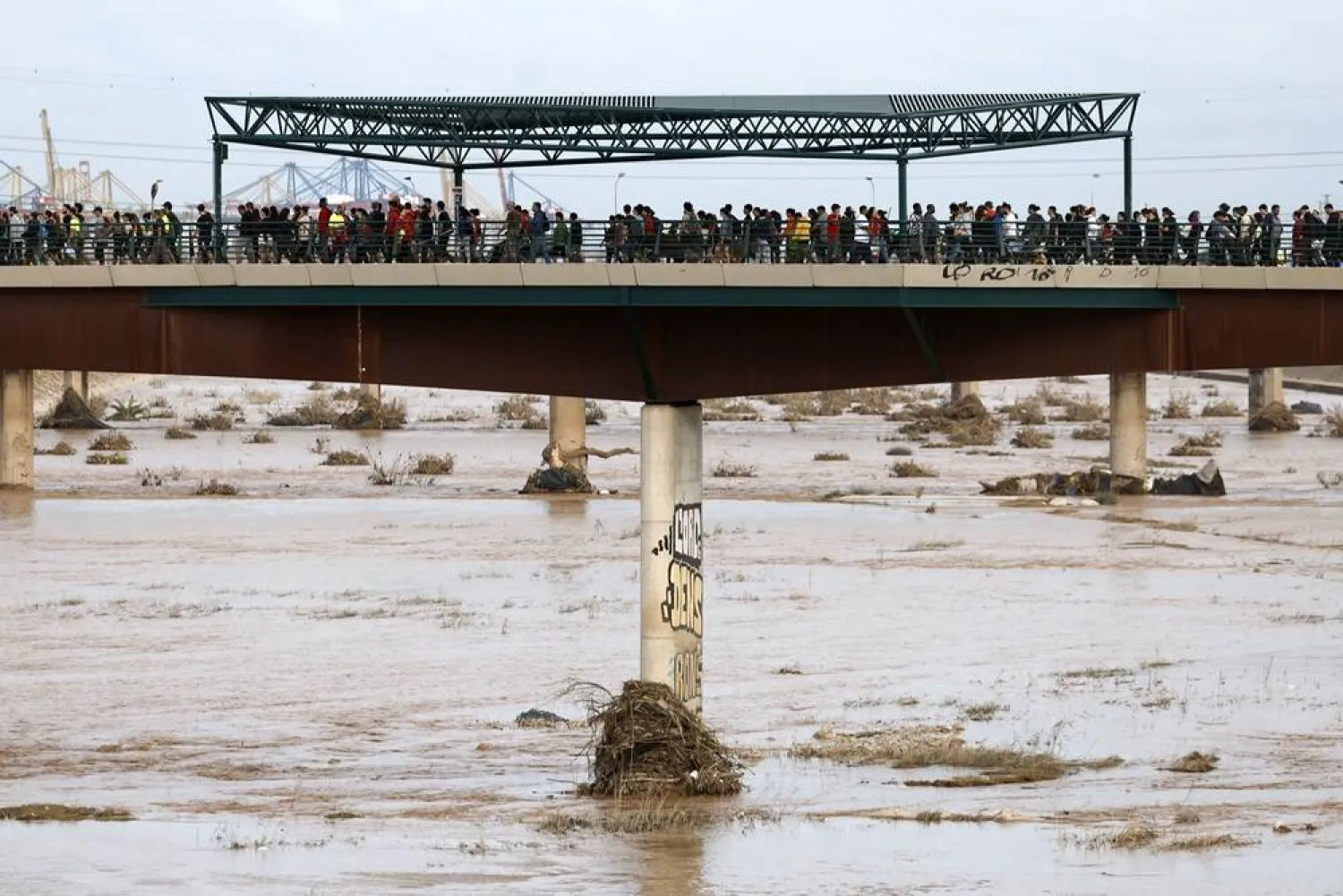
People cross the Turia river to help flood-affected neighborhoods in Valencia, Spain, 01 November 2024. (EPA)
TT

Death Toll from Spanish Floods Climbs to 205 as Shock Turns to Anger and Frustration

People cross the Turia river to help flood-affected neighborhoods in Valencia, Spain, 01 November 2024. (EPA)

The death toll from historic flash floods in Spain climbed to least 205 people Friday, with many more believed to be missing, as the initial shock gave way to anger, frustration and a wave of solidarity.

Spanish emergency authorities said 202 of the victims were in the eastern region of Valencia, and officials warned that more rain is expected in the coming days.

The damage from the storm Tuesday and Wednesday recalled the aftermath of a tsunami, with survivors left to pick up the pieces as they mourn loved ones lost in Spain’s deadliest natural disaster in living memory. Many streets were still blocked by piled-up vehicles and debris, in some cases trapping residents in their homes. Some places still don’t have electricity, running water, or stable telephone connections.

"The situation is unbelievable. It’s a disaster and there is very little help," said Emilio Cuartero, in Masanasa, on the outskirts of Valencia city. "We need machinery, cranes, so that the sites can be accessed. We need a lot of help. And bread and water."

In Chiva, residents were clearing debris from mud-filled streets. The Valencian town received more rain in eight hours on Tuesday than it had in the preceding 20 months, and water overflowed a gully that crosses the town, tearing up roads and homes.

The mayor, Amparo Fort, told RNE radio that "entire houses have disappeared, we don’t know if there were people inside or not."

So far, 205 bodies have been recovered — 202 in Valencia, two in neighboring Castilla La Mancha and one in Andalusia in the south. Members of the security forces and 1,700 soldiers from the emergency unit are searching for an unknown number of missing people. Officials fear more bodies could be found in wrecked vehicles and flooded garages.

Guardia Civil has rescued more than 4,500 people trapped by the floods, said Interior Minister Fernando Grande-Marlaska in a news conference from Valencia.

The regional authorities, who are in charge of the response to the tragedy, asked the central government to mobilize an additional 500 soldiers, who will be deployed on Saturday.

"I have been there all my life, all my memories are there, my parents lived there ... and now in one night it is all gone," Chiva resident Juan Vicente Pérez told The Associated Press near the place he lost his home. "If we had waited five more minutes, we would not be here in this world."

Before-and-after satellite images of the city of Valencia illustrated the scale of the catastrophe, showing the transformation of the Mediterranean metropolis into a landscape inundated with muddy waters. The V-33 highway was completely covered in a thick, brown layer of mud.

The tragedy has unleashed a wave of solidarity across the country. Throughout the morning, hundreds of residents have been arriving on foot in the worst affected areas, carrying water, essential products, shovels and brooms to help remove the mud. The number of people coming to help is so high that the authorities have asked them not to drive or walk there, because they are blocking the roads needed by the emergency services.

"It is very important that you return home," said regional president Carlos Mazón, who thanked the volunteers for their goodwill.

Other than volunteer contributions, local governments have begun distributing water, food and basic products in schools, town halls and sports venues.

The Red Cross used its vast network of aid to help those affected by the floods. Since Tuesday, it has carried out more than 3,500 interventions, half of them in 13 of the shelters set up by the authorities, to distribute food, blankets and hygiene products, and to provide internet access.

"There will be quite serious consequences. People who were already vulnerable will be even more, and we are going to find new needs because there are people who have lost their livelihoods," said Ana Gómez, spokesperson for the Red Cross in Valencia.

And more storms are expected. Skies in Valencia were partially sunny on Friday, but the Spanish weather agency issued alerts for strong rains in the region as well as the coast of Huelva, Andalusia; Tarragona, in Catalonia; and part of the Balearic Islands.

The storm cut power and water services on Tuesday night, but about 85% of 155,000 affected customers had their power back on by Friday, the utility said in a statement.

"This is a disaster. There are a lot of elderly people who don’t have medicine. There are children who don’t have food. We don’t have milk, we don’t have water. We have no access to anything," a resident of Alfafar, one of the most affected towns in south Valencia, told state television station TVE. "No one even came to warn us on the first day."

Juan Ramón Adsuara, the mayor of Alfafar, said the aid isn't nearly enough for residents trapped in an "extreme situation."

"There are people living with corpses at home. It’s very sad. We are organizing ourselves, but we are running out of everything," he told reporters. "We go with vans to Valencia, we buy and we come back, but here we are totally forgotten."

Rushing water turned narrow streets into death traps and spawned rivers that tore through homes and businesses, leaving many uninhabitable. Authorities have arrested ``people accused of looting shops.

Social networks have channeled the needs of those affected. Some posted images of missing people in the hope of getting information about their whereabouts, while others launched initiatives such as Suport Mutu — or Mutual Support — which connects requests for help with people who are offering it. Others organized collections of basic goods nationwide and launched fundraisers.

Pope Francis offered prayers for "the deceased, and their loved ones, and for all the destitute families," as well as the rescuers working in Valencia during the traditional Angelus blessing on the Catholic All Saint’s holiday.

Spain’s Mediterranean coast is used to autumn storms that can cause flooding, but this was the most powerful flash flooding in recent memory. Scientists link it to climate change, which is also behind increasingly high temperatures and droughts in Spain and the heating up of the Mediterranean Sea.

"Climate change is turbocharging extreme weather. We can expect to see more of the devastation and the despair that we have been seeing this week as a warming atmosphere brings more energy into our climate system", said Clare Nullis, a spokesperson for the World Meteorological Organization.

"As a result of rising temperatures, the hydrological cycle has accelerated. It’s also become more erratic, more unpredictable", she added. "We are facing growing problems of either too much water or too little. And that’s what we’re seeing playing out in Spain at the moment."

Spain has suffered through an almost two-year drought, making the flooding worse because the dry ground was so hard that it could not absorb the heavy rain.

In August 1996, a flood swept away a campsite along the Gallego river in Biescas, in the northeast, killing 87 people.



Trump to Travel to China Next Month, with US Trade Policy in Focus

US President Donald Trump arrives at Joint Base Andrews in Maryland, US, February 19, 2026. (Reuters)
TT

Trump to Travel to China Next Month, with US Trade Policy in Focus

US President Donald Trump arrives at Joint Base Andrews in Maryland, US, February 19, 2026. (Reuters)

US President Donald Trump will travel to China from March 31 to April 2 for a highly anticipated meeting between the world's two biggest economies, following the Supreme Court's decision to overturn Trump's sweeping tariffs against imported goods.

A White House official confirmed the trip on Friday, just before the highest US court struck down many of the tariffs Trump has used to manage sometimes-tense relations with China.

Trump is expected to visit Beijing and meet Chinese President Xi Jinping as part of a lavish, extended visit. Trump was last in China in 2017, ‌the most ‌recent trip by a US president.

A key topic had been whether ‌to ⁠extend a trade ⁠truce that kept both countries from further hiking tariffs. After Friday's ruling, however, it was not immediately clear whether - and under what legal authority - Trump would restore tariffs on imports from China.

TRUMP SEES TRADE IMBALANCE AS NATIONAL EMERGENCY

The administration has said the tariffs were necessary because of national emergencies related to trade imbalances and China's role in producing illicit fentanyl-related chemicals.

"That's going to be a wild one," Trump told foreign leaders visiting Washington on Thursday ⁠about the trip. "We have to put on the biggest display you've ‌ever had in the history of China."

The Chinese ‌embassy in Washington did not immediately respond to a request for comment. Beijing has not ‌confirmed the trip.

The visit would be the leaders' first talks since February and their first ‌in-person visit since an October meeting in South Korea. At that October meeting, Trump agreed to trim tariffs on China in exchange for Beijing cracking down on the fentanyl trade, resuming US soybean purchases and keeping rare earth minerals flowing.

While the October meeting largely sidestepped the sensitive issue of ‌Taiwan, Xi raised US arms sales to the island in February.

Washington announced its largest-ever arms sales deal with Taiwan in December, ⁠including $11.1 billion in ⁠weapons that could ostensibly be used to defend against a Chinese attack. Taiwan expects more such sales.

China views Taiwan as its own territory, a position Taipei rejects. The United States has formal diplomatic ties with China, but it maintains unofficial ties with Taiwan and is the island's most important arms supplier. The United States is bound by law to provide Taiwan with the means to defend itself.

Xi also said during the February call that he would consider further increasing soybean purchases, according to Trump.

Struggling US farmers are a major political constituency for Trump, and China is the top soybean consumer.

Although Trump has justified several hawkish policy steps from Canada to Greenland and Venezuela as necessary to thwart China, he has eased policy toward Beijing in the past several months in key areas, from tariffs to advanced computer chips and drones.


Diplomacy Is Still the Only Viable Path to Peace in Ukraine, UN Refugee Chief Barham Salih Says

UNCHR High Commissioner Barham Salih talks during an interview with The Associated Press in Kyiv, Ukraine, Friday, Feb. 20, 2026. (AP)
TT

Diplomacy Is Still the Only Viable Path to Peace in Ukraine, UN Refugee Chief Barham Salih Says

UNCHR High Commissioner Barham Salih talks during an interview with The Associated Press in Kyiv, Ukraine, Friday, Feb. 20, 2026. (AP)

There are many obstacles to a peace deal in Ukraine, but a diplomatic solution remains the only viable option, the newly appointed head of the UN refugee agency said Friday, warning that humanitarian operations are increasingly overstretched because of multiple global crises.

Barham Salih, Iraq’s former president who was elected UNHCR high commissioner in December, made his first visit to Ukraine since taking office.

After traveling to Ukraine’s front-line cities, including Kharkiv and Zaporizhzhia, he met with President Volodymyr Zelenskyy and discussed the latest in efforts to secure a peace deal. He also discussed the future of UNHCR operations as Ukraine endures Russian attacks on its energy grid during a harsh winter.

“You have to be hopeful, but I do understand the difficulties in the situation, and it’s clear, of course, there are many, many impediments along the way, but at the end of the day, there is no military solution. There needs to be peace, a durable and just peace so that people can go back to their lives,” he said, speaking to The Associated Press in an interview in Kyiv.

“Things are not necessarily easy, definitely not easy, but let’s redouble the effort to make sure that diplomacy has a chance and really bring about a durable and just peace to this war that has been going on for far too long,” he added.

Of the agency’s $470 million appeal for Ukraine, only $150 million has been pledged. The shortfall reflects deep cuts across the humanitarian sector, making it increasingly difficult to deliver aid across multiple crises.

There are 3.7 million Ukrainians displaced within the country and nearly 6 million Ukrainians outside the country who have become refugees in Europe and elsewhere, he said.

“This tells you the gap between what is needed and what is available,” he said. “My appeal to the international community is, really, this is not the moment to walk away, this is not a moment to look the other way round. These vulnerable populations need support. We should deliver this help to them.”

The UN agency in Ukraine predicts 10.8 million Ukrainians will require humanitarian assistance in 2026, according to a report from the agency. The most critical needs are concentrated along the war’s front lines in the eastern and southern parts of Ukraine, as well as in the northern border region. Intensified hostilities produce fresh waves of displacement.

The agency’s Ukraine appeal competes with large-scale conflicts in Sudan and Gaza. Since his appointment, Salih has spent only one week in his Geneva office, traveling to Kenya, Chad, Türkiye and Jordan before visiting Ukraine.

Drastic cuts to US humanitarian funding under President Donald Trump has accelerated the erosion of global humanitarian infrastructure and severely undermined the ability of organizations to deliver aid.

There are 117 million displaced people worldwide, including at least 42 million refugees, Salih said. Two-thirds face protracted displacement and remain dependent on humanitarian assistance.

Deciding where to prioritize given shrinking resources is “difficult” he said.

“It’s really very difficult to prioritize given the scale of the problem. I was in Kenya and I was in Chad recently and I was in Türkiye and in Jordan talking to refugees from Syria. And of course, now in Ukraine, these are all pressing issues, pressing requirements,” he said.

“We need to be there to help people, but also I have to say we really need to look at durable solutions too as well. It’s not a matter of sustaining dependency or humanitarian assistance,” he added.

In his meeting with Zelenskyy, Salih said they discussed the need to focus on the “recovery phase and sustainable solutions and self reliance as we go forward,” he said.


Israel Army Says on ‘Defensive Alert’ Regarding Iran but No Change to Public Guidelines

Israeli air defense system fires to intercept missiles during an Iranian attack over Tel Aviv, Israel, Thursday, June 19, 2025. (AP)
TT

Israel Army Says on ‘Defensive Alert’ Regarding Iran but No Change to Public Guidelines

Israeli air defense system fires to intercept missiles during an Iranian attack over Tel Aviv, Israel, Thursday, June 19, 2025. (AP)

The Israeli army said it was on "defensive alert" as the United States threatens potential military action against Iran, but insisted there were no changes in its guidelines for the public.

"We are closely monitoring regional developments and are aware of the public discourse concerning Iran. The (Israeli military) is on defensive alert," army spokesman Brigadier General Effie Defrin said in a video statement published Friday.

"Our eyes are wide open in all directions, and our finger is more than ever on the trigger in response to any change in the operational reality," he added, but emphasized "there is no change in the instructions".