50 European Leaders Assess How Trump Will Affect their Fortunes

In this handout photograph taken and released by the Ukrainian Presidential Press Service on November 7, 2024, European leaders, including Hungary's Prime Minister Viktor Orban (1st row, C) and Ukraine's President Volodymyr Zelensky (1st row, 3rd L) pose for a group photo during the European Political Community Summit in Budapest. (Photo by Handout / UKRAINIAN PRESIDENTIAL PRESS SERVICE / AFP)
TT

50 European Leaders Assess How Trump Will Affect their Fortunes

In this handout photograph taken and released by the Ukrainian Presidential Press Service on November 7, 2024, European leaders, including Hungary's Prime Minister Viktor Orban (1st row, C) and Ukraine's President Volodymyr Zelensky (1st row, 3rd L) pose for a group photo during the European Political Community Summit in Budapest. (Photo by Handout / UKRAINIAN PRESIDENTIAL PRESS SERVICE / AFP)

Around 50 European leaders on Thursday called for a stronger defense posture across the continent that no longer necessitates a fundamental dependence on Washington as they gave a guarded welcome to incoming US President Donald Trump.
The European Political Community summit on Thursday in Hungary's capital Budapest reassessed trans-Atlantic relations in the hope that Donald Trump's second US presidency will avoid the strife of his first administration.
“He was elected by the American people. He will defend the American interests," French President Emmanuel Macron told the other leaders, adding that it was not the role of European Union leaders to “comment on the election ... to wonder if it is good or not.”
“The question is whether we are willing to defend the European interest. It is the only question. It is our priority,” The Associated Press quoted Macron as saying.
Time and again, leaders stepped up to say European defense efforts should be increased.
During his first 2017-2021 presidency, Trump strongly pushed the European NATO allies to spend more on defense, up to and beyond 2% of gross domestic product, and to be less reliant on US military cover. That point has totally sunk in.
“He was the one in NATO who stimulated us to move over the 2%. And now, also thanks to him, NATO, if you take out the numbers of the US, is above the 2%,” NATO chief Mark Rutte said.
Charles Michel, the council president of the 27-nation EU, agreed that the continent needed to become less reliant on the United States.
“We have to be more masters of our destiny,” he said. “Not because of Donald Trump or Kamala Harris, but because of our children.”
Greek Prime Minister Kyriakos Mitsotakis said it was “time to wake up from our geopolitical naivete and to realize that we need to commit additional resources in order to be able to address major challenges. It is a (question of) competitiveness and a European defense.”
During his election campaign, Trump threatened anything from a trade war with Europe to a withdrawal from NATO commitments and a fundamental shift of support for Ukraine in its war with Russia — all issues that could have groundbreaking consequences for nations across Europe.
“Of course he said a lot of things during the campaign,” said Dutch Prime Minister Dick Schoof, adding they won't all be appearing in his official policies. “Transatlantic cooperation is of the utmost importance both for the US and European interests.”
For now, European leaders hope a new beginning holds the promise of smoother relations.
Rutte, who was Dutch prime minister during Trump's first presidency, said, “I worked with him very well for four years. He is extremely clear about what he wants. He understands that you have to deal with each other to come to joint positions. And I think we can do that.”
And Rutte insisted that the challenges posed by Russia in Ukraine affected both sides of the Atlantic.
“Russia is delivering the latest technology into North Korea in return for North Korean help with the war against Ukraine. And this is a threat not only to the European part of NATO, but also to the US mainland,” he said as he arrived at the summit.
During the campaign, Trump said if he were reelected, he would end the war in Ukraine, now well into its third year, in a single day. Ukraine and many of its European backers fear that this means a peace on terms favorable to Russian President Vladimir Putin and involving the surrender of territory.
European allies in NATO hope to convince Trump that if he helps to negotiate any peace, it should be done from a position of strength, for both Ukraine and the US.
Ukrainian President Volodymyr Zelenskyy, who spoke to Trump last night by phone, told reporters in Budapest that Europe and the US need each other to remain strong.
“It was a good, productive conversation. Of course, we cannot yet know what his specific actions will be. But we hope that America will become stronger. This is the kind of America Europe needs. And a strong Europe is what America needs. This is the bond between allies that should be valued and must not be lost,” he said.
Hungarian Prime Minister Viktor Orbán, the summit’s host and an ardent Trump fan, said early Thursday that he already had a phone call with the incoming president overnight, announcing, “We have big plans for the future!”
So did hard-right Italian Prime Minister Giorgia Meloni, who lauded the “deep and historic strategic partnership that has always tied Rome and Washington.”
That partnership came under constant pressure during Trump’s first term. Trump’s administration slapped tariffs on EU steel and aluminum in 2018, based on the claim that foreign products, even if produced by American allies, were a threat to US national security. Europeans and other allies retaliated with duties on US-made motorcycles, peanut butter and jeans, among other items.
Further compounding an already complicated situation in Europe, Germany — the continent's troubled economic juggernaut — sank into political crisis after German Chancellor Olaf Scholz fired his finance minister, causing his governing coalition to collapse. Scholz, who remained in Berlin instead of joining the summit in Budapest, will now lead a minority government.
The turmoil raises the specter of an election in a few months and yet another standoff between the emboldened hard right and the establishment parties in Europe.
Those two combined “adds even more pepper and salt to this situation,” Polish Prime Minister Donald Tusk said.



Venezuela: Amnesty Law Excludes those who Promoted Military Action

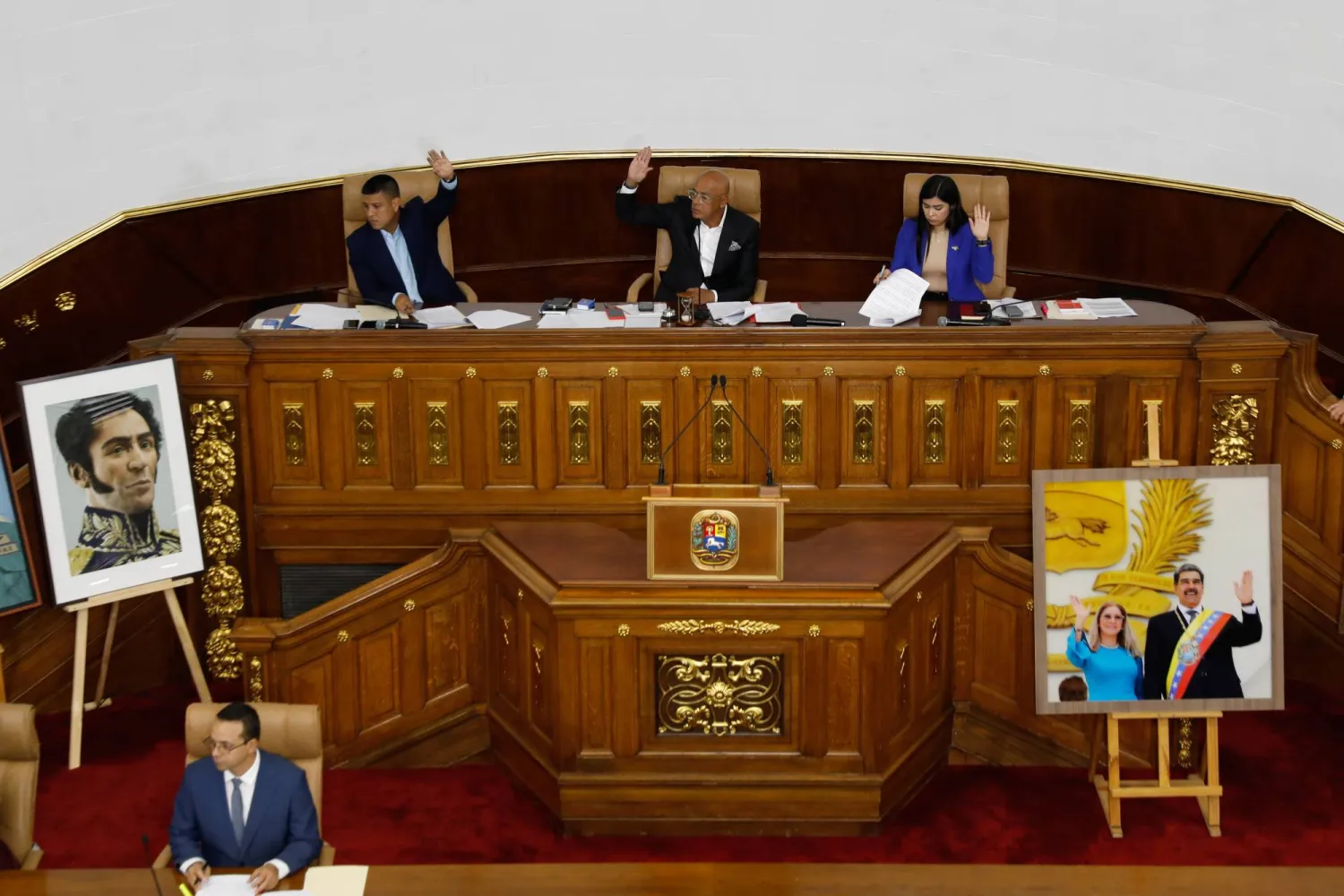
National Assembly President Jorge Rodriguez, center, presides over a session debating an amnesty bill in Caracas, Venezuela, Thursday, Feb. 19, 2026. (AP Photo/Crisitian Hernandez)
TT

Venezuela: Amnesty Law Excludes those who Promoted Military Action

National Assembly President Jorge Rodriguez, center, presides over a session debating an amnesty bill in Caracas, Venezuela, Thursday, Feb. 19, 2026. (AP Photo/Crisitian Hernandez)

Venezuela's parliament unanimously approved an amnesty law on Thursday that could free political prisoners, almost two months after President Nicolas Maduro was captured by US forces.

“The law on democratic coexistence has been approved. It has been forwarded to acting president Delcy Rodriguez for announcement,” said National Assembly President, Jorge Rodriguez, before parliament.

Acting president Delcy Rodriguez signed the legislation after it was handed to her by Jorge Rodrigez, her brother.

The passage of the law led to the end of a hunger strike by relatives of political prisoners.

Ten women have participated in a hunger strike outside the Zona 7 police facility in the capital Caracas last Saturday, setting up camps outside the prison and demanding the release of their relatives, according to AFP.

Because they experienced health problems, nine of them stopped the protest on Wednesday evening. Only one woman continued until Thursday, ending “136 hours,” or more than five days, of strike.

But the amnesty law excludes those who have been prosecuted or convicted of promoting military action against the country – which could include opposition leaders like Nobel Peace Prize winner Maria Corina Machado, who has been accused by the ruling party of calling for international intervention like the one that ousted Maduro.

Article 9 of the bill lists those excluded from amnesty as “persons who are being prosecuted or may be convicted for promoting, instigating, soliciting, invoking, favoring, facilitating, financing or participating in armed actions or the use of force against the people, sovereignty, and territorial integrity” of Venezuela “by foreign states, corporations or individuals.”


Türkiye’s Approval of Peace Roadmap is Important Step, PKK Source Says

A Turkish parliamentary commission’s approval of a report setting out a roadmap for legal reforms alongside the disbandment of the Kurdistan Workers Party (PKK) group is an important step and the beginning of a fundamental change in Turkish policy, a PKK source said Thursday. (AFP/File)
TT

Türkiye’s Approval of Peace Roadmap is Important Step, PKK Source Says

A Turkish parliamentary commission’s approval of a report setting out a roadmap for legal reforms alongside the disbandment of the Kurdistan Workers Party (PKK) group is an important step and the beginning of a fundamental change in Turkish policy, a PKK source said Thursday. (AFP/File)

A Turkish parliamentary commission's approval of a report setting out a roadmap for legal reforms alongside the disbandment of the Kurdistan Workers Party (PKK) group is an important step and the beginning of a fundamental change in Turkish policy, a PKK source told Reuters on Thursday.

The commission voted overwhelmingly on Wednesday to approve the report, advancing a peace process designed to end decades of conflict.

"The vote is considered an achievement and an important ‌step toward consolidating democracy ‌in Türkiye," said the PKK source.

The PKK - designated a ‌terrorist ⁠organization by Türkiye, ⁠the United States and the European Union - halted attacks last year and said in May it had decided to disband and end its armed struggle.

The parliamentary vote shifts the peace process to the legislative theatre, as President Tayyip Erdogan, Türkiye’s leader of more than two decades, bids to end a conflict focused in mainly Kurdish southeast Türkiye.

The insurgency began in 1984 and has killed more than 40,000 people, sowing deep discord at home and ⁠spreading violence across borders into Iraq and Syria.

IMPORTANT ISSUES OUTSTANDING

The PKK ‌source said there were foundations for resolving ‌the Kurdish issue, but there was a lack of clarity on the issue in the report.

"There also ‌remain other important issues, such as initiating constitutional amendments, especially in aspects related to ‌the Kurdish language as well as amendments to the anti-terrorism law," the source said.

Another issue was legislation concerning the return of PKK militants to Türkiye and their integration into society, the source said.

A key element of Wednesday's report recommended strengthening mechanisms to ensure compliance with decisions by the ‌European Court of Human Rights (ECHR) and the Constitutional Court.

Among key ECHR decisions related to Türkiye are rulings that the rights of ⁠jailed former pro-Kurdish ⁠party leader Selahattin Demirtas had been violated and that he should be released immediately.

Ankara's final appeal against that was rejected in November.

SIGN OF INTENT

Demirtas' lawyer Mahsuni Karaman told Reuters the report's comments on the ECHR were important as a sign of intent.

"We hope this will be reflected in judicial practice—that is our wish and expectation,” Karaman said.

Demirtas was detained in November 2016 on terrorism-related charges, which he denies. In May 2024, a court convicted him in connection with deadly 2014 protests and sentenced him to more than 40 years in prison.

Turkish nationalist leader Devlet Bahceli, a key Erdogan ally whose call in 2024 triggered the current PKK peace process, said in November that it "would be beneficial" to release Demirtas from prison.

The opposition pro-Kurdish DEM Party — the successor party of Demirtas' HDP — remains parliament's third-largest bloc and has cooperated closely with the parliamentary commission.


US Renews Threat to Leave IEA

US Energy Secretary Chris Wright speaks at an IEA ministerial meeting in Paris (X)
TT

US Renews Threat to Leave IEA

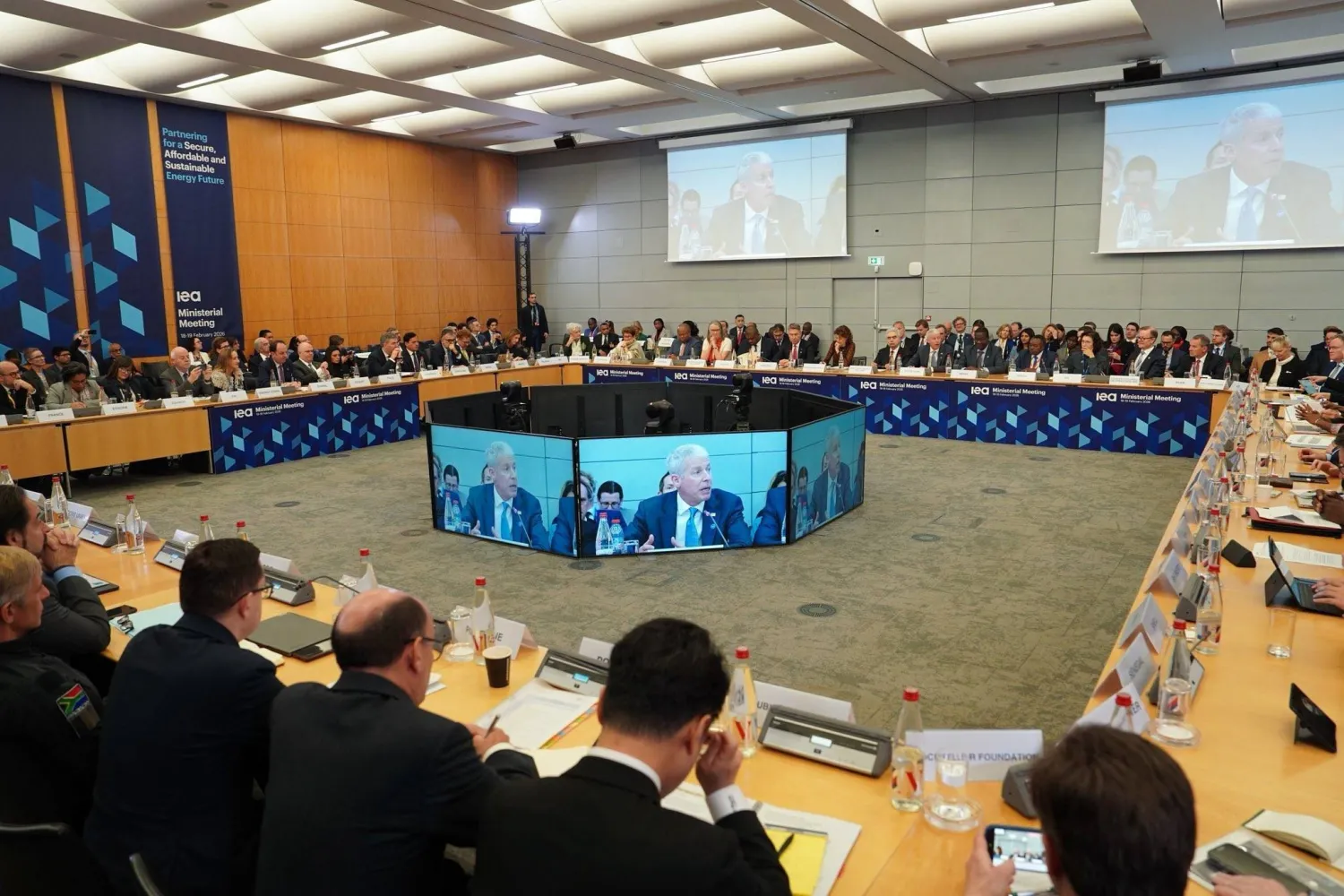
US Energy Secretary Chris Wright speaks at an IEA ministerial meeting in Paris (X)

US Energy Secretary Chris Wright renewed his threat Thursday to pull out of the International Energy Agency, saying Washington would press the organization to abandon a net-zero agenda “in the next year or so.”

Speaking on the last day of an IEA ministerial meeting in Paris, Wright said the 52-year-old agency should return to its founding mission of ensuring energy security.

“The US will use all the pressure we have to get the IEA to eventually, in the next year or so, move away from this agenda,” Wright said in a news conference.

“But if the IEA is not able to bring itself back to focusing on the mission of energy honesty, energy access and energy security, then sadly we would become an ex-member of the IEA,” he added.

Meaning of Wright’s Warning

A US exit means a deep cut to IEA’s budget undermining the agency’s global influence.

Washington is not just a member of the agency but its largest funder. It alone contributes to 25% of the IEA core budget (equivalent to between $25 and $30 million annually) and therefore its exit would “dry up” a quarter of the agency’s financial resources.

Also, Washington is the world's largest oil and gas producer, meaning the US exit will affect the agency's reports and their credibility in markets.

The IEA was created to coordinate responses to major disruptions of supplies after the 1973 oil crisis. But in recent years, it became the main advocate of green transition policies, which the US considers as “politicized.”

The IEA produces monthly reports on oil demand and supply as well as annual world energy outlooks that include data on the growth of solar and wind energy, among other analyses.

Wright praised IEA Executive Director Fatih Birol for reinserting in November 2025’s annual outlook a Current Policies Scenario in which oil and gas demand would grow in the next decades. That scenario had been dropped for the past five years.

But the report still included a scenario where the world reaches net zero emissions by mid-century.

Birol’s current four-year term ends in 2027, but Wright demurred when asked who he would like to head the IEA, which has over 30 member nations.

“We remain today undecided or neutral on who the leadership is. We care about the mission much more than the individual leaders,” the US energy chief said.

If Birol can make the agency “get out the politics and get out the anti-energy part of it, that's great by us,” said Wright, who first warned last year that the US could leave the IEA if it did not reform.

For his part, Birol insisted that the Paris-based agency was “data-driven.” He said, “We are a non-political organization.”

The IEA was created “to focus on energy security,” Wright said on Wednesday at a ministerial meeting of the agency in Paris.

“That mission is beyond critical and I'm here to plead to all the members (of the IEA) that we need to keep the focus of the IEA on this absolutely life-changing, world-changing mission of energy security,” he said.

The Energy Secretary said he wanted to get support from “all the nations in this noble organization to work with us, to push the IEA to drop the climate. That's political stuff.”

His comments come just a day after he publicly threatened to quit the organization unless it abandoned its focus on the energy transition— a call that several countries rejected, including the UK, Austria and France.