


Erdogan Invites Trump to Visit Türkiye

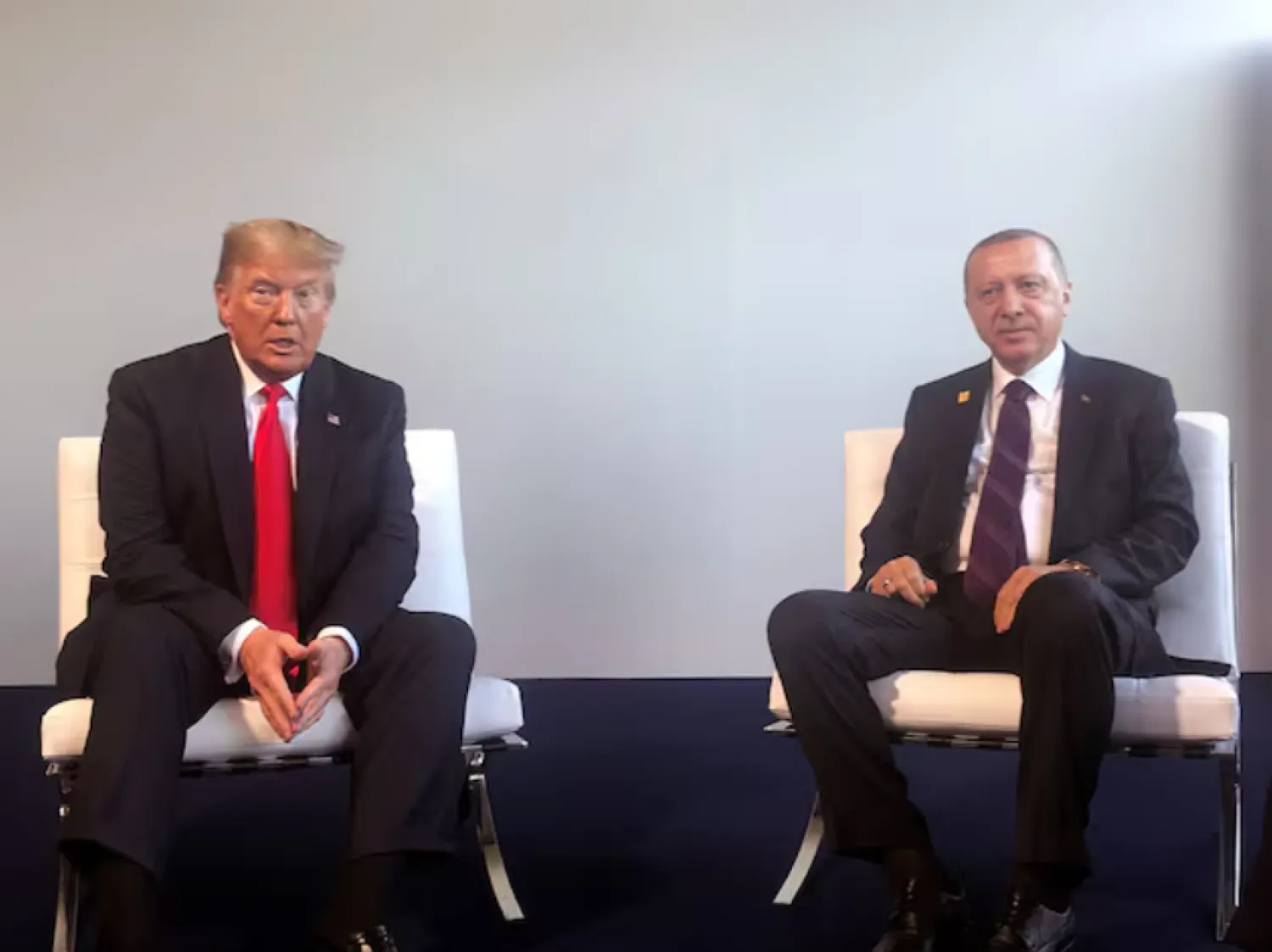
Turkish President Tayyip Erdogan meets with US President Donald Trump during the NATO summit in London, Britain, December 4, 2019. Murat Cetinmuhurdar/Presidential Press Office/Handout via REUTERS/File Photo
TT

Erdogan Invites Trump to Visit Türkiye

Turkish President Tayyip Erdogan meets with US President Donald Trump during the NATO summit in London, Britain, December 4, 2019. Murat Cetinmuhurdar/Presidential Press Office/Handout via REUTERS/File Photo

President Tayyip Erdogan sought to reset Türkiye's strained ties with the United States by inviting President-elect Donald Trump to visit, and said Trump spoke very positively about Türkiye during a phone call.

Trump's election victory this week was generally met with cheer in NATO-member Türkiye, with markets rallying and some officials cautiously optimistic about prospects for new US economic policies.

Erdogan told reporters on a flight back from a European summit in Budapest that he hoped Trump would accept the invitation.

He said he hoped a visit would strengthen cooperation between Türkiye and the United States and lead to a relationship "different from (Trump's) previous term", when clashes on a number of issues led to Washington imposing punitive tariffs that hurt Türkiye's economy.

"We had a sincere call with Mr. Trump while he was at a family dinner (that included) Elon Musk and Musk's child," Erdogan said of the Wednesday call, according to an official Turkish readout.

"He had very nice things to say about Türkiye regarding the period ahead. We invited him to our country. I hope he accepts..."

Ankara's cooperation with Trump's White House could also help solve regional crises, added Erdogan, who has led Türkiye for more than 21 years in what opponents call an increasingly authoritarian style, accusations he denies.

Outgoing US President Joe Biden did not visit Türkiye during his term and Erdogan's planned White House visit early this year fell through with little explanation, underlining the cool relations.

While Erdogan and Trump had closer personal bonds in Trump's 2017-21 term as president, it was also a period of strained bilateral ties due to disputes over Washington's ties with Kurdish fighters in Syria and over Ankara's ties with Moscow.

An official in Erdogan's AK Party told Reuters that Ankara expects the Trump administration to be more flexible and understanding of its security needs, especially against the outlawed Kurdistan Worker's Party (PKK) in Syria and Iraq.

After Trump's election win, Türkiye's lira touched its strongest level in weeks, while Istanbul stocks have since risen more than 5%.

Trade Minister Omer Bolat said on Thursday he expected Trump to lower tariffs on Türkiye's steel and textile exports, even as Trump has promised to levy 10% tariffs on all imported goods.

The fallout still lingers from clashes between Türkiye's and the United States during Trump's first term, when Washington was angered by Türkiye's purchase of a Russian missile defense system and the jailing of US citizens including a pastor.

The Turkish economy bore the brunt of the strains, including higher tariffs on metal imports imposed by Trump in 2018, contributing to the first in a series of lira currency crises that set off years of soaring inflation.

The strains grew in 2019 as Türkiye launched an incursion against a Syrian Kurdish militia that Ankara calls a terrorist group but which is a US ally against ISIS.

At the time, Trump threatened to "totally destroy and obliterate" Türkiye's economy over the operation. He sent Erdogan a letter saying: "You don't want to be responsible for slaughtering thousands of people, and I don't want to be responsible for destroying the Turkish economy - and I will."

Sinan Ulgen, a former Turkish diplomat and director of the Center for Economic and Foreign Policy Studies (EDAM) said Ankara would probably be happy with a Trump victory in the short term, making it easier to open dialogue after the stand-offish Biden years.

But broader foreign policy differences on issues such as the Israeli-Palestinian conflict and Syria could still become thorny in the long term, he added.

"Ankara will try to create an agenda aimed at a reset in Turkish-American ties. This can easily turn into a more transactional relationship that Trump can get on board with," he said. "What the United States' expectation will be of Türkiye in such a relationship, that needs to be cleared up."



Iran Says No Country Can Deprive it of Enrichment Rights

A handout photo made available by Iran's Islamic Revolutionary Guard Corps (IRGC)'s official website Sepahnews on 17 February 2026 shows IRGC conducting a military drill in the Strait of Hormuz, in the Persian gulf, southern Iran. EPA/SEPAHNEWS HANDOUT
TT

Iran Says No Country Can Deprive it of Enrichment Rights

A handout photo made available by Iran's Islamic Revolutionary Guard Corps (IRGC)'s official website Sepahnews on 17 February 2026 shows IRGC conducting a military drill in the Strait of Hormuz, in the Persian gulf, southern Iran. EPA/SEPAHNEWS HANDOUT

Iran's atomic energy chief Mohammad Eslami said no country can deprive the Iranian republic of its right to nuclear enrichment, after US President Donald Trump again hinted at military action following talks in Geneva.

"The basis of the nuclear industry is enrichment. Whatever you want to do in the nuclear process, you need nuclear fuel," said Eslami, according to a video published by Etemad daily on Thursday.

"Iran's nuclear program is proceeding according to the rules of the International Atomic Energy Agency, and no country can deprive Iran of the right to peacefully benefit from this technology."

The comments follow the second round of Oman-mediated talks between Tehran and Washington in Geneva on Tuesday.

The two foes had held an initial round of discussions on February 6 in Oman, the first since previous talks collapsed during the 12-day Iran-Israel war in June.

The United States briefly joined the war alongside Israel, striking Iranian nuclear facilities.

On Wednesday, Trump again suggested the United States might strike Iran in a post on his Truth Social site.

He warned Britain against giving up sovereignty over the Chagos Islands in the Indian Ocean, saying that the archipelago's Diego Garcia airbase might be needed were Iran not to agree a deal, "in order to eradicate a potential attack by a highly unstable and dangerous regime".

Washington has repeatedly called for zero enrichment, but has also sought to address Iran's ballistic missile program and its support for militant groups in the region -- issues which Israel has pushed to include in the talks.

Western countries accuse the Iranian republic of seeking to acquire nuclear weapons.

Tehran denies having such military ambitions but insists on its right to this technology for civilian purposes.

Trump, who has ratcheted up pressure on Iran to reach an agreement, has deployed a significant naval force to the region, which he has described as an "armada".

After sending the aircraft carrier USS Abraham Lincoln and escort battleships to the Gulf in January, he recently indicated that a second aircraft carrier, the Gerald Ford, would depart "very soon" for the Middle East.

Separately, the Iranian and Russian navies were conducting joint drills in the Sea of Oman and the northern Indian Ocean on Thursday.


Karachi Building Collapse after Blast Kills 16

Rescue workers and people gather at the site of a residential compound following a suspected gas leakage blast in Karachi, Pakistan, 19 February 2026. EPA/REHAN KHAN
TT

Karachi Building Collapse after Blast Kills 16

Rescue workers and people gather at the site of a residential compound following a suspected gas leakage blast in Karachi, Pakistan, 19 February 2026. EPA/REHAN KHAN

A building collapse caused by an explosion in Pakistan's southern megacity of Karachi killed at least 16 people on Thursday, including children, officials said.

More than a dozen people were injured in the incident in the Soldier Bazaar neighborhood of Karachi at around 4:00 am, when Muslim families start preparing Sehri, the pre-sunrise meal eaten during Ramadan.


Australian Police Investigate Threatening Letter to Country's Largest Mosque

FILE PHOTO: A security guard stands outside the Lakemba Imam Ali bin Abi Talib Mosque as people arrive for Friday prayers in Sydney, Australia, December 19, 2025. REUTERS/Hollie Adams/File Photo
TT

Australian Police Investigate Threatening Letter to Country's Largest Mosque

FILE PHOTO: A security guard stands outside the Lakemba Imam Ali bin Abi Talib Mosque as people arrive for Friday prayers in Sydney, Australia, December 19, 2025. REUTERS/Hollie Adams/File Photo

Australian police said on Thursday they had launched an investigation after a threatening letter was sent to the country’s largest mosque, the third such incident in the lead-up to the Muslim fasting month of Ramadan.

The letter sent to Lakemba Mosque in Sydney’s west on Wednesday contained a drawing of a pig and a threat to kill the "Muslim race", local media reported. Police said they had taken the letter for forensic testing, and would continue to patrol ‌religious sites including ‌the mosque, as well as community events.

The latest letter ‌comes ⁠weeks after a ⁠similar message was mailed to the mosque, depicting Muslim people inside a mosque on fire.

Police have also arrested and charged a 70-year-old man in connection with a third threatening letter sent to Lakemba Mosque's staff in January.

The Lebanese Muslim Association, which runs the mosque, told the Australian Broadcasting Corp (ABC) it had written to the government to request more funding for additional security guards and ⁠CCTV cameras.

Some 5,000 people are expected to attend ‌the mosque each night during Ramadan. More ‌than 60% of residents in the suburb of Lakemba identify as Muslim, according to ‌the Australian Bureau of Statistics.

Bilal El-Hayek, mayor of Canterbury-Bankstown council, where Lakemba ‌is located, said the community was feeling "very anxious".

"I've heard first-hand from people saying that they won't be sending their kids to practice this Ramadan because they're very concerned about things that might happen in local mosques," AFP quoted him as saying.

Prime Minister Anthony Albanese ‌condemned the recent string of threats.

"It is outrageous that people just going about commemorating their faith, particularly during the ⁠holy month ⁠for Muslims of Ramadan, are subject to this sort of intimidation," he told ABC radio.

"I have said repeatedly we need to turn down the temperature of political discourse in this country, and we certainly need to do that."

Anti-Muslim sentiment has been growing in Australia since the war in Gaza War in late 2023, according to a recent report commissioned by the government.

The Islamophobia Register Australia has also documented a 740% rise in reports following the Bondi mass shooting on December 14, where authorities allege two gunmen inspired by ISIS killed 15 people attending a Jewish holiday celebration.

"There's been a massive increase post-Bondi," Mayor El-Hayek said. "Without a doubt, this is the worst I have ever seen it. There's a lot of tension out there."