

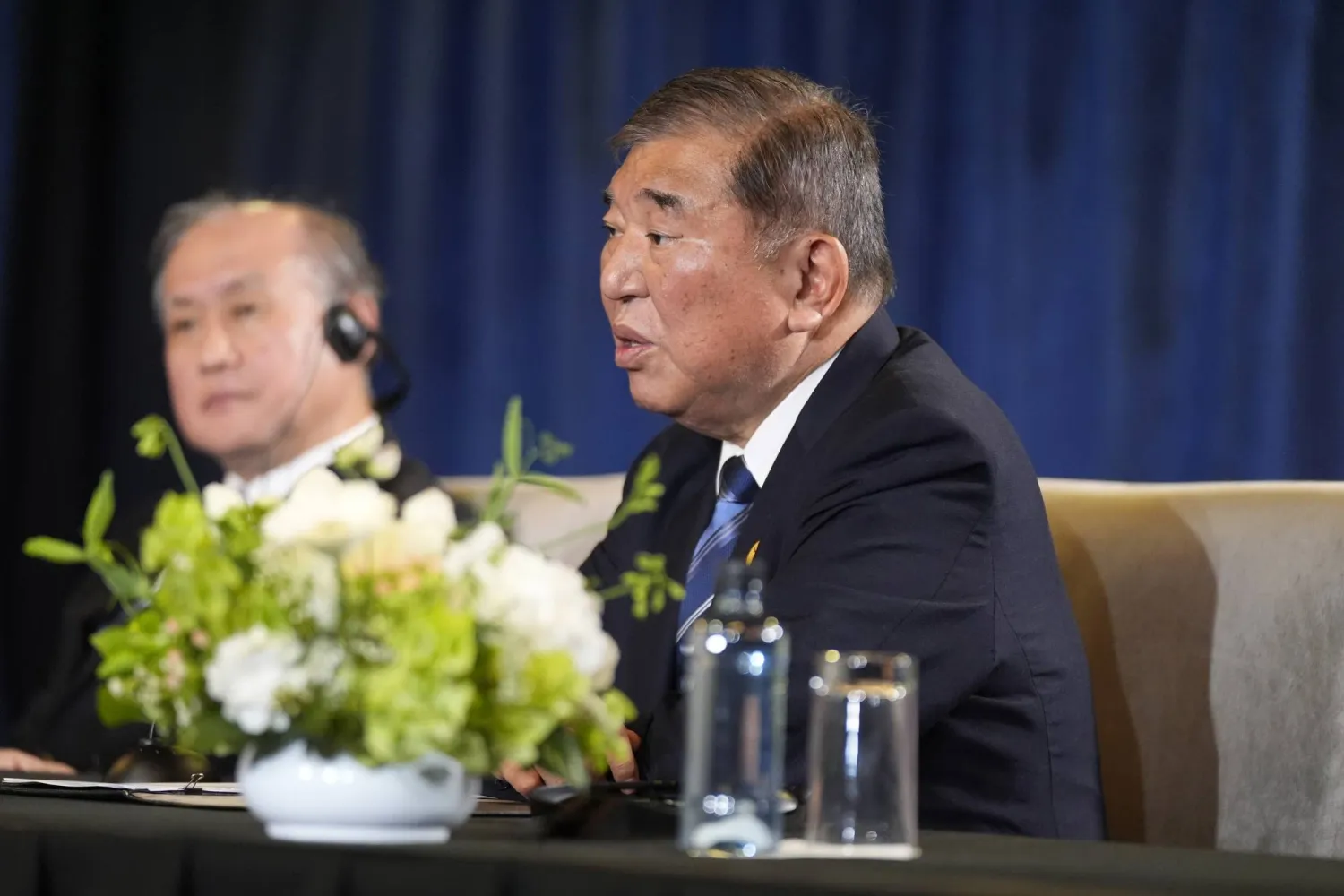

Japan PM Expresses Concern to Xi Over South China Sea Situation

Prime Minister of Japan Shigeru Ishiba speaks during a trilateral meeting with President Joe Biden and the President of South Korea Yoon Suk Yeol in Lima, Peru, Friday, Nov. 15, 2024. (AP Photo/Manuel Balce Ceneta)
TT

Japan PM Expresses Concern to Xi Over South China Sea Situation

Prime Minister of Japan Shigeru Ishiba speaks during a trilateral meeting with President Joe Biden and the President of South Korea Yoon Suk Yeol in Lima, Peru, Friday, Nov. 15, 2024. (AP Photo/Manuel Balce Ceneta)

Japanese Prime Minister Shigeru Ishiba expressed "serious concerns" over the situation in the South China Sea to Chinese President Xi Jinping in their first in-person talks, Tokyo's foreign ministry said Saturday.
But the pair agreed to work to expand cultural exchanges and continue high-level dialogue on the economy, both Tokyo and Beijing said after the talks on the sidelines of the Asia-Pacific Economic Cooperation (APEC) summit in Peru.
The meeting comes after Ishiba kept his job as prime minister in a parliamentary vote this week despite having led the ruling coalition to its worst election result in 15 years, AFP said.
Relations between Japan and China have worsened as Beijing builds up its military capacity in the region and Tokyo boosts security ties with the United States and its allies.
Ishiba "conveyed serious concerns over the Chinese military's growing activity" to Xi, the Japanese foreign ministry said.
He stressed that "the peace and stability of the Taiwan Strait is extremely important to Japan and the international community, while also expressing serious concerns over the situation surrounding the South China Sea, Hong Kong and Xinjiang".
China has ramped up military pressure on self-ruled Taiwan in recent years to pressure Taipei into accepting its claims of sovereignty, which the island's government rejects.

Beijing has also in recent months pressed its sweeping territorial claims in the East and South China Seas more stridently.
Xi said he hoped Japan would work with China to "properly handle major issues of principle such as history and Taiwan" and "manage differences constructively," according to a statement from the Chinese Ministry of Foreign Affairs.
China and Japan, "whose economic interests and industrial and supply chains are deeply intertwined," need to "pursue win-win cooperation and maintain the global free trade system as well as stable and unimpeded production and supply chains", Xi said.
Tokyo said they had agreed to "work towards realizing mutual visits by respective foreign ministers, as well as the high-level dialogue on cultural exchange and economy".
Another recent flashpoint in bilateral ties was the fatal stabbing in September of a 10-year-old Japanese schoolboy in Shenzhen.
Ishiba urged Xi to "strengthen measures to ensure the safety of Japanese citizens" living in China, while Xi promised that the "safety of foreign nationals including Japanese people will be secured," Japan's foreign ministry said.
At APEC, Ishiba also met outgoing US President Joe Biden and held trilateral talks with Biden and South Korean President Yoon Suk Yeol.
"We strongly oppose any unilateral attempts to change the status quo" in Asia-Pacific waters, the three leaders said in a joint statement, without mentioning China directly.
"We steadfastly oppose the dangerous use of coast guard and maritime militia vessels and coercive activities in the South China Sea," it said.



Georgia Arrests Two Foreigners Trying to Purchase Uranium

FILE PHOTO: A block with the symbol, atomic number and mass number of Uranium (U) element, in this illustration taken January 21, 2026. REUTERS/Dado Ruvic/Illustration/File Photo
TT

Georgia Arrests Two Foreigners Trying to Purchase Uranium

FILE PHOTO: A block with the symbol, atomic number and mass number of Uranium (U) element, in this illustration taken January 21, 2026. REUTERS/Dado Ruvic/Illustration/File Photo

Georgia has ‌detained two people who attempted to purchase $3 million worth of uranium and a cache of a radioactive isotope found in nuclear weapons testing programs, the national security service said on Thursday.

Two foreign nationals from unspecified countries were arrested in the city of Kutaisi, the State Security Service said in a statement.

"They were planning to ‌illegally purchase ‌nuclear material uranium and radioactive ‌substance ⁠Cesium 137 for $3 ⁠million and illegally transport it to the territory of another country," Reuters quoted it as saying.

It said other foreigners had been arriving in Georgia in recent weeks with the aim of purchasing and transporting the nuclear and ⁠radioactive materials, without elaborating further.

The ‌statement did ‌not specify the quantity of materials the individuals were ‌attempting to procure. There were ‌no details on the substances' origin or potential destination.

Cesium 137 is a radioactive isotope present primarily in the aftermath of nuclear weapons testing ‌and nuclear power plant accidents such as the Chernobyl disaster in ⁠then-Soviet ⁠Ukraine in 1986.

The security of nuclear materials was one of the biggest concerns after the 1991 fall of the Soviet Union, of which Georgia was part. There have been several serious incidents involving the illicit trade in nuclear materials in Georgia over recent decades.

Most recently, three Chinese citizens were arrested in the capital Tbilisi for attempting to purchase two kilograms of "nuclear material" uranium.


Former South Korean President Yoon Receives Life Sentence for Imposing Martial Law

FILE PHOTO: South Korea’s impeached President Yoon Suk Yeol attends the fourth hearing of his impeachment trial over his short-lived imposition of martial law at the Constitutional Court in Seoul, South Korea, 23 January 2025. JEON HEON-KYUN/Pool via REUTERS/File Photo
TT

Former South Korean President Yoon Receives Life Sentence for Imposing Martial Law

FILE PHOTO: South Korea’s impeached President Yoon Suk Yeol attends the fourth hearing of his impeachment trial over his short-lived imposition of martial law at the Constitutional Court in Seoul, South Korea, 23 January 2025. JEON HEON-KYUN/Pool via REUTERS/File Photo

Former South Korean President Yoon Suk Yeol was sentenced to life in prison for his brief imposition of martial law in a dramatic culmination to the country’s biggest political crisis in decades.

Yoon was ousted from office after a baffling attempt to overcome an opposition-controlled legislature by declaring martial law and sending troops to surround the National Assembly on Dec. 3, 2024, The Associated Press said.

Judge Jee Kui-youn of the Seoul Central District Court said he found Yoon guilty of rebellion for mobilizing military and police forces in an illegal attempt to seize the liberal-led Assembly, arrest politicians and establish unchecked power for a “considerable” time.

Martial law crisis recalled dictatorial past Yoon’s martial law imposition, the first of its kind in more than four decades, harkened back to South Korea’s past military-backed governments when authorities occasionally proclaimed emergency decrees that allowed them to station soldiers, tanks and armored vehicles on streets or at public places such as schools to prevent anti-government demonstrations.

As lawmakers rushed to the National Assembly, Yoon’s martial law command issued a proclamation declaring sweeping powers, including suspending political activities, controlling the media and publications, and allowing arrests without warrants.

The decree lasted about six hours before being lifted after a quorum of lawmakers managed to break through a military blockade and unanimously voted to lift the measure.

Yoon was suspended from office on Dec. 14, 2024, after being impeached by lawmakers and was formally removed by the Constitutional Court in April 2025. He has been under arrest since last July while facing multiple criminal trials, with the rebellion charge carrying the most severe punishment.

Yoon's lawyers reject conviction Yoon Kap-keun, one of the former president’s lawyers, accused Jee of issuing a “predetermined verdict” based solely on prosecutors’ arguments and said the “rule of law” had collapsed. He said he would discuss whether to appeal with his client and the rest of the legal team.

Yoon Suk Yeol told the court the martial law decree was only meant to raise public awareness of how the liberals were paralyzing state affairs, and that he was prepared to respect lawmakers if they voted against the measure.

Prosecutors said it was clear Yoon was attempting to disable the legislature and prevent lawmakers from lifting the measure through voting, actions that exceeded his constitutional authority even under martial law.

In announcing Yoon and Kim’s verdicts, Jee said the decision to send troops to the National Assembly was key to his determination that the imposition of martial law amounted to rebellion.

“This court finds that the purpose of (Yoon’s) actions was to send troops to the National Assembly, block the Assembly building and arrest key figures, including the National Assembly speaker and the leaders of both the ruling and opposition parties, in order to prevent lawmakers from gathering to deliberate or vote,” Jee said. “It’s sufficiently established that he intended to obstruct or paralyze the Assembly’s activities so that it would be unable to properly perform its functions for a considerable period of time.”

Protesters rally outside court

As Yoon arrived in court, hundreds of police officers watched closely as Yoon supporters rallied outside a judicial complex, their cries rising as the prison bus transporting him drove past. Yoon’s critics gathered nearby, demanding the death penalty.

There were no immediate reports of major clashes following the verdict.

A special prosecutor had demanded the death penalty for Yoon Suk Yeol, saying his actions posed a threat to the country’s democracy and deserved the most serious punishment available, but most analysts expected a life sentence since the poorly-planned power grab did not result in casualties.

South Korea has not executed a death row inmate since 1997, in what is widely seen as a de facto moratorium on capital punishment amid calls for its abolition.

Other officials sentenced for enforcing martial law

The court also convicted and sentenced several former military and police officials involved in enforcing Yoon’s martial law decree, including ex-Defense Minister Kim Yong Hyun, who received a 30-year jail term for his central role in planning the measure and mobilizing the military.

Last month, Yoon was sentenced to five years in prison for resisting arrest, fabricating the martial law proclamation and sidestepping a legally mandated full Cabinet meeting before declaring the measure.

The Seoul Central Court has also convicted two members of Yoon’s Cabinet in other cases. That includes Prime Minister Han Duck-soo, who received a 23-year prison sentence for attempting to legitimize the decree by forcing it through a Cabinet Council meeting, falsifying records and lying under oath. Han has appealed the verdict.

Yoon is the first former South Korean president to receive a life sentence since former military dictator Chun Doo-hwan, who was sentenced to death in 1996 for his 1979 coup, a bloody 1980 crackdown on pro-democracy protesters in Gwangju that left more than 200 people dead or missing, and corruption.

The Supreme Court later reduced his sentence to life imprisonment, and he was released in late 1997 under a special presidential pardon. He died in 2021.


UK Condemns 10-year Sentence for British Couple in Iran

(FILES) A handout photograph released in London on August 4, 2025 by the family of Craig and Lindsay Foreman, shows Craig and Lindsay at Naqsh-e Jahan Square, or Shah Square, with the Shah Mosque in the background, in Isfahan, Iran, at an undated time. (Photo by FAMILY HANDOUT / AFP)
TT

UK Condemns 10-year Sentence for British Couple in Iran

(FILES) A handout photograph released in London on August 4, 2025 by the family of Craig and Lindsay Foreman, shows Craig and Lindsay at Naqsh-e Jahan Square, or Shah Square, with the Shah Mosque in the background, in Isfahan, Iran, at an undated time. (Photo by FAMILY HANDOUT / AFP)

British foreign minister Yvette Cooper on Thursday condemned as "totally unjustifiable" the 10-year sentence given to a British couple in Iran for spying, saying the government would continue to press for their release.

Craig and Lindsay Foreman had been charged with espionage after Iran accused them of gathering information in several parts of the country.

"We will pursue this case relentlessly with the Iranian government until we see ‌Craig and Lindsay ‌Foreman safely returned to the UK and reunited with ‌their ⁠family," Reuters quoted Cooper as saying in ⁠a statement.

The Foremans were arrested on January 3 of last year while travelling through Iran on a global motorcycle journey. Iranian state media announced their detention the following month over espionage charges and they have now been held for more than 13 months.

Joe Bennett, Lindsay's son, said in a separate statement the couple had appeared at a three-hour trial ⁠on October 27, in which they were not allowed to ‌present a defense.

"We have seen no ‌evidence to support the charge of espionage," he said, adding that the family ‌was deeply concerned about the couple's welfare and the lack of transparency ‌in the judicial process.

Bennett called on the British government to "act decisively and use every available avenue" to secure their release.

The Iranian embassy in London did not immediately respond to a request for comment on the sentencing.

According to a family ‌statement, the couple have been held for extended periods without being able to communicate. They have had limited or ⁠delayed access ⁠to legal representation, periods of solitary confinement and delays in receiving funds for basic necessities. They also reported disrupted or cancelled consular visits.

Cooper, whose office did not comment on the disruption, said they would continue to provide consular assistance.

Lindsay Foreman has been held in the women's section of Tehran's Evin Prison, while her husband Craig has been held in its political wing.

Iran's Revolutionary Guards have in recent years detained foreign and dual nationals, typically on espionage or national security charges.

Human rights organizations say the authorities use such arrests as leverage in disputes with other countries, a practice they describe as part of a broader pattern of politically motivated detentions. Tehran has rejected those accusations and said the cases involved legitimate security concerns.