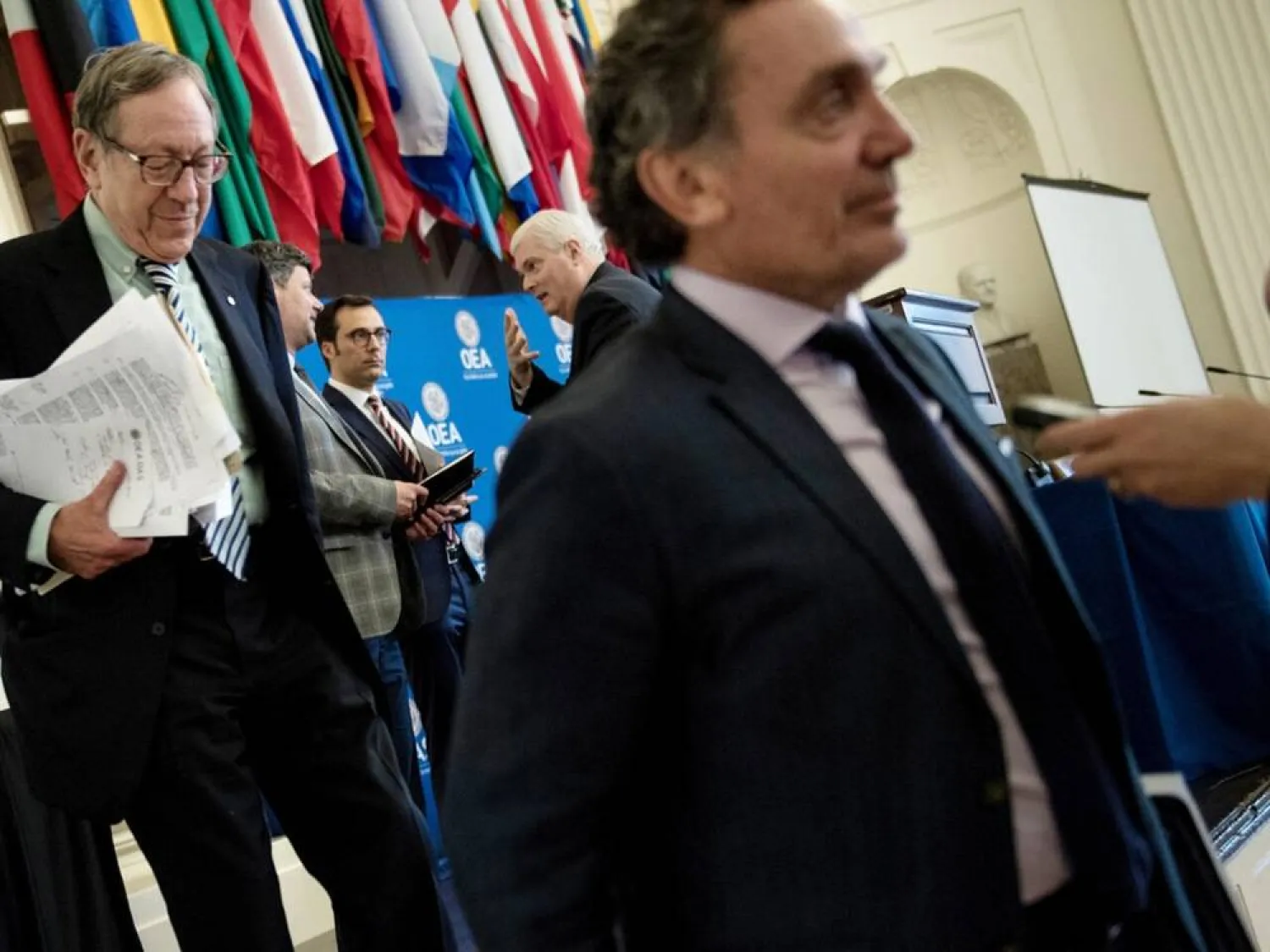
Canada Foiled Iran Plot to Assassinate Former Minister

 Irwin Cotler (L) was targeted in an alleged Iranian assassination plot. (AFP)
Irwin Cotler (L) was targeted in an alleged Iranian assassination plot. (AFP)
TT

Canada Foiled Iran Plot to Assassinate Former Minister

 Irwin Cotler (L) was targeted in an alleged Iranian assassination plot. (AFP)
Irwin Cotler (L) was targeted in an alleged Iranian assassination plot. (AFP)

Canadian authorities recently foiled an alleged Iranian plot to assassinate Irwin Cotler, a former justice minister who has been a strong critic of Tehran, Cotler's organization said Monday.

The 84-year-old was justice minister and attorney general from 2003 to 2006. He retired from politics in 2015 but has remained active with many associations that campaign for human rights around the world.

The Globe and Mail newspaper reported that he was informed on October 26 that he faced an imminent threat -- within 48 hours -- of assassination from Iranian agents.

Authorities tracked two suspects in the plot, the paper said, citing an unnamed source.

In an email to AFP, the Raoul Wallenberg Center for Human Rights, where Cotler is international chair, confirmed the Globe and Mail report.

Cotler "has no knowledge or details regarding any arrests made," said Brandon Golfman, an organization spokesman.

Tehran late on Monday denied what it described as "the claim of Canadian media that Iran tried to assassinate a Canadian person," the official IRNA news agency reported, citing Issa Kameli, the director general for the Americas at the foreign ministry.

The Iranian diplomat denounced the report as "ridiculous storytelling and in line with the misinformation campaign against Iran".

A spokesperson for Canadian Public Safety Minister Dominic LeBlanc declined to comment, telling AFP: "We cannot comment on, nor confirm specific RCMP (Royal Canadian Mounted Police) operations due to security reasons."

Another senior government minister, Francois-Philippe Champagne, called the plot "very concerning."

Jean-Yves Duclos, the government's senior minister in Quebec province, where Cotler lives, said it was likely "very difficult for (Cotler), in particular, and his family and friends to hear" about it.

The House of Commons, meanwhile, passed a unanimous motion praising Cotler's work in defense of human rights and "condemning the death threats against him orchestrated by agents of a foreign regime."

Cotler had already been receiving police protection for more than a year after the October 7, 2023 attack in Israel by Hamas gunmen.

Cotler, who is Jewish and a strong backer of Israel, has advocated globally to have Iran's Revolutionary Guard Corps listed as a terrorist entity.

His name reportedly also came up in an FBI probe of a 2022 Iranian murder-for-hire operation in New York that targeted American human rights activist Masih Alinejad.

Ottawa, which severed diplomatic ties with Iran more than a decade ago, listed the Revolutionary Guard as a banned terror group in June.

It said at the time that Iranian authorities displayed a consistent "disregard for human rights both inside and outside of Iran, as well as a willingness to destabilize the international rules-based order."

As a lawyer, Cotler also represented Iranian political prisoners and dissidents.

His daughter, Michal Cotler-Wunsh, is an Israeli politician and diplomat who previously served as a member of Israel's parliament.


Netanyahu Vows to Eliminate Iran Threat ‘Once and for All’

10 November 2026, Israel, Jerusalem: Caretaker Israeli Prime Minister Benjamin Netanyahu delivers a speech on the sidelines of the opening session of the new Knesset. (dpa)
TT

Netanyahu Vows to Eliminate Iran Threat ‘Once and for All’

10 November 2026, Israel, Jerusalem: Caretaker Israeli Prime Minister Benjamin Netanyahu delivers a speech on the sidelines of the opening session of the new Knesset. (dpa)

Israel's caretaker prime minister Benjamin Netanyahu on Saturday reiterated his calls for a national unity government with his opponent Gadi Eisenkot, as well as his vow to eliminate the threat from Iran.

A meeting with Eisenkot on Thursday "only strengthened the conviction that it is essential to form a national unity government" to guarantee Israel's security, Netanyahu said in a video statement, adding that such a government could "eliminate the Iranian threat once and for all".


Ukraine’s Zelenskiy Escalates Criticism of SpaceX Over Speed Caps

Ukraine's President Volodymyr Zelenskiy holds a press briefing in Copenhagen November 10, 2026. (AFP)
TT

Ukraine’s Zelenskiy Escalates Criticism of SpaceX Over Speed Caps

Ukraine's President Volodymyr Zelenskiy holds a press briefing in Copenhagen November 10, 2026. (AFP)

Ukraine's President Volodymyr Zelenskiy ‌escalated his criticism of SpaceX on Saturday, saying speed restrictions on its military-grade Starshield satellite terminals had dangerous political implications and undermined critical air defenses.

Zelenskiy said Starshield terminals operating in temporarily Russian-occupied territories of Ukraine had been limited to a maximum speed of 161 kph for the past five days, hampering Ukraine's military capabilities.

The Ukrainian Defense Ministry has raised the issue with SpaceX at the ‌institutional level, ‌Zelenskiy said.

"The restrictions have now ‌been ⁠in place for ⁠five days. They say it is some kind of technical issue. We do not believe that is the case," Zelenskiy told reporters in remarks released by his office on Saturday.

"If you impose restrictions there, you are already partially recognizing the temporarily ⁠occupied territories as not ours. And ‌that is why I ‌believe we have the right to raise this ‌issue and restore the speed – so that there ‌are no restrictions at all."

Zelenskiy said the speed restrictions made it more difficult for Ukrainian air defense units to intercept Russian jet-powered drones and made Ukrainian cities ‌more vulnerable. He said he had ordered his top military and foreign ministry ⁠officials ⁠to address the issue and seek clarification.

SpaceX has pushed back against the allegations, denying that it introduced new restrictions or made any changes to its satellite operations.

It is the second such outage in recent weeks. In mid-October, Ukrainian officials said that SpaceX limited the speed of Starlink and its Starshield communication systems to about 160 kph (100 mph) amid tensions with US President Donald Trump's administration over Ukrainian attacks on Russian oil refineries. Service was then restored on October 24.


UN Official Urges Iran, US to Let Fertilizers Through Hormuz Strait

Jorge Moreira da Silva, Executive Director of UNOPS (United Nations Office for Project Services), and coordinator of the UN Strait of Hormuz Task Force established by the UN Secretary-General, speaks during an interview with AFP on the sidelines of the 31st United Climate Change Conference (COP31), at the media center located on the Antalya Expo Center in Antalya on November 14, 2026. (AFP)
TT

UN Official Urges Iran, US to Let Fertilizers Through Hormuz Strait

Jorge Moreira da Silva, Executive Director of UNOPS (United Nations Office for Project Services), and coordinator of the UN Strait of Hormuz Task Force established by the UN Secretary-General, speaks during an interview with AFP on the sidelines of the 31st United Climate Change Conference (COP31), at the media center located on the Antalya Expo Center in Antalya on November 14, 2026. (AFP)

Iran and the United States should "immediately" allow fertilizer shipments through the Strait of Hormuz to ease the crisis in some of the most vulnerable countries, a senior UN official said Saturday.

Jorge Moreira da Silva, head of the UN Office for Project Services, told the COP31 climate talks in the Turkish resort city of Antalya that the lack of fertilizers could push millions into poverty.

The Iranian blockade of the vital waterway, which started after the joint US-Israeli attack against Iran in late February, has choked shipping in the region and beyond. The US blockade of Iranian ports has further complicated matters.

While Iran and the United States are still trying to negotiate an end to the conflict, Moreira da Silva said he had the same message for both countries.

"They should continue their negotiations about the comprehensive deal -- but that deal should not avoid an immediate, exceptional, limited, and time-bound solution for the fertilizers," he said.

"Basically, what we need is five vessels a day with fertilizers," he added.

- Millions at risk -

Moreira da Silva heads up the UN task force dedicated to facilitating the safe passage of fertilizers during the crisis.

Before the conflict, a third of the world's fertilizers passed through the Strait of Hormuz, and since the blockades, their prices had risen by 30 percent, he said.

"But what I think is not sufficiently recognized is the disproportionate impact on the most vulnerable countries," he added.

Sudan's finance minister recently told him that the price of food there had doubled in six months, he added. In Nepal, they had told him that farmers could no longer afford to buy fertilizers.

"So, it's very important that we are aware that countries such as Mozambique, Kenya, Sudan, Somalia, Nepal, Bangladesh, Sri Lanka are facing very significant impact."

The effects of this shortage could be catastrophic, he warned.

"If we continue missing the planting seasons in different parts of the world we may have 45 million people facing severe and acute food insecurity," he said.

"We may have 30 million people being forced into poverty."

The UN had a system ready to get fertilizer shipments moving within seven to 10 days, he said.