


Trump Extends Unprecedented Invites to China's Xi and Other World Leaders for His Inauguration

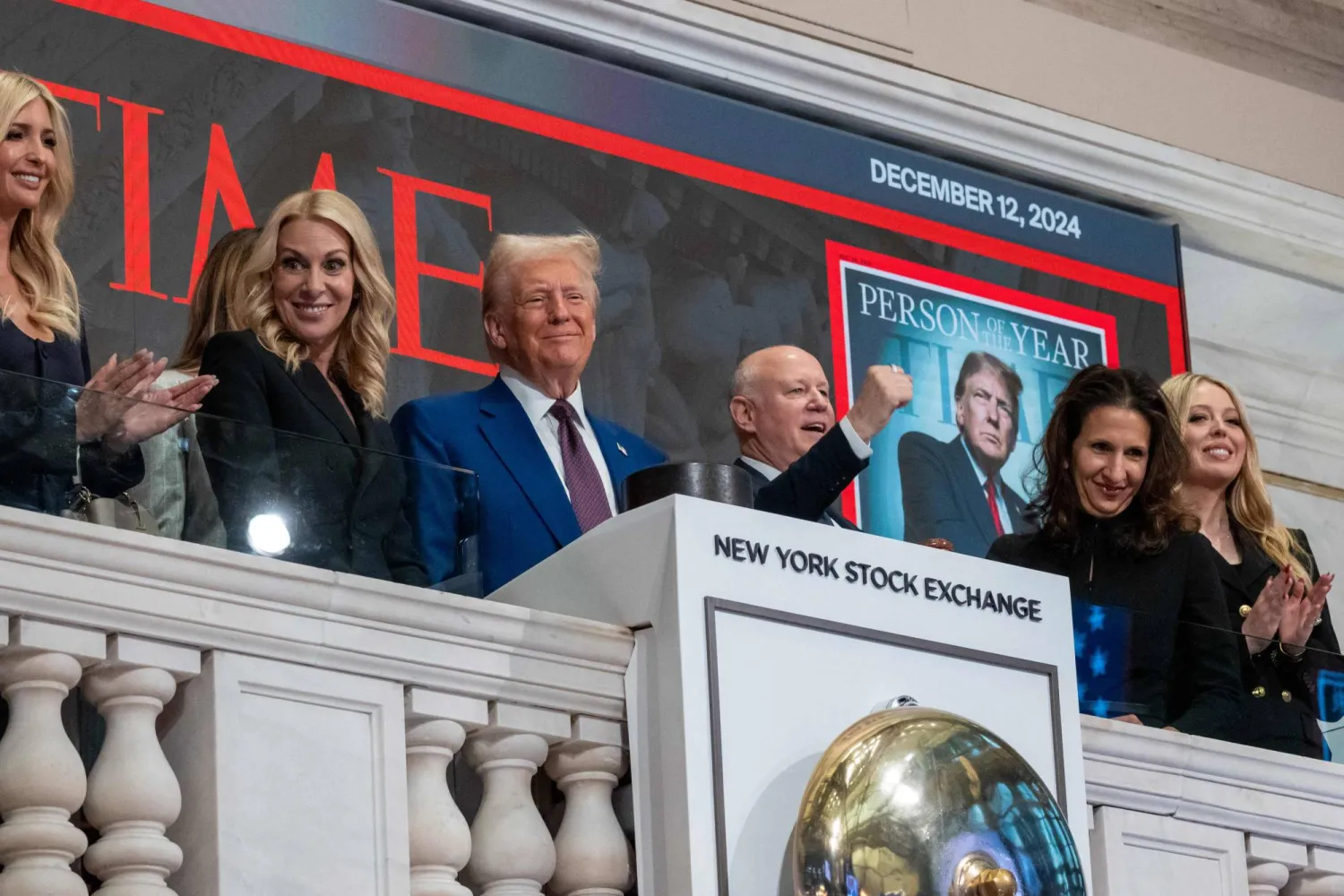
President-elect Donald Trump rings the opening bell on the trading floor of the New York Stock Exchange (NYSE) on December 12, 2024 in New York City. Spencer Platt/Getty Images/AFP
TT

Trump Extends Unprecedented Invites to China's Xi and Other World Leaders for His Inauguration

President-elect Donald Trump rings the opening bell on the trading floor of the New York Stock Exchange (NYSE) on December 12, 2024 in New York City. Spencer Platt/Getty Images/AFP

President-elect Donald Trump has invited Chinese President Xi Jinping and other world leaders to his inauguration next month — an unorthodox move that would fold US allies and adversaries into a very American political tradition.
Trump said Thursday during an appearance at the New York Stock Exchange, where he was ringing the opening bell to kick off trading for the day, that he’s been “thinking about inviting certain people to the inauguration” without referring to any specific individuals, The Associated Press said.
“And some people said, ‘Wow, that’s a little risky, isn’t it?’” Trump said. “And I said, ‘Maybe it is. We’ll see. We’ll see what happens.’ But we like to take little chances.”
His comments came soon after his incoming White House press secretary, Karoline Leavitt, confirmed during a Thursday morning appearance on “Fox & Friends” that Trump had invited Xi and other world leaders to attend his inauguration. No head of state has previously made an official visit to the US for the inauguration, according to State Department historical records.
The unprecedented invitations come at a moment when much of the world is bracing for what comes next when Trump and his “America First” worldview return to the White House.
The president-elect has vowed to levy massive tariffs against the United States' chief economic competitor, China, as well as neighbors Canada and Mexico unless those countries do more to reduce illegal immigration and the flow of illegal drugs such as fentanyl into the United States.
Trump also pledged to move quickly to end Russia's nearly three-year war in Ukraine and press NATO allies who are spending less than 2% of their GDP on defense to step up or risk the United States not coming to their defense, as required by the transatlantic alliance's treaty, should they come under attack.
“We’ve been talking and discussing with President Xi some things, and others, other world leaders, and I think we’re going to do very well all around,” Trump said. “We’ve been abused as a country. We’ve been badly abused from an economic standpoint, I think, and even militarily, you know, we put up all the money, they put up nothing, and then they abuse us on the economy. And we just can’t let that happen.”
Xi is likely to see the invitation as too risky to accept, and the gesture from Trump may have little bearing on the increasingly competitive ties between the two nations as the White House changes hands, experts say.
Danny Russel, vice president for international security and diplomacy at the Asia Society Policy Institute, said Xi would not allow himself to “be reduced to the status of a mere guest celebrating the triumph of a foreign leader — the US president, no less.”
Still, Leavitt saw it as a plus.
“This is an example of President Trump creating an open dialogue with leaders of countries that are not just our allies, but our adversaries and our competitors, too,” she said on "Fox & Friends." “We saw this in his first term. He got a lot of criticism for it, but it led to peace around this world. He is willing to talk to anyone, and he will always put America’s interest first.”
Asked at a Chinese Foreign Ministry briefing Thursday about Trump's invitation, spokesperson Mao Ning responded, “I have nothing to share at present.”
Leavitt did not detail which leaders beyond Xi have been invited.
But Trump's decision to invite Xi, in particular, squares with his belief that foreign policy — much like a business negotiation — should be carried out with carrots and sticks to get the United States' opponents to operate closer to his administration's preferred terms.
Jim Bendat, a historian and author of “Democracy’s Big Day: The Inauguration of Our President,” said he was not aware of a previous US inauguration attended by a foreign head of state.
“It's not necessarily a bad thing to invite foreign leaders to attend,” Bendat said. “But it sure would make more sense to invite an ally before an adversary.”
Edward Frantz, a presidential historian at the University of Indianapolis, said the invitation helps Trump burnish his “dealmaker and savvy businessman” brand.
“I could see why he might like the optics," Frantz said. “But from the standpoint of American values, it seems shockingly cavalier."
White House officials said it was up to Trump to decide whom he invites to the inauguration.
“I would just say, without doubt, it's the single most consequential bilateral relationship that the United States has in the world,” White House national security spokesperson John Kirby said. “It is a relationship both fraught with peril and responsibility.”
It's unclear which leaders, if any, might show.
A top aide to Hungarian President Viktor Orban, one of Trump's most vocal supporters on the world stage, said Thursday that Orban isn't slated to attend the inauguration.
“There is no such plan, at least for the time being," said Gergely Gulyás, Orban's chief of staff.
The nationalist Hungarian leader is embraced by Trump but has faced isolation in Europe as he's sought to undermine the European Union's support for Ukraine, and routinely blocked, delayed or watered down the bloc’s efforts to provide weapons and funding and to sanction Moscow for its invasion. Orban recently met with Trump at Mar-a-Lago.
Every country's chief of mission to the United States will also be invited, according to a Trump Inaugural Committee official who was not authorized to comment publicly and spoke on condition of anonymity. Such invitations to diplomats stationed in Washington has been customary during past inaugurations.
Xi, during a meeting with President Joe Biden last month in Peru, urged the United States not to start a trade war.
“Make the wise choice,” Xi cautioned. “Keep exploring the right way for two major countries to get along well with each other.”
Canadian Prime Minister Justin Trudeau has also pushed back on Trump's threats, warning that such tariffs would be perilous for the US economy as well.
Trudeau earlier this week said Americans “are beginning to wake up to the real reality that tariffs on everything from Canada would make life a lot more expensive” and said he will retaliate if Trump goes ahead with them.
Trump responded by calling Canada a state and Trudeau the governor.
In addition to the tariff dispute, US-China relations are strained over other issues, including what US officials see as Beijing's indirect support of Russia's war on Ukraine.
The Biden administration says China has supported Russia with a surge in sales of dual-use components that help keep its military industrial base afloat.
US officials also have expressed frustration with Beijing for not doing more to rein in North Korea's support for the Russian war. China accounts for the vast majority of North Korea’s trade.
North Korean leader Kim Jong Un has dispatched thousands of troops to Russia to help repel Ukrainian forces from the Kursk border region. The North Koreans also have provided Russia with artillery and other munitions, according to US and South Korean intelligence officials.
Trump’s Jan. 20 inauguration is set to take place a day after the US deadline for ByteDance, the Chinese parent company of social media giant TikTok, to sell the social media app or face a ban in the United States.

Taiwan Says Chinese Aircraft Carrier Sailed Through Taiwan Strait 

Chinese aircraft carrier Shandong sails in Pacific Ocean waters, about 300 kilometers (186 miles) south of Okinawa prefecture, Japan, April 5, 2023. (Reuters)
TT

Taiwan Says Chinese Aircraft Carrier Sailed Through Taiwan Strait 

Chinese aircraft carrier Shandong sails in Pacific Ocean waters, about 300 kilometers (186 miles) south of Okinawa prefecture, Japan, April 5, 2023. (Reuters)

China's newest and most advanced aircraft carrier, the Fujian, sailed through the Taiwan Strait on Tuesday, Taiwan's defense ministry said, its first transit of the sensitive waterway since formally entering service last month.

Taiwan, which Beijing views as its territory, reports almost daily Chinese military activity around the island in what Taipei views as an ongoing pressure campaign against the democratically elected government.

In a statement on Wednesday, Taiwan's defense ministry said the Fujian had transited the strait the previous day and that Taiwan's forces had monitored it.

The ministry showed a grainy, black-and-white picture of the carrier with no aircraft on its deck. It did not say where the picture was taken and offered no other details.

China's defense ministry did not immediately respond to a request for comment.

China says it alone has sovereignty over the strait, a major maritime artery for freight traffic. Taiwan and the United States say it is an international waterway.

In September, the carrier sailed through the Taiwan Strait and into the disputed South China Sea during trials.

The Fujian is China's third aircraft carrier, with a flat flight deck and electromagnetic catapults for take-offs that make it a potentially far more powerful naval weapon than China's first two Russian-designed carriers.

The Fujian will be able to carry significantly more and heavier armed jet fighters than the Liaoning and Shandong carriers, which are smaller and rely on ramps to launch aircraft.

With a flat deck and electromagnetic catapults to launch aircraft, the Fujian is expected to host a larger and wider range of planes than the other two carriers - including early-warning aircraft and, eventually, China's first carrier-capable stealth jet fighters.

China's President Xi Jinping attended its commissioning and flag presenting ceremony in the southern island province of Hainan last month and boarded the vessel for an inspection tour.


Alleged Bondi Gunman Charged with 15 Murders as Funerals of Victims Begin 

Police officers remove police tape from the scene of Sunday's shooting at Bondi Beach, in Sydney on December 17, 2025. (AFP)
TT

Alleged Bondi Gunman Charged with 15 Murders as Funerals of Victims Begin 

Police officers remove police tape from the scene of Sunday's shooting at Bondi Beach, in Sydney on December 17, 2025. (AFP)

A man who allegedly opened fire on a Jewish Hanukkah celebration on Sydney's famed Bondi Beach has been charged with 59 offences, including murder and terrorism, police said on Wednesday.

The alleged father-and-son perpetrators opened fire on the celebration at Sydney's famed Bondi Beach on Sunday, killing 15 in an attack that shook the nation and intensified fears of rising antisemitism and violent extremism.

Funerals of the Jewish victims of the attack began on Wednesday, amid anger over how the gunmen - one of whom was briefly investigated for links to extremists - were allowed access to powerful firearms.

Sajid Akram, 50, was shot dead by police at the scene, while his 24-year-old son Naveed Akram emerged from a coma on Tuesday afternoon after also being shot by police.

New South Wales Police said on Wednesday that a man had been charged with 59 offences, including 15 counts of murder, 40 counts of wounding with attempt to murder, as well as a terror offence and other charges.

"Police will allege in court the man engaged in conduct that caused death, serious injury and endangered life to advance a religious cause and cause fear in the community," it said in a statement.

"Early indications point to a terrorist attack inspired by ISIS, a listed terrorist organization in Australia."

A court filing on Wednesday named Naveed Akram, who remains in a Sydney hospital under heavy police guard, as the man charged.

He will appear via video link before a local court on Monday morning.

The father and son had travelled to the southern Philippines, a region long plagued by militancy, weeks before the shooting that Australian police said appeared to be inspired by ISIS.

US President Donald Trump told a Hanukkah event at the White House late on Tuesday that he was thinking of the victims of the "horrific and antisemitic terrorist attack".

"We join in mourning all of those who were killed, and we're praying for the swift recovery of the wounded," he said.

STATE GOVERNMENT TO PASS GUN REFORMS

The leader of the Australian state of New South Wales said on Wednesday he will recall parliament next week to pass wide-ranging reforms of gun and protest laws, days after the country's deadliest mass shooting in three decades.

Chris Minns, the Premier of New South Wales state where the attack took place, told a news conference parliament would return on December 22 to hear "urgent" reforms, including capping the number of firearms allowed by a single person and making certain types of shotguns harder to access.

The state government will also look at reforms making it harder to hold large street protests after terror events, in order to prevent further tensions.

"We've got a monumental task in front of us. It's huge," he said.

"It's a huge responsibility to pull the community together. I think we need a summer of calm and togetherness, not division."

FUNERALS FOR JEWISH VICTIMS BEGIN

A funeral for Rabbi Eli Schlanger, an assistant rabbi at Chabad Bondi Synagogue and a father of five, was held on Wednesday. He was known for his work for Sydney’s Jewish community through Chabad, a global organization fostering Jewish identity and connection.

Schlanger would travel to prisons and meet with Jewish people living in Sydney's public housing communities, Jewish leader Alex Ryvchin said on Monday.

Prime Minister Anthony Albanese is facing criticism that his center-left government did not do enough to prevent the spread of antisemitism in Australia during the two-year Israel-Gaza war.

"We will work with the Jewish community, we want to stamp out and eradicate antisemitism from our society," Albanese told reporters.

The government and intelligence services are also under pressure to explain why Sajid Akram was allowed to legally acquire the high-powered rifles and shotguns used in the attack.

The government has already promised sweeping reforms to gun laws.

Naveed Akram, meanwhile, was briefly investigated by Australia's domestic intelligence agency in 2019 over alleged links to ISIS, but there was no evidence at the time he posed a threat, Albanese said.

MAN PRAISED AS HERO TO UNDERGO SURGERY

Albanese said Ahmed al-Ahmed, 43, the man who tackled one of the shooters to disarm his rifle and suffered gunshot wounds, was due to undergo surgery on Wednesday.

Al-Ahmed's uncle, Mohammed al-Ahmed in Syria, said his nephew left his hometown in Syria's northwest province of Idlib nearly 20 years ago to seek work in Australia.

"We learned through social media. I called his father and he told me that it was Ahmed. Ahmed is a hero, we're proud of him. Syria in general is proud of him," the uncle told Reuters.

The family of 22-year-old police officer Jack Hibbert, who was shot twice on Sunday and had been on the force for just four months, said in a statement on Wednesday he had lost vision in one eye and faced a "long and challenging recovery" ahead.

"In the face of a violent and tragic incident, he responded with courage, instinct, and selflessness, continuing to protect and help others whilst injured, until he was physically no longer able to," the family said.

New South Wales Premier Minns said 23 people were still in several Sydney hospitals.

HOLOCAUST SURVIVOR AMONG VICTIMS

Other shooting victims included a Holocaust survivor, a husband and wife who first approached the gunmen before they started firing, and a 10-year-old girl named Matilda, according to interviews, officials and media reports.

Matilda's father told a Bondi vigil on Tuesday night he did not want his daughter's legacy to be forgotten.

"We came here from Ukraine ... and I thought that Matilda is the most Australian name that can ever exist. So just remember the name, remember her," local media reported him as saying.

In Bondi on Wednesday, swimmers gathered on Sydney's most popular beach and held a minute's silence. A New Year's Eve party due to be held on the beach was cancelled by organizers.

"This week has obviously been very profound, and this morning, I definitely feel a sense of the community getting together, and a sense of everyone sitting together," Archie Kalaf, a 24-year-old Bondi man, told Reuters. "Everyone's grieving, everyone's understanding and processing it in their own way."


Iran FM in Russia for Nuclear Talks

Iranian Foreign Minister Abbas Araghchi meets with Russian legislators in Moscow. (Iranian Foreign Ministry)
TT

Iran FM in Russia for Nuclear Talks

Iranian Foreign Minister Abbas Araghchi meets with Russian legislators in Moscow. (Iranian Foreign Ministry)

Iranian Foreign Minister Abbas Araghchi arrived in Moscow on Tuesday amid a crisis in his country’s relations with the International Atomic Energy Agency (IAEA) and ongoing disagreements with the West over a nuclear deal.

Ahead of Araghchi’s arrival, Russian Foreign Minister Sergei Lavrov told Iranian state media that the IAEA needed to be neutral in dealing with Iran.

“The IAEA did not condemn the (US and Israeli) strikes on Iran (in June) even though the agency had a mandate to monitor the bombed sites – these were the sites in question. This omission was a blatant violation of all the rules and norms,” Lavrov said.

“This is why IAEA’s actions did not exactly please anyone in Iran, to say the least, which is more than understandable,” he noted.

Iran passed a law in July to suspend its cooperation with the IAEA, denying UN inspectors access into the country. The suspension came after US and Israeli airstrikes targeted Iran’s nuclear facilities on June 22.

The FM said Russia supported Iran at various stages of the negotiations with the IAEA.

President Vladimir Putin “discussed the current situation with our Iranian friends at various levels. We shared with our Iranian friends our opinion on how to deal with this situation, how to restore relations with the IAEA and with Western countries and on what terms, if they are interested in this. But the final decision remains, of course, with the leadership of Iran,” Lavrov added.

IAEA chief Rafael Grossi had been calling on Iran to allow inspectors access to three key nuclear facilities that enrich uranium and were hit by the US and Israeli airstrikes in June.

But head of the Atomic Energy Organization of Iran (AEOI) Mohammad Eslami said the IAEA has no right to demand inspections of the targeted sites.

In a related development, Egyptian Foreign Minister Badr Abdelatty held telephone talks with Grossi on Monday over the Iranian nuclear file.

Abdelatty underscored the importance of continuing efforts aimed at building confidence and paving the way for sustained cooperation between Iran and the IAEA.

In an interview with Radio France International (RFI) on Monday, Grossi said: “Contact with Iran remains in place. We haven’t yet been able to restore cooperation to the required level, but I believe it is critically important.”

He said dialogue with Iran continues through behind-the-scenes negotiations and confidential contacts.

Last month, Kamal Kharrazi, a top foreign affairs advisor to Supreme Leader Ali Khamanei, said Tehran was ready to consider a Russian and Chinese plan to resume cooperation with IAEA.

In Russia, Araghchi met with Leonid Slutsky, chairman of the international committee of the lower house of parliament, and leader of the Liberal Democratic Party of Russia (LDPR).

He said Russian-Iranian ties are developing across all areas of cooperation.

Araghchi and Lavrov are set to meet on Wednesday.