


Revolutionary Guard Chief: We Haven’t Lost Our Regional Arms

The head of Iran’s Revolutionary Guard, Hossein Salami (IRNA)
TT

Revolutionary Guard Chief: We Haven’t Lost Our Regional Arms

The head of Iran’s Revolutionary Guard, Hossein Salami (IRNA)

The head of Iran’s Revolutionary Guard, Hossein Salami, has defended the withdrawal of his forces from Syria, saying “strategies must adapt to changing circumstances” after the removal of Tehran’s key ally, President Bashar al-Assad.

Salami stated, “I proudly say the last to leave the resistance lines in Syria were our forces, and the final person to leave was one of our members.”

He added, “We cannot tackle global and regional issues with rigid, unchanging strategies.”

Salami discussed recent events in Syria and their consequences before a group of Revolutionary Guard leaders, according to the Tasnim News Agency.

This is Salami’s second comment on Assad’s fall. Two days earlier, lawmakers quoted him saying in a closed session that Iran "has not been weakened" after Assad's removal.

On Thursday, Salami stated that Iran “worked day and night to offer support” and must “adapt to the situation in Syria, observe it, and act accordingly,” as reported by IRNA.

He added, “Some expect us to fight instead of the Syrian army,” questioning, “Is it logical for us to send all our forces to fight in another country while that country's army does nothing?”

Salami explained, “All routes to Syria were blocked. The regime worked tirelessly to help, but we had to deal with the realities on the ground. We observe and act based on those facts.”

He also reaffirmed Iran’s stance that it knew about the opposition's plans months before Assad's fall.

“We were aware of the militants' movements. Our intelligence helped identify their attack routes and inform both the political and military leadership in Syria. Unfortunately, due to a lack of real will to change and fight, the result was as you saw.”

Iran’s relationship with Syria deepened during the civil war that began in 2011, when the Revolutionary Guard sent “military advisors” to assist Assad, led by the Quds Force, the Guard’s external arm.

Salami also denied claims that Iran had lost its regional influence, stating, “Some suggest the Iranian regime has lost its arms, but this is not true. The regime still has its arms.”

He added, “Support for the resistance front remains open, and the situation in Syria may evolve.”

Salami emphasized that Iran’s decisions are based on its internal strengths.

“We have the will to fight, legitimacy to defend, a united nation, and strong armed forces. If we were weak, we couldn't carry out operations like ‘True Promise.’”

He explained that Iran’s presence in Syria was to prevent ISIS dominance. “We had no choice but to be in Iraq and Syria,” he said.

The fall of Assad has led to criticism of Iran’s military role in Syria. Salami said, “Iran’s military presence and support in Iraq and Syria were necessary to stop the spread of danger.”

He added, “Without Qassem Soleimani, our resources would have been ineffective.”

Salami continued, “After defeating ISIS, we withdrew unnecessary forces from Syria. The situation had stabilized, and the Syrian army took over defense. They also wanted to reduce Iranian presence to avoid giving opposition groups a chance to attack.”

He concluded, “We reduced our presence to the minimum necessary and joined the Astana process to monitor the ceasefire and ensure security in Syria.”



Trump Vows Strikes on Iran’s Power Plants, Bridges if Strait of Hormuz isn't Reopened

ABD Başkanı Donald Trump (Reuters)
TT

Trump Vows Strikes on Iran’s Power Plants, Bridges if Strait of Hormuz isn't Reopened

ABD Başkanı Donald Trump (Reuters)

US President Donald Trump has promised strikes on Iran’s power plants and bridges on Tuesday, restating his threat to attack civilian infrastructure if the Strait of Hormuz isn’t reopened.

In an expletive-laden post Sunday morning, Trump promised the “crazy bastards” would be “living in Hell” if the waterway isn’t opened to marine traffic, The AP news reported.

Trump had previously threatened strikes two weeks ago, but extended the deadline for Iran to reopen the waterway twice, claiming there were positive signs in negotiations with the Iranians. But there have been few public signs of progress in a diplomatic off-ramp to the war.


Pope Leo Marks First Easter as Pontiff with Call for Hope Amid Global Conflicts

 Pope Leo XIV presides over Easter Mass in St. Peter's Square at the Vatican, Sunday, April 5, 2026 (AP)
Pope Leo XIV presides over Easter Mass in St. Peter's Square at the Vatican, Sunday, April 5, 2026 (AP)
TT

Pope Leo Marks First Easter as Pontiff with Call for Hope Amid Global Conflicts

 Pope Leo XIV presides over Easter Mass in St. Peter's Square at the Vatican, Sunday, April 5, 2026 (AP)
Pope Leo XIV presides over Easter Mass in St. Peter's Square at the Vatican, Sunday, April 5, 2026 (AP)

Pope Leo celebrated his first Easter Mass as pontiff with a call Sunday to exercise hope against “the violence of war that kills and destroys,” saying “we need this song of hope today” as conflicts spread around the world.

With the US-Israeli war on Iran in its second month and Russia’s ongoing campaign in Ukraine, Leo has repeatedly called for a halt in hostilities. In his Easter homily, the pope singled out those who wage war, abuse the weak and prioritize profits.

Leo, the first US-born pope, addressed the faithful from an open-air altar in St. Peter’s Square flanked with white roses, while the steps leading down to the piazza where the faithful gathered were filled with spring perennials, symbolically resonating with the pope’s message of hope.

The pontiff implored the faithful to keep their hope in the face of death, which lurks “in injustices, in partisan selfishness, in the oppression of the poor, in the lack of attention given to the most vulnerable.

“We see it in violence, in the wounds of the world, in the cry of pain that rises from every corner because of the abuses that crush the weakest among us, because of the idolatry of profit that plunders the earth’s resources, because of the violence of war that kills and destroys,” he said.

He quoted his predecessor Pope Francis in warning against falling into indifference in the face of “persistent injustice, evil, indifference and cruelty,” because “it is also true that in the midst of darkness, something new always springs to life and sooner or later produces fruit.”

He will later deliver the traditional “Urbi et Orbi” message — Latin for “to the city and the world.”

Christians in the Holy Land were marking a subdued Easter Traditional ceremonies at the Church of the Holy Sepulchre, revered by Christians as the traditional site of Jesus’ crucifixion and resurrection, were scaled back under an agreement with Israeli police. Authorities have put limits on the sizes of public gatherings due to ongoing missile attacks.

The restrictions also dampened the recent Muslim holy month of Ramadan and Eid al-Fitr holiday, as well as the current weeklong Jewish festival of Passover. On Sunday, the Jewish priestly blessing at the Western Wall — normally attended by tens of thousands — was limited to just 50 people.

The restrictions have strained relations between Israeli authorities and Christian leaders. Police last week prevented two of the church’s top religious leaders, including Latin Patriarch Pierbattista Pizzaballa, from celebrating Palm Sunday at the Church of the Holy Sepulchre.

On Tuesday, the pope had expressed hope that the war could be finished before Easter.


France Condemns China’s Execution of a French Citizen Held on Death Row for 15 Years

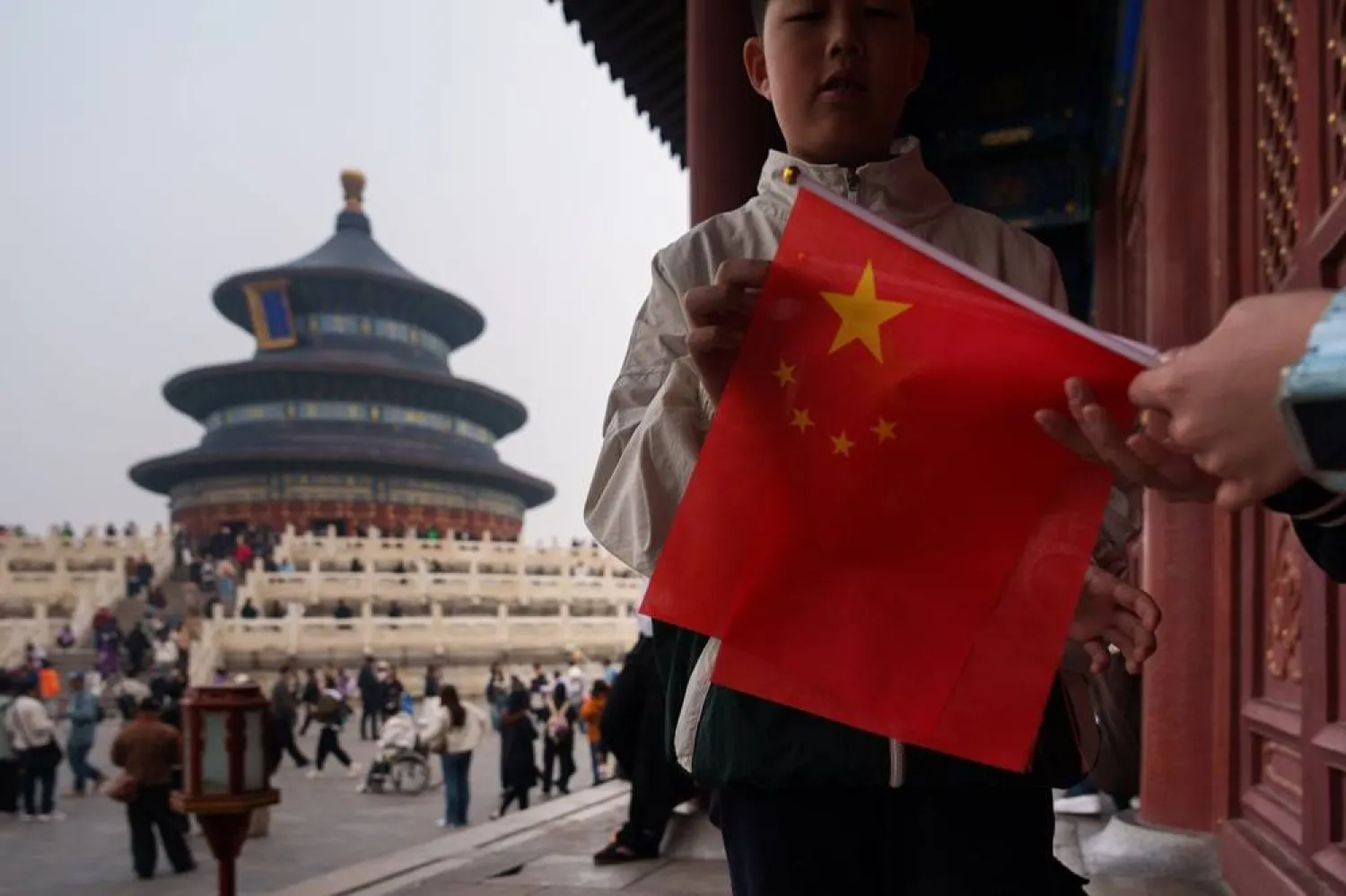
 A child holds a Chinese national flag near the Hall of Prayer for Good Harvests in Beijing, China, Friday, April 3, 2026. (AP)
A child holds a Chinese national flag near the Hall of Prayer for Good Harvests in Beijing, China, Friday, April 3, 2026. (AP)
TT

France Condemns China’s Execution of a French Citizen Held on Death Row for 15 Years

 A child holds a Chinese national flag near the Hall of Prayer for Good Harvests in Beijing, China, Friday, April 3, 2026. (AP)
A child holds a Chinese national flag near the Hall of Prayer for Good Harvests in Beijing, China, Friday, April 3, 2026. (AP)

France said China has executed a French citizen convicted of drug trafficking after keeping him on death row for more than 15 years. 

Chan Thao Phoumy, 62, was executed in the southern Chinese city of Guangzhou, despite French authorities’ clemency appeals, the French Foreign Ministry said in a statement late Saturday. It didn’t say when the sentence was carried out. A Chinese court sentenced him to death in 2010. 

The ministry’s statement expressed “consternation” and added: “We particularly regret that Mr. Chan’s defense did not have access to the final court hearing, which constitutes a violation of his rights.” 

“We extend our condolences to his family, whose grief we share,” it said. 

In a short statement Sunday that didn't mention Chan by name, the Chinese Embassy in Paris said that China “treats defendants of all nationalities equally, handles all cases impartially and strictly in accordance with the law.” 

France abolished the death penalty by act of parliament in 1981, and has become a vigorous campaigner against its use and for its abolition everywhere. 

China's use of executions — carried out by firing squads or lethal injections — is shrouded in secrecy but has long been extensive. Amnesty International says China is the world's lead executioner, believed to sentence and put to death thousands of people annually.