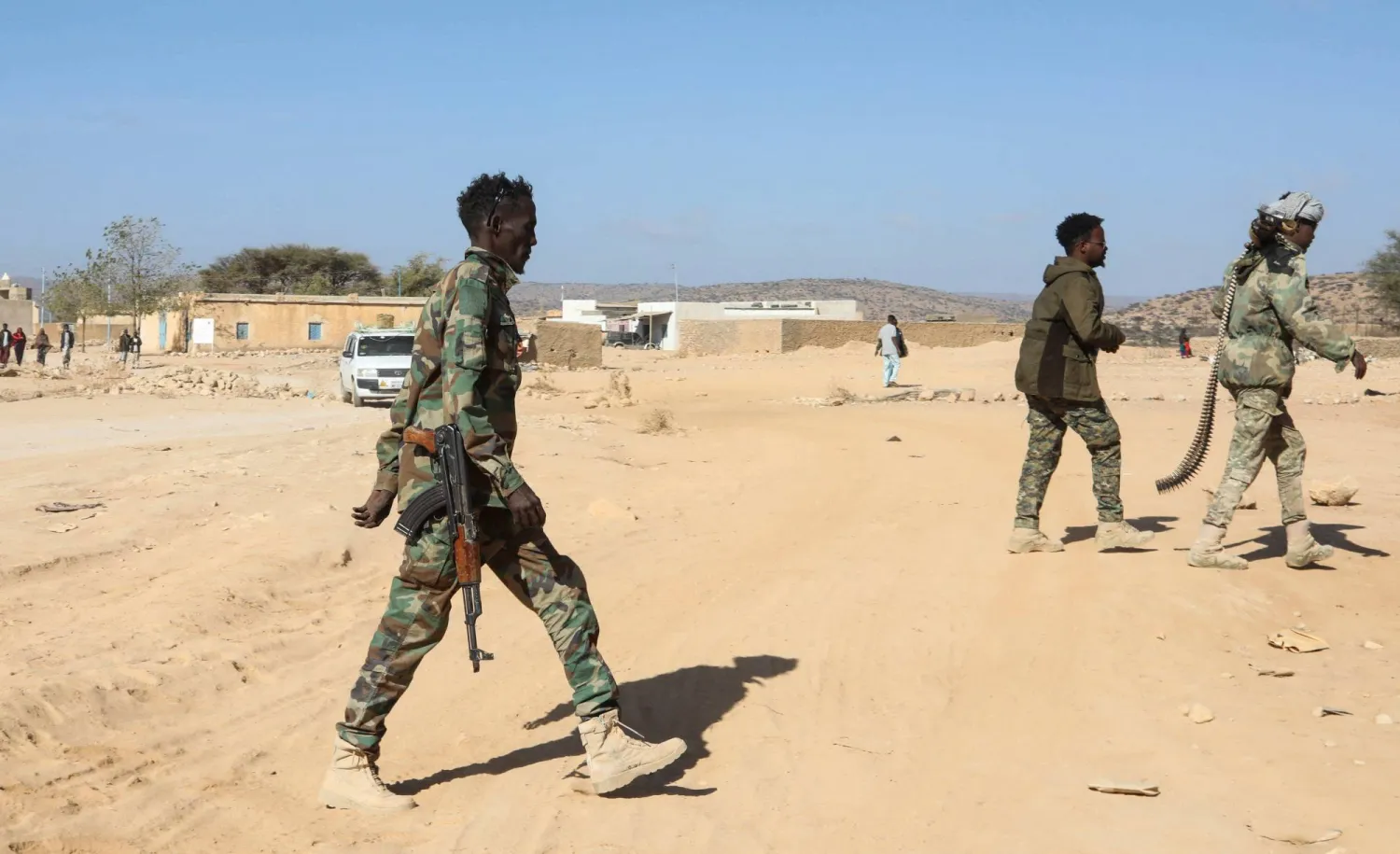
Puntland Offensive Deals Blow to ISIS in Somalia

Puntland Security Forces patrol in Balidhidin village in Bari Region, east of the Gulf of Aden in the city of Bosasso, Puntland region, Somalia January 26, 2025 REUTERS/Feisal Omar
TT

Puntland Offensive Deals Blow to ISIS in Somalia

Puntland Security Forces patrol in Balidhidin village in Bari Region, east of the Gulf of Aden in the city of Bosasso, Puntland region, Somalia January 26, 2025 REUTERS/Feisal Omar

Forces from Somalia's semi-autonomous Puntland region have captured swathes of territory from ISIS during a weeks-long offensive they hope will draw increased international support, according to officials and Reuters reporters.
The advances come against an ISIS faction that has gained in importance and was the target last week of the first airstrikes of U. President Donald Trump's new administration.
Before those strikes, Reuters reporters who gained rare access to the village of Balidhidin, which ISIS controlled for a decade, saw Puntland security forces patrolling and residents circulating on foot near the carcasses of army trucks destroyed in recent fighting.
The village is in the middle of the northern Golis Mountains, which are the stronghold of ISIS in Somalia and were also the site of the US strikes. Villagers said security forces had captured other areas too.
Many in Balidhidin had fled the harsh rule of the militants, especially after they killed the district commissioner in 2021. They took refuge in nearby villages and the port city of Bosaso.
"There was a lot of fear. We were threatened," said Saido Abdirahman, who had just returned to Balidhidin. "Although we were mothers who were indoors, there was fear which made people flee."
ISIS in Somalia - with an estimated 700 to 1,500 fighters in Puntland's mountains - is much smaller than al Qaeda-linked al Shabaab, which controls large parts of southern and central Somalia. But it has become an increasingly important part of its parent organization’s worldwide network in recent years, analysts say.
It has been aided, officials and analysts say, by an influx of foreign fighters from the Middle East and other African countries and revenues earned by extorting local businesses.
Some media outlets reported last year that its head, Abdulqadir Mumin, had become ISIS's global leader, citing US officials. ISIS has not confirmed the move.
CALL FOR SUPPORT
The US military has carried out periodic airstrikes against the group for years and also helped train Puntland's security forces.
Mohammed Aided, Puntland's information minister, told Reuters that the region's security forces had captured 250 square kilometers, including 50 bases, from ISIS since December 31 in the biggest offensive against the group in years.
Puntland's military spokesperson told Reuters on Thursday that the security forces had killed at least 85 ISIS militants in battles over the past two days, while 17 soldiers also died.
Aided said there was no coordination on the operations with the federal government in Mogadishu, which Puntland's government stopped recognizing altogether last year, and called for more foreign support.
"This is an international war on terror. We request the international community to supply with us experts, hardware, anti-mines, and anti-drone facilities that can jam drones of terrorists. It is a difficult war," Aided said.
Matt Bryden, a Somalia analyst and co-founder of the Sahan Research think tank, said the Trump administration, some of whose members have publicly derided the Mogadishu government as weak, might look to boost direct security cooperation with local authorities like Puntland to fight ISIS and al Shabaab.
"There's already a recognition that the federal government of Somalia is no longer really a credible partner in fighting against armed extremist groups," he said.
In response to written questions, Information Minister Daud Aweis said the Somali federal government appreciates the support of international partners and "maintains ongoing security engagements with relevant stakeholders, including Puntland, to ensure the effectiveness of counterterrorism operations."
"Strengthening Somalia’s federal institutions and ensuring a cohesive national strategy remain critical for sustainable security and stability," he said.
The US State Department did not immediately respond to a request for comment.



Satellite Imagery Shows ‘Recent Activity’ at Iran Nuclear Facility

An inspector of the International Atomic Energy Agency sets up surveillance equipment at a uranium conversion facility in Iran in 2005. Photograph: Mehdi Ghasemi/AP
TT

Satellite Imagery Shows ‘Recent Activity’ at Iran Nuclear Facility

An inspector of the International Atomic Energy Agency sets up surveillance equipment at a uranium conversion facility in Iran in 2005. Photograph: Mehdi Ghasemi/AP

New satellite imagery shows recent activity at the Natanz nuclear facility that was damaged during June's 12-day war with Israel, according to the US-based Institute for Science and International Security (ISIS).

During the June conflict, the IAEA confirmed Israeli strikes hit Iran's Natanz underground enrichment plant.

The think tank said the satellite imagery from December 13 show panels placed on top of the remaining anti-drone structure at the Pilot Fuel Enrichment Plant (PFEP), providing cover for the damaged facility.

It suggested the new covering allows Iran to examine or retrieve materials from the rubble while limiting external observation.

The Natanz uranium enrichment facility, located some 250 km south of the Iranian capital Tehran, is one of Iran's most important and most controversial nuclear facilities in the Middle East.

Although the facility “likely held several kilograms of highly enriched uranium,” ISIS stressed that such material is “not negligible” in the broader context of Iran’s nuclear capabilities.

While PFEP shows renewed activity, ISIS said it has not observed similar signs at other major nuclear sites, including the underground Fordow facility also damaged in June by airstrikes.

Inspections
On December 15, IAEA chief Rafael Grossi has reiterated that Iran must allow inspectors access to the three key nuclear facilities that enrich uranium and were hit by the US and Israeli airstrikes last June.

Speaking to RIA Novosti, Grossi said the agency’s activities in Iran are very limited. “We are only allowed to access sites that were not hit.”

In October, the head of the UN nuclear watchdog told AP that Iran does not appear to be actively enriching uranium but that the agency has recently detected renewed movement at the country’s nuclear sites.

Grossi said that despite being unable to fully access Iranian nuclear sites, inspectors have not seen any activity via satellite to indicate that Tehran has accelerated its production of uranium enriched beyond what it had compiled before the 12-day war with Israel in June.

“However, the nuclear material enriched at 60% is still in Iran,” Grossi said in an interview at the United Nations headquarters in New York.

“And this is one of the points we are discussing because we need to go back there and to confirm that the material is there and it’s not being diverted to any other use,” he added, “This is very, very important.”

Iran’s Foreign Minister Abbas Araghchi said on December 8 that resuming the agency’s inspections is currently not possible because “there is no protocol or guideline” for inspecting facilities he described as “peaceful.”

ISIS reported on October 3 that new satellite imagery shows that Iran is ongoing construction efforts at a mountainous area just south of the Natanz enrichment site known as Kuh-e Kolang Gaz La, or Pickaxe Mountain.

On Sept. 26, The Washington Post said according to a review of satellite imagery and independent analysis, Iran has increased construction at a mysterious underground site in the months since the US and Israel pummeled its main nuclear facilities, suggesting Tehran has not entirely ceased work on its suspected weapons program and may be cautiously rebuilding.


Rubio: Venezuela Cooperates with Iran, Hezbollah

Secretary of State Marco Rubio speaks during a news conference at the State Department, Friday, Dec. 19, 2025, in Washington. (AP Photo/Julia Demaree Nikhinson)
TT

Rubio: Venezuela Cooperates with Iran, Hezbollah

Secretary of State Marco Rubio speaks during a news conference at the State Department, Friday, Dec. 19, 2025, in Washington. (AP Photo/Julia Demaree Nikhinson)

US Secretary of State Marco Rubio has accused the illegitimate regime in Venezuela of cooperating with criminals that threaten the national security of the United States.

Rubio said Friday the regime of President Nicolas Maduro openly cooperates with Iran, Hezbollah, and drug trafficking groups.

“They (Venezuela regime) operate and cooperate with terrorist organizations against the national interest of the United States, not just cooperate, but partner with and participate in activities to threaten the national interest of the United States,” he told reporters at a news conference at the State Department.

According to Rubio, Venezuela is a country that is not just an illegitimate regime that does not cooperate with the US but also a regime that openly cooperates with criminal and terrorist elements, including Hezbollah, Iran and others.

“And clearly these narco groups cooperate openly from there,” the Secretary of State said.

“We have a regime that cooperates with Iran, that cooperates with Hezbollah; that cooperates with narcotrafficking and narcoterrorist organizations, inclusive not just protecting their shipments and allowing them to operate with impunity, but also allows some of them to control territory,” he added.

Earlier, US President Donald Trump said he was leaving the possibility of war with Venezuela on the table, according to an interview with NBC News published on Friday.

“I don't rule it out, no,” he told NBC News in a phone interview.

Trump also said there would be additional seizures of oil tankers near Venezuelan waters, according to the interview. The US seized a sanctioned oil tanker off the coast of Venezuela last week.

“If they're foolish enough to be sailing along, they'll be sailing along back into one of our harbors,” he told NBC News.

On Tuesday, Trump ordered a “blockade” of all sanctioned oil tankers entering and leaving Venezuela, in Washington's latest move to increase pressure on Nicolas Maduro's government, targeting its main source of income, following which Venezuela's government said it rejected Trump's “grotesque threat.”


Iran Says it Executed Man Accused of Spying for Israel

A general view of the snow-covered mountains surrounding Tehran, Iran, 19 Dec 2025. EPA/ABEDIN TAHERKENAREH
TT

Iran Says it Executed Man Accused of Spying for Israel

A general view of the snow-covered mountains surrounding Tehran, Iran, 19 Dec 2025. EPA/ABEDIN TAHERKENAREH

Iran executed on Saturday a man convicted of spying for the Israeli intelligence and army, state media reported.

According to The Associated Press, State TV identified the executed man as Aghil Keshavarz, saying he had “close intelligence cooperation” with the Mossad and took photos of Iranian military and security areas.

Keshavarz was arrested while taking pictures of a military headquarters in the northwestern city of Urmia, some 600 kilometers northwest of the capital Tehran in May. He was accused of carrying out more than 200 similar assignments for the Mossad in various cities of Iran, including Tehran.

He was tried and given the death sentence, a ruling the Supreme Court upheld, the report said.

Keshavarz, 27, reportedly studied architecture.

Iran is known to have executed 11 people for espionage since a 12-day air war that Israel waged against Iran in June, killing nearly 1,100 people, including military commanders and nuclear scientists. In return, Iran’s missile barrage killed 28 in Israel.

In October, Iran executed an unknown person convicted of spying for Israel’s intelligence agency Mossad in the city of Qom.