


Canada, Philippines in Final Negotiations for Joint Exercises in South China Sea

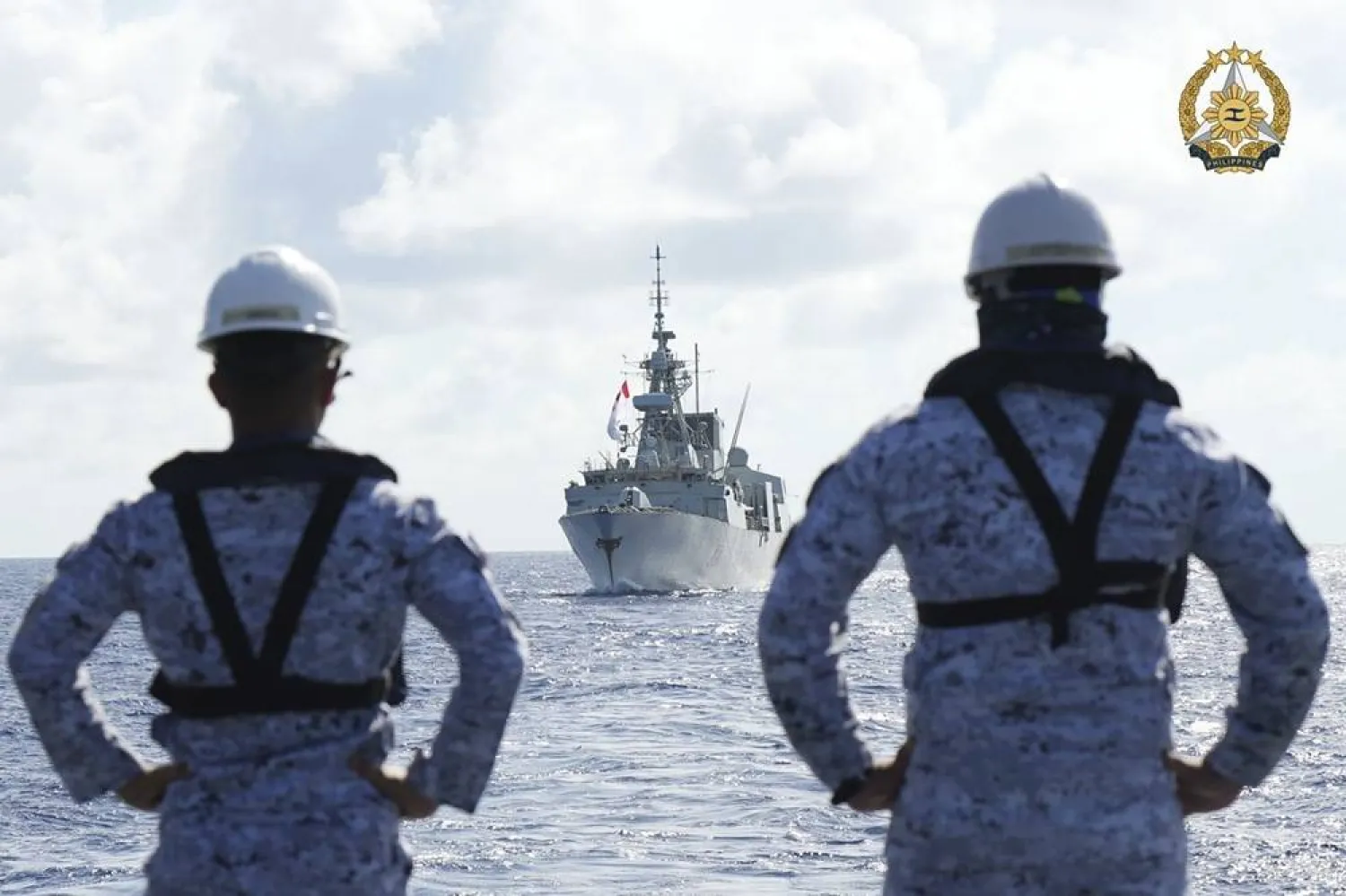
In this handout photo provided by Public Affairs Office Armed Forces of the Philippines, Philippine Navy personnel watch the Canadian vessel HMCS Montreal (FFH336) during the Multilateral Maritime Cooperative Activity being held in the West Philippine Sea, on Wednesday, Aug. 7, 2024. (Private First Class Carmelotes/Public Affairs Office Armed Forces of the Philippines via AP, File)
TT

Canada, Philippines in Final Negotiations for Joint Exercises in South China Sea

In this handout photo provided by Public Affairs Office Armed Forces of the Philippines, Philippine Navy personnel watch the Canadian vessel HMCS Montreal (FFH336) during the Multilateral Maritime Cooperative Activity being held in the West Philippine Sea, on Wednesday, Aug. 7, 2024. (Private First Class Carmelotes/Public Affairs Office Armed Forces of the Philippines via AP, File)

Canada and the Philippines are in the final stages of negotiating a key defense pact that would allow their forces to hold larger military drills in the South China Sea, where Ottawa has rejected China’s "provocative and unlawful actions," the Canadian ambassador to Manila said.

Canada has been reinforcing its military presence in the Indo-Pacific region and has committed to help promote the rule of law and expand trade and investment.

That dovetails with Philippine efforts under President Ferdinand Marcos Jr. to broaden defense ties with friendly countries to bolster his country’s external defense as it faces an increasingly assertive China in the disputed waters.

Canadian Ambassador David Hartman said Friday night that his country and the Philippines were "in the final stages of the negotiations of our status of forces visiting agreement that will enable us to have even more substantive participation in joint and multilateral training exercises and operations with the Philippines and allies here in the region."

Hartman spoke before Philippine national security officials, foreign ambassadors and defense attaches aboard the HMCS Ottawa, a Royal Canadian Navy Halifax-class frigate on a port visit to Manila. The vessel will take part in a joint exercise next week, he said.

The Philippine military has staged multinational patrols and drills since last year with counterparts from the US, Japan, France, Australia and Canada, including in the South China Sea, infuriating China.

China claims virtually the entire sea passage, a key global trade route, and has deployed coast guard and naval fleets and other vessels to guard what it says is its territory. The Philippines, Vietnam, Malaysia, Brunei, Taiwan also lay claims that clash with China’s and territorial confrontations have flared particularly between Beijing and Manila in the last two years.

In August last year, Canada joined the United States, Australia and the Philippines in air and naval maneuvers to promote the rule of law and unhindered passage in the South China Sea.

In an apparent response, China said it conducted air and sea combat patrols on the same day. Although no confrontations were reported, the Philippine military said three Chinese navy ships tailed the four-nation maneuvers off the western coast of the Philippines.

"We have been vocal in confronting the provocative and unlawful actions of the People’s Republic of China in the South China Sea and the West Philippine Sea," Hartman said. "We will continue to do so."

Canada signed an agreement on defense cooperation with the Philippines last year. Another agreement signed in Ottawa in 2023 gave the Philippines access to data from Canada’s "Dark Vessel Detection System," which harnesses satellite technology to track illegal vessels even if they switch off their location-transmitting devices.

The Philippine coast guard has accused Chinese coast guard ships and fishing vessels of switching off their location-transmitting devices to avoid detection and surveillance in the South China Sea.

The Philippines has visiting forces agreements, which provide a legal framework for temporary visits of foreign troops and large- scale combat exercises, only with the United States and Australia. In July last year, the Philippines signed a similar accord with Japan, which still needs to be ratified by Japanese legislators.

The Philippines is in separate talks over defense pacts with France and New Zealand.


NATO: Ukraine Still Receiving Arms Despite Mideast War

NATO Secretary General Mark Rutte via Reuters/File
TT

NATO: Ukraine Still Receiving Arms Despite Mideast War

NATO Secretary General Mark Rutte via Reuters/File

Ukraine is still getting essential defense equipment despite the war in the Middle East, which is depleting stockpiles in Europe and the United States, NATO Secretary General Mark Rutte said Thursday.

"The good news is that essential equipment into Ukraine continues to flow," he told reporters. That included American-made Patriot missile interceptors, which Ukraine desperately needs, he added, AFP reported.

The PURL program, launched last year, allows Ukraine to receive US equipment financed by European countries.

Some 75 percent of the missiles used by Patriot batteries in Ukraine have been supplied through the program, and 90 percent of the munitions used by other air-defense systems, Rutte added.

Rutte called on European countries to increase their own production capacity.

"They need to produce more extra production lines, extra shifts, opening new factories. The money is there," he said.


Germany FM Says 'Encouraging' if US Speaking Directly to Iran

German Foreign Minister Johann Wadephul. (Reuters: File Photo)
TT

Germany FM Says 'Encouraging' if US Speaking Directly to Iran

German Foreign Minister Johann Wadephul. (Reuters: File Photo)

Germany's foreign minister Thursday said it was encouraging if the United States was talking directly to Iran to end the war in the Middle East, but Washington should make its intentions clear.

"I hear that there are signs that the US is speaking directly to Iran. I think that this is encouraging and this is welcome," Johann Wadephul told reporters before heading into the meeting of G7 foreign ministers outside Paris, AFP reported.

With US Secretary of State Marco Rubio set to join the discussions from Friday, he added: "For the German government it is of great importance to know precisely what our American partners are intending."


US Envoy Witkoff Says Iran is Seeking an Off-ramp

US Special Envoy Steve Witkoff speaks during a cabinet meeting at the White House in Washington, DC, US, March 26, 2026. REUTERS/Evelyn Hockstein
TT

US Envoy Witkoff Says Iran is Seeking an Off-ramp

US Special Envoy Steve Witkoff speaks during a cabinet meeting at the White House in Washington, DC, US, March 26, 2026. REUTERS/Evelyn Hockstein

The United States has sent Iran a "15-point action list" as a basis for negotiations to end the current conflict, US Special Envoy Steve Witkoff said on Thursday, adding that there are signs that Tehran was interested in making a deal.


Witkoff, speaking during a cabinet meeting at the White House, said that the nascent talks could be successful if the Iranians realize there were no good alternatives - a realization Tehran might be coming to, he argued, Reuters reported.


"We will see where things lead, and if we can convince Iran that this is the inflection point with no good alternatives for them other than more death and destruction," Witkoff told reporters.


"We have strong signs that this is a possibility."


Witkoff said Pakistan had been acting as a mediator, confirming statements from Pakistani officials.
