

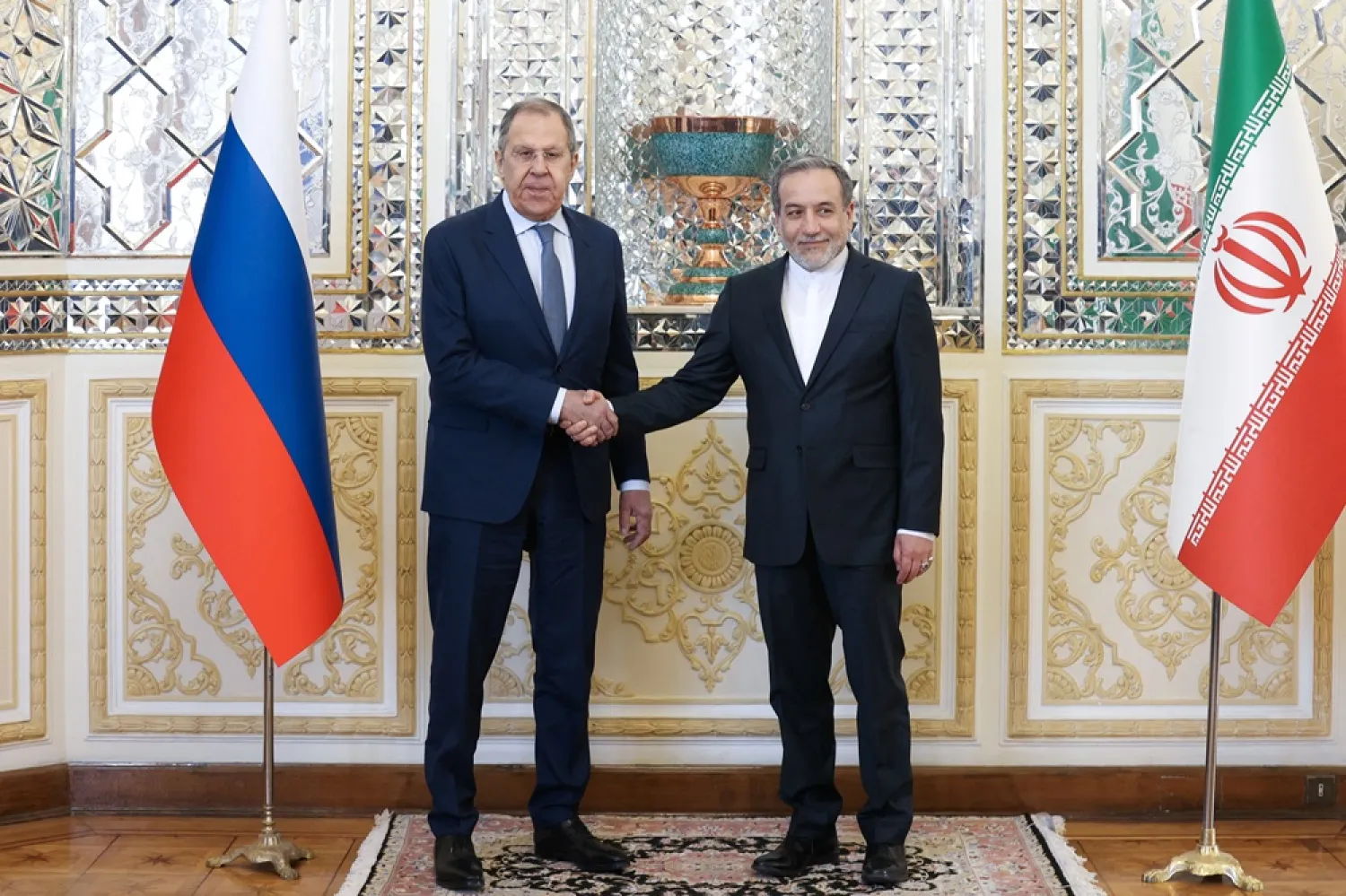

Iran Rules Out ‘Direct Talks’ with US on Nuclear Issue

Russia's Foreign Minister Sergei Lavrov shakes hands with Iranian Foreign Minister Abbas Araghchi during a meeting in Tehran, Iran, February 25, 2025. (Russian Foreign Ministry/Handout via Reuters)
TT

Iran Rules Out ‘Direct Talks’ with US on Nuclear Issue

Russia's Foreign Minister Sergei Lavrov shakes hands with Iranian Foreign Minister Abbas Araghchi during a meeting in Tehran, Iran, February 25, 2025. (Russian Foreign Ministry/Handout via Reuters)

Iranian Foreign Minister Abbas Araghchi on Tuesday dismissed the possibility of direct negotiations with the United States on his country's nuclear program.  

His remarks came a day after Washington announced fresh sanctions on Tehran targeting more than 30 vessels and people, including the head of the national oil company, accused of involvement in brokering the sale and shipment of Iranian oil.  

The sanctions were the latest to be imposed since US President Donald Trump reinstated his "maximum pressure" policy towards Iran, reprising his approach during his first term.

"There will be no possibility of direct talks between us and the United States on the nuclear issue as long as the maximum pressure is applied in this way," Araghchi said during a joint press conference with his visiting Russian counterpart Sergei Lavrov.

"Regarding the nuclear negotiations, the position of Iran is very clear. We will not negotiate under pressure, threat or sanctions."  

Lavrov arrived in Tehran on Tuesday for talks with Araghchi and other senior officials on a range of topics including bilateral relations, regional developments and the 2015 nuclear deal between Iran and major powers.  

During Trump's first term, which ended in 2021, Washington withdrew from the deal that had imposed curbs on Iran's nuclear program in return for sanctions relief.  

On Monday, Iran held a new round of talks with Germany, France and Britain about its nuclear program after reviving engagement with the trio, known as the E3, late last year.  

Araghchi said he had briefed Lavrov about the latest discussions.  

"On the nuclear issue, we will move forward with the cooperation and coordination of our friends in Russia and China," he added.  

- 'Very close' on Syria -  

With Russia too facing sanctions over its war in Ukraine, Moscow and Tehran have stepped up their cooperation in recent years.  

Ukraine and its Western allies have accused Iran of supplying Russia with weapons for use in the war -- allegations Iran has repeatedly denied.  

During a visit to Moscow in January, Iranian President Masoud Pezeshkian signed a strategic partnership with his Russian counterpart Vladimir Putin underpinning their economic and military cooperation.  

Both Iran and Russia suffered a major setback in Syria in December when opposition groups toppled their longtime ally Bashar al-Assad after both governments invested heavily to support him over more than a decade of civil war.  

Araghchi said Iran and Russia's positions on Syria remain "very close".  

"Iran wants peace, stability, preservation of territorial integrity and unity, and the progress of Syria based on the will of the people," he said.  

Lavrov, for his part, said "we will do our utmost to ensure that the situation calms down and does not pose a threat either to the Syrian people... or to the people of neighboring states".  

The Russian diplomat's visit comes one week after he met with his US counterpart Marco Rubio in Saudi Arabia to discuss the war in Ukraine.  

On Monday, the United States sided with Russia in two votes in New York, refusing to condemn its invasion of Ukraine and signaling a seismic shift as Trump stakes out a drastically new position on the war.  

"Yesterday's event at the UN General Assembly and the Security Council showed one very important thing: the understanding that the approach aimed at eliminating the root causes of the crisis has no alternative," Lavrov said in Tehran.



NATO: Ukraine Still Receiving Arms Despite Mideast War

NATO Secretary General Mark Rutte via Reuters/File
TT

NATO: Ukraine Still Receiving Arms Despite Mideast War

NATO Secretary General Mark Rutte via Reuters/File

Ukraine is still getting essential defense equipment despite the war in the Middle East, which is depleting stockpiles in Europe and the United States, NATO Secretary General Mark Rutte said Thursday.

"The good news is that essential equipment into Ukraine continues to flow," he told reporters. That included American-made Patriot missile interceptors, which Ukraine desperately needs, he added, AFP reported.

The PURL program, launched last year, allows Ukraine to receive US equipment financed by European countries.

Some 75 percent of the missiles used by Patriot batteries in Ukraine have been supplied through the program, and 90 percent of the munitions used by other air-defense systems, Rutte added.

Rutte called on European countries to increase their own production capacity.

"They need to produce more extra production lines, extra shifts, opening new factories. The money is there," he said.


Germany FM Says 'Encouraging' if US Speaking Directly to Iran

German Foreign Minister Johann Wadephul. (Reuters: File Photo)
TT

Germany FM Says 'Encouraging' if US Speaking Directly to Iran

German Foreign Minister Johann Wadephul. (Reuters: File Photo)

Germany's foreign minister Thursday said it was encouraging if the United States was talking directly to Iran to end the war in the Middle East, but Washington should make its intentions clear.

"I hear that there are signs that the US is speaking directly to Iran. I think that this is encouraging and this is welcome," Johann Wadephul told reporters before heading into the meeting of G7 foreign ministers outside Paris, AFP reported.

With US Secretary of State Marco Rubio set to join the discussions from Friday, he added: "For the German government it is of great importance to know precisely what our American partners are intending."


US Envoy Witkoff Says Iran is Seeking an Off-ramp

US Special Envoy Steve Witkoff speaks during a cabinet meeting at the White House in Washington, DC, US, March 26, 2026. REUTERS/Evelyn Hockstein
TT

US Envoy Witkoff Says Iran is Seeking an Off-ramp

US Special Envoy Steve Witkoff speaks during a cabinet meeting at the White House in Washington, DC, US, March 26, 2026. REUTERS/Evelyn Hockstein

The United States has sent Iran a "15-point action list" as a basis for negotiations to end the current conflict, US Special Envoy Steve Witkoff said on Thursday, adding that there are signs that Tehran was interested in making a deal.


Witkoff, speaking during a cabinet meeting at the White House, said that the nascent talks could be successful if the Iranians realize there were no good alternatives - a realization Tehran might be coming to, he argued, Reuters reported.


"We will see where things lead, and if we can convince Iran that this is the inflection point with no good alternatives for them other than more death and destruction," Witkoff told reporters.


"We have strong signs that this is a possibility."


Witkoff said Pakistan had been acting as a mediator, confirming statements from Pakistani officials.