


Trump Awards Boeing Much-Needed Win with F-47 Fighter Jet Contract

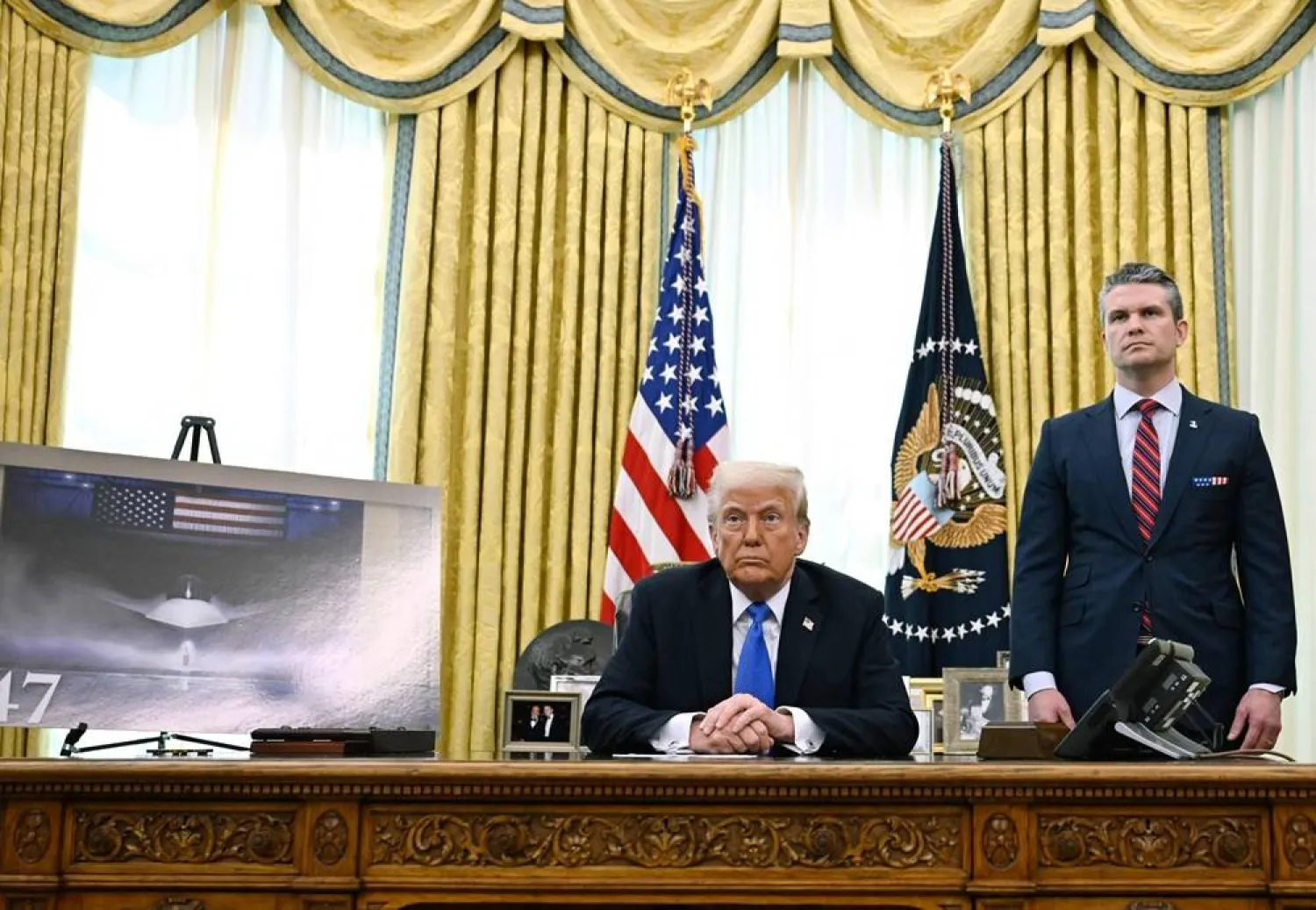
 US President Donald Trump and Secretary of Defense Pete Hegseth listen during an event in the Oval Office of the White House in Washington, DC, on March 21, 2025. Trump announced the award to Boeing of a major contract for the Air Force's high-tech next-generation F-47 fighter plane. (AFP)
US President Donald Trump and Secretary of Defense Pete Hegseth listen during an event in the Oval Office of the White House in Washington, DC, on March 21, 2025. Trump announced the award to Boeing of a major contract for the Air Force's high-tech next-generation F-47 fighter plane. (AFP)
TT

Trump Awards Boeing Much-Needed Win with F-47 Fighter Jet Contract

 US President Donald Trump and Secretary of Defense Pete Hegseth listen during an event in the Oval Office of the White House in Washington, DC, on March 21, 2025. Trump announced the award to Boeing of a major contract for the Air Force's high-tech next-generation F-47 fighter plane. (AFP)
US President Donald Trump and Secretary of Defense Pete Hegseth listen during an event in the Oval Office of the White House in Washington, DC, on March 21, 2025. Trump announced the award to Boeing of a major contract for the Air Force's high-tech next-generation F-47 fighter plane. (AFP)

US President Donald Trump awarded Boeing on Friday the contract to build the US Air Force's most sophisticated fighter jet yet, dubbed the F-47, handing the company a much-needed win.

The Next Generation Air Dominance program will replace Lockheed Martin's F-22 Raptor with a crewed aircraft built to enter combat alongside drones.

Trump, the 47th president, announced the new jet's name, the F-47.

"We've given an order for a lot. We can't tell you the price," Trump told reporters in the Oval Office.

"Our allies are calling constantly," Trump added, saying foreign sales could be an option. "They want to buy them also."

For Boeing, the win marks a reversal of fortune for a company that has struggled on both the commercial and defense sides of its business. It is a major boost for its St. Louis, Missouri, fighter jet production business.

The engineering and manufacturing development contract is worth more than $20 billion. The winner will eventually receive hundreds of billions of dollars in orders over the contract's multi-decade lifetime.

Shares of Boeing rose 4% after the news. The US company beat out Lockheed Martin for the deal. Lockheed's shares fell nearly 7%.

Reuters reported Boeing's victory before the official announcement.

The plane's design remains a closely held secret, but would likely include stealth, advanced sensors, and cutting-edge engines.

"Compared to the F-22, the F-47 will cost less and be more adaptable to future threats - and we will have more of the F-47s in our inventory," said Chief of Staff of the Air Force General David Allvin.

Boeing and Lockheed did not immediately respond to requests for comment.

NGAD was conceived as a "family of systems" centered around a sixth-generation fighter to counter adversaries such as China and Russia.

Allvin added the F-47 will have significantly longer range, more advanced stealth, and will be more sustainable and more easily supported than the F-22.

MAJOR WIN

Boeing's commercial operations have struggled as it attempts to get its best-selling 737 MAX jet production back up to full speed, while its defense operation has been weighed down by underperforming contracts for mid-air refueling tankers, drones and training jets.

"The win is a major boost for the company, which has struggled with cost overruns, schedule delays and execution on other DoD programs," said Roman Schweizer, an analyst at TD Cowen.

Cost overruns at the KC-46 mid-air refueling tanker program have surpassed $7 billion in recent years, while another fixed-price contract to upgrade two Air Force One planes has created a $2-billion loss for the top 5 US defense contractor.

Boeing has faced ongoing scrutiny since a series of crises including a mid-air emergency in January 2024 involving a new Alaska Airlines 737 MAX 9 missing four key bolts. In January, Boeing reported an $11.8-billion annual loss - its largest since 2020 - due to problems at its major units, along with fallout from a crippling strike that shuttered production of most of its jets.

Boeing has ceded ground to rival Airbus in the delivery race and entered the crosshairs of regulators and customers following a series of missteps. The Federal Aviation Administration in early 2024 imposed a production cap of 38 MAX planes per month.

Lockheed, which was recently eliminated from the competition to build the Navy's next-generation carrier-based stealth fighter, faces an uncertain future in the high-end fighter market after the loss.

Billionaire and presidential adviser Elon Musk has voiced skepticism about the effectiveness of crewed high-end fighters, saying cheaper drones were a better option.

While Lockheed could still protest the award to Boeing, the fact Trump announced the deal in a high-profile Oval Office press conference could reduce the possibility of a public airing of arguments against the agreement from the Bethesda, Maryland-based defense firm.



China Opposes Recognition of Somaliland, Affirms Support for Somalia

A man holds a flag of Somaliland in front of the Hargeisa War Memorial monument in Hargeisa on November 7, 2024. (AFP)
TT

China Opposes Recognition of Somaliland, Affirms Support for Somalia

A man holds a flag of Somaliland in front of the Hargeisa War Memorial monument in Hargeisa on November 7, 2024. (AFP)

China opposes any attempt to split territories ​in Somalia, the foreign ministry said on Monday, affirming Chinese support for the sovereignty, unity and territorial ‌integrity of ‌the East ‌African ⁠country.

"No ​country ‌should encourage or support other countries' internal separatist forces for its own selfish interests," ministry spokesperson ⁠Lin Jian told reporters ‌at a ‍regular ‍press conference, urging authorities ‍in Somaliland to stop "separatist activities and collusion with external forces".

Israel drew international condemnation when it became ​the first country on Friday to formally recognize ⁠the self-declared Republic of Somaliland as an independent and sovereign state, seeking immediate cooperation with Somaliland in agriculture, health, technology and the economy.


China Launches Military Drills Simulating Blockade of Taiwan Ports

A Taiwan Air Force Mirage 2000 fighter jet takes off at Hsinchu Air Base in Hsinchu on December 29, 2025. (AFP)
TT

China Launches Military Drills Simulating Blockade of Taiwan Ports

A Taiwan Air Force Mirage 2000 fighter jet takes off at Hsinchu Air Base in Hsinchu on December 29, 2025. (AFP)

China launched live-fire drills around Taiwan on Monday that it said would simulate a blockade of the self-ruled island's key ports, prompting Taipei to condemn Beijing's "military intimidation".

Beijing claims Taiwan as part of its sovereign territory and has refused to rule out using military action to seize the island democracy.

The latest show of force follows a bumper round of arms sales to Taipei by the United States, Taiwan's main security backer.

Beijing warned on Monday that "external forces" arming Taipei would "push the Taiwan Strait into a perilous situation of imminent war", but did not mention any countries by name.

Any attempts to stop China's unification with Taiwan were "doomed to fail", foreign ministry spokesman Lin Jian said.

China said earlier it was conducting "live-fire training on maritime targets to the north and southwest of Taiwan" in large-scale exercises involving destroyers, frigates, fighters, bombers and drones.

A military spokesman said Beijing would send army, navy, air force and rocket force troops for "major military drills" code-named "Justice Mission 2025".

The activities will focus on "sea-air combat readiness patrol, joint seizure of comprehensive superiority, blockade on key ports and areas, as well as all-dimensional deterrence outside the island chain", said Senior Colonel Shi Yi of the People's Liberation Army's Eastern Theater Command.

Chinese authorities also published a map of five large zones around Taiwan where further live-fire activities would take place from 8:00 am to 6:00 pm (0000 to 1000 GMT) on Tuesday.

"For the sake of safety, any irrelevant vessel or aircraft is advised not to enter the afore-mentioned waters and airspace," the statement said.

- 'Rapid response' -

Taiwan condemned China's "disregard for international norms and the use of military intimidation to threaten neighboring countries", Presidential Office spokeswoman Karen Kuo said.

Taipei said Monday it had detected four Chinese coastguard ships sailing off its northern and eastern coasts.

Its coastguard said it "immediately deployed large vessels to pre-position responses in relevant areas" and "sent additional support units".

Taiwan's military said it had established a response center, deployed "appropriate forces" and "carried out a rapid response exercise".

The drills by China's ruling Communist Party "further confirm its nature as an aggressor, making it the greatest destroyer of peace", Taipei's defense ministry said.

- 'Stern warning' -

Shi, the Chinese military spokesman, said the drills were "a stern warning against 'Taiwan Independence' separatist forces, and... a legitimate and necessary action to safeguard China's sovereignty and national unity".

Beijing's military released a poster about the drills showing "arrows of justice" -- one engulfed in flames -- raining down on what appeared to be green worms on a geographical outline of Taiwan.

Chinese state broadcaster CCTV reported that a core theme of the exercises was a "blockade" of key Taiwanese ports including Keelung in the north and Kaohsiung in the south.

China's military last held large-scale drills involving live firing around Taiwan in April -- surprise maneuvers condemned by Taipei.

China said this month it would take "resolute and forceful measures" to safeguard its territory after Taiwan said the United States had approved a major $11 billion arms sale.

Beijing announced fresh sanctions on 20 American defense companies last week, though they appeared to have little or no business in China.

Last month, Japan's Prime Minister Sanae Takaichi triggered a backlash from Beijing when she said the use of force against Taiwan could warrant a military response from Tokyo.


Top Diplomats of China, Cambodia and Thailand Meet as Beijing Seeks to Strengthen Role in Dispute

This handout photo taken and released by Agence Kampuchea Press (AKP) on December 29, 2025 shows China's Foreign Minister Wang Yi (C), Cambodia's Deputy Prime Minister Prak Sokhonn (L), who is also the country's Foreign Minister, and Thailand's Foreign Minister Sihasak Phuangketkeow (R) linking arms during a meeting in China's Yunnan province. (Handout / Agence Kampuchea Press (AKP) / AFP)
TT

Top Diplomats of China, Cambodia and Thailand Meet as Beijing Seeks to Strengthen Role in Dispute

This handout photo taken and released by Agence Kampuchea Press (AKP) on December 29, 2025 shows China's Foreign Minister Wang Yi (C), Cambodia's Deputy Prime Minister Prak Sokhonn (L), who is also the country's Foreign Minister, and Thailand's Foreign Minister Sihasak Phuangketkeow (R) linking arms during a meeting in China's Yunnan province. (Handout / Agence Kampuchea Press (AKP) / AFP)

Foreign ministers from Cambodia and Thailand convened with their Chinese counterpart on Monday as the Beijing government, building on its expanding presence in the world diplomatic arena, sought to play a stronger mediating role in the violent border dispute between the two Southeast Asian countries.

The trilateral meeting, held in a southwestern Chinese province north of the contested border, came two days after Thailand and Cambodia signed a fresh ceasefire agreement to end weeks of fighting that killed more than 100 people and forced hundreds of thousands to be evacuated on both sides of the border.

Chinese Foreign Minister Wang Yi called for joint efforts to promote regional peace, stability and development, which is language typical for China in such situations.

“Allowing the flames of war to be reignited is absolutely not what the people of the two countries want, and not what China, as your friend, wants to see. Therefore, we should resolutely look ahead and move forward,” Wang said during the meeting Monday in Yunnan province.

It was noteworthy that the meeting was held there, nearer to the dispute and to Southeast Asia, rather than in Beijing, the Chinese capital and seat of government about 1,300 miles (2,500 kilometers) northeast.

Cambodian Foreign Minister Prak Sokhonn said he believed the latest ceasefire would last and would create an environment for both countries to work on their relations and resume the previously agreed-upon ways to settle their differences, according to a Chinese interpreter.

Thai Foreign Minister Sihasak Phuangketkeow also expressed hopes for peace with neighboring countries, the interpreter said.

The Thai Foreign Ministry later said in a statement that China volunteered to be a platform to support peace between the two countries and Thailand reiterated that adjustments of ties should be conducted “on a step-by-step basis.”

“The Thai side will consider the release of 18 soldiers after the 72 hours ceasefire observation period and requests that Cambodia facilitate the return of Thais along the border,” the ministry said.

A day after the fresh pact was signed, Sihasak and Prak Sokhonn held separate meetings with Wang on Sunday, the first day of the two-day gathering.

The meetings represented China's latest efforts to strengthen its role as an international mediator and, in particular, its influence in Asian regional crises. As China grows and becomes more of an economic and political force regionally and globally, Beijing has spent the past decade and more working in various ways to increase its voice as a third party in diplomatic matters.

Disputes continue

The two Southeast Asian countries originally reached a ceasefire in July. It was brokered by Malaysia and pushed through under pressure from US President Donald Trump, who threatened to withhold trade privileges unless Thailand and Cambodia agreed. The preliminary pact was followed by a more detailed October agreement.

But Thailand and Cambodia carried on a bitter propaganda war, with minor, cross-border violence continuing. The tensions erupted into heavy fighting in early December.

The Saturday agreement calls for Thailand, after the ceasefire has held for 72 hours, to repatriate 18 Cambodian soldiers who have been held prisoner since the earlier fighting in July. Their release has been a major demand of the Cambodian side.

The agreement also calls on both sides to adhere to international agreements against deploying land mines, a major concern of Thailand.

Cambodian Prime Minister Hun Manet on Monday issued a statement to all Cambodian combatants along the border with Thailand.

“Even though we can still fight," he said, “as a small country we still have nothing to gain from prolonging the fighting for a long time.”