


UK and France Accuse Putin of Delaying Ukraine Ceasefire Efforts

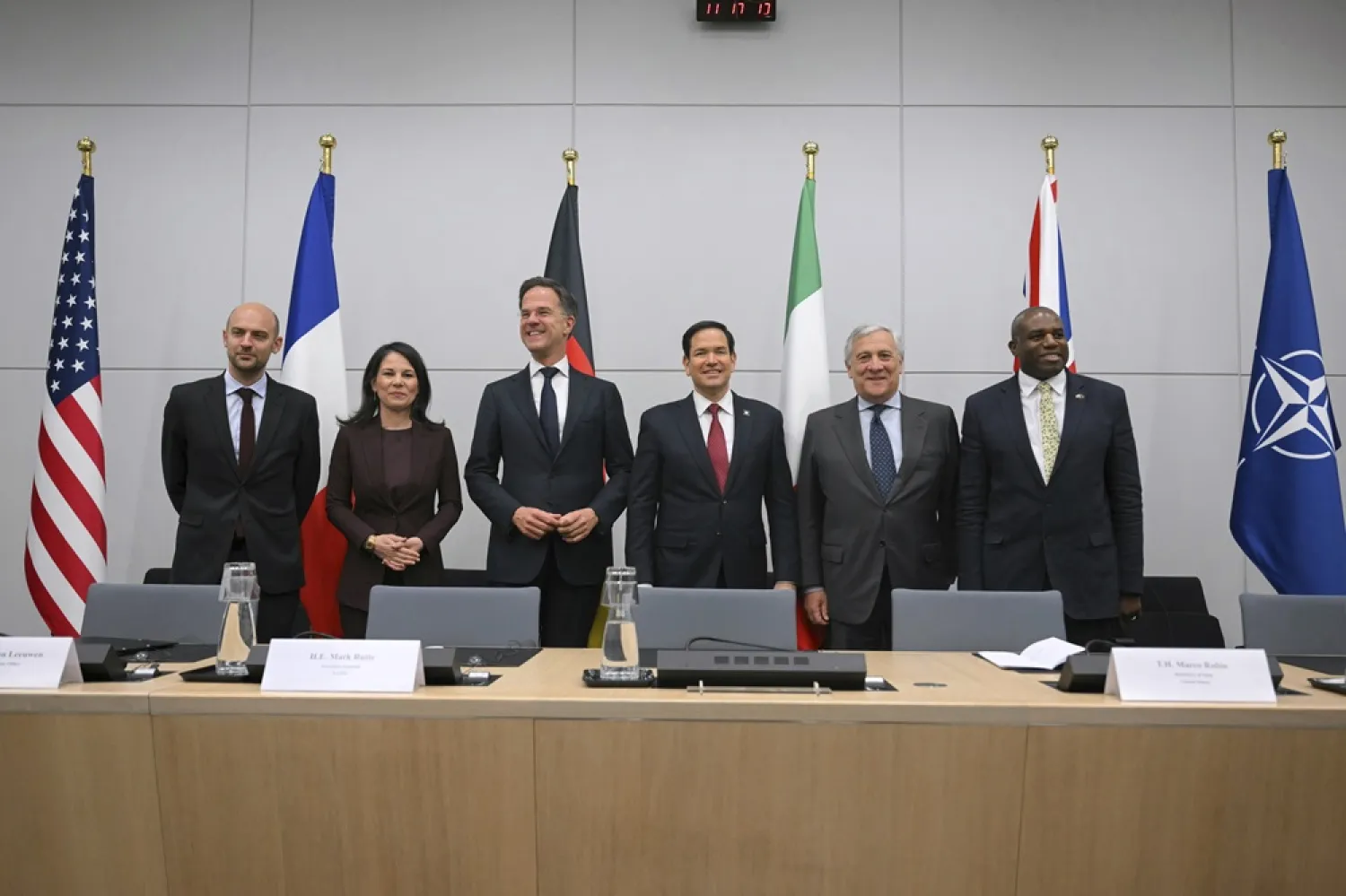
From left, French Foreign Minister Jean-Noel Barrot, Germany's Foreign Minister Annalena Baerbock, NATO Secretary General Mark Rutte, United States Secretary of State Marco Rubio, Italy's Foreign Minister Antonio Tajani and Britain's Foreign Secretary David Lammy pose for a group photo during a meeting on the sidelines of the NATO foreign ministers at NATO headquarters in Brussels, Friday, April 4, 2025. (Nicolas Tucat, Pool Photo via AP)
TT

UK and France Accuse Putin of Delaying Ukraine Ceasefire Efforts

From left, French Foreign Minister Jean-Noel Barrot, Germany's Foreign Minister Annalena Baerbock, NATO Secretary General Mark Rutte, United States Secretary of State Marco Rubio, Italy's Foreign Minister Antonio Tajani and Britain's Foreign Secretary David Lammy pose for a group photo during a meeting on the sidelines of the NATO foreign ministers at NATO headquarters in Brussels, Friday, April 4, 2025. (Nicolas Tucat, Pool Photo via AP)

The UK and French foreign ministers on Friday accused Russian President Vladimir Putin of dragging his feet in ceasefire talks aimed at halting Moscow's all-out invasion of Ukraine and demanded a swift response from Russia after weeks of US efforts to secure a truce.

A Russian drone attack late Thursday on Kharkiv, Ukraine's second-largest city, killed five civilians and dramatized the diplomatic insistence on a ceasefire. Emergency crews carried black body bags from a burning apartment building as onlookers wept and hugged in the dark.

Some of the 32 wounded, bloodied and in shock, limped out into the street or were carried on stretchers as flames shot from the windows of their homes.

“Now, I think it is obvious who wants peace and who wants war,” Ukrainian Foreign Minister Andrii Sybiha said at a NATO meeting in Brussels, referring to the Kharkiv strike. “We must get Russia serious about peace. We must pressure Russia into peace.”

Russia has effectively rejected a US proposal for a full and immediate 30-day halt in the fighting.

“Our judgment is that Putin continues to obfuscate, continues to drag his feet,” UK Foreign Secretary David Lammy told reporters at NATO headquarters, standing alongside French counterpart Jean-Noel Barrot in a symbolic show of unity.

US Secretary of State Marco Rubio said that Russia’s real intentions in the negotiations will become clear within weeks.

“We will know from their answers very soon whether they are serious about proceeding with real peace or whether it’s a delay tactic,” Rubio told reporters. “Now we’ve reached the stage where we need to make progress.”

A Kremlin envoy who visited Washington this week for talks with Trump administration officials said Friday that further meetings would be needed to resolve outstanding issues.

Kirill Dmitriev told Russian reporters that “the dialogue will take some time, but it’s proceeding positively and constructively.”

He criticized what he called a “well-coordinated media campaign and attempts by various politicians to spoil Russia-US relations, distort what Russia says, and cast Russia and its leaders in a negative way.”

Dmitriev, the head of Russia’s sovereign wealth fund, was sanctioned by the Biden administration after Moscow launched the full-scale invasion of Ukraine on Feb. 24, 2022. The US had to temporarily lift the restrictions to allow him to travel to Washington this week.

Civilian areas in three other Ukrainian regions were also hit in Russian attacks overnight, officials said. The Ukrainian air force said that Russia fired 78 strike and decoy drones. Russia’s Defense Ministry said that its air defenses destroyed 107 Ukrainian drones.

"We see you, Vladimir Putin. We know what you are doing,” Lammy said.

Plans for ground offensive  

Russian forces are preparing to launch a new military offensive in the coming weeks to maximize pressure on Ukraine, and strengthen the Kremlin’s negotiating position in the ceasefire talks, according to Ukrainian government and Western military analysts.

The planned multipronged ground offensive along the 1,000-kilometer (620-mile) front line comes as muddy fields dry out, which will allow tanks, armored vehicles and other heavy equipment to roll into key positions across the countryside.

The United Kingdom and France are helping to lead a multinational effort known as the “coalition of the willing” to set up a force that might police any future peace agreement in Ukraine. A senior Ukrainian official said earlier this week that between 10 and 12 countries have said they are ready to join the coalition.

‘Russia has been flip-flopping’  

Barrot said that Ukraine had accepted ceasefire terms three weeks ago, and that Russia now "owes an answer to the United States.”

US President Donald Trump has expressed frustration with Putin and Ukrainian President Volodymyr Zelenskyy, after he promised last year to bring the war to a swift conclusion.

“Russia has been flip-flopping, continuing its strikes on energy infrastructure, continuing its war crimes,” Barrot said. “It has to be ‘yes.’ It has to be ‘no.’ It has to be a quick answer.”

He said that Russia shows no intention of halting its military campaign, noting that Putin on Monday ordered a call-up intended to draft 160,000 conscripts for a one-year tour of compulsory military service.

The two foreign ministers pledged to continue helping to build up Ukraine’s armed forces — the country’s best security guarantee since the US took any prospect of NATO membership off the table.

Moscow’s measured approach to the ceasefire negotiations hasn't surprised Western observers, because its army has momentum on the battlefield.

A US intelligence community annual threat assessment, published last month, noted that for Russia, “positive battlefield trends allow for some strategic patience.”

“Russia in the past year has seized the upper hand in … Ukraine and is on a path to accrue greater leverage to press Kyiv and its Western backers to negotiate an end to the war that grants Moscow concessions it seeks,” the report said.

Coalition army chiefs were due to meet in Kyiv on Friday. Defense ministers from the group will meet at NATO headquarters next Thursday.

Russia rebuilds its military  

Gen. Christopher Cavoli, the top US general in Europe, said at a hearing before the US Senate Armed Services Committee in Washington on Thursday that Russia is also rebuilding its military strength.

Russian forces on the front line in Ukraine now number more than 600,000 troops, he said. That is the highest number in the war and almost double the size of the initial invasion force, he said, and Russia is on track to replace all the tanks, armored vehicles, artillery and air defense systems it has lost so far.

In addition, Cavoli said, Russia is set to produce 250,000 artillery shells a month, allowing it to build a stockpile three times bigger than those of the US and Europe combined.


‘No Good Choice’: The Afghans Forced to Return from Iran

 An Afghan national arrives with his belongings at the Islam Qala border crossing between Afghanistan and Iran in Herat province on March 10, 2026, upon his arrival from Iran amid the Middle East war. (AFP)
An Afghan national arrives with his belongings at the Islam Qala border crossing between Afghanistan and Iran in Herat province on March 10, 2026, upon his arrival from Iran amid the Middle East war. (AFP)
TT

‘No Good Choice’: The Afghans Forced to Return from Iran

 An Afghan national arrives with his belongings at the Islam Qala border crossing between Afghanistan and Iran in Herat province on March 10, 2026, upon his arrival from Iran amid the Middle East war. (AFP)
An Afghan national arrives with his belongings at the Islam Qala border crossing between Afghanistan and Iran in Herat province on March 10, 2026, upon his arrival from Iran amid the Middle East war. (AFP)

Exhausted Afghans cross the border from Iran in a sandstorm, leaving behind a country in the grip of war to return to a homeland that is battered by conflict and humanitarian crisis.

At the Islam Qala crossing point in Herat province, western Afghanistan, Talibshah, who did not to give his family name, said he had been working in agriculture northwest of Tehran.

He was cheated by money changers at the border and was trying to figure out how to get back to Sar-e-Pol province in the north, hundreds of kilometers away on difficult, mountainous roads.

Talibshah's work in Qazvin in northern Iran helped support seven people -- his mother, father, brothers and sisters -- at a time when drought had made farming difficult, if not impossible, back home.

"I don't know whether I will be able to find a job or not. We are left without prospects," he told AFP.

"If I don't find a job here, I'll have to emigrate again. We have no choice. We can't starve," he added.

- Funding shortfall -

The United Nations has warned that nearly half of Afghanistan -- 21.9 million people -- will need humanitarian aid this year.

Since February 26, the country has been hit by fresh clashes with neighboring Pakistan to the east, which have killed at least 56 civilians and forced about 115,000 from their homes.

The UN refugee agency's representative in Afghanistan, Arafat Jamal, said there was "no good choice" for those coming back.

"They're fleeing war in Iran and coming to a country that is also itself at war," he said. "In other words, these people are coming into a country that is wracked by drought, that has unemployment, and that now has conflict inside it."

Since the war began in the Middle East on February 28, about 1,700 people have returned every day. But the UNHCR is expecting bigger numbers in the future if there is no let-up in the conflict.

The agency is ready in terms of staff and infrastructure to receive those leaving Iran but funding was lacking for the relief effort, said Jamal.

- '50 times greater' -

At the Islam Qala border post, more people arrived on Tuesday than the previous week, said an AFP correspondent on the ground.

Families crossed quickly, their faces expressionless, with one or two suitcases holding their meager belongings.

Mohammad Kabir Nazari, 48, had been working for the last 11 months as a security guard in Tehran, and was in the country during the 12-day war last June.

He described the latest strikes as "50 times greater".

"Missiles were coming from all sides, every day," he said. "For Afghans, there was no shelter. The situation was very bad."

Nazari, originally from Ghazni province in eastern Afghanistan, said he had been travelling to Iran for the last 32 years.

Then, the markets were busy around the Persian new year, Nowruz, and for the end of Ramadan but were currently empty, he added.

The slowdown in Iran's economy has consequences for the many Afghan migrant workers: one friend of Nazari told him he had been sacked with other Afghans and forced to return.

- 'Waves and waves' -

Naeemullah Rahimi, 24, was also working as a security guard at a factory in the Tehran suburbs. He said he was forced to shelter from air strikes in the basement.

"When we saw that the situation was very bad, we had to come back to Afghanistan," he said.

Jobs are scarce in his home province of Wardak in central Afghanistan.

"I don't know what to do," said Rahimi. "But if I find a job, I'll work."

The UNHCR's Jamal said "waves and waves" of people have been deported to Afghanistan from Iran and Pakistan since September 2023. Last year alone, 2.8 million Afghans returned.

"That was the largest such movement in the world," he added.

"If we start to experience similar numbers this year, will Afghanistan really be able to cope? Perhaps, but it needs international support.

"We cannot afford to let Afghanistan fail," he said, warning that forgetting the region will had an even more destabilizing effect in the world.


Report: Boeing Signs $289 Million Israel Contract for 5,000 Smart Bombs

Members of the US Air Force (USAF) prepare munitions at RAF Fairford in south-west England on March 10, 2026, after USAF B-1 Lancer bomber jets and Air Force Boeing B-52 Stratofortress bombers landed at the RAF base. (AFP)
TT

Report: Boeing Signs $289 Million Israel Contract for 5,000 Smart Bombs

Members of the US Air Force (USAF) prepare munitions at RAF Fairford in south-west England on March 10, 2026, after USAF B-1 Lancer bomber jets and Air Force Boeing B-52 Stratofortress bombers landed at the RAF base. (AFP)

Boeing ‌has signed a new $289 million contract with Israel to deliver as many as 5,000 new air-launched smart bombs, a source told Reuters on Tuesday.

The new contract is not related to the ongoing US-Israeli air strikes on Iran, with deliveries not scheduled to start for 36 months, Bloomberg News reported earlier, citing a person familiar ‌with the matter.

Boeing ‌declined to comment when ‌contacted ⁠by Reuters.

The company's ⁠Small Diameter Bomb is a guided munition that can be launched by Israeli jets at targets more than 40 miles (64 kilometers) away.

Last year, Boeing was awarded an $8.6 billion contract by the Pentagon ⁠to produce and deliver F-15 jets ‌to Israel ‌as part of a foreign military sale between the ‌governments.

The US has long been by ‌far the largest arms supplier to its closest Middle East ally.

Reuters reported last week that President Donald Trump's administration has bypassed US ‌Congress using an emergency authority to expedite the sale of more than ⁠20,000 ⁠bombs to Israel worth around $650 million.

A State Department official had said on Saturday that Israel will purchase an extra $298 million worth of critical munitions via direct commercial sales.

Earlier this year, the US State Department approved more than $6.5 billion in three separate contracts for potential military sales to Israel, which include Boeing's Apache helicopters.


Romania to Review US Request to Use Local Air Base for Iran Operations

Aerial view of US Army barracks and driveways inside MK Airbase, in Mihail Kogalniceanu, Constanta county, Romania, November 25, 2025. (Inquam Photos/George Calin via Reuters)
TT

Romania to Review US Request to Use Local Air Base for Iran Operations

Aerial view of US Army barracks and driveways inside MK Airbase, in Mihail Kogalniceanu, Constanta county, Romania, November 25, 2025. (Inquam Photos/George Calin via Reuters)

Romanian President Nicusor Dan has convened the EU and NATO nation's top defense council on Wednesday to discuss whether to allow US aircraft access to its military bases for support linked to its Tehran operations, political sources said.

The council will meet for the first ‌time this ‌year to discuss the security fallout ‌from ⁠the conflict in ⁠the Middle East, its impact on Romania's energy market and "the temporary deployment of military capability on Romanian territory."

That deployment, political sources said without elaborating, referred to a US request to use the Mihail Kogalniceanu air base.

While some ⁠EU countries, such as France, Greece and ‌Italy, have sent warships ‌to Cyprus after Iranian-made drones struck a British ‌base on the island, others allow use ‌of their military bases.

Most EU top officials have condemned Iranian strikes in the region and urged an end ‌and diplomatic solution to the conflict.

The US withdrew about 1,000 troops ⁠from ⁠Romania's Mihail Kogalniceanu air base last year, as the US focused on its own borders and the Indo-Pacific region. Another 1,000 US troops remain in Romania.

The permanent allied presence in Romania stands at around 3,500 NATO troops, including US soldiers.

Romania shares a 650 km (400 mile) land border with Ukraine, over which Russian drones have flown towards Kyiv, while mines in the Black Sea from the conflict impact key trade and energy routes.
