Trump Pauses Tariffs on Most Nations for 90 Days, Raises Taxes on Chinese Imports

A crane lifts an imports container from the cargo ship Epaminondas while it is docked at the Port of Baltimore, Wednesday, April 9, 2025, in Baltimore. (AP)
TT

Trump Pauses Tariffs on Most Nations for 90 Days, Raises Taxes on Chinese Imports

A crane lifts an imports container from the cargo ship Epaminondas while it is docked at the Port of Baltimore, Wednesday, April 9, 2025, in Baltimore. (AP)

Facing a global market meltdown, President Donald Trump on Wednesday abruptly backed down on his tariffs on most nations for 90 days, but raised the tax rate on Chinese imports to 125%.

It was seemingly an attempt to narrow what had been an unprecedented trade war between the US and most of the world to a showdown between the US and China. The S&P 500 stock index jumped nearly 7% after the announcement, but the precise details of Trump's plans to ease tariffs on non-China trade partners were not immediately clear.

Trump posted on Truth Social that because "more than 75 Countries" had reached out to the US government for trade talks and have not retaliated in meaningful way "I have authorized a 90 day PAUSE, and a substantially lowered Reciprocal Tariff during this period, of 10%, also effective immediately."

The 10% tariff was the baseline rate for most nations that went into effect on Saturday. It's meaningfully lower than the 20% tariff that Trump had set for goods from the European Union, 24% on imports from Japan and 25% on products from South Korea. Still, 10% would represent an increase in the tariffs previously charged by the US government.

The announcement came after the global economy appeared to be in open rebellion against Trump's tariffs as they took effect Wednesday, a signal that the US president was not immune from market pressures.

Business executives were warning of a potential recession caused by his policies, some of the top US trading partners are retaliating with their own import taxes and the stock market is quivering after days of decline.

White House press secretary Karoline Leavitt said the walk back was part of some grand negotiating strategy by Trump.

"President Trump created maximum negotiating leverage for himself," she said, adding that the news media "clearly failed to see what President Trump is doing here. You tried to say that the rest of the world would be moved closer to China, when in fact, we’ve seen the opposite effect the entire world is calling the United States of America, not China, because they need our markets."

But market pressures had been building for weeks ahead of Trump's move.

Particularly worrisome was that US government debt had lost some of its luster with investors, who usually treat Treasury notes as a safe haven when there's economic turbulence. Government bond prices had been falling, pushing up the interest rate on the 10-year US Treasury note to 4.45%. That rate eased after Trump's reversal.

Gennadiy Goldberg, head of US rates strategy at TD Securities, said before the announcement that markets wanted to see a truce in the trade disputes.

"Markets more broadly, not just the Treasury market, are looking for signs that a trade de-escalation is coming," he said. "Absent any de-escalation, it’s going to be difficult for markets to stabilize."

John Canavan, lead analyst at the consultancy Oxford Economics, noted that while Trump said he changed course due to possible negotiations, he had previously indicated that the tariffs would stay in place.

"There have been very mixed messages on whether there would be negotiations," Canavan said. "Given what's been going on with the markets, he realized the safest thing to do is negotiate and put things on pause."

Presidents often receive undue credit or blame for the state of the US economy as their time in the White House is subject to financial and geopolitical forces beyond their direct control.

But by unilaterally imposing tariffs, Trump is exerting extraordinary influence over the flow of commerce, creating political risks and pulling the market in different directions based on his remarks and social media posts. There still appears to be 25% tariffs on autos, steel and aluminum, with more imports set to be tariffed in the weeks ahead.

On CNBC, Delta Air Lines CEO Ed Bastian said the administration was being less strategic than it was during Trump's first term. His company had in January projected it would have its best financial year in history, only to scrap its expectations for 2025 due to the economic uncertainty.

"Trying to do it all at the same time has created chaos in terms of being able to make plans," he said, noting that demand for air travel has weakened.

Before Trump's reversal, economic forecasters say his second term has had a series of negative and cascading impacts that could put the country into a downturn.

"Simultaneous shocks to consumer sentiment, corporate confidence, trade, financial markets as well as to prices, new orders and the labor market will tip the economy into recession in the current quarter," said Joe Brusuelas, chief economist at the consultancy RSM.

Treasury Secretary Scott Bessent has previously said it could take months to strike deals with countries on tariff rates, and the administration has not been clear on whether the baseline 10% tariffs imposed on most countries will stay in place. But in an appearance on "Mornings with Maria," Bessent said the economy would "be back to firing on all cylinders" at a point in the "not too distant future."

He said there has been an "overwhelming" response by "the countries who want to come and sit at the table rather than escalate." Bessent mentioned Japan, South Korea, and India. "I will note that they are all around China. We have Vietnam coming today," he said.

What's not yet known is what Trump does with the rest of his tariff agenda. In a Tuesday night speech, he said taxes on imported drugs would happen soon.

Trump Says US Will 'Come to Their Rescue' if Iran Kills Protesters

PALM BEACH, FLORIDA - DECEMBER 29: US President Donald Trump holds a press conference with Israeli Prime Minister Benjamin Netanyahu at his Mar-a-Lago club on December 29, 2025 in Palm Beach, Florida. Joe Raedle/Getty Images/AFP
TT

Trump Says US Will 'Come to Their Rescue' if Iran Kills Protesters

PALM BEACH, FLORIDA - DECEMBER 29: US President Donald Trump holds a press conference with Israeli Prime Minister Benjamin Netanyahu at his Mar-a-Lago club on December 29, 2025 in Palm Beach, Florida. Joe Raedle/Getty Images/AFP

President Donald Trump said Friday that the United States is "locked and loaded" to respond if Iran kills protesters, after cost-of-living demonstrations in the country turned deadly.

Protesters and security forces clashed in several Iranian cities Thursday with six reported killed in the first deaths since the unrest escalated.

Shopkeepers in the capital Tehran went on strike Sunday over high prices and economic stagnation, actions that have since spread to other parts of the country, reported AFP.

Trump said on his Truth Social platform that "if Iran shots and violently kills peaceful protesters, which is their custom, the United States of America will come to their rescue."

"We are locked and loaded and ready to go," the Republican leader added.

Iran's Fars news agency reported Thursday that two people were killed in clashes between security forces and protesters in the city of Lordegan, in the province of Chaharmahal and Bakhtiari, and three in Azna, in neighboring Lorestan province.

State television reported earlier that a member of Iran's security forces was killed overnight during protests in the western city of Kouhdasht.

The demonstrations are smaller than the last major incident in 2022, triggered by the death in custody of Mahsa Amini, who was arrested for allegedly violating Iran's strict dress code for women.

Her death sparked a nationwide wave of anger that left several hundred people dead including dozens of members of the security forces.


North Korean Leader's Daughter in First Visit to Symbolic Mausoleum

North Korean leader Kim Jong Un watching a New Year's performance with his daughter Kim Ju Ae (L) at the May Day Stadium in Pyongyang. STR / KCNA VIA KNS/AFP
TT

North Korean Leader's Daughter in First Visit to Symbolic Mausoleum

North Korean leader Kim Jong Un watching a New Year's performance with his daughter Kim Ju Ae (L) at the May Day Stadium in Pyongyang. STR / KCNA VIA KNS/AFP

The North Korean leader's daughter Kim Ju Ae has made her first visit to a mausoleum housing her grandfather and great-grandfather, state media images showed Friday, further solidifying her place as her father's successor.

The Kim family has ruled North Korea with an iron grip for decades, and a cult of personality surrounding their so-called "Paektu bloodline" dominates daily life in the isolated country.

Current leader Kim Jong Un is the third in line to rule in the world's only communist monarchy, following father Kim Jong Il and grandfather Kim Il Sung.

The two men -- dubbed "eternal leaders" in state propaganda -- are housed in the Kumsusan Palace of the Sun, a vast mausoleum in downtown Pyongyang.

The state-run Korean Central News Agency (KCNA) reported that Kim Jong Un had visited the palace, accompanied by top officials.

And images released by the agency showed daughter Ju Ae in tow.

South Korea's spy agency said last year she was now understood to be the next in line to rule North Korea after she accompanied her father on a high-profile visit to Beijing.

Ju Ae was publicly introduced to the world in 2022, when she accompanied her father to an intercontinental ballistic missile launch.

North Korean state media have since referred to her as "the beloved child", and a "great person of guidance" -- "hyangdo" in Korean -- a term typically reserved for top leaders and their successors.

Before 2022, the only confirmation of her existence had come from former NBA star Dennis Rodman, who made a visit to the North in 2013.


Russia Blames Ukraine for Deadly New Year Drone Strike

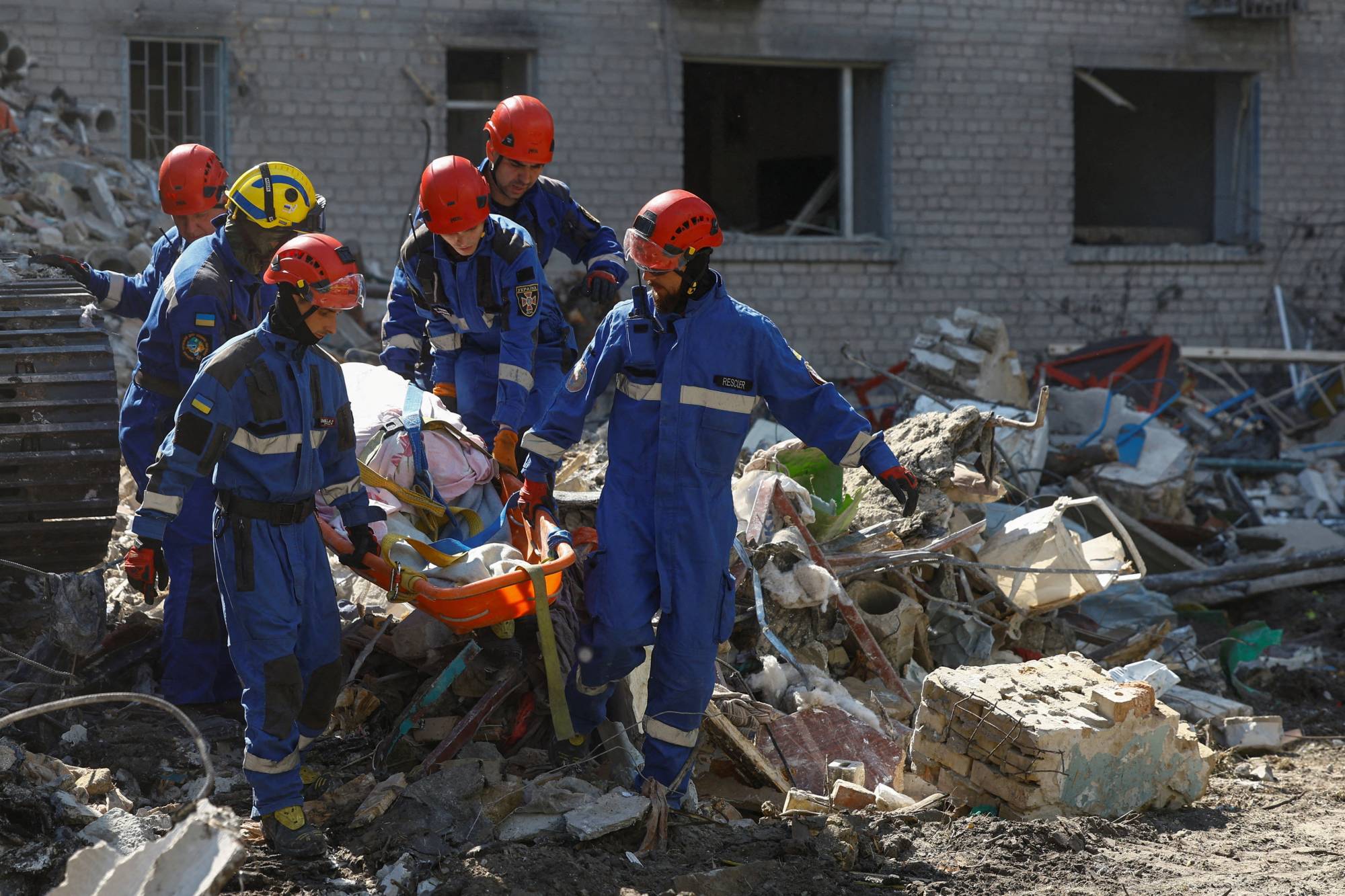
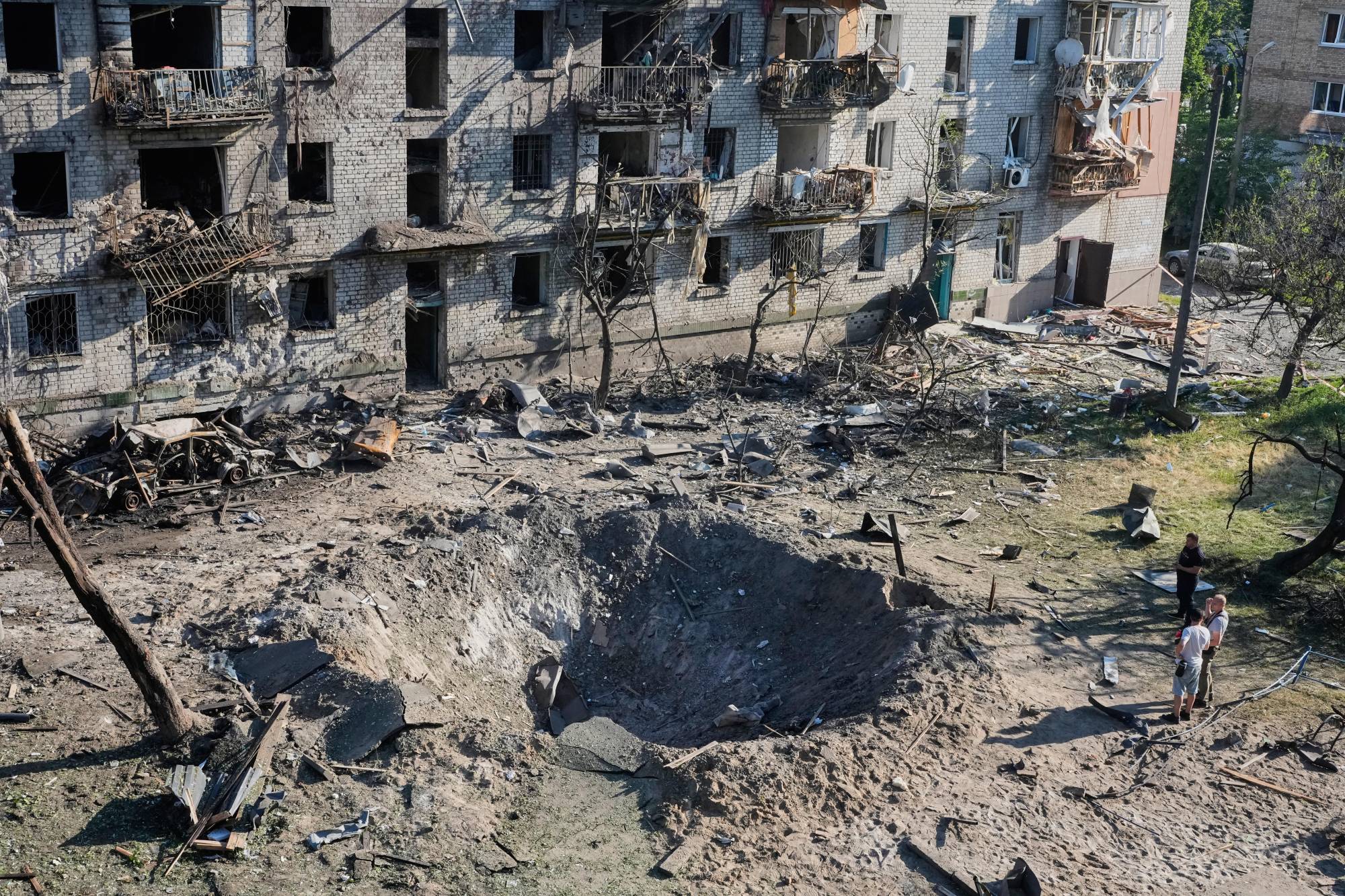
The Russia-appointed governor of the Kherson region said 'the enemy' had fired three drones that struck a cafe and hotel. The Governor of Kherson region Vladimir Saldo/AFP
TT

Russia Blames Ukraine for Deadly New Year Drone Strike

The Russia-appointed governor of the Kherson region said 'the enemy' had fired three drones that struck a cafe and hotel. The Governor of Kherson region Vladimir Saldo/AFP

Russia on Thursday said Kyiv was behind a drone strike on a hotel in the Moscow-held part of Ukraine's southern Kherson region that killed at least 20 people celebrating the New Year, accusing it of "torpedoing" peace attempts.

The accusation came at a crunch moment, after weeks of diplomacy aimed at brokering an end to the nearly four-year war, and as Ukrainian President Volodymyr Zelensky said his country was "10 percent" away from a peace deal.

Tens of thousands of people have been killed, eastern Ukraine decimated and millions forced to flee their homes since Russia launched its all-out offensive in 2022.

According to the Russia-appointed governor of the Kherson region, Vladimir Saldo, "the enemy" fired three drones that struck a cafe and hotel on the Black Sea coast in Khorly where "civilians were celebrating the New Year".

A building gutted by fire, piles of smoldering rubble and charred bodies were seen in pictures he posted on Telegram.

Kyiv has not commented on the allegations.

Russia's Investigative Committee said it had opened a probe into the attack, which had "killed more than 20 people and injured many more". The Russian foreign ministry said the death toll was still being clarified.

According to Saldo, more than 100 revelers gathered at the hotel the night of the attack.

The Russian foreign ministry accused Ukraine of carrying out a "terrorist attack", called on international organizations to condemn it and warned Kyiv of "appropriate consequences" in a statement.

It also accused the Ukrainian authorities of "deliberately torpedoing any attempts to find a peaceful resolution to the conflict".

Zelensky meanwhile said Russia was carrying the war "into the New Year" with more than 200 drones fired overnight, mainly targeting energy facilities.

"A significant number of consumers" had their electricity cut, said Ukraine's power operator Ukrenergo. Railway and port infrastructure was also damaged in the latest barrage.

In the Kharkiv region, Russia struck a park with a zoo, wounding one person. The attack also wounded animals, including lions, and killed pheasants and parrots, the park's owner Oleksandr Feldman told Ukrainian media.

New talks in sight

Ukraine came under intense pressure in 2025, both from Russian bombardment and on the battlefield, where it has steadily ceded ground to Russia's army.

An AFP analysis based on Ukrainian air force data showed a slight fall in overnight Russian drone and missile attacks on Ukraine in December.

Russia fired at least 5,134 drones in overnight attacks in the final month of 2025, six percent less than the month before, while the number of missiles declined by 18 percent in the same period, according to the data.

However, the same data showed Ukraine destroyed a smaller share of the total sum of missiles and drones in December -- 80 percent, compared with 82 percent in November.

US President Donald Trump, who regularly complains he does not receive credit as a peacemaker, has engaged in talks with both sides in a bid to end the fighting.

Ukraine says Russia is not interested in peace and is deliberately trying to sabotage diplomatic efforts to seize more Ukrainian territory.

Moscow earlier this week accused Ukraine of attempting a drone attack on one of Russian President Vladimir Putin's residences, drawing a sharp rebuttal from Kyiv, which said there was no "plausible" evidence of such an attack.

Ukraine's allies have also expressed skepticism about Russia's claim -- but Moscow on Thursday said it would hand over to the United States "decrypted data" from the drone that was allegedly targeting the secluded residence.

"These materials will be transferred to the American side through established channels," Russia's defense ministry said in a statement.

Zelensky said on Tuesday he would hold a meeting with leaders of Kyiv's allies from the so-called coalition of the willing next week in France.

The summit will be preceded by a meeting of security advisers from the allied countries on Saturday in Ukraine.