


Judge Releases Palestinian Student Activist Who was Arrested at His Citizenship Interview

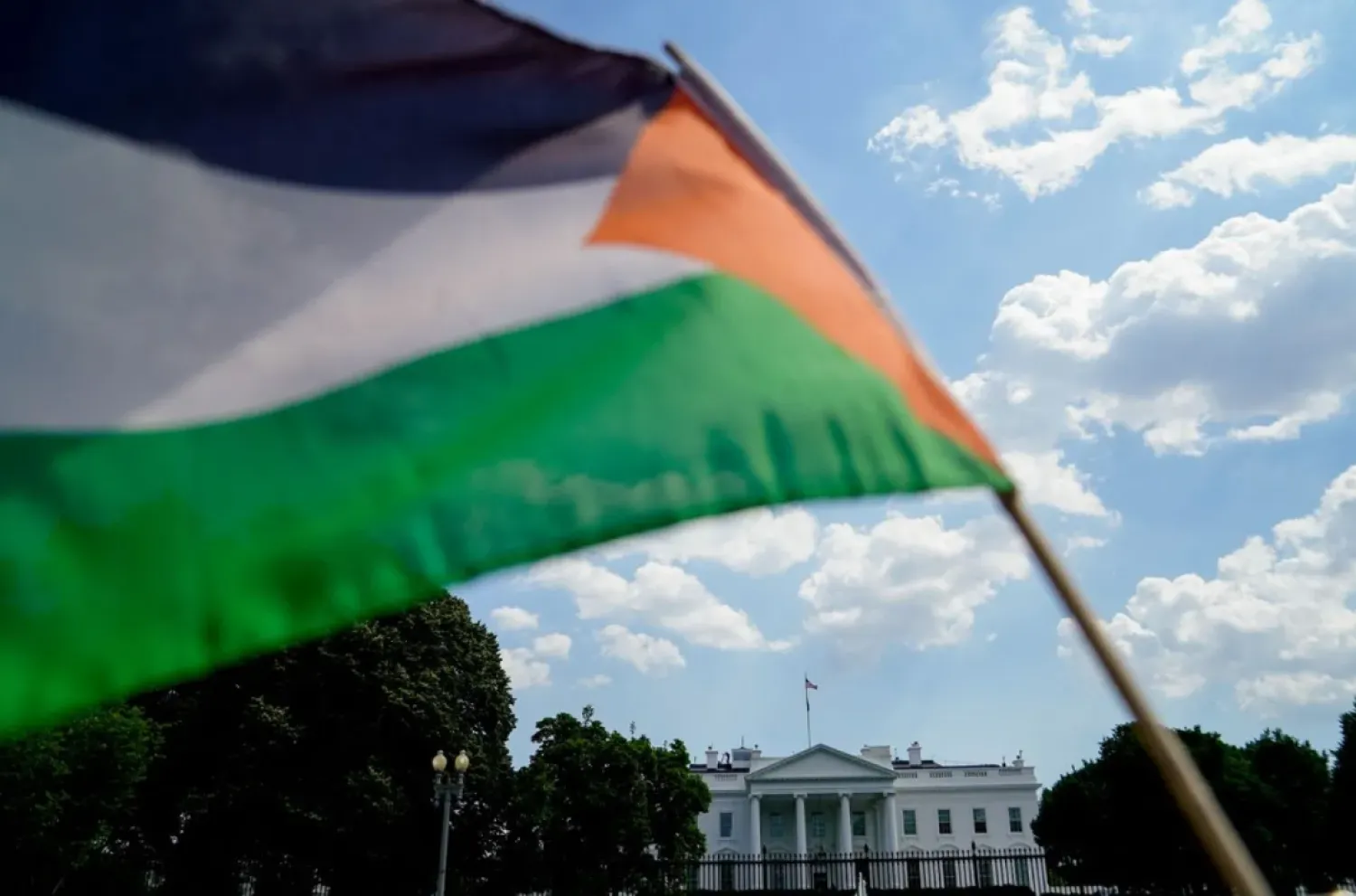
Activists wave a Palestinian flag outside the White House during a memorial for Palestinians who have died during the past year of Israeli-Palestinian violence, in Washington, US, June 5, 2021. REUTERS/Erin Scott/File Photo
TT

Judge Releases Palestinian Student Activist Who was Arrested at His Citizenship Interview

Activists wave a Palestinian flag outside the White House during a memorial for Palestinians who have died during the past year of Israeli-Palestinian violence, in Washington, US, June 5, 2021. REUTERS/Erin Scott/File Photo

A judge on Wednesday released a Palestinian man who led protests against the war in Gaza as a student at Columbia University and was arrested by immigration officials during an interview about finalizing his US citizenship.

Outside the courthouse in Vermont, Mohsen Mahdawhi led supporters in chanting “The people united will never be defeated” “No fear” and “Free Palestine.” He said people must come together in the defense of both democracy and humanity, The AP news reported.

“Never give up on the idea that justice will prevail,” he said. “We want to stand up for humanity, because the rest of the world - not only Palestine - is watching us. And what is going to happen in America is going to affect the rest of the world.”

His notice to appear in immigration court says Mahdawi is removable under the Immigration and Nationality Act because US Secretary of State Marco Rubio determined his presence and activities “would have serious adverse foreign policy consequences and would compromise a compelling US foreign policy interest.”

His lawyers say Mahdawi — legal permanent resident for 10 years — was detained in retaliation for his speech advocating for Palestinian human rights.

US District Judge Geoffrey Crawford in Burlington, Vermont, issued his ruling Wednesday following a hearing on Mahdawi, who was arrested by Immigration and Customs Enforcement agents on April 14. He has been held at the Northwest State Correctional Facility in St. Albans.

The government argues his detention is a “constitutionally valid aspect of the deportation process” and that district courts are barred from hearing challenges to how and when such proceedings are begun.

“District courts play no role in that process. Consequently, this Court lacks jurisdiction over Petitioner’s claims, which are all, at bottom, challenges to removal proceedings,” Michael Drescher, Vermont’s acting US attorney, wrote. His office did not immediately respond to a request for comment.

According to a court filing, Mahdawi was born in a refugee camp in the Israeli-occupied West Bank and moved to the United States in 2014. He recently completed coursework at Columbia and was expected to graduate in May before beginning a master’s degree program there in the fall.

As a student, Mahdawi was an outspoken critic of Israel’s war in Gaza and organized campus protests until March 2024. He cofounded the Palestinian Student Union at Columbia with Mahmoud Khalil, another Palestinian permanent resident of the US and graduate student who was detained by immigration authorities.

Speaking to supporters, Mahdawi directly addressed President Donald Trump and his Cabinet, saying “I am not afraid of you.”

“If there is no fear, what is it replaced with?” he said. “Love. Love is our way.”

An immigration judge in Louisiana ruled that the government’s assertion that Khalil’s presence in the US posed “potentially serious foreign policy consequences” satisfied the requirements for deportation.



China Opposes Recognition of Somaliland, Affirms Support for Somalia

A man holds a flag of Somaliland in front of the Hargeisa War Memorial monument in Hargeisa on November 7, 2024. (AFP)
TT

China Opposes Recognition of Somaliland, Affirms Support for Somalia

A man holds a flag of Somaliland in front of the Hargeisa War Memorial monument in Hargeisa on November 7, 2024. (AFP)

China opposes any attempt to split territories ​in Somalia, the foreign ministry said on Monday, affirming Chinese support for the sovereignty, unity and territorial ‌integrity of ‌the East ‌African ⁠country.

"No ​country ‌should encourage or support other countries' internal separatist forces for its own selfish interests," ministry spokesperson ⁠Lin Jian told reporters ‌at a ‍regular ‍press conference, urging authorities ‍in Somaliland to stop "separatist activities and collusion with external forces".

Israel drew international condemnation when it became ​the first country on Friday to formally recognize ⁠the self-declared Republic of Somaliland as an independent and sovereign state, seeking immediate cooperation with Somaliland in agriculture, health, technology and the economy.


China Launches Military Drills Simulating Blockade of Taiwan Ports

A Taiwan Air Force Mirage 2000 fighter jet takes off at Hsinchu Air Base in Hsinchu on December 29, 2025. (AFP)
TT

China Launches Military Drills Simulating Blockade of Taiwan Ports

A Taiwan Air Force Mirage 2000 fighter jet takes off at Hsinchu Air Base in Hsinchu on December 29, 2025. (AFP)

China launched live-fire drills around Taiwan on Monday that it said would simulate a blockade of the self-ruled island's key ports, prompting Taipei to condemn Beijing's "military intimidation".

Beijing claims Taiwan as part of its sovereign territory and has refused to rule out using military action to seize the island democracy.

The latest show of force follows a bumper round of arms sales to Taipei by the United States, Taiwan's main security backer.

Beijing warned on Monday that "external forces" arming Taipei would "push the Taiwan Strait into a perilous situation of imminent war", but did not mention any countries by name.

Any attempts to stop China's unification with Taiwan were "doomed to fail", foreign ministry spokesman Lin Jian said.

China said earlier it was conducting "live-fire training on maritime targets to the north and southwest of Taiwan" in large-scale exercises involving destroyers, frigates, fighters, bombers and drones.

A military spokesman said Beijing would send army, navy, air force and rocket force troops for "major military drills" code-named "Justice Mission 2025".

The activities will focus on "sea-air combat readiness patrol, joint seizure of comprehensive superiority, blockade on key ports and areas, as well as all-dimensional deterrence outside the island chain", said Senior Colonel Shi Yi of the People's Liberation Army's Eastern Theater Command.

Chinese authorities also published a map of five large zones around Taiwan where further live-fire activities would take place from 8:00 am to 6:00 pm (0000 to 1000 GMT) on Tuesday.

"For the sake of safety, any irrelevant vessel or aircraft is advised not to enter the afore-mentioned waters and airspace," the statement said.

- 'Rapid response' -

Taiwan condemned China's "disregard for international norms and the use of military intimidation to threaten neighboring countries", Presidential Office spokeswoman Karen Kuo said.

Taipei said Monday it had detected four Chinese coastguard ships sailing off its northern and eastern coasts.

Its coastguard said it "immediately deployed large vessels to pre-position responses in relevant areas" and "sent additional support units".

Taiwan's military said it had established a response center, deployed "appropriate forces" and "carried out a rapid response exercise".

The drills by China's ruling Communist Party "further confirm its nature as an aggressor, making it the greatest destroyer of peace", Taipei's defense ministry said.

- 'Stern warning' -

Shi, the Chinese military spokesman, said the drills were "a stern warning against 'Taiwan Independence' separatist forces, and... a legitimate and necessary action to safeguard China's sovereignty and national unity".

Beijing's military released a poster about the drills showing "arrows of justice" -- one engulfed in flames -- raining down on what appeared to be green worms on a geographical outline of Taiwan.

Chinese state broadcaster CCTV reported that a core theme of the exercises was a "blockade" of key Taiwanese ports including Keelung in the north and Kaohsiung in the south.

China's military last held large-scale drills involving live firing around Taiwan in April -- surprise maneuvers condemned by Taipei.

China said this month it would take "resolute and forceful measures" to safeguard its territory after Taiwan said the United States had approved a major $11 billion arms sale.

Beijing announced fresh sanctions on 20 American defense companies last week, though they appeared to have little or no business in China.

Last month, Japan's Prime Minister Sanae Takaichi triggered a backlash from Beijing when she said the use of force against Taiwan could warrant a military response from Tokyo.


Top Diplomats of China, Cambodia and Thailand Meet as Beijing Seeks to Strengthen Role in Dispute

This handout photo taken and released by Agence Kampuchea Press (AKP) on December 29, 2025 shows China's Foreign Minister Wang Yi (C), Cambodia's Deputy Prime Minister Prak Sokhonn (L), who is also the country's Foreign Minister, and Thailand's Foreign Minister Sihasak Phuangketkeow (R) linking arms during a meeting in China's Yunnan province. (Handout / Agence Kampuchea Press (AKP) / AFP)
TT

Top Diplomats of China, Cambodia and Thailand Meet as Beijing Seeks to Strengthen Role in Dispute

This handout photo taken and released by Agence Kampuchea Press (AKP) on December 29, 2025 shows China's Foreign Minister Wang Yi (C), Cambodia's Deputy Prime Minister Prak Sokhonn (L), who is also the country's Foreign Minister, and Thailand's Foreign Minister Sihasak Phuangketkeow (R) linking arms during a meeting in China's Yunnan province. (Handout / Agence Kampuchea Press (AKP) / AFP)

Foreign ministers from Cambodia and Thailand convened with their Chinese counterpart on Monday as the Beijing government, building on its expanding presence in the world diplomatic arena, sought to play a stronger mediating role in the violent border dispute between the two Southeast Asian countries.

The trilateral meeting, held in a southwestern Chinese province north of the contested border, came two days after Thailand and Cambodia signed a fresh ceasefire agreement to end weeks of fighting that killed more than 100 people and forced hundreds of thousands to be evacuated on both sides of the border.

Chinese Foreign Minister Wang Yi called for joint efforts to promote regional peace, stability and development, which is language typical for China in such situations.

“Allowing the flames of war to be reignited is absolutely not what the people of the two countries want, and not what China, as your friend, wants to see. Therefore, we should resolutely look ahead and move forward,” Wang said during the meeting Monday in Yunnan province.

It was noteworthy that the meeting was held there, nearer to the dispute and to Southeast Asia, rather than in Beijing, the Chinese capital and seat of government about 1,300 miles (2,500 kilometers) northeast.

Cambodian Foreign Minister Prak Sokhonn said he believed the latest ceasefire would last and would create an environment for both countries to work on their relations and resume the previously agreed-upon ways to settle their differences, according to a Chinese interpreter.

Thai Foreign Minister Sihasak Phuangketkeow also expressed hopes for peace with neighboring countries, the interpreter said.

The Thai Foreign Ministry later said in a statement that China volunteered to be a platform to support peace between the two countries and Thailand reiterated that adjustments of ties should be conducted “on a step-by-step basis.”

“The Thai side will consider the release of 18 soldiers after the 72 hours ceasefire observation period and requests that Cambodia facilitate the return of Thais along the border,” the ministry said.

A day after the fresh pact was signed, Sihasak and Prak Sokhonn held separate meetings with Wang on Sunday, the first day of the two-day gathering.

The meetings represented China's latest efforts to strengthen its role as an international mediator and, in particular, its influence in Asian regional crises. As China grows and becomes more of an economic and political force regionally and globally, Beijing has spent the past decade and more working in various ways to increase its voice as a third party in diplomatic matters.

Disputes continue

The two Southeast Asian countries originally reached a ceasefire in July. It was brokered by Malaysia and pushed through under pressure from US President Donald Trump, who threatened to withhold trade privileges unless Thailand and Cambodia agreed. The preliminary pact was followed by a more detailed October agreement.

But Thailand and Cambodia carried on a bitter propaganda war, with minor, cross-border violence continuing. The tensions erupted into heavy fighting in early December.

The Saturday agreement calls for Thailand, after the ceasefire has held for 72 hours, to repatriate 18 Cambodian soldiers who have been held prisoner since the earlier fighting in July. Their release has been a major demand of the Cambodian side.

The agreement also calls on both sides to adhere to international agreements against deploying land mines, a major concern of Thailand.

Cambodian Prime Minister Hun Manet on Monday issued a statement to all Cambodian combatants along the border with Thailand.

“Even though we can still fight," he said, “as a small country we still have nothing to gain from prolonging the fighting for a long time.”