King Charles Expresses Love for ‘Strong and Free’ Canada

 Canada Prime Minister Mark Carney, left, applauds King Charles after delivering the speech from the throne in the Senate in Ottawa, Canada on Tuesday, May 27, 2025. (Adrian Wyld/The Canadian Press via AP)
Canada Prime Minister Mark Carney, left, applauds King Charles after delivering the speech from the throne in the Senate in Ottawa, Canada on Tuesday, May 27, 2025. (Adrian Wyld/The Canadian Press via AP)
TT

King Charles Expresses Love for ‘Strong and Free’ Canada

 Canada Prime Minister Mark Carney, left, applauds King Charles after delivering the speech from the throne in the Senate in Ottawa, Canada on Tuesday, May 27, 2025. (Adrian Wyld/The Canadian Press via AP)
Canada Prime Minister Mark Carney, left, applauds King Charles after delivering the speech from the throne in the Senate in Ottawa, Canada on Tuesday, May 27, 2025. (Adrian Wyld/The Canadian Press via AP)

King Charles, speaking during a symbolic visit to show support for Canada at a time it has faced annexation threats from US President Donald Trump, on Tuesday expressed his love for the country, which he described as "strong and free".

Charles, Canada's head of state, is the first British monarch in almost 70 years to preside over the opening of the Canadian parliament.

In a speech in the Senate, Charles referred to "the country that Canadians and I love so much" but made no direct reference to Trump, who has imposed tariffs on Canadian exports and muses about turning Canada into the 51st US state.

"The True North is indeed strong and free," Charles said, referring to the Canadian national anthem.

The speech outlining the government's plans for the next session was largely written by officials working for Prime Minister Mark Carney. But Charles was responsible for the comments about his love for Canada.

"Every time I come to Canada ... a little more of Canada seeps into my bloodstream – and from there straight to my heart," said the monarch, accompanied by his wife Queen Camilla.

Charles, who joked and laughed with Carney before the speech, wore the Order of Canada around his neck.

He and Camilla were driven to the Senate in a horse-drawn carriage, escorted by 28 riders from the Royal Canadian Mounted Police and cheered on by flag-waving onlookers. Charles then inspected an honor guard, all clad in bright red uniforms.

An Ipsos Reid poll released Tuesday for Global News found that 66% of respondents believed Canada's relationship with the monarchy was useful because it helped set the nation apart from the United States, up from 54% in April 2023.

In the speech, the government reiterated its belief that Canada needs to agree a new relationship with the US and look for more reliable trading partners.

The warm welcome for the royal couple contrasted with a visit to Australia last October, when an Indigenous senator heckled Charles in Parliament House, accusing him of "genocide".

Australia has long debated the need to keep a distant monarch. A 1999 referendum in Australia on becoming a republic lost with 55% of voters opposed.

Australian Prime Minister Anthony Albanese and much of his center-left Labor party support the republican cause.

The monarchy is not generally a major factor in Canadian daily life, even though coins and bank notes feature the monarch's head and the country is defended by the Royal Canadian Air Force and the Royal Canadian Navy.

A poll from the non-profit Angus Reid Institute released on Tuesday showed 83% of Canadians say they were indifferent or did not care about the monarch's historic visit.


Iran and the US Harden their Positions as Tehran Keeps Its Grip on the Strait of Hormuz

FILE - A thick plume of smoke rises from an oil storage facility hit by a US-Israeli strike in Tehran, Iran, March 8, 2026. (AP Photo/Vahid Salemi, File)
TT

Iran and the US Harden their Positions as Tehran Keeps Its Grip on the Strait of Hormuz

FILE - A thick plume of smoke rises from an oil storage facility hit by a US-Israeli strike in Tehran, Iran, March 8, 2026. (AP Photo/Vahid Salemi, File)

Iran and the United States hardened their positions as diplomacy aimed at reaching a ceasefire in the war in the Middle East appeared to be faltering on Thursday. Tehran moved to formalize its control over the crucial Strait of Hormuz while Washington prepared for the arrival of US combat forces in the region that could be used on the ground in the Iranian Republic.

Iran is instituting a “de facto ‘toll booth’ regime,” industry experts say, with some ships paying in Chinese yuan to pass through the strait, where 20% of all traded oil and natural gas is transported in peacetime.

Meanwhile, a strike group anchored by the amphibious assault ship USS Tripoli drew closer to the Mideast with some 2,500 Marines. Also, at least 1,000 paratroopers from the 82nd Airborne have been ordered to the region, The Associated Press said.

The troop movements don’t guarantee US President Donald Trump will try to use force to compel Iran to open the strait and halt its attacks on Gulf Arab states.

Trump previously deployed a large force in the Caribbean before the American military captured former Venezuelan leader Nicolás Maduro in January. In the current situation, the US is seen as focused on possibly seizing Iran’s oil terminal at Kharg Island or other sites near the strait.

US Navy Adm. Brad Cooper, who commands the American military in the region, said his forces have hit more than 10,000 targets since Israel and the US started the war Feb. 28, destroying 92% of Iran's largest ships and more than two-thirds of the country's missile, drone and naval production facilities.

“We’re not done yet,” said Cooper, who heads the US Central Command, in a video message. “We are on a path to completely eliminate Iran’s wider military apparatus.”

Iran seen as operating Strait of Hormuz as ‘de facto toll booth’

With its stranglehold on traffic through the Strait of Hormuz, which leads from the Arabian Gulf toward the open ocean, Iran has been blocking ships it perceives as linked to the US and Israeli war effort, but letting through a trickle of others.

The Fars and Tasnim news agencies, both close to Iran’s paramilitary Revolutionary Guard, quoted lawmaker Mohammadreza Rezaei Kouchi as saying that parliament was working to formalize the process of charging fees to let ships pass.

“We provide its security, and it is natural that ships and oil tankers should pay such fees,” he was quoted as saying.

Lloyd’s List Intelligence called it a “de facto ‘toll booth’ regime.”

The shipping intelligence firm said vessels have to provide manifests, crew details and their destination to Iran’s Guard for sanctions screening, cargo alignment checks that currently prioritizes oil over all other commodities, and for what is described as ‘geopolitical vetting.’”

“While not all ships are paying a direct toll, at least two vessels have and the payment is settled in yuan,” Lloyd’s List said, referring to China’s currency.

Iran's grip on the strait and relentless attacks on Gulf regional energy infrastructure has sent oil prices skyrocketing and concerns of a global energy crisis surging. Brent crude, the international standard, traded at US$104 early Thursday, up more than 40% from the day the war started.

“To make it crystal clear, this war is a catastrophe for world's economies,” German Defense Minister Boris Pistorius told reporters during a visit to Australia.

US maintains negotiations are ongoing but Iran says there are no talks

Using Pakistan as an intermediary, Washington has delivered to Iran a 15-point ceasefire proposal, which includes the reopening of the Strait of Hormuz.

Trump, speaking at a fundraiser Wednesday night in Washington, insisted that Iran still wants to cut a deal.

“They are negotiating, by the way, and they want to make a deal so badly, but they’re afraid to say it because they figure they’ll be killed by their own people,” Trump said.

Iran’s Foreign Minister Abbas Araghchi said in an interview on state TV, however, that his government has not engaged in talks to end the war, “and we do not plan on any negotiations.”

Araghchi said the US had tried to send messages to Iran through other nations, “but that is not a conversation nor a negotiation.”

Press TV, the English-language broadcaster on Iranian state television, said Iran has its own five-point proposal, which includes “sovereignty over the Strait of Hormuz.”

A wave of Israeli airstrikes hits as Iran fires on Gulf neighbors

Israel said it carried out a wave of attacks early on Thursday targeting Iranian infrastructure, and air defenses were heard in Tehran, while heavy strikes were also reported around Isfahan, a city some 330 kilometers (205 miles) south of the Iranian capital.

Ifahan is home to a major Iranian air base and other military sites, as well as one of the nuclear sites bombed by the US during the 12-day war between Israel and Iran in June.

Sirens sounded very early on Thursday morning in parts of Tel Aviv and cities in central Israel. Rescue workers said two people were injured in a blast in Kfar Qasim.

Saudi Arabia's Defense Ministry said it intercepted multiple drones over its oil-rich Eastern Province, the United Arab Emirates' air defenses also worked to intercept incoming fire, and Bahrain reported extinguishing a blaze in a neighborhood that is home to the Bahrain International Airport.

Since the war began, more than 1,500 people have been killed in Iran, its Health Ministry says. Twenty people have been killed in Israel; two Israeli soldiers have also been killed in Lebanon. At least 13 US military members have been killed. More than a dozen civilians in the occupied West Bank and Gulf Arab states have also died.

Nearly 1,100 people have died in Lebanon, authorities said. In Iraq, where Iranian-supported militant groups have entered the conflict, 80 members of the security forces have been killed.



Pentagon Reaches Deals with Defense Firms to Expand Munitions Production

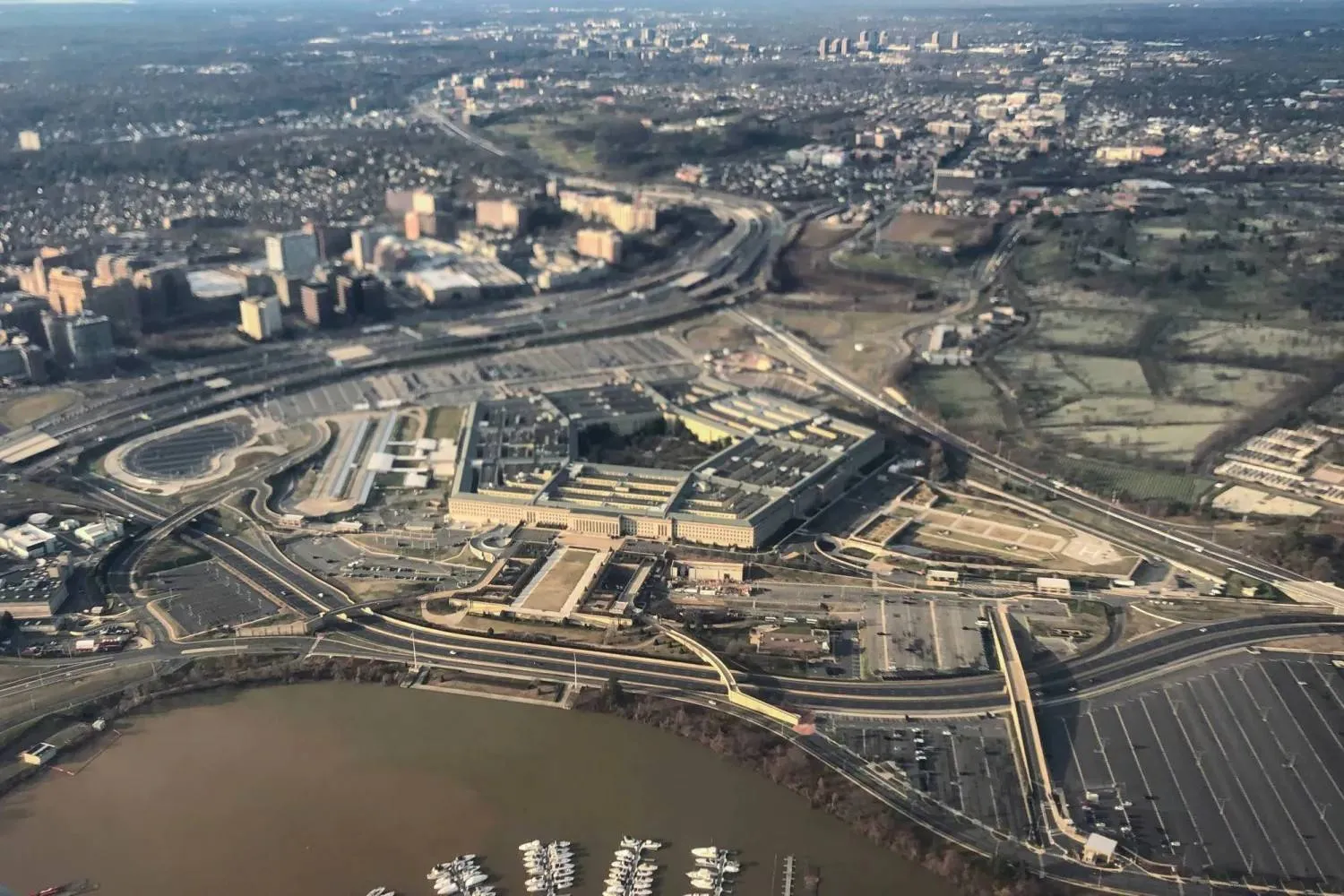
A general view of the Pentagon in Washington, DC (AP) 
TT

Pentagon Reaches Deals with Defense Firms to Expand Munitions Production

A general view of the Pentagon in Washington, DC (AP) 

The Pentagon said on Wednesday it had reached framework agreements with BAE Systems, Lockheed and Honeywell to boost production of defense systems munitions as part of a push to put the US military on a “wartime footing.”

The ‌announcements come more than three weeks after US President Donald Trump and Israel launched a war on Iran. They also follow Trump's meeting earlier this month with executives from seven defense contractors as the Pentagon sought to replenish weapons stocks depleted by US strikes on Iran and other recent military operations.

The Pentagon also plans to send thousands of airborne troops to ⁠the Gulf to give Trump more options to order a ground assault, Reuters reported on Tuesday.

Under the agreements, Honeywell Aerospace will “surge production of critical components for America's munitions stockpile,” as part of a $500 million multi-year investment, the Pentagon said.

BAE Systems and Lockheed Martin will also quadruple production of seekers for the Terminal High Altitude Area Defense (THAAD) interceptor, while a new framework agreement with Lockheed will accelerate production of its Precision Strike Missile, the Pentagon added.

Honeywell said the agreement would support increased output of navigation systems, missile steering actuators and electronic warfare products used ‌across ⁠US military platforms.

Honeywell Aerospace CEO Jim Currier said the company was ready to help meet the urgent demand.

Lockheed Martin CEO Jim Taiclet also said the company was “working closely with the Department of War and the US Army to scale production to meet operational demand.”

Trump in January signed an executive order directing ⁠officials to identify contractors deemed to be underperforming on government contracts while continuing to return profits to shareholders. His administration has also stepped up pressure on defense companies to prioritize production over shareholder payouts.

“We discussed ⁠production and production schedules,” Trump said of the earlier meeting, which included executives from Lockheed Martin, RTX, BAE Systems, Boeing, Honeywell Aerospace, L3Harris Technologies and Northrop Grumman.

The United States has drawn ⁠down billions of dollars worth of weapons from its stockpiles since Russia invaded Ukraine in 2022, and during Israel's military operations in Gaza, including artillery systems, ammunition and anti-tank missiles.


Strikes Near Iran, Israel Nuclear Sites Risk ‘Unmitigated Catastrophe’, Says UN

 A drone view shows a damage in a residential neighborhood, following a night of Iranian missile strikes which injured dozens of Israelis, amid the US-Israel conflict with Iran, in Dimona, southern Israel March 22, 2026. (Reuters)
A drone view shows a damage in a residential neighborhood, following a night of Iranian missile strikes which injured dozens of Israelis, amid the US-Israel conflict with Iran, in Dimona, southern Israel March 22, 2026. (Reuters)
TT

Strikes Near Iran, Israel Nuclear Sites Risk ‘Unmitigated Catastrophe’, Says UN

 A drone view shows a damage in a residential neighborhood, following a night of Iranian missile strikes which injured dozens of Israelis, amid the US-Israel conflict with Iran, in Dimona, southern Israel March 22, 2026. (Reuters)
A drone view shows a damage in a residential neighborhood, following a night of Iranian missile strikes which injured dozens of Israelis, amid the US-Israel conflict with Iran, in Dimona, southern Israel March 22, 2026. (Reuters)

Strikes around Iran and Israel's nuclear sites risk unleashing an "unmitigated catastrophe", the United Nations rights chief said Wednesday, warning that the Middle East war had created an "extremely dangerous" situation.

Speaking before the UN Human Rights Council, where countries were holding an urgent debate on Tehran's attacks across the Gulf, Volker Turk warned that many of the strikes in the weeks-long war "raise serious concerns under international law".

In particular, Turk cautioned that "recent missile strikes near nuclear sites in both Israel and Iran underscore the immense danger of further escalation".

"States are flirting with unmitigated catastrophe."

His comments came after the UN nuclear watchdog said Iran had informed it that "another projectile hit the premises" of the Bushehr nuclear power plant on Tuesday, without damaging it.

Over the weekend, an Iranian strike hit the southern Israeli town of Dimona, home to a nuclear facility, in what Tehran said was in response to an earlier attack on its nuclear site at Natanz.

"The situation is extremely dangerous and unpredictable, and has created chaos across the region," Turk said, insisting that "we cannot go back to war as a tool of international relations".

The UN rights chief also warned that "this conflict has an unprecedented power to ensnare countries across borders and around the world".

"The complex dynamics could ignite further national, regional or global crises at any moment, with an appalling impact on civilians and people everywhere."