


UN Nuclear Watchdog Can Guarantee Iran Will Not Develop Nuclear Weapons

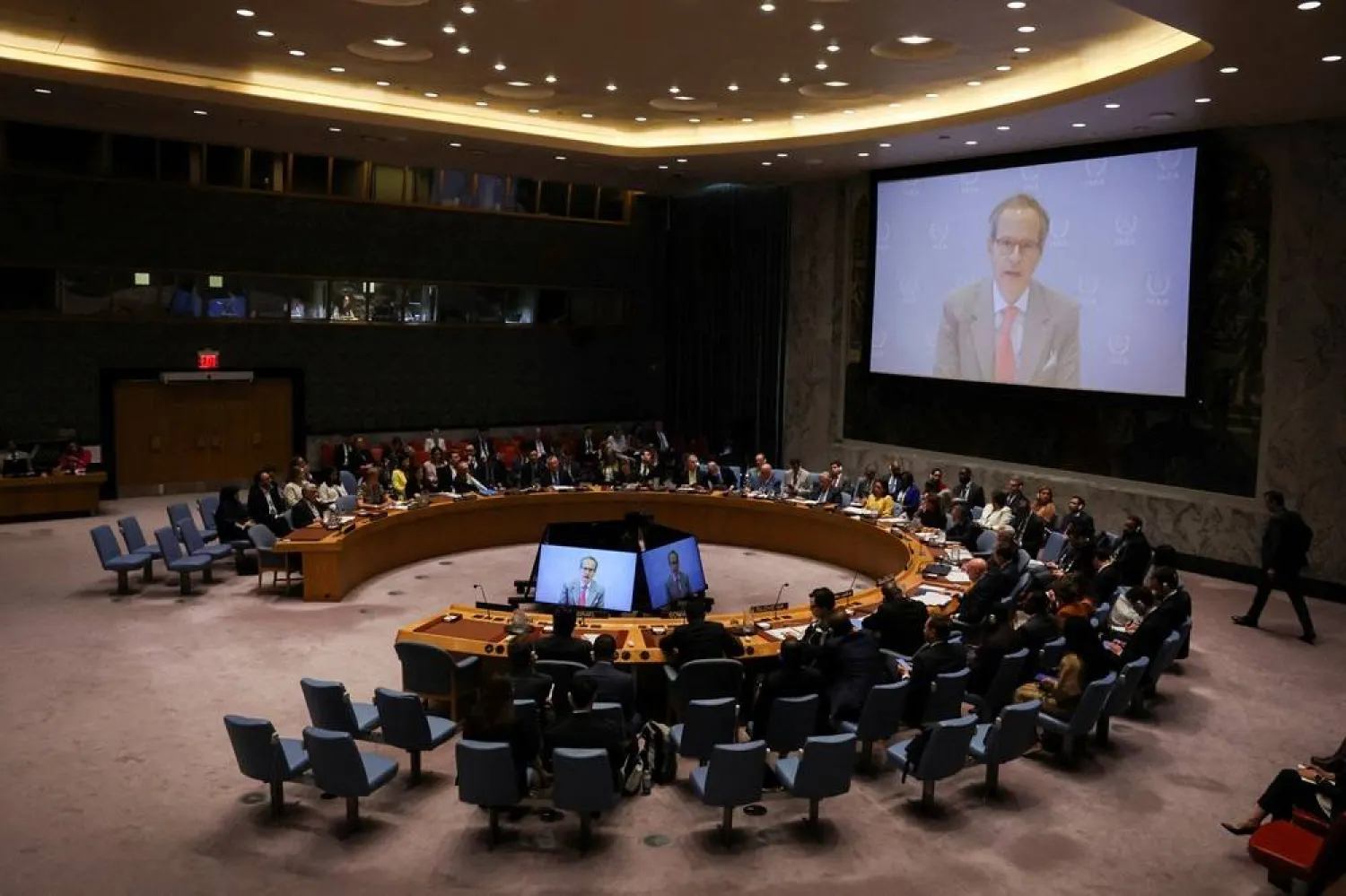
Rafael Mariano Grossi, Director General of the International Atomic Energy Agency (IAEA) speaks via video during a meeting of the United Nations Security Council, about the conflict between Israel and Iran, at UN headquarters in New York City, US, June 20, 2025. (Reuters)
TT

UN Nuclear Watchdog Can Guarantee Iran Will Not Develop Nuclear Weapons

Rafael Mariano Grossi, Director General of the International Atomic Energy Agency (IAEA) speaks via video during a meeting of the United Nations Security Council, about the conflict between Israel and Iran, at UN headquarters in New York City, US, June 20, 2025. (Reuters)

UN nuclear chief Rafael Grossi told the UN Security Council on Friday the International Atomic Energy Agency can do this “through a watertight inspection system.”

He said elements for an agreement on reining in Iran’s nuclear program have been discussed.

He was speaking at an emergency meeting of the Security Council about the Israel-Iran conflict.

Grossi called for “maximum restraint” in the war, adding: “A diplomatic solution is within reach if the necessary political will is there.”

He warned against any potential attack on Iran’s only commercial nuclear power plant as well as a research reactor near Tehran, saying it could lead to radiation leaks with “severe consequences.”

Even a hit that disabled the two lines supplying electrical power to the Bushehr plant “could cause its reactor core to melt, which could result in a high release of radioactivity to the environment,” he added.

Grossi said Israeli attacks on nuclear sites at Natanz and Isfahan and at the Arak heavy water plant have so far not led to any radiological release.

He said an Israeli military official erroneously reported Thursday that Bushehr was hit by an airstrike, but Israel then retracted that claim. He stressed that the confusion “underscored the vital need for clear and accurate communication.”

More on the Tehran Research Reactor

The Tehran Research Reactor is at the headquarters of the Atomic Energy Organization of Iran, the civilian body overseeing the country’s atomic program.

The US actually provided Iran the reactor in 1967 as part of America’s “Atoms for Peace” program during the Cold War. It initially required highly enriched uranium but was later retrofitted to use low-enriched uranium over proliferation concerns

Iran’s only commercial nuclear power plant is in Bushehr on the Arabian Gulf, some 750 kilometers (465 miles) south of Tehran. Construction on the plant began under Iran’s Shah Mohammad Reza Pahlavi in the mid-1970s. After the 1979 revolution, the plant was repeatedly targeted in the Iran-Iraq war. Russia later completed construction of the facility.

Iran is building two other reactors like it at the site. Bushehr is fueled by uranium produced in Russia, not Iran, and is monitored by the IAEA.



Trump Says Iran 'Totally Defeated'

US President Donald Trump steps off Air Force One as he arrives at Palm Beach International Airport in West Palm Beach, Florida on March 13, 2026. (Photo by SAUL LOEB / AFP)
TT

Trump Says Iran 'Totally Defeated'

US President Donald Trump steps off Air Force One as he arrives at Palm Beach International Airport in West Palm Beach, Florida on March 13, 2026. (Photo by SAUL LOEB / AFP)

US President Donald Trump said Friday that Iran has been "totally defeated" in the US-Israeli military campaign against the country and wanted a deal he would not accept, despite Iranian officials pledging to continue the fight.

"The Fake News Media hates to report how well the United States Military has done against Iran, which is totally defeated and wants a deal - But not a deal that I would accept!" Trump wrote on his Truth Social platform, without elaborating.

Trump's comments came after he said that Washington had heavily bombed military targets on Iran's oil hub Kharg Island and the US Navy would soon begin escorting tankers through the Strait of Hormuz.

But as the US strikes on Iran persisted, Tehran launched a new wave of drone and missile attacks on Israel.

Iran's top diplomat said this week that talks remain off the table and attacks would continue for as long as necessary.

"I don't think talking with the Americans would be on our agenda anymore," Iran's Foreign Minister Abbas Araghchi told PBS News this week, adding Tehran had a "very bitter experience" during previous negotiations with the US.

Iran's semi-official Fars news agency reported, citing sources, that more than 15 explosions were heard on Kharg during the US attacks. The sources said air defenses, a naval base and airport facilities were hit, but there was no damage to oil infrastructure.

Iran also claimed success in shooting down five drones over its airspace, bringing to 114 the total US and Israeli drones it has downed ⁠during the war, Iranian state TV reported on Saturday.

On Friday, the Israeli military said its air force had struck more than 200 targets in western and central Iran over the past day, including ballistic missile launchers, air-defense systems and weapons production sites.


NKorea Fires About 10 Missiles Toward Sea During US-SKorea Drills

US soldiers from the 2nd Infantry Division/ROK-US Combined Division, conducts a combined exercise (maneuvering, wet gap crossing) with South Korean soldiers from the Lightning Brigade, Capital Mechanized Infantry Division and 7th Engineer Brigade, as part of the Freedom Shield 26 exercise, in Yeoncheon, Gyeonggi province, South Korea, 14 March 2026. EPA/JEON HEON-KYUN
TT

NKorea Fires About 10 Missiles Toward Sea During US-SKorea Drills

US soldiers from the 2nd Infantry Division/ROK-US Combined Division, conducts a combined exercise (maneuvering, wet gap crossing) with South Korean soldiers from the Lightning Brigade, Capital Mechanized Infantry Division and 7th Engineer Brigade, as part of the Freedom Shield 26 exercise, in Yeoncheon, Gyeonggi province, South Korea, 14 March 2026. EPA/JEON HEON-KYUN

North Korea on Saturday fired about 10 ballistic missiles toward the eastern sea, South Korea’s military said, staging its own show of force as the rival South conducts a joint military exercise with the United States.

South Korea’s Joint Chiefs of Staff said the missiles were fired from an area in Sunan, the site of Pyongyang’s international airport, and flew about 350 kilometers (220 miles).

Japanese Defense Minister Shinjiro Koizumi said the weapons landed outside the country’s exclusive economic zone and that there were no reports of damage to planes or ships.

The South’s Joint Chiefs said the military has stepped up surveillance and is maintaining readiness against possible additional launches while closely sharing information with the US and Japan.

The launches came as the US and South Korean militaries conduct their annual springtime exercises involving thousands of troops while the Trump administration also wages an escalating war in the Middle East.

The war has raised concerns about potential security lapses in South Korea, as local media — citing security camera footage and other images — have speculated that the US is relocating some missile defense assets stationed in the country to support operations against Iran.

When asked by The Associated Press this week whether US Forces Korea was moving interceptor missiles from its Terminal High Altitude Area Defense, or THAAD, system in Seongju to the Middle East, South Korean President Lee Jae Myung’s office said it could not confirm details about US military operations.

The office said the potential relocation of US military assets would not affect the allies’ defense posture against nuclear-armed North Korea, while also citing South Korea’s conventional military strength. It earlier gave a similar response to reports about the possible relocation of Patriot missile defense systems from South Korea.

The launches came hours after South Korean Prime Minister Kim Min-seok, Seoul’s No. 2 official after Lee, met US President Donald Trump in Washington and expressed hope for renewed diplomacy between Washington and Pyongyang. Lee seeks improved inter-Korean relations, and some of his top officials have said Trump’s expected visit to China, starting March 31, may create an opening with Pyongyang.

But Saturday’s launches appeared to dim such hopes, signaling defiance by Pyongyang, which in recent months has hardened its stance toward Seoul and urged Washington to drop denuclearization demands as a precondition for talks.


Iran Arrests Man Accused of Running Starlink Internet Network

 A man leaves a subway train past an image of the late Iranian Supreme Leader Ali Khamenei, in Tehran, Iran, Friday, March 13, 2026. (AP)
A man leaves a subway train past an image of the late Iranian Supreme Leader Ali Khamenei, in Tehran, Iran, Friday, March 13, 2026. (AP)
TT

Iran Arrests Man Accused of Running Starlink Internet Network

 A man leaves a subway train past an image of the late Iranian Supreme Leader Ali Khamenei, in Tehran, Iran, Friday, March 13, 2026. (AP)
A man leaves a subway train past an image of the late Iranian Supreme Leader Ali Khamenei, in Tehran, Iran, Friday, March 13, 2026. (AP)

Iranian authorities have arrested a man accused of leading a network that sold access to the internet via Starlink terminals, a technology that is banned in Iran, the ISNA news agency reported on Friday.

Iran has been digitally sealed off from the rest of the world by a complete internet blackout since the start of the Middle East war.

To get around those restrictions, some Iranians have turned to Starlink terminals from the US company SpaceX, which connect to the internet via satellites.

Doing so is a criminal offence in Iran punishable with prison time.

"A 37-year-old man, who had put in place a network in several provinces of the country to sell access to the unrestricted internet via Starlink, has been arrested" in Shiraz, ISNA reported, citing a deputy police commander for Fars province.

It did not say when the arrest took place.

Iranians were previously placed under an 18-day internet blackout in January, the longest so far, amid anti-government protests during which thousands were killed.

At the time, the authorities managed to disrupt the operation of Starlink terminals.

Under Iranian law, people found guilty of "the use, transportation, purchase or sale of electronic internet communication devices such as Starlink" used to access banned content can be jailed for up to two years in prison.