
32 Go on Trial Over Fatal Hotel Fire in Türkiye

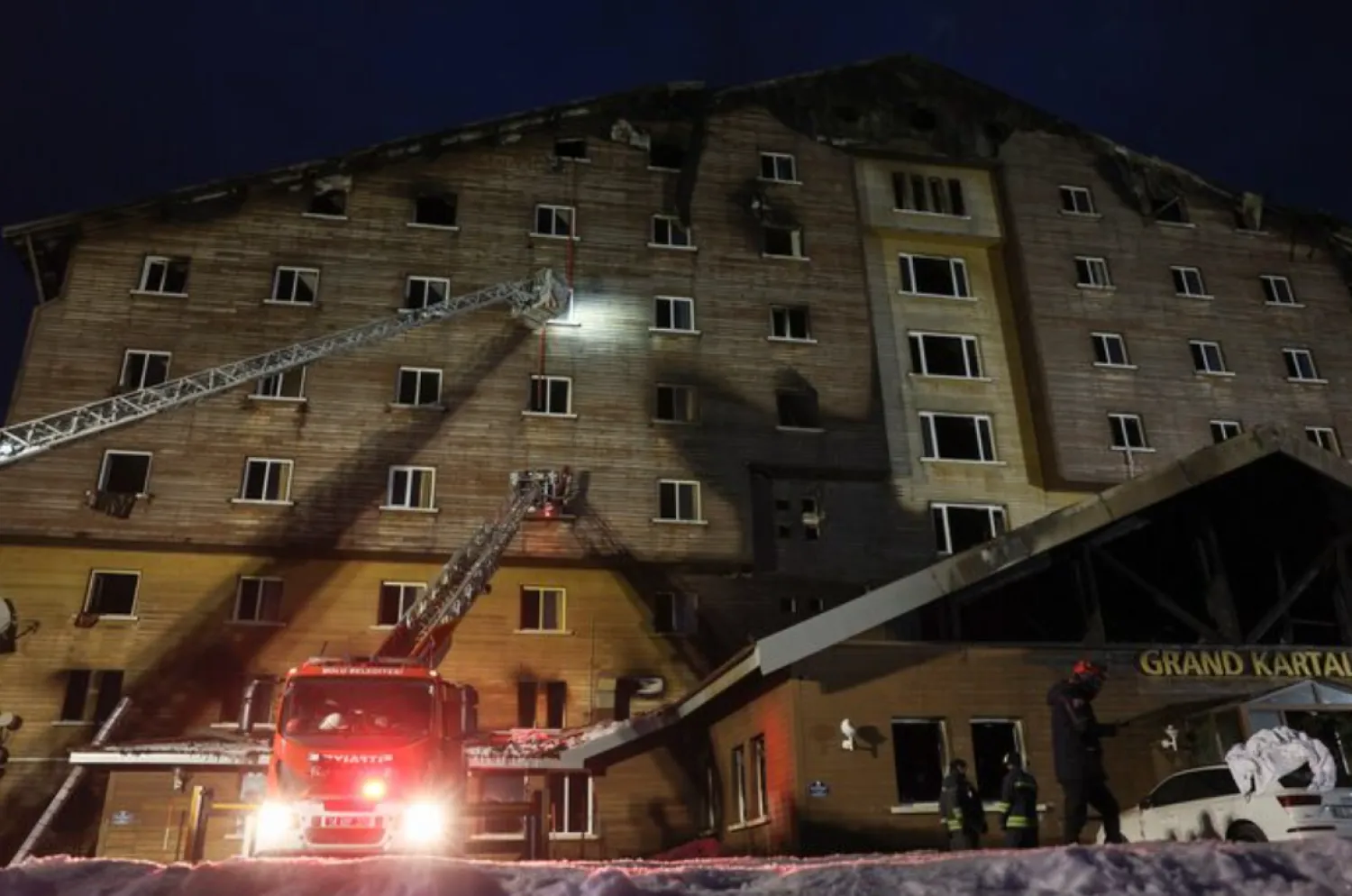
A fire truck is seen in front of a hotel, following a deadly fire, in the ski resort of Kartalkaya, in Bolu, Türkiye, January 21, 2025. REUTERS/Murad Sezer/File Photo
TT

32 Go on Trial Over Fatal Hotel Fire in Türkiye

A fire truck is seen in front of a hotel, following a deadly fire, in the ski resort of Kartalkaya, in Bolu, Türkiye, January 21, 2025. REUTERS/Murad Sezer/File Photo

Thirty-two people went on trial in Türkiye on Monday over a fire at a luxury ski resort hotel in January that killed 78 people, including 36 children, local media reported.

Entire families perished when the huge blaze swept through the Grand Kartal Hotel in the northern mountain resort of Kartalkaya in the early hours of January 21.

Questions have multiplied about fire safety measures at the hotel and victims' families allege that negligence contributed to the high death toll.

More than 130 people were injured and the 12-storey building was destroyed.

Thirteen of the defendants -- including senior officials at the hotel, the fire department and the city council -- face up to 1,998 years in prison each on 78 charges, including "manslaughter with possible intent" to kill, AFP reported.

Survivors and experts have said the hotel's fire alarm system did not work.

According to the indictment, the suspects facing manslaughter charges include the hotel's owner, managers and members of the board, the deputy mayor of Bolu city and two fire department officials.

Before the hearing, victims' families gathered outside Bolu high school, where the trial is taking place, carrying portraits of the deceased.

They read out a statement, alleging countless breaches of safety and attempts to conceal evidence.

"During the fire, the owners, managers and employees of the Grand Kartal Hotel failed to alert guests or activate the alarm system.

"They rushed to save their cars while our loved ones were suffocating in the smoke," they alleged.

"An inspection report drawn up just one month before the fire clearly showed a lack of fire safety measures but the hotel owners ignored it on the grounds that the measures would be too costly," they continued.

"We know that the authorities turned a blind eye to this negligence, that evidence was concealed and that the camera recordings were deleted."

At the time of the fire, the tourism ministry and Bolu city council blamed each other for the disaster.

Due to the large number of defendants and plaintiffs -- 210 civil parties, the Bolu High Criminal Court is sitting at the high school's sports hall.

Ozgur Ozel, leader of the main opposition CHP, would attend the hearing, the social-democratic party said.

The trial is expected to last two weeks.


Thousands of Chinese Boats Mass at Sea, Raising Questions

China's massive fishing fleet operates in the Yellow Sea, East China Sea and the South China Sea, competing with fishers from Japan, South Korea, Taiwan, Vietnam and the Philippines. (AFP)
TT

Thousands of Chinese Boats Mass at Sea, Raising Questions

China's massive fishing fleet operates in the Yellow Sea, East China Sea and the South China Sea, competing with fishers from Japan, South Korea, Taiwan, Vietnam and the Philippines. (AFP)

Thousands of Chinese fishing boats have been massing in geometric formations in the East China Sea, in coordinated actions that experts believe are part of Beijing's preparations for a potential regional crisis or conflict.

Monitoring ship-tracking data on Christmas Day, Jason Wang could tell something "unusual" was underway as fishing boats swarmed into two parallel inverted Ls, each about 400 kilometers (about 250 miles) long.

Wang could see the roughly 2,000 fishing boats among the many thousands of vessels that ply the busy waterway through their automatic identification systems (AIS) -- a GPS-type signal that commercial ships use to avoid collisions.

The vessels, which were as close as 500 meters (1,640 feet) to each other, held their positions for about 30 hours in near gale-force winds and then suddenly scattered.

"Something didn't look right to me because in nature very rarely do you see straight lines," said Wang, chief operating officer of ingeniSPACE, which analyses satellite imagery and ship signals data.

"We've seen like two, 300, up to a thousand (Chinese fishing boats congregate), but anything exceeding a thousand I thought was unusual."

Maritime and military experts told AFP the massing of Chinese fishing boats on December 25, about 300 kilometers northeast of Taiwan, was on a scale they had never seen before.

Another incident detected in early January involved around 1,000 Chinese fishing vessels clustered in an uneven rectangle, about 400 kilometers long, for more than a day in the same area of the East China Sea.

Hundreds of those vessels were also detected in the December 25 event, Wang told AFP in an interview in Taipei.

Last week, around 1,200 boats massed in two parallel lines further east of the January and December events and held their positions for about 30 hours, Wang said.

China's massive fishing fleet operates in the Yellow Sea, East China Sea and the South China Sea, competing with fishers from Japan, South Korea, Taiwan, Vietnam and the Philippines.

While there is debate about why so many Chinese fishing vessels would gather in geometric formations in the open sea, experts widely agree that they were not there to fish.

Some experts said the only plausible explanation was that China was testing its ability to marshal a large number of fishing vessels that could potentially be deployed in a military operation, such as a blockade or invasion of Taiwan, or a crisis with Japan.

"I've never seen a massing of Chinese fishing boats in these numbers anywhere outside of port ever," Gregory Poling, director of the Asia Maritime Transparency Initiative at the Washington-based Center for Strategic and International Studies (CSIS), said of the December 25 event.

The maneuvers were a "demonstration with a military lens" to show those watching that the boats had the ability to coordinate their movements, said Jennifer Parker, a former Australian naval warfare officer.

"I've sailed around the entire world and I've not seen fishermen operating in that proximity to each other, in that degree of concentration," said Parker, now an Expert Associate at the National Security College of the Australian National University.

"They're definitely not fishing."

Global Fishing Watch chief scientist David Kroodsma said the Chinese fishing fleet was "highly coordinated" and it was possible that the vessels were ordered not to fish in a certain area.

"Most of the time when you see lines of boats, it's because they're right up against some boundary where they're not allowed to be. In this region that's what you see most of the time," Kroodsma said.

"If you look across the year, you see many, many examples of when there's clearly a line that they're not supposed to fish across at different time periods. We don't know why."

- 'State operation' -

AFP's reporting for this story involved the analysis of AIS data and nighttime satellite imagery, and interviews with experts from ingeniSPACE, Starboard Maritime Intelligence, CSIS and Global Fishing Watch, who also observed the December and January formations.

Unseenlabs, a French company specializing in maritime surveillance, verified the December 25 data for AFP, describing the concentration of vessels as "surprising and unusual".

The experts were confident that the majority of the vessels were real and not spoofed, which is when AIS data is manipulated to give misleading information about a vessel's location or identity.

"We've had enough other corroborating data... to confirm that those vessels were clearly out there," Poling said.

As part of his efforts to verify the data, Mark Douglas, a former New Zealand naval officer and now a maritime domain analyst at Starboard, said he examined fishing patterns in the same area over the previous two years.

"At no time has the behavior been the same as this," Douglas said. "During other periods of adverse weather the vessels returned to port, rather than massing offshore in these kinds of formations."

"I can't speak to the why... but the how certainly seems to be that there was direction provided to these vessels that this is what they needed to do," Douglas said.

The number of vessels involved indicated a "state operation", said Thomas Shugart, a former US Navy submarine warfare officer and now an Adjunct Senior Fellow with the Defense Program at the Center for a New American Security.

"There's no commercial entity that controls that many fishing boats that I know of," Shugart said.

- 'Maritime militia' -

China's navy ranks number one in the world in terms of the number of warships and submarines on the Global Firepower list.

Beijing is also tapping its huge civilian fleet, including fishing boats, ferries and cargo ships, as part of its preparations for a regional crisis or conflict, including over Taiwan, experts say.

China has threatened to use force, if necessary, to seize Taiwan, which it claims is part of its territory, and US officials have flagged 2027 as a possible timeline for an attack.

In its 2025 report to Congress on China's military power, the US Department of Defense said: "The PLA continues to make steady progress toward its 2027 goals" and "China expects to be able to fight and win a war on Taiwan" by the end of that year.

Beijing has stepped up military pressure on Taiwan in recent years, deploying fighter jets and warships around the island on an almost daily basis.

China has also held multiple large-scale exercises around Taiwan that are often described as rehearsals for a blockade and seizure of the territory.

Civilian vessels were "absolutely central" to Chinese military planning for an operation against Taiwan, said Shugart.

China's navy does not have enough landing vessels to deliver the troops and equipment it would need to make an invasion of Taiwan feasible.

"In the absence of that dual-purpose, civil-military maritime mass, I don't think they can invade Taiwan," Shugart said. "With that, (it) turns into a 'maybe they can'."

Many of the fishing boats involved in the December and January massing events were likely part of China's maritime militia, some experts said.

The maritime militia is made up of fishing boats trained to support the military and the fleet has been used to assert China's territorial claims, including in the South China Sea where they have swarmed contested reefs.

AIS data showed the "vast majority" of vessels congregating in the East China Sea appeared to be from the eastern province of Zhejiang, where several maritime militia ports are located, said Poling.

"Like militia on land in China, they get called up from time to time for reserve service," Poling said.

"My guess is that this was an effort to just see if the militia could muster. These are civilians, these are not the professional militia in the South China Sea, they're fishermen," he said.

Maritime militia would have a "range of roles" in a military operation, said Parker, such as harassing warships or acting as decoys for missiles fired by opposing forces, though she noted their presence could also interfere with China's own ability to hit targets.

"It's clear that China's operations planning in the South China Sea and around Taiwan include the maritime militia as a force multiplier," she said.

"It's reasonable to assume that this would also be the case in the event of a military crisis with Japan."

- Threats of retaliation -

The maritime militia's role in the South China Sea has expanded beyond swarming reefs to helping the Chinese coastguard in "blocking and harassing" Philippine fishing boats and even using water cannon against Filipino fishermen, Philippine Coast Guard spokesman Jay Tarriela said.

"They don't have covert roles anymore," Tarriela said.

"They're actually part of the (Chinese) government, a flotilla, advancing their illegal interests in the South China Sea."

Beijing has not publicly commented on the fishing boat formations in the East China Sea.

Japan's coast guard declined to comment when contacted by AFP. Tokyo is involved in a deepening spat with Beijing after Prime Minister Sanae Takaichi suggested that Japan would intervene militarily if China sought to take Taiwan by force.

Responding to China's grey zone activities -- coercive actions that fall short of an act of war -- or military operations in the region is "really hard", a diplomat told AFP on the condition of anonymity.

"China often threatens or implies retaliation -- what is often unclear," the diplomat said.

Experts said the fishing boat maneuvers were consistent with Chinese President Xi Jinping's overall aim of preparing the military so it could potentially seize Taiwan.

"I can't tell you if Xi Jinping's going to decide to pull the trigger or not," said Shugart.

"But as an analyst, it sure looks like the PLA is, as directed, developing the capabilities required to credibly threaten an invasion in 2027."


Trump Administration Denounces CNN for Airing Messages from Iranian Leaders

The new Iranian leader, Mojtaba Khamenei (archive - Tasnim)
TT

Trump Administration Denounces CNN for Airing Messages from Iranian Leaders

The new Iranian leader, Mojtaba Khamenei (archive - Tasnim)

The Trump administration denounced CNN on Thursday for airing a portion of the new Iranian supreme leader's public statement, the second time in three days that he's targeted the network for reporting on how the regime is responding to the American attacks.

The attack illustrated the care news outlets must take in reporting during wartime, and the responsibilities of American journalists to report the perspective of countries its government views as enemies. It also exposed inconsistencies. The message of Supreme Leader Mojtaba Khamenei during his first public statement since he succeeded his father, who was killed in an Israeli airstrike, was widely available elsewhere.

The White House said on social media that “fake news CNN just aired four straight minutes of uninterrupted Iranian state TV, run by the same psychotic and murderous regime that prided itself on brutally slaughtering Americans for 47 years.”

Earlier CNN interview criticized by Trump's communications leader Two days earlier, White House communications director Steven Cheung took issue with CNN anchor Erin Burnett's interview with Hossein Mousavian, a former Iranian nuclear negotiator. Burnett asked Mousavian what he had been hearing about the Iranian government's interest in having talks with the United States. There wasn't much, he said.

“Ever notice how CNN just regurgitates quotes and unverified information from Iranian terrorists?” Cheung wrote on X. “Total disgrace. They have become the murderous Iranian Regime's version of Pravda,” he said, referring to the official newspaper of the former Soviet Union.

CNN did not address Cheung's statement but did respond to the White House attack on Thursday. It noted that CNN, Sky News and Al Jazeera also showed portions of the Iranian leaders’ statement live.

“The world is watching with anticipation which direction this war will take,” CNN said. “Purported remarks from Iran's new supreme leader are a critical component in helping audiences understand where this conflict is heading and were aired for their obvious news value.”

Other news outlets, including The Associated Press, sent out alerts on what Khamenei said. His vow to keep up attacks on other Arab countries in the region and plans to choke off the world's oil supply were headlines. The New York Times led its website with a story on the speech in its immediate aftermath, later writing that the speech “was an early indication of how the new supreme leader would approach the war, as well as how he would lead the country.”

CNN has long been a favored target of President Donald Trump, dating back to his first term. It's a particularly vulnerable time for the network with Paramount Global's agreement to purchase CNN's parent company, Warner Bros. Discovery, raising questions about its future editorial independence.

CNN showed a news anchor reading a portion of Khameini's remarks in Farsi, with an English translation. It did not air them in full. After the speech, correspondent Nick Paton Walsh gave a debrief to anchor Kate Bolduan, noting how the non-appearance of the leader — reportedly injured in an air attack — was as important as what he said.

“We were waiting to see the face of the man to have proof of his health and survival,” Walsh said, “and they've not met that moment. Instead, a handwritten message, it seems, that mostly reiterates things we kind of already knew.”

A social media message board for Iran's point of view The Tech Transparency Project has reported that several Iranian leaders and institutions maintain verified accounts on X, formerly Twitter, owned by Trump ally Elon Musk. CNBC said Thursday that Khamenei has one of them, and an X account with his portrait posted the text of his remarks, available in Farsi and in an English translation.

Even though Khamenei's father is dead, an account with his portrait was active on Thursday, mainly reposting messages from his son. “The revenge we have in mind is not just because of the martyrdom of the illustrious Leader of the Revolution,” read one message posted Thursday. “Every member of the nation martyred by the enemy is a separate case that demands we seek revenge.”

X is officially blocked in Iran, though many use a virtual private network to bypass restrictions. A message sent to the platform on Thursday was not immediately returned.

There's a long history of journalists seeking interviews with world leaders, even when they are regarded as enemies of the United States. Most notable was “60 Minutes” correspondent Mike Wallace's interview with Iran's Khomeini in 1979, when that country was holding Americans hostage.

Thursday's remarks by Iran's new supreme leader were absolutely newsworthy and legitimate for CNN to air them, said Jane Ferguson, a veteran international correspondent and founder of the journalism platform Noosphere. It's not the job of government leaders to pick apart what CNN is reporting, she said.

“We've always faced this,” she said, about when reporters interview leaders or other figures hostile to American interests. “This has been a bit of low-hanging fruit for awhile.”

Historian Douglas Brinkley of Rice University said that it's unfair for CNN to be singled out in this instance. He, too, believes it is newsworthy to learn what leaders of an adversary are thinking, but it's important to make sure that journalists are careful.

“You have to be leery of being used as a propaganda tool by the Iranian regime,” he said. “On the other hand, knowing what the enemy is saying and looking for a sign of a peace offering or a nuance is important ... It's a difficult balance.”


Moscow Piles Pressure on US Over Oil Sanctions

Tourists watch marine life, with the MT Desert Kite oil tanker carrying Russian oil in the background, at Narara Marine National Park in the Arabian Sea, Gujarat, India March 11 , 2026. (Reuters)
TT

Moscow Piles Pressure on US Over Oil Sanctions

Tourists watch marine life, with the MT Desert Kite oil tanker carrying Russian oil in the background, at Narara Marine National Park in the Arabian Sea, Gujarat, India March 11 , 2026. (Reuters)

Moscow said on Friday that the global energy market "cannot remain stable" without its oil, piling pressure on Washington to lift more sanctions as the Middle East war strangles supplies.

The United States has eased some oil sanctions on Russia imposed over its invasion of Ukraine, prompting backlash from Western allies who urged Washington to keep up restrictions as the Ukraine conflict drags into its fifth year.

The US-Israel strikes on Iran and Tehran's retaliatory attacks across the Gulf region have upended the world's energy and transport sectors, virtually halting activity in the strategically vital Strait of Hormuz.

The United States is temporarily allowing the sale of oil from Russia -- one of the world's largest oil producers and exporters -- that is at sea, the Treasury Department said Thursday, as nations scrambled to boost supply and bring down prices.

Oil prices soared to almost $120 a barrel this week, the highest price since the pandemic.

-- G7 resistance --

Russia's economic envoy Kirill Dmitriev said on Friday that it was "increasingly inevitable" that Washington would lift more sanctions.

"The United States is effectively acknowledging the obvious: without Russian oil, the global energy market cannot remain stable," Dmitriev posted on Telegram.

"Amid the growing energy crisis, further easing of restrictions on Russian energy sources appears increasingly inevitable, despite resistance from some in the Brussels bureaucracy," he added.

But French President Emmanuel Macron, whose country holds the rotating presidency of the Group of Seven advanced economies, said that the Strait of Hormuz's shutdown "in no way" justified lifting the sanctions on Russia.

"The consensus was that we should not change our position on Russia and should maintain our efforts on Ukraine," Macron said after a video call with other G7 leaders discussing the economic fallout from the US-Israeli war with Iran.

On Thursday, the US Treasury issued a license authorizing the delivery and sale of Russian crude oil and petroleum products that have been loaded on vessels on or before 12:01 am Eastern Time March 12, through 12:01 am on April 11.

The move came after Washington last week temporarily allowed Russian oil that was stranded at sea to be sold to India.

Treasury Secretary Scott Bessent insisted that the India authorization was a "narrowly tailored, short-term measure."

He said in a statement it would not provide "significant financial benefit to the Russian government, which derives the majority of its energy revenue from taxes assessed at the point of extraction."

Dmitriev said earlier this week he had joined a "productive meeting" with US negotiators in Florida, the first talks between Moscow and Washington since the start of the Iran war.