


Trump Criticizes Putin After Approving More Weapons for Ukraine

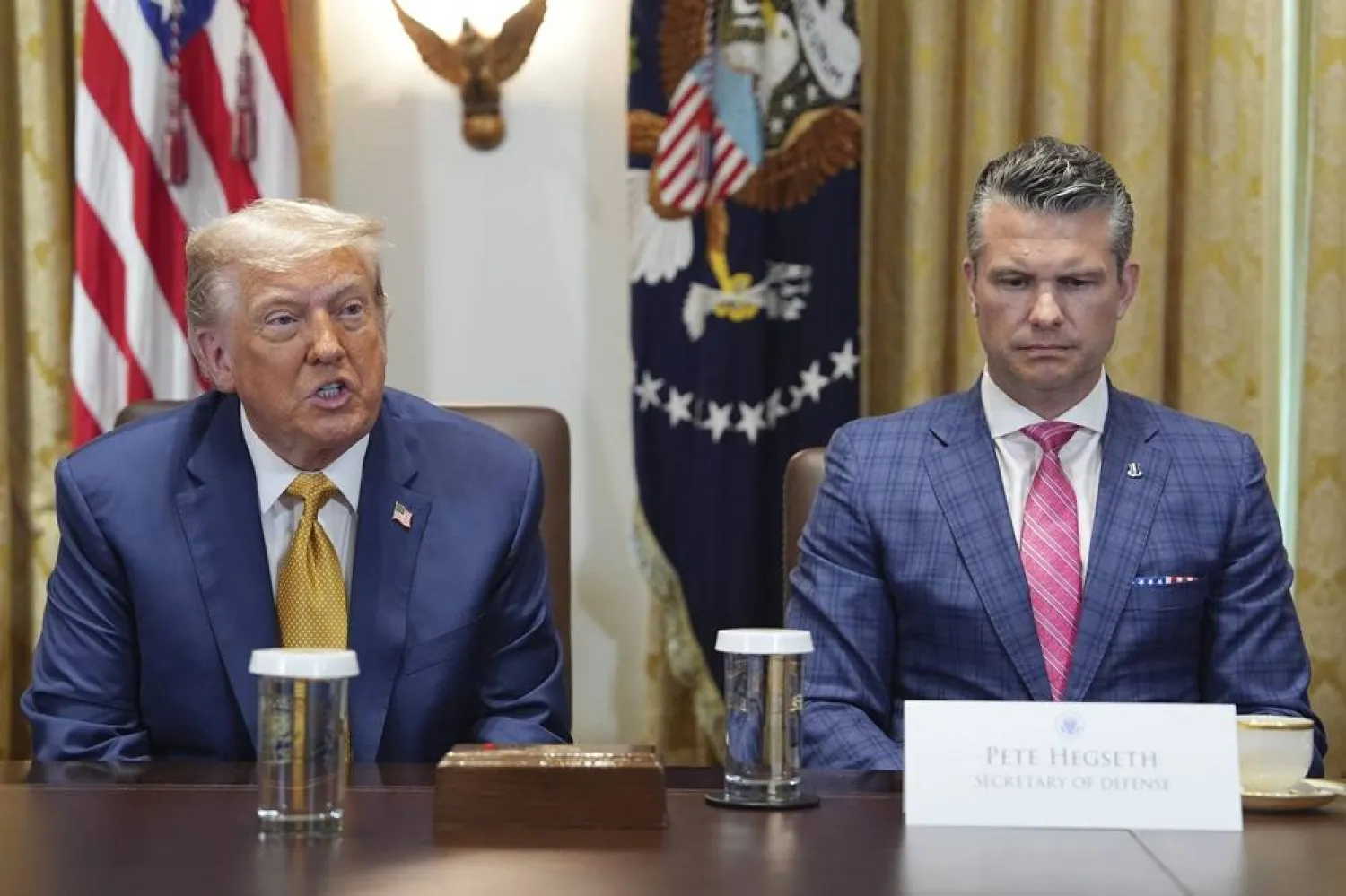
 President Donald Trump, left, with Defense Secretary Pete Hegseth, right, during a cabinet meeting at the White House, Tuesday, July 8, 2025, in Washington. (AP)
President Donald Trump, left, with Defense Secretary Pete Hegseth, right, during a cabinet meeting at the White House, Tuesday, July 8, 2025, in Washington. (AP)
TT

Trump Criticizes Putin After Approving More Weapons for Ukraine

 President Donald Trump, left, with Defense Secretary Pete Hegseth, right, during a cabinet meeting at the White House, Tuesday, July 8, 2025, in Washington. (AP)
President Donald Trump, left, with Defense Secretary Pete Hegseth, right, during a cabinet meeting at the White House, Tuesday, July 8, 2025, in Washington. (AP)

President Donald Trump said on Tuesday he had approved sending US defensive weapons to Ukraine and was considering additional sanctions on Moscow, underscoring his frustration with Russian President Vladimir Putin over the growing death toll in Russia's war with Ukraine.

Trump, who pledged as a presidential candidate to end the war within a day, has not been able to follow through on that promise and efforts by his administration to broker peace have come up short.

Trump directed his ire at Putin on Tuesday during a meeting with cabinet officials at the White House.

"I'm not happy with Putin. I can tell you that much right now," Trump said, noting that Russian and Ukrainian soldiers were dying in the thousands.

"We get a lot of [expletive] thrown at us by Putin ... He's very nice all the time, but it turns out to be meaningless," Trump said.

Trump said he was considering whether to support a bill in the Senate that would impose steep sanctions on Russia over the war. "I'm looking at it very strongly," he said.

The bill, whose lead sponsors are Republican Senator Lindsey Graham of South Carolina and Democratic Senator Richard Blumenthal of Connecticut, would also punish other countries that trade with Moscow, imposing 500% tariffs on nations that buy Russian oil, gas, uranium and other exports.

DEFENSIVE WEAPONS AGAINST RUSSIAN ADVANCES

Trump said on Monday that the United States would send more weapons to Ukraine, primarily defensive ones, to help it defend itself against Russian advances.

On Tuesday he said he had approved such a move. "We're sending some defensive weapons to Ukraine, and I've approved that," he said.

Ukrainian President Volodymyr Zelenskiy said on Tuesday he had ordered an expansion of contacts with the United States to ensure critical deliveries of military supplies, primarily air defense.

"We currently have all the necessary political statements and decisions and we must implement them as quickly as possible to protect our people and positions," he said. "These are critical deliveries that mean saving lives and protecting Ukrainian cities and villages. I expect results from these contacts very soon. And this week, we are preparing formats for meetings of our military and political teams."

Zelenskiy has repeatedly urged Ukraine's Western allies to impose tougher sanctions on Moscow to force the Kremlin to agree to a ceasefire as a step towards reaching an end to the war, now 40 months old.

A decision by the Pentagon to halt some shipments of critical weapons to Ukraine prompted warnings by Kyiv last week that the move would weaken its ability to defend against Russia's intensifying airstrikes and battlefield advances.

Trump, who was seated next to Defense Secretary Pete Hegseth, was asked on Tuesday who had ordered that pause. "I don't know. Why don't you tell me?" Trump responded.



Iran Military Official Says Renewed War with US ‘Likely’

A woman walks past an anti-US graffiti painted on the wall of the Tehran University on Enqelab-e-Eslami street in downtown Tehran, Iran, Saturday, April 25, 2026. (AP)
TT

Iran Military Official Says Renewed War with US ‘Likely’

A woman walks past an anti-US graffiti painted on the wall of the Tehran University on Enqelab-e-Eslami street in downtown Tehran, Iran, Saturday, April 25, 2026. (AP)

A senior Iranian military officer said on Saturday that renewed fighting between the US and Iran was "likely", hours after President Donald Trump said he was "not satisfied" with a new Iranian negotiating proposal.

Iran delivered the draft to mediator Pakistan on Thursday evening, state media reported without detailing its contents.

The war, launched by the United States and Israel in late February, has been on hold since April 8, with one failed round of peace talks having taken place in Pakistan since then.

"At this moment I'm not satisfied with what they're offering," Trump told reporters, blaming stalled talks on "tremendous discord" within Iran's leadership.

"Do we want to go and just blast the hell out of them and finish them forever -- or do we want to try and make a deal?" he added, saying he would "prefer not" to take the first option "on a human basis".

On Saturday morning, Mohammad Jafar Asadi, a senior figure in the Iranian military's central command, said "a renewed conflict between Iran and the United States is likely", in quotes published by Iran's Fars news agency.

"Evidence has shown that the United States is not committed to any promises or agreements," he added.

- 'Stuck in purgatory' -

Iran's judiciary chief Gholamhossein Mohseni Ejei said on Friday that his country had "never shied away from negotiations", but added it would not accept an "imposition" of peace terms.

The White House has declined to provide details on the latest Iranian proposal, but news site Axios reported that US envoy Steve Witkoff had submitted amendments putting Tehran's nuclear program back on the negotiating table.

The changes reportedly include demands that Iran not move enriched uranium from bombed sites or resume activity there during talks.

News of the Iranian proposal briefly pushed oil prices down nearly five percent, though they remain about 50 percent above pre-war levels amid the ongoing closure of the Strait of Hormuz.

Iran has maintained a stranglehold on the strait since the war began, choking off major flows of oil, gas and fertilizer to the world economy, while the United States has imposed a counter-blockade on Iranian ports.

Tehran resident Amir told Paris-based AFP journalists that the stalemate "feels like we are stuck in purgatory", and he expressed little hope for the Iranian proposal.

"This is all to waste time," he said, predicting the United States and Israel "will attack again".

Despite the ceasefire in the Gulf, fighting has continued in Lebanon, where Israel has carried out deadly strikes despite a separate truce with the Iran-backed armed group Hezbollah.

Lebanon's health ministry said 13 people were killed in strikes in the south, including in the town of Habboush, where the Israeli military had issued an evacuation warning.

- 'Terminated' -

In Washington, lawmakers were wrestling with a legal dispute over whether Trump had breached a deadline to seek congressional approval for the war.

Administration officials argue that the ceasefire pauses a 60-day limit, after which congressional authorization would be required -- a claim disputed by opposition Democrats.

Trump faces growing domestic pressure, with inflation rising, no clear victory in sight and midterm elections approaching.

"There has been no exchange of fire between United States Forces and Iran since April 7, 2026," Trump said in letters to congressional leaders, adding that the hostilities "have terminated".

In Iran, the war's economic toll is deepening.

Washington has imposed new sanctions on three Iranian currency firms and warned others against paying a "toll" for safe passage through Hormuz, as demanded by Iran.

The US military says its blockade of Iranian ports has stopped $6 billion in Iranian oil exports, while inflation in Iran, already high before the war, has surged past 50 percent.

"For many people, paying rent and even buying food has become difficult, and some have nothing left at all," 28-year-old Iranian Mahyar told an AFP reporter based outside the country.

Supreme leader Mojtaba Khamenei said on Friday that "the owners of damaged businesses should avoid, as much as possible, layoffs and separation of their workforce".

He also threatened Iran's enemies with "economic and cultural" war.


Separatists in Canada Oil Province Seek Independence Referendum

Oil pumpjacks operating in a farmer’s field near Calgary, Alberta, Canada, November 26, 2025. (Reuters)
TT

Separatists in Canada Oil Province Seek Independence Referendum

Oil pumpjacks operating in a farmer’s field near Calgary, Alberta, Canada, November 26, 2025. (Reuters)

Separatists in Alberta are preparing to submit a petition on Monday that they say has enough signatures to force a referendum on independence for the oil-rich Canadian province.

Polls indicate the pro-independence camp remains a minority among Alberta's five million people, but has hit a historic high of roughly 30 percent.

Alberta separatists are also closer than ever to forcing a referendum, riding momentum fueled by intensifying grievances over Ottawa's control of the provincial oil industry.

They have also undeniably gotten a boost from the return to power of US President Donald Trump.

After launching a petition in January, Stay Free Alberta, the group coordinating the independence push, had until the beginning of May to collect 178,000 signatures to force a referendum.

The group's leader, Mitch Sylvestre, expressed confidence the group will succeed.

"We will have the required signatures to trigger the referendum with a comfortable buffer," Sylvestre told AFP Thursday.

The separatists plan to present their list to provincial officials in the capital Edmonton on Monday.

- 'Permanent change' -

Alberta's First Nations have filed a court challenge, arguing independence would violate their treaty rights, a case that could render a referendum illegal.

But even if the vote never happens, or the separatists ultimately lose, many believe the process has left Canada permanently changed.

Michael Wagner is an independent historian and long-standing supporter of Albertan independence.

"Even if we lose the referendum, (this) is not going to just disappear," he told AFP. "I think this is going to be a permanent change in our political culture."

Jason Kenney, a conservative federalist former Alberta premier, agreed.

If the independence camp gets 20-35 percent support in a referendum, "it will turn the separatist movement from a marginal fringe into a real factor in our politics that will be disruptive for a long time to come," he told an event last month.

- 'Tipping point' -

Alberta joined the Canadian confederation in 1905 and resentments towards eastern political leaders in Ontario and Quebec fueled marginal separatist movements at various points over the last century.

But Wagner said separatism gathered real pace in protest against former prime minister Pierre Trudeau's 1980 National Energy Program, which broadened Ottawa's control over the oil industry.

The program included price controls for domestic oil sales and new taxes giving Ottawa more revenue from Alberta's oil.

Trudeau's government argued the measures protected Canadians following the global oil price shocks of the 1970s.

Wagner said the program was considered an attack in Alberta and called it a "game-changer" which entrenched the idea of independence.

Fast-forward 35 years, Trudeau's son Justin is elected prime minister with a climate-conscious agenda reviled by many in Alberta.

Through Trudeau's decade in power, Albertans accused his Liberal government of demonizing oil production and stifling investments in the sector, especially for pipeline capacity.

Mark Carney's 2025 election was "a tipping point", Wagner said.

Conservative leader Pierre Poilievre had a huge polling lead in early 2025.

"It was fully expected he would be our hero. He would rescue us from the Liberal government. When the polls started turning for Carney, and then Carney actually won, the disappointment here was so dramatic," Wagner said.

- 51st state? -

Trump has discussed annexing Canada and weakening it economically, but the US role in Alberta's current separatist effort is disputed.

Treasury Secretary Scott Bessent drew attention in January when he said the US and Alberta were "natural partners."

Some secessionists insist Alberta's future lies in union with Washington.

But Sylvestre's legal advisor Jeffrey Rath, who says he has met several times with top State Department officials on future Alberta-US ties, rejects statehood.

"The people in our movement are not interested in freeing themselves from the clutches of the federal government... just to put ourselves under yet another government 3,500 miles away," he told the right-wing True North media outlet.

But, he argued, Trump's support will be crucial to stabilizing Alberta as it breaks away from Canada.

For Wagner, "51st state people have always been a very small minority."

"Most Alberta independence supporters are actually patriotic Canadians who have just been frustrated."


Trump Expands US Sanctions on Cuban Government and Affiliates

People march while holding a giant Cuban national flag during a May Day rally in Havana, Cuba, May 1, 2026. (Reuters)
TT

Trump Expands US Sanctions on Cuban Government and Affiliates

People march while holding a giant Cuban national flag during a May Day rally in Havana, Cuba, May 1, 2026. (Reuters)

US President Donald Trump signed an executive order on Friday broadening US sanctions against the Cuban government, two White House officials told Reuters, as he seeks to put more pressure on Havana after ousting Venezuela's leader.

The fresh sanctions target people, entities and affiliates that support the Cuban government's security apparatus or are complicit in corruption or serious human rights violations, as well as agents, officials or supporters of the government, the officials said.

It was not immediately clear who exactly had been hit with sanctions under the order, which was first reported by Reuters.

But a copy of the order released by the White House said the sanctions could apply to "any ‌foreign person" operating ‌in the "energy, defense and related materiel, metals and mining, financial services, ‌or ⁠security sector of ⁠the Cuban economy, or any other sector of the Cuban economy."

The order authorizes secondary sanctions for conducting or facilitating transactions with those targeted under the order, the officials said.

Cuban President Miguel Diaz-Canel said the new "coercive" measures reinforce the US's "brutal, genocidal" blockade against the island.

"The blockade and its reinforcement cause so much harm because of the intimidating and arrogant behavior of the world's greatest military power," Diaz-Canel wrote on social media.

Cuba's foreign minister, Bruno Rodriguez, said the sanctions measures, which were announced as the island held its traditional May Day celebrations, ⁠aim to impose "collective punishment on the Cuban people" and that Cubans would not ‌be intimidated.

RATCHETING UP PRESSURE ON CUBAN GOVERNMENT

Jeremy Paner, a former ‌sanctions investigator at the US Treasury's Office of Foreign Assets Control, said the move was the most significant one ‌for non-American companies since the US embargo against Cuba began decades ago.

"Oil and gas, mining companies, ‌and banks that have carefully segregated their Cuba operations from the United States are no longer protected," said Paner, who is now a partner at Hughes Hubbard & Reed, a law firm.

The new sanctions are the latest broadside by the Trump administration against Cuba, which the president has repeatedly declared is near a state of collapse.

Under Trump, ‌US forces have launched strikes on boats allegedly carrying drugs off Venezuela and gone into Caracas to seize President Nicolas Maduro. Trump has said, without providing ⁠specifics, that "Cuba is ⁠next."

The officials said Trump's order contained an implicit warning to Cuba, accusing the Havana government of aligning itself with Iran and armed groups like Hezbollah.

"Cuba provides a permissive environment for hostile foreign intelligence, military, and terrorist operations less than 100 miles from the American homeland," one official said.

The US has long demanded Cuba open its state-run economy, pay reparations for properties expropriated by the government of former leader Fidel Castro and hold "free and fair" elections. Cuba has said its form of socialist government is not up for negotiation.

The US heaped additional sanctions and pressure on the island early this year, when it halted Venezuelan oil exports to Cuba after ousting Maduro on January 3. Trump later threatened to slap punishing tariffs on any other country that sent crude to Cuba, prompting Mexico, another top supplier, to stop shipments to the island.

The fuel shortage in Cuba has contributed to major national-level blackouts and prompted many foreign airlines to suspend flights to the island.