


State Department Starts Firing More than 1,350 Workers in Trump’s Shake-up of Diplomatic Corps

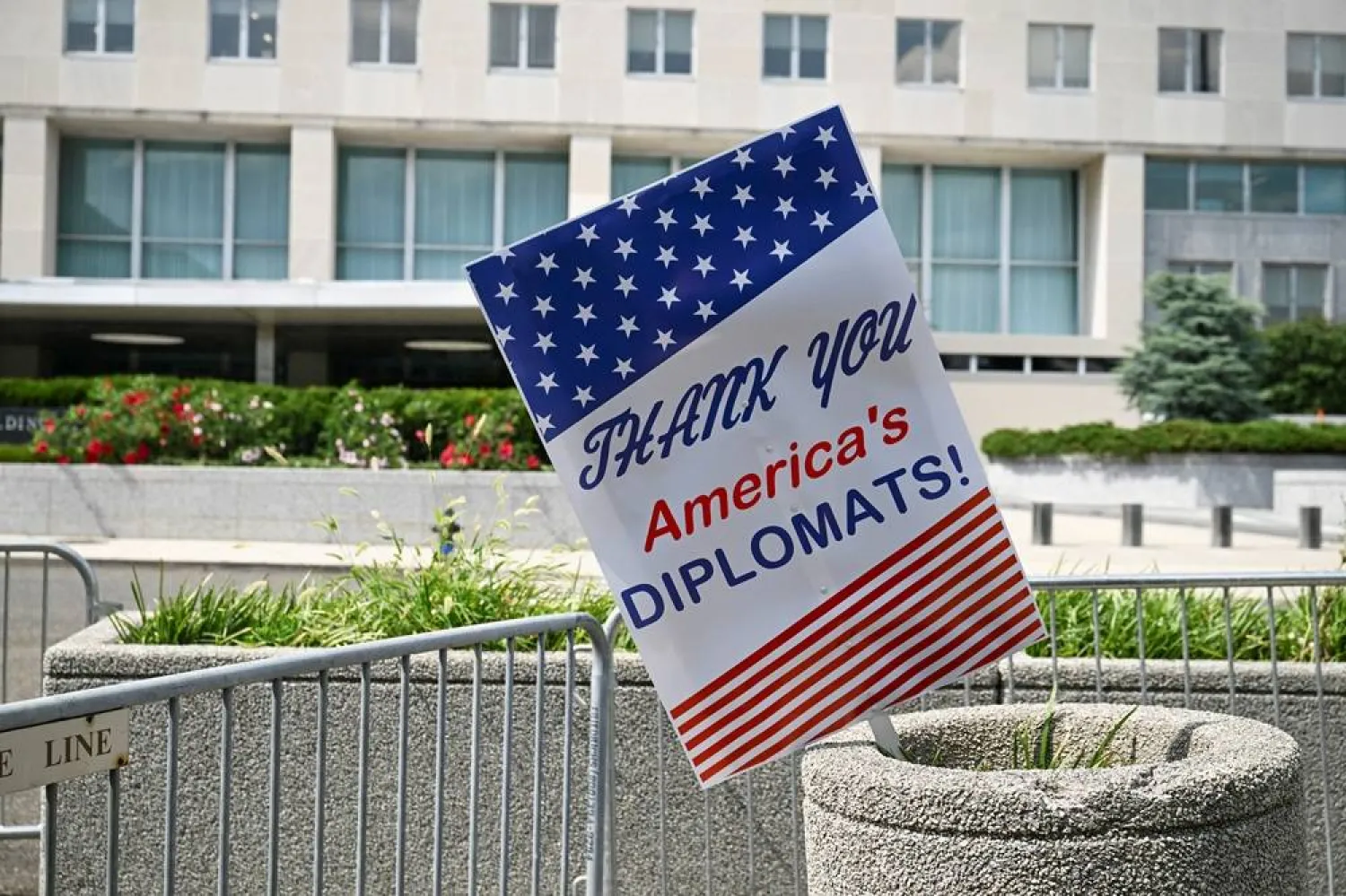
A sign thanking US diplomats sits in a pot during a sendoff event for US State Department workers in Washington, DC, US, July 11, 2025. (Reuters)
TT

State Department Starts Firing More than 1,350 Workers in Trump’s Shake-up of Diplomatic Corps

A sign thanking US diplomats sits in a pot during a sendoff event for US State Department workers in Washington, DC, US, July 11, 2025. (Reuters)

The State Department began firing more than 1,350 US-based employees on Friday as the administration of President Donald Trump presses ahead with an unprecedented overhaul of its diplomatic corps, a move critics say will undermine US ability to defend and promote US interests abroad.

The layoffs, which affect 1,107 civil service and 246 foreign service officers based in the United States, come at a time when Washington is grappling with multiple crises on the world stage: Russia's war in Ukraine, the almost two-year-long Gaza conflict, and the Middle East on edge due to high tension between Israel and Iran.

"The Department is streamlining domestic operations to focus on diplomatic priorities," an internal State Department notice that was sent to the workforce said.

"Headcount reductions have been carefully tailored to affect non-core functions, duplicative or redundant offices, and offices where considerable efficiencies may be found," it added.

The total reduction in the workforce will be nearly 3,000, including the voluntary departures, according to the notice and a senior State Department official, out of the 18,000 employees based in the United States.

The move is the first step of a restructuring that Trump has sought to ensure US foreign policy is aligned with his "America First" agenda. Former diplomats and critics say the firing of foreign service officers risks America's ability to counter the growing assertiveness from adversaries such as China and Russia.

"President Trump and Secretary of State Rubio are once again making America less safe and less secure," Democratic senator Tim Kaine from Virginia said in a statement.

"This is one of the most ridiculous decisions that could possibly be made at a time when China is increasing its diplomatic footprint around the world and establishing an overseas network of military and transportation bases, Russia is continuing its years-long brutal assault of a sovereign country, and the Middle East is careening from crisis to crisis," Kaine said.

Dozens of State Department employees crowded the lobby of the agency’s headquarters in Washington holding an impromptu "clap-out" for their colleagues who have been fired. Dozens of people were crying, as they carried their belongings in boxes and hugged and bid farewell to friends and fellow workers.

Outside, dozens of others were lined up continuing to clap and cheer for them with some holding banners that read, “Thank you America’s diplomats.” Democratic Senator Chris Van Hollen attended the demonstration.

Several offices were set up inside the building for employees who are being laid off to turn in their badges, laptops, telephones and other property owned by the agency.

The offices were marked by posters that read "Transition Day Out Processing". One counter was labeled an "Outprocessing service center" with small bottles of water placed next to a box of tissues. Inside one office, cardboard boxes were visible.

A five-page "separation checklist" that was sent to workers who were fired on Friday and seen by Reuters tells the employees that they would lose access to the building and their emails at 5 p.m. EDT on Friday.

Many members of a State Department office overseeing the US resettlement of Afghans who worked for the US government during the 20-year war have also been terminated as part of the overhaul.

'WRONG SIGNAL'

Trump in February ordered Secretary of State Marco Rubio to revamp the foreign service to ensure that the Republican president's foreign policy is "faithfully" implemented. He has also repeatedly pledged to "clean out the deep state" by firing bureaucrats that he deems disloyal.

The shake-up is part of an unprecedented push by Trump to shrink the federal bureaucracy and cut what he says is wasteful spending of taxpayer money. His administration dismantled the US Agency for International Aid, Washington's premier aid arm that distributed billions of dollars of assistance worldwide, and folded it under the State Department.

Rubio announced the plans for the State Department shake-up in April, saying the Department in its current form was "bloated, bureaucratic" and was not able to perform its mission "in this new era of great power competition."

He envisioned a structure that he said would give back the power to regional bureaus and embassies and get rid of programs and offices that do not align with America's core interests.

That vision would see the elimination of the role of top official for civilian security, democracy, and human rights and the closure of some offices that monitored war crimes and conflicts around the world.

The reorganization had been expected to be largely concluded by July 1 but did not proceed as planned amid ongoing litigation, as the State Department waited for the US Supreme Court to weigh in on the Trump administration's bid to halt a judicial order blocking mass job cuts.

On Tuesday, the court cleared the way for the Trump administration to pursue the job cuts and the sweeping downsizing of numerous agencies. Since then, The White House Counsel's Office and the Office of Personnel Management have been coordinating with federal agencies to ensure their plans comply with the law.



Iran Says Redirects US-sanctioned Oil Tanker to Its Shores

FILE PHOTO: An aerial view of the Iranian shores and the island of Qeshm in the strait of Hormuz, December 10, 2023. REUTERS/Stringer/File Photo
TT

Iran Says Redirects US-sanctioned Oil Tanker to Its Shores

FILE PHOTO: An aerial view of the Iranian shores and the island of Qeshm in the strait of Hormuz, December 10, 2023. REUTERS/Stringer/File Photo

Iran said on Friday it redirected a US-sanctioned oil tanker carrying Iranian oil back to its shores, though it was unclear from its statement why it would have returned it, reported AFP.

"The Islamic Republic of Iran's navy, through a specially planned operation in the Sea of Oman, seized the offending tanker Ocean Koi," the army said in a statement carried by state television, adding that the oil belonged to Iran.

It said the ship was redirected to Iran's southern shores after it sought "to damage and disrupt Iran's oil exports," without elaborating.


Meloni Meets Rubio as Iran War Strains Italy-US Ties

US Secretary of State Marco Rubio leaves the San Damaso courtyard after meeting Pope Leo XIV at the Vatican, May 7, 2026. REUTERS/Yara Nardi
TT

Meloni Meets Rubio as Iran War Strains Italy-US Ties

US Secretary of State Marco Rubio leaves the San Damaso courtyard after meeting Pope Leo XIV at the Vatican, May 7, 2026. REUTERS/Yara Nardi

Italian Prime Minister Giorgia Meloni met US Secretary of State Marco Rubio on Friday at a moment of unusual strain between her government and President Donald Trump's administration, driven largely by the war with Iran.

Rubio is in Italy for a two-day trip aimed at easing ties with Pope Leo after unprecedented attacks on the pontiff by Trump, while also addressing Washington's frustration over Italy's refusal to support the US-Israeli war on Iran.

Meloni had been one of Trump's firmest supporters in Europe, cultivating close ties with him and presenting herself as a natural ‌bridge between Washington ‌and other EU states that had no natural political ‌affinity ⁠with the Republican ⁠US leader.

But that alignment has come under increasing strain in recent months, as the Iran war has forced her to balance loyalty to the United States against Italian public animosity to the war and the growing economic cost of the conflict.

Before heading to the prime minister's office, Rubio met Italy's Foreign Minister Antonio Tajani, who said the talks had been positive.

"I am convinced ⁠that Europe needs America, Italy needs America, but the United ‌States also needs Europe and Italy," Tajani ‌told reporters.

Meloni and Rubio were expected to discuss the situation in the Gulf, as ‌well as Russia's war on Ukraine, US tariffs on European goods and ‌the outlook for Cuba, which Washington is seeking to isolate both diplomatically and economically.

TRUMP'S ATTACKS ON POPE

The Italians will also be keen for a readout on Rubio's meetings at the Vatican. Trump's recent attacks on Pope Leo crossed a sensitive ‌line in overwhelmingly Catholic Italy and prompted Meloni to call them "unacceptable."

Her criticism in turn drew a sharp rebuke ⁠from Trump, who said ⁠she lacked courage and had let Washington down. He subsequently threatened to withdraw US troops from Italy.

Meloni said on Monday she would not support such a move, but acknowledged that the decision "doesn't depend on me".

Italy last month refused to allow US aircraft to use the Sigonella air base in Sicily for combat operations linked to the Iran conflict. Italian officials have said Washington had not sought prior authorization from Rome for the use of the site.

Defense Minister Guido Crosetto, a close Meloni ally, later warned that the Iran war was putting US global leadership at risk and said he feared the "madness" of nuclear escalation.

Pollsters say Meloni's ties to Trump could prove a potential liability with voters ahead of national elections due next year.


Trump Says Ceasefire Still Holds after Fighting Between the US and Iran Flares

US President Donald Trump looks on as he speaks to reporters near the Lincoln Memorial Reflecting Pool as it undergoes renovations, in Washington, D.C., US, May 7, 2026. REUTERS/Kylie Cooper
TT

Trump Says Ceasefire Still Holds after Fighting Between the US and Iran Flares

US President Donald Trump looks on as he speaks to reporters near the Lincoln Memorial Reflecting Pool as it undergoes renovations, in Washington, D.C., US, May 7, 2026. REUTERS/Kylie Cooper

US and Iranian forces clashed in the Gulf, but President Donald Trump said a ceasefire was still holding despite the flare-up, which dented hopes for a swift diplomatic resolution to the crisis.

The escalation came as Washington awaited Tehran's response to a US proposal to end the war, which began on February 28 when the US and Israel launched airstrikes on Iran.

Trump said on Thursday three US Navy destroyers were attacked as they moved through the Strait of Hormuz, a conduit for around a fifth of the world's oil and liquefied natural gas flows that Iran has all but closed since the conflict began.

"Three World Class American Destroyers just transited, very successfully, out of the Strait of Hormuz, under fire. There was no damage done to the three Destroyers, but great damage done to the Iranian attackers," Trump wrote on Truth Social.

He later told reporters the ceasefire remained in effect and played down the exchange.

"They trifled with us today. We blew them away," Trump said in Washington.

Iran, however, accused the United ⁠States of breaching ⁠the ceasefire, an agreement that has been punctuated by intermittent clashes since it was announced on April 7.

Iran's top joint military command said US forces had targeted an Iranian oil tanker and another ship, and carried out air attacks on civilian areas on Qeshm Island in the Strait of Hormuz and nearby coastal areas. It said Iranian forces responded by attacking US military vessels east of the strait and south of the port of Chabahar.

A spokesperson for Iran's Khatam al-Anbiya Central Headquarters said the Iranian strikes inflicted "significant damage," but US Central Command said none of its assets were hit.

Iranian state media later signaled a de-escalation, with Press TV reporting that, after several hours of exchanges, "the situation on Iranian islands and coastal cities by the Strait of Hormuz is back to normal now."