

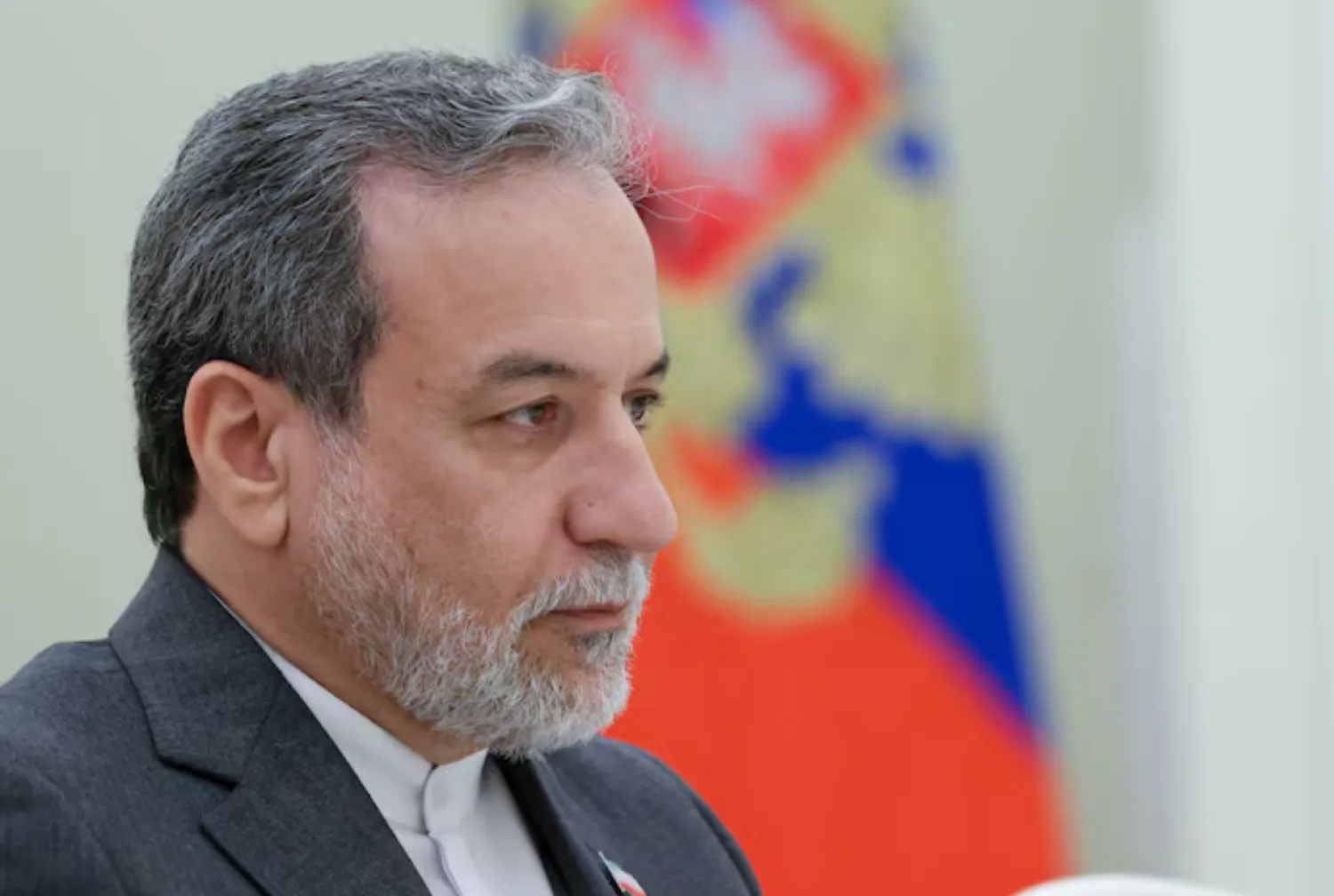

Iran Says it Would Resume Nuclear Talks with US if Guaranteed No Further Attacks

Iranian Foreign Minister Abbas Araghchi attends a meeting with Russian President Vladimir Putin at the Kremlin in Moscow, Russia June 23, 2025. Sputnik/Sergei Karpukhin/Pool via REUTERS/File Photo
TT

Iran Says it Would Resume Nuclear Talks with US if Guaranteed No Further Attacks

Iranian Foreign Minister Abbas Araghchi attends a meeting with Russian President Vladimir Putin at the Kremlin in Moscow, Russia June 23, 2025. Sputnik/Sergei Karpukhin/Pool via REUTERS/File Photo

Iran’s foreign minister said Saturday that his country would accept a resumption of nuclear talks with the US if there were assurances of no more attacks against it, state media reported.

Foreign Minister Abbas Araghchi said in a speech to Tehran-based foreign diplomats that Iran has always been ready and will be ready in the future for talks about its nuclear program, but, “assurance should be provided that in case of a resumption of talks, the trend will not lead to war.”

Referring to the 12-day Israeli bombardment of Iran's nuclear and military sites, and the US strike on June 22, Araghchi said that if the US and others wish to resume talks with Iran, "first of all, there should be a firm guarantee that such actions will not be repeated. The attack on Iran's nuclear facilities has made it more difficult and complicated to achieve a solution based on negotiations.”

Following the strikes, Iran suspended cooperation with the UN nuclear watchdog, which led to the departure of inspectors.

Araghchi said that under Iranian law, the country will answer the agency’s request for cooperation "case by case,” based on Iran’s interests. He also said any inspection by the agency should be done based on Iran's “security” concerns as well as the safety of the inspectors. “The risk of proliferation of radioactive ingredients and an explosion of ammunition that remains from the war in the attacked nuclear sites is serious,” he said.

"The risk of spreading radioactive materials and the risk of exploding leftover munitions ... are serious," he added.

"For us, IAEA inspectors approaching nuclear sites has both a security aspect ... and the safety of the inspectors themselves is a matter that must be examined."

He also reiterated Iran's position on the need to continue enriching uranium on its soil. US President Donald Trump has insisted that cannot happen.

Israel claims it acted because Tehran was within reach of a nuclear weapon. US intelligence agencies and the International Atomic Energy Agency had assessed Iran last had an organized nuclear weapons program in 2003, though Tehran had been enriching uranium up to 60% — a short, technical step away from weapons-grade levels of 90%.

Iranian President Masoud Pezeshkian in an interview published Monday said the US airstrikes so badly damaged his country’s nuclear facilities that Iranian authorities still have not been able to access them to survey the destruction.



EU Urges Iran to Release Nobel-Prize Winner Mohammadi

A handout photo provided by the Narges Mohammadi Foundation on October 2, 2023 shows an undated, unlocated photo of Iranian rights campaigner Narges Mohammadi. (Narges Mohammadi Foundation/AFP)
TT

EU Urges Iran to Release Nobel-Prize Winner Mohammadi

A handout photo provided by the Narges Mohammadi Foundation on October 2, 2023 shows an undated, unlocated photo of Iranian rights campaigner Narges Mohammadi. (Narges Mohammadi Foundation/AFP)

The European Union called on Saturday for the release of Nobel Peace Prize laureate Narges Mohammadi, who was detained by Iranian security forces along with at least eight other activists.

Brussels described Friday's arrests in the eastern city of Mashhad as "deeply concerning".

"The EU urges Iranian authorities to release Ms. Mohammadi, taking also into account her fragile health condition, as well as all those unjustly arrested in the exercise of their freedom of expression," Anouar El Anouni, a spokesman for the bloc's diplomatic service, said.

Mohammadi, 53, who was last arrested in November 2021, has spent much of the past decade behind bars.

The 2023 Peace Prize laureate was granted temporary leave from prison on health grounds after problems related to her lungs and other issues in December 2024.

On Friday she was detained once again along with eight other activists at a ceremony for lawyer Khosrow Alikordi, who was found dead in his office last week, her foundation said.

Within Iran, the Mehr news agency cited the Mashhad governor Hassan Hosseini as saying individuals held at the ceremony had chanted "slogans deemed contrary to public norms" but did not name them.

"Mohammadi, who already had to endure years in prison because of her advocacy, bravely continues to use her voice to defend human dignity and the fundamental rights of Iranians, including freedom of expression, which must be respected at all times," El Anouni said.

Alikordi, 45, was a lawyer who had defended clients in sensitive cases, including people arrested in a crackdown on nationwide protests that erupted in 2022.

His body was found on December 5, with rights groups calling for an investigation into his death, which Norway-based NGO Iran Human Rights said "had very serious suspicion of a state murder".


US, Ukraine to Discuss Ceasefire in Berlin Ahead of European Summit

Anti-drone nets hang taut along a road near the city of Izyum of Kharkiv region, northeastern Ukraine, 12 December 2025. (EPA)
TT

US, Ukraine to Discuss Ceasefire in Berlin Ahead of European Summit

Anti-drone nets hang taut along a road near the city of Izyum of Kharkiv region, northeastern Ukraine, 12 December 2025. (EPA)

Germany will host US and Ukrainian delegations over the weekend for talks on a ceasefire in Ukraine, ahead of a summit with European leaders and President Volodymyr Zelenskiy in Berlin on Monday, a German official said on Saturday.

A US official said overnight that President Donald Trump's envoy Steve Witkoff and son-in-law Jared Kushner were travelling to Germany for talks involving Ukrainians and Europeans.

The choice to send Witkoff, who has led negotiations with Ukraine and Russia regarding a US peace proposal, appeared to be a signal that Washington saw a chance of progress. The White House had said on Thursday Trump would send an official to talks only if he felt there was enough progress to be made.

"Talks on a possible ceasefire in Ukraine are taking place in Berlin this weekend between foreign policy advisors from, among others, the US and Ukraine," said a German government source when asked about the meetings.

On Monday, Merz is hosting Zelenskiy and European leaders for a summit in Berlin, the latest in a series of public shows of support for the Ukrainian leader from allies across Europe as Kyiv faces pressure from Washington to sign up to a peace plan that initially backed Moscow's main demands.

Britain, France and Germany have been working in the last few weeks to refine the US proposals, which, in a draft disclosed last month, called for Kyiv to cede more territory, abandon its ambition to join NATO and accept limits on its armed forces.


Germany to Send Soldiers to Fortify Poland Border

A border guard officer stands guard at the Polish-Belarusian border, in Polowce, Poland. (AP file photo)
TT

Germany to Send Soldiers to Fortify Poland Border

A border guard officer stands guard at the Polish-Belarusian border, in Polowce, Poland. (AP file photo)

Germany has said it will send a group of soldiers to Poland to help with a project to fortify the country's eastern border as worries mount about the threat from Russia.

Poland, a strong supporter of Ukraine in its fight against Moscow, announced plans in May last year to bolster a long stretch of its border that includes Belarus and the Russian exclave of Kaliningrad.

The main task of the German soldiers in Poland will be "engineering activities," a spokesman for the defense ministry in Berlin said late Friday.

This could include "constructing fortifications, digging trenches, laying barbed wire, or erecting tank barriers," he said.

"The support provided by German soldiers as part of (the operation) is limited to these engineering activities."

The spokesman did not specify the exact number of troops involved, saying only it would be a "mid-range two-digit number".

They are expected to participate in the project from the second quarter of 2026 until the end of 2027.

The spokesman stressed that parliamentary approval was not needed for the deployment as "there is no immediate danger to the soldiers from military conflicts".

Except for certain exceptional cases, the German parliament has to approve the deployment of the country's armed forces overseas.

Since Russia's full-scale invasion of Ukraine in 2022, Warsaw has staunchly backed Kyiv and been a transit route for arms being supplied by Ukraine's Western allies.

Warsaw has also modernized its army and hiked defense spending.

Germany is Ukraine's second-biggest supplier of military aid after the United States and has sent Kyiv a huge quantity of equipment ranging from air defence systems to armored vehicles.