


Russia May Hope to Use Trump's 50-day Window to Wear Down Ukraine, but Quick Gains Seem Unlikely

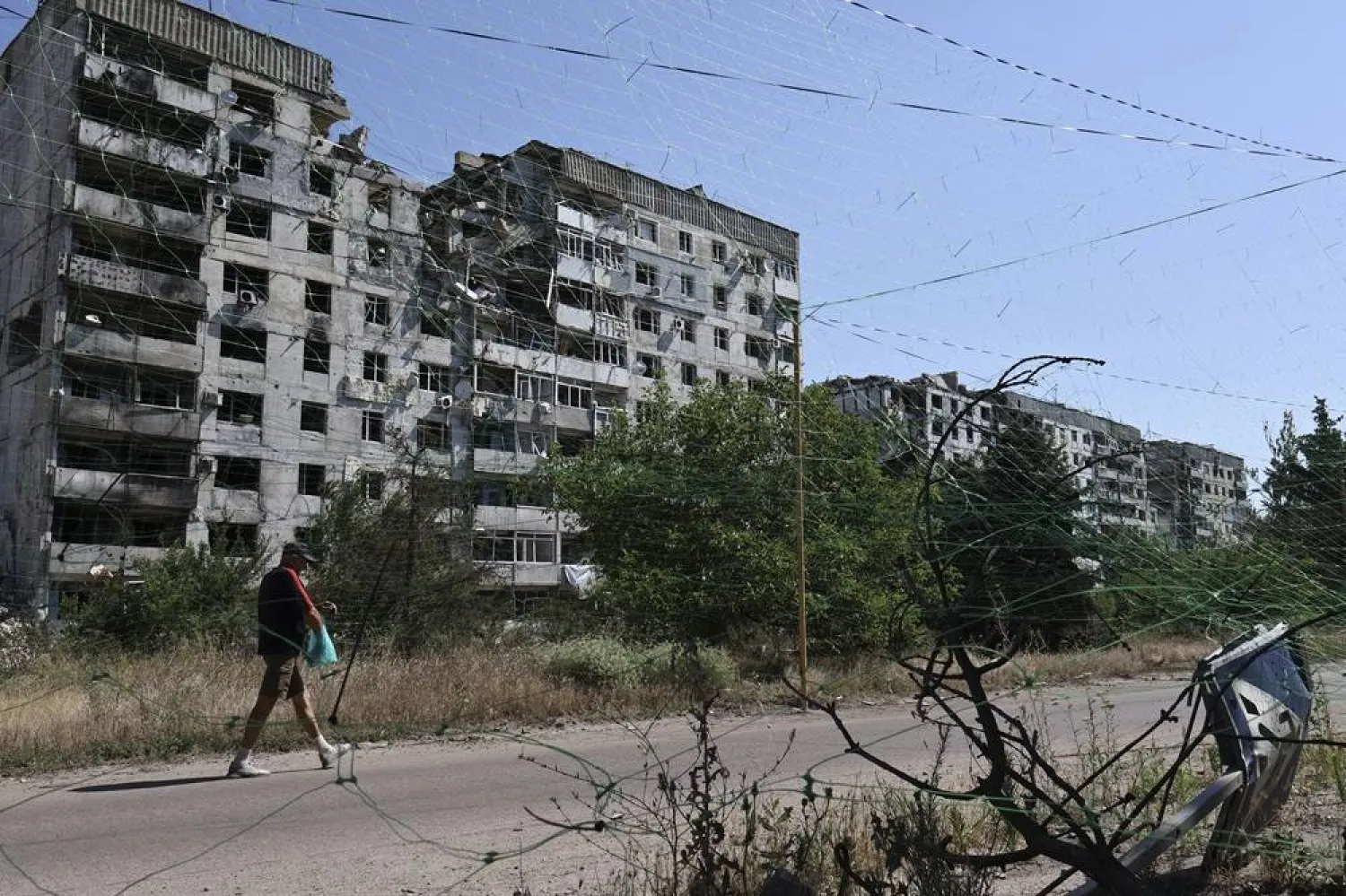
In this photo provided by Ukraine's 65th Mechanized Brigade press service, a local resident walks along the street under an anti-drone net in Orikhiv, Zaporizhzhia region, Ukraine, Tuesday, July 15, 2025. (Andriy Andriyenko/Ukraine's 65th Mechanized Brigade via AP)
TT

Russia May Hope to Use Trump's 50-day Window to Wear Down Ukraine, but Quick Gains Seem Unlikely

In this photo provided by Ukraine's 65th Mechanized Brigade press service, a local resident walks along the street under an anti-drone net in Orikhiv, Zaporizhzhia region, Ukraine, Tuesday, July 15, 2025. (Andriy Andriyenko/Ukraine's 65th Mechanized Brigade via AP)

President Donald Trump’s ultimatum to Russia to accept a peace deal in Ukraine within 50 days or face bruising sanctions on its energy exports has given the Kremlin extra time to pursue its summer offensive.

The dogged Ukrainian resistance, however, makes it unlikely that the Russian military will make any quick gains, The Associated Press said.

President Vladimir Putin has declared repeatedly that any peace deal should see Ukraine withdraw from the four regions that Russia illegally annexed in September 2022 but never fully captured. He also wants Ukraine to renounce its bid to join NATO and accept strict limits on its armed forces -– demands Kyiv and its Western allies have rejected.

A chronic shortage of manpower and ammunition has forced Ukrainian forces to focus on holding ground rather than launching counteroffensives.

But despite a renewed Russian push — and an onslaught of aerial attacks on Kyiv and other cities in recent weeks — Ukrainian officials and analysts say it remains unlikely that Moscow can achieve any territorial breakthrough significant enough in 50 days to force Ukraine into accepting the Kremlin's terms anytime soon.

Russia's main targets

Since spring, Russian troops have accelerated their land gains, capturing the most territory in eastern Ukraine since the opening stages of Moscow's full-scale invasion in 2022.

Russian forces are closing in on the eastern strongholds of Pokrovsk and Kostyantynivka in the Donetsk region, methodically capturing villages near both cities to try to cut key supply routes and envelop their defenders — a slow offensive that has unfolded for months.

Capturing those strongholds would allow Russia to push toward Slovyansk and Kramatorsk, setting the stage for the seizure of the entire Donetsk region.

If Russian troops seize those last strongholds, it would open the way for them to forge westward to the Dnipropetrovsk region. The regional capital of Dnipro, a major industrial hub of nearly 1 million, is about 150 kilometers (just over 90 miles) west of Russian positions.

The spread of fighting to Dnipropetrovsk could damage Ukrainian morale and give the Kremlin more leverage in any negotiations.

In the neighboring Luhansk region, Ukrainian troops control a small sliver of land, but Moscow has not seemed to prioritize its capture.

The other two Moscow-annexed regions — Kherson and Zaporizhzhia — seem far from being totally overtaken by Russia.

Early in the war, Russia quickly overran the Kherson region but pulled back from large swaths of it in November 2022, retreating to the eastern bank of the Dnieper River. A new attempt to cross the waterway to seize the rest of the region would involve massive challenges, and Moscow doesn’t seem to have the capability to mount such an operation.

Fully capturing the Zaporizhzhia region appears equally challenging.

Russian attempts to establish a ‘buffer zone’ Moscow’s forces captured several villages in northeastern Ukraine's Sumy region after reclaiming chunks of Russia’s Kursk region from Ukrainian troops who staged a surprise incursion in August 2024. Ukraine says its forces have stopped Russia's offensive and maintain a presence on the fringe of the Kursk region, where they are still tying down as many as 10,000 Russian troops.

Putin recently described the offensive into the Sumy region as part of efforts to carve a “buffer zone” to protect Russian territory from Ukrainian attacks.

The regional capital of Sumy, a city of 268,000, is about 30 kilometers (less than 20 miles) from the border. Putin said Moscow doesn’t plan to capture the city for now but doesn’t exclude it.

Military analysts, however, say Russian forces in the area clearly lack the strength to capture it.

Russian forces also have pushed an offensive in the neighboring Kharkiv region, but they haven't made much progress against fierce Ukrainian resistance.

Some commentators say Russia may hope to use its gains in the Sumy and Kharkiv regions as bargaining chips in negotiations, trading them for parts of the Donetsk region under Ukrainian control.

“A scenario of territorial swaps as part of the talks is quite realistic,” said Mikhail Karyagin, a Kremlin-friendly political expert, in a commentary.

Wearing down Ukraine with slow pressure Ukrainian commanders say the scale and pace of Russian operations suggest that any game-changing gains are out of reach, with Moscow’s troops advancing slowly at a tremendous cost to its own forces.

While exhausted Ukrainian forces are feeling outnumbered and outgunned, they are relying on drones to stymie Moscow's slow offensive. Significant movements of troops and weapons are easily spotted by drones that are so prolific that both sides use them to track and attack even individual soldiers within minutes.

Russian military commentators recognize that Ukraine’s drone proficiency makes any quick gains by Moscow unlikely. They say Russia aims to bleed Ukraine dry with a strategy of “a thousand cuts,” using relentless pressure on many sectors of the front and steadily increasing long-range aerial attacks against key infrastructure.

“The Russian army aims to exhaust the enemy to such an extent that it will not be able to hold the defense, and make multiple advances merge into one or several successes on a strategic scale that will determine the outcome of the war,” Moscow-based military analyst Sergei Poletayev wrote in an analysis. “It’s not that important where and at what speed to advance: the target is not the capture of this or that line; the target is the enemy army as such.”

Western supplies are essential for Ukraine

Ukrainian troops on the front express exasperation and anger about delays and uncertainty about US weapons shipments.

Delays in US military assistance have forced Kyiv's troops to ration ammunition and scale back operations as Russia intensifies its attacks, Ukrainian soldiers in eastern Ukraine told The Associated Press.

The United States will sell weapons to its NATO allies in Europe so they can provide them to Ukraine, according to Trump and US Secretary of State Marco Rubio. Included are Patriot air defense systems, a top priority for Ukraine.

Speeded-up weapons shipments from European allies are crucial to allowing Ukraine to stem the Russian attacks, according to analysts.

“The rate of Russian advance is accelerating, and Russia’s summer offensive is likely to put the armed forces of Ukraine under intense pressure,” Jack Watling of the Royal United Services Institute in London said in a commentary.

But most of the capabilities that Ukraine needs — from drones to artillery systems — can be provided by NATO allies in Europe, he said.

“In the short-term, Europe can cover most of Ukraine’s needs so long as it can purchase some critical weapons types from the US,” Watling said.



Georgia Arrests Two Foreigners Trying to Purchase Uranium

FILE PHOTO: A block with the symbol, atomic number and mass number of Uranium (U) element, in this illustration taken January 21, 2026. REUTERS/Dado Ruvic/Illustration/File Photo
TT

Georgia Arrests Two Foreigners Trying to Purchase Uranium

FILE PHOTO: A block with the symbol, atomic number and mass number of Uranium (U) element, in this illustration taken January 21, 2026. REUTERS/Dado Ruvic/Illustration/File Photo

Georgia has ‌detained two people who attempted to purchase $3 million worth of uranium and a cache of a radioactive isotope found in nuclear weapons testing programs, the national security service said on Thursday.

Two foreign nationals from unspecified countries were arrested in the city of Kutaisi, the State Security Service said in a statement.

"They were planning to ‌illegally purchase ‌nuclear material uranium and radioactive ‌substance ⁠Cesium 137 for $3 ⁠million and illegally transport it to the territory of another country," Reuters quoted it as saying.

It said other foreigners had been arriving in Georgia in recent weeks with the aim of purchasing and transporting the nuclear and ⁠radioactive materials, without elaborating further.

The ‌statement did ‌not specify the quantity of materials the individuals were ‌attempting to procure. There were ‌no details on the substances' origin or potential destination.

Cesium 137 is a radioactive isotope present primarily in the aftermath of nuclear weapons testing ‌and nuclear power plant accidents such as the Chernobyl disaster in ⁠then-Soviet ⁠Ukraine in 1986.

The security of nuclear materials was one of the biggest concerns after the 1991 fall of the Soviet Union, of which Georgia was part. There have been several serious incidents involving the illicit trade in nuclear materials in Georgia over recent decades.

Most recently, three Chinese citizens were arrested in the capital Tbilisi for attempting to purchase two kilograms of "nuclear material" uranium.


Former South Korean President Yoon Receives Life Sentence for Imposing Martial Law

FILE PHOTO: South Korea’s impeached President Yoon Suk Yeol attends the fourth hearing of his impeachment trial over his short-lived imposition of martial law at the Constitutional Court in Seoul, South Korea, 23 January 2025. JEON HEON-KYUN/Pool via REUTERS/File Photo
TT

Former South Korean President Yoon Receives Life Sentence for Imposing Martial Law

FILE PHOTO: South Korea’s impeached President Yoon Suk Yeol attends the fourth hearing of his impeachment trial over his short-lived imposition of martial law at the Constitutional Court in Seoul, South Korea, 23 January 2025. JEON HEON-KYUN/Pool via REUTERS/File Photo

Former South Korean President Yoon Suk Yeol was sentenced to life in prison for his brief imposition of martial law in a dramatic culmination to the country’s biggest political crisis in decades.

Yoon was ousted from office after a baffling attempt to overcome an opposition-controlled legislature by declaring martial law and sending troops to surround the National Assembly on Dec. 3, 2024, The Associated Press said.

Judge Jee Kui-youn of the Seoul Central District Court said he found Yoon guilty of rebellion for mobilizing military and police forces in an illegal attempt to seize the liberal-led Assembly, arrest politicians and establish unchecked power for a “considerable” time.

Martial law crisis recalled dictatorial past Yoon’s martial law imposition, the first of its kind in more than four decades, harkened back to South Korea’s past military-backed governments when authorities occasionally proclaimed emergency decrees that allowed them to station soldiers, tanks and armored vehicles on streets or at public places such as schools to prevent anti-government demonstrations.

As lawmakers rushed to the National Assembly, Yoon’s martial law command issued a proclamation declaring sweeping powers, including suspending political activities, controlling the media and publications, and allowing arrests without warrants.

The decree lasted about six hours before being lifted after a quorum of lawmakers managed to break through a military blockade and unanimously voted to lift the measure.

Yoon was suspended from office on Dec. 14, 2024, after being impeached by lawmakers and was formally removed by the Constitutional Court in April 2025. He has been under arrest since last July while facing multiple criminal trials, with the rebellion charge carrying the most severe punishment.

Yoon's lawyers reject conviction Yoon Kap-keun, one of the former president’s lawyers, accused Jee of issuing a “predetermined verdict” based solely on prosecutors’ arguments and said the “rule of law” had collapsed. He said he would discuss whether to appeal with his client and the rest of the legal team.

Yoon Suk Yeol told the court the martial law decree was only meant to raise public awareness of how the liberals were paralyzing state affairs, and that he was prepared to respect lawmakers if they voted against the measure.

Prosecutors said it was clear Yoon was attempting to disable the legislature and prevent lawmakers from lifting the measure through voting, actions that exceeded his constitutional authority even under martial law.

In announcing Yoon and Kim’s verdicts, Jee said the decision to send troops to the National Assembly was key to his determination that the imposition of martial law amounted to rebellion.

“This court finds that the purpose of (Yoon’s) actions was to send troops to the National Assembly, block the Assembly building and arrest key figures, including the National Assembly speaker and the leaders of both the ruling and opposition parties, in order to prevent lawmakers from gathering to deliberate or vote,” Jee said. “It’s sufficiently established that he intended to obstruct or paralyze the Assembly’s activities so that it would be unable to properly perform its functions for a considerable period of time.”

Protesters rally outside court

As Yoon arrived in court, hundreds of police officers watched closely as Yoon supporters rallied outside a judicial complex, their cries rising as the prison bus transporting him drove past. Yoon’s critics gathered nearby, demanding the death penalty.

There were no immediate reports of major clashes following the verdict.

A special prosecutor had demanded the death penalty for Yoon Suk Yeol, saying his actions posed a threat to the country’s democracy and deserved the most serious punishment available, but most analysts expected a life sentence since the poorly-planned power grab did not result in casualties.

South Korea has not executed a death row inmate since 1997, in what is widely seen as a de facto moratorium on capital punishment amid calls for its abolition.

Other officials sentenced for enforcing martial law

The court also convicted and sentenced several former military and police officials involved in enforcing Yoon’s martial law decree, including ex-Defense Minister Kim Yong Hyun, who received a 30-year jail term for his central role in planning the measure and mobilizing the military.

Last month, Yoon was sentenced to five years in prison for resisting arrest, fabricating the martial law proclamation and sidestepping a legally mandated full Cabinet meeting before declaring the measure.

The Seoul Central Court has also convicted two members of Yoon’s Cabinet in other cases. That includes Prime Minister Han Duck-soo, who received a 23-year prison sentence for attempting to legitimize the decree by forcing it through a Cabinet Council meeting, falsifying records and lying under oath. Han has appealed the verdict.

Yoon is the first former South Korean president to receive a life sentence since former military dictator Chun Doo-hwan, who was sentenced to death in 1996 for his 1979 coup, a bloody 1980 crackdown on pro-democracy protesters in Gwangju that left more than 200 people dead or missing, and corruption.

The Supreme Court later reduced his sentence to life imprisonment, and he was released in late 1997 under a special presidential pardon. He died in 2021.


UK Condemns 10-year Sentence for British Couple in Iran

(FILES) A handout photograph released in London on August 4, 2025 by the family of Craig and Lindsay Foreman, shows Craig and Lindsay at Naqsh-e Jahan Square, or Shah Square, with the Shah Mosque in the background, in Isfahan, Iran, at an undated time. (Photo by FAMILY HANDOUT / AFP)
TT

UK Condemns 10-year Sentence for British Couple in Iran

(FILES) A handout photograph released in London on August 4, 2025 by the family of Craig and Lindsay Foreman, shows Craig and Lindsay at Naqsh-e Jahan Square, or Shah Square, with the Shah Mosque in the background, in Isfahan, Iran, at an undated time. (Photo by FAMILY HANDOUT / AFP)

British foreign minister Yvette Cooper on Thursday condemned as "totally unjustifiable" the 10-year sentence given to a British couple in Iran for spying, saying the government would continue to press for their release.

Craig and Lindsay Foreman had been charged with espionage after Iran accused them of gathering information in several parts of the country.

"We will pursue this case relentlessly with the Iranian government until we see ‌Craig and Lindsay ‌Foreman safely returned to the UK and reunited with ‌their ⁠family," Reuters quoted Cooper as saying in ⁠a statement.

The Foremans were arrested on January 3 of last year while travelling through Iran on a global motorcycle journey. Iranian state media announced their detention the following month over espionage charges and they have now been held for more than 13 months.

Joe Bennett, Lindsay's son, said in a separate statement the couple had appeared at a three-hour trial ⁠on October 27, in which they were not allowed to ‌present a defense.

"We have seen no ‌evidence to support the charge of espionage," he said, adding that the family ‌was deeply concerned about the couple's welfare and the lack of transparency ‌in the judicial process.

Bennett called on the British government to "act decisively and use every available avenue" to secure their release.

The Iranian embassy in London did not immediately respond to a request for comment on the sentencing.

According to a family ‌statement, the couple have been held for extended periods without being able to communicate. They have had limited or ⁠delayed access ⁠to legal representation, periods of solitary confinement and delays in receiving funds for basic necessities. They also reported disrupted or cancelled consular visits.

Cooper, whose office did not comment on the disruption, said they would continue to provide consular assistance.

Lindsay Foreman has been held in the women's section of Tehran's Evin Prison, while her husband Craig has been held in its political wing.

Iran's Revolutionary Guards have in recent years detained foreign and dual nationals, typically on espionage or national security charges.

Human rights organizations say the authorities use such arrests as leverage in disputes with other countries, a practice they describe as part of a broader pattern of politically motivated detentions. Tehran has rejected those accusations and said the cases involved legitimate security concerns.