

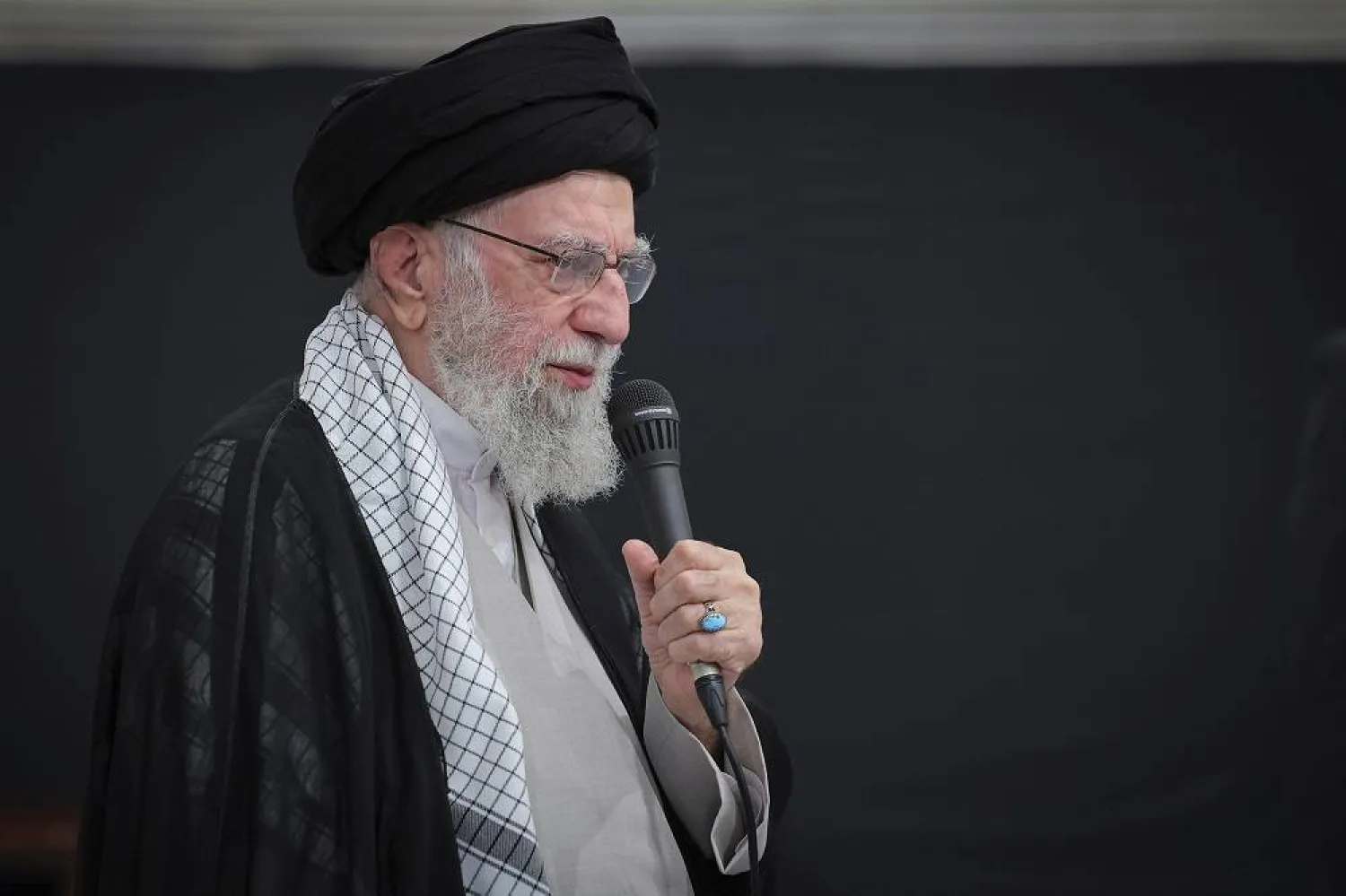

Khamenei Says West Is Using Nuclear Program as Excuse to Confront Iran

In this photo released by an official website of the office of the Iranian supreme leader, Supreme Leader Ali Khamenei speaks during a ceremony commemorating military personnel, nuclear scientists and other people who were killed during Israeli airstrikes in June, in Tehran, Iran, Tuesday, July 29, 2025. (Office of the Iranian Supreme Leader via AP)
TT

Khamenei Says West Is Using Nuclear Program as Excuse to Confront Iran

In this photo released by an official website of the office of the Iranian supreme leader, Supreme Leader Ali Khamenei speaks during a ceremony commemorating military personnel, nuclear scientists and other people who were killed during Israeli airstrikes in June, in Tehran, Iran, Tuesday, July 29, 2025. (Office of the Iranian Supreme Leader via AP)

Iran’s Supreme Leader Ali Khamenei on Tuesday defied Western pressure, saying their demands over Tehran's nuclear program are an excuse to confront the country.

“All their talk about nuclear issues, [uranium] enrichment, human rights, and such things are nothing but excuses,” to confront Iran, Khamenei said in a speech in Tehran commemorating Iranian military commanders and scientists killed during the 12-day Israel-Iran war last month. “What they are after is your religion and knowledge.”

Khamenei’s comments came a day after US President Donald Trump, who ordered a strike on three key Iranian nuclear sites during the Israeli campaign targeting the nuclear program, said Monday that the US would “openly and gladly” strike Iran again if it restarts its nuclear program.

In a brief eight-minute speech, the Iranian Supreme Leader said: “Much to the enemy’s dismay, we will succeed in elevating Iran to the peak of progress and the pinnacle of honor.”

He said what happened during these 12 days showed the power of the Iranian people, their determination and resolve, their steadfastness, and their ability to the world.

This was the third public appearance of the Iranian leader since the war broke out between Iran and Israel. Khamenei did not participate in the funeral prayers or the burial of Iranian military and scientific leaders after the war ended.

He said the recent events are not something Iran had not experienced before. “For more than 45 years, in addition to the eight-year war (with Iraq), there have been seditions, inciting weak-willed individuals against the nation, and various other plots; military, political, security-related plots, as well as coups and other similar actions. The country has overcome them all.”

The ceremony was attended by Foreign Minister Abbas Araghchi. When asked about Iran’s position on nuclear talks, the FM said, “No plan has been set for negotiations yet. However, in any field, including the negotiating table, our goal is to defend the legacy and the blood of the martyrs who sacrificed their lives for a cause.”

On Monday, Araghchi warned that it would respond to the United States and Israel in a “more decisive manner” should they attack Iran again.

The comments appeared to also be in response to Trump’s remarks a day earlier.

“If aggression is repeated, we will not hesitate to react in a more decisive manner and in a way that will be IMPOSSIBLE to cover up,” Araghchi said in a post on X.

Earlier on Tuesday, Major General Abdolrahim Mousavi, Chief of Iran's General Staff of the Armed Forces, said his country places absolutely “no trust” in the US and Israeli promises and that Iran stands “fully prepared” to decisively confront any renewed aggression.

Speaking with Tajikistan’s Defense Minister, Emomali Abdur Rahim Sobirzoda, Mousavi said the US and Israel “did not achieve their goals and received heavy blows, which is why they called for a ceasefire to save the Zionist regime.”

On Monday, Iran's Ministry of Intelligence published a report detailing some of its operations launched to counter US-Israeli attacks during the 12-day war.

The Ministry said it neutralized a complex hybrid and military operation between June 13 and June 24, and that it thwarted efforts aimed at destabilizing the Iranian government and promoting national disintegration.

The Ministry revealed it thwarted assassinations plots against 35 officials and foiled infiltration plots by 300 foreign terrorists near the southeast border and 150 members in the west, both targeting Iran.

A significant US-Israeli plot to install an opposition-led puppet government was uncovered, the Ministry stated.

Last week, Israeli sources said the US and Israeli strikes in Iran hampered the country's development of two types of nuclear warheads and an “electromagnetic pulse (EMP) weapon that could cripple Israel electronically,” the Washington Post reported Saturday.



US Says Mexico Agrees to Water Treaty Obligations

FILE PHOTO: The sun sets over the Rio Grande River in Salineno, Texas, US, February 18, 2025. REUTERS/Cheney Orr/File Photo
TT

US Says Mexico Agrees to Water Treaty Obligations

FILE PHOTO: The sun sets over the Rio Grande River in Salineno, Texas, US, February 18, 2025. REUTERS/Cheney Orr/File Photo

The United States and Mexico reached an agreement on water-sharing on Friday, after President Donald Trump threatened new sanctions.

Trump said Mexico owed 800,000 acre-feet of water to the US and demanded it release a quarter of this amount by December 31 or be hit with a new five percent tariff, AFP said.

The Republican leader accused Mexico of violating a 1944 treaty under which the US shares water from the Colorado River in exchange for flows from the Rio Grande, which forms part of the border between the two countries.

"The United States and Mexico reached an understanding to meet the current water obligations of American farmers and ranchers," the US Department of Agriculture agency said in a statement.

It said the agreement includes both the current water cycle and the deficit from the previous cycle.

The two countries are expected to finalize the plan at the end of January.

The agreement as it stands would have Mexico releasing 202,000 acre-feet of water starting next week.

US Agriculture Secretary Brooke Rollins said in a statement on Friday that Mexico "has delivered more water in the last year than in the previous four years combined," but fallen short of their obligations.

"Farmers across South Texas have been reeling from the uncertainty caused by the lack of water. Now they can expect the resources promised to them," Rollins added.

Rollins echoed Trump's threat saying that if "Mexico continues to violate its commitments, the United States reserves the right and will impose five percent tariffs on Mexican products."

Mexican President Claudia Sheinbaum has not commented on the agreement, but on Tuesday expressed confidence in reaching a solution.

At the time, she also cautioned it would be physically impossible to meet the December 31 deadline because of limitations on the pumping equipment, but said: "We have the best will to deliver the amount of water that is owed."

Mexico acknowledged that it has been behind in its water deliveries to the US over the past five years, citing drought in 2022 and 2023.

Trump had previously threatened Mexico in April with economic repercussions over the water dispute, prompting Mexico at the time to immediately send water.

Mexican goods currently face a 25 percent tariff unless they fall under the United States-Mexico-Canada Agreement (USMCA), a free trade deal struck during Trump's first term and which Washington is aiming to renegotiate in 2026.


Bolivian Court Orders Ex-president Jailed for 5 Months on Corruption Charges

Former Bolivian President Luis Arce Catacora enters San Pedro prison after a judge ordered him held in pre-trial detention for five months as part of an investigation into alleged embezzlement, in La Paz, Bolivia, December 12, 2025. REUTERS/Claudia Morales
TT

Bolivian Court Orders Ex-president Jailed for 5 Months on Corruption Charges

Former Bolivian President Luis Arce Catacora enters San Pedro prison after a judge ordered him held in pre-trial detention for five months as part of an investigation into alleged embezzlement, in La Paz, Bolivia, December 12, 2025. REUTERS/Claudia Morales

A Bolivian court on Friday ordered the country's former President Luis Arce to remain detained for five months while he awaits trial on corruption charges, the latest development in a case that threatens to exacerbate Bolivia's political tensions.

Arce, 62, a leader from Bolivia’s Movement Toward Socialism party, was elected in 2020 and left office a month ago following the election of Bolivia's first right-wing leader in nearly two decades. He strongly denies the charges of breach of duty and financial misconduct. He faces up to six years in prison if convicted.

Two days after Arce's sudden arrest on the streets of Bolivia's capital of La Paz, a judge ordered his detention in a virtual hearing Friday, The Associated Press reported.

Arce was transferred to one of Bolivia's largest prisons in La Paz at night. No trial date was announced.

The accusations concern the alleged diversion of millions of dollars from a state fund into private accounts and date back to when Arce served as economy minister under former President Evo Morales from 2006 until 2017.

Although the scandal first broke in 2017, investigations into the alleged graft stalled during Morales' presidency as Bolivia's courts proved submissive to the political power of the day. The case was reopened when conservative President Rodrigo Paztook office last month, ending almost two decades of dominance by the Movement Toward Socialism, or MAS, party.

Paz campaigned on a promise to clean up the government and seek justice for corruption as he rode to power on a wave of outrage over Bolivia's worst economic crisis in four decades.

Arce criticized the charges as political persecution.

“I’m a scapegoat,” he told the judge, insisting that he had no personal involvement in the government fund under scrutiny, which supported the Indigenous people and peasant farmers who formed the backbone of MAS support.

“The accusations are politically motivated.”

Officials involved in the previous iteration of the investigation say Arce is accused of siphoning off money from rural development projects to secure loyalty from MAS-allied union and Indigenous leaders during election campaigns.

Morales was elected to three consecutive terms, but was ousted in 2019 when his reelection to an unprecedented fourth term sparked accusations of fraud and mass protests.

Arce's lawyers asked the judge to grant his release pending trial, citing the ex-president's battle with kidney cancer several years ago.

But Judge Elmer Laura denied the appeal, and even exceeded the prosecution’s request of three months in a juvenile detention center by ordering five months in a state prison.

“These are crimes that directly affect state assets and resources that were allocated to vulnerable sectors," Laura said.


Iran Detains 18 Crew Members of Foreign Tanker Seized in Gulf of Oman

St Nikolas ship X1 oil tanker involved in US-Iran dispute in the Gulf of Oman which state media says was seized is seen in the Tokyo bay, Japan, October 4, 2020, in this handout picture. Daisuke Nimura/Handout via REUTERS
TT

Iran Detains 18 Crew Members of Foreign Tanker Seized in Gulf of Oman

St Nikolas ship X1 oil tanker involved in US-Iran dispute in the Gulf of Oman which state media says was seized is seen in the Tokyo bay, Japan, October 4, 2020, in this handout picture. Daisuke Nimura/Handout via REUTERS

Iranian authorities detained 18 crew members of a foreign tanker seized in the Gulf of Oman on Friday that they said was carrying 6 million liters of smuggled fuel, Iranian media reported on Saturday, citing the Hormozgan province judiciary.

It said those detained under the ongoing investigation include the captain of the tanker, Reuters reported.

The semi-official news agency Fars said the crew were from India, Sri Lanka and Bangladesh.

The authorities said the tanker had committed multiple violations, including "ignoring stop orders, attempting to flee, (and) lacking navigation and cargo documentation".

Iran, which has some of the world's lowest fuel prices due to heavy subsidies and the plunge in the value of its national currency, has been fighting rampant fuel smuggling by land and sea to neighboring countries.