


Trump Escalates Trade War with Canada Following Palestine Stance

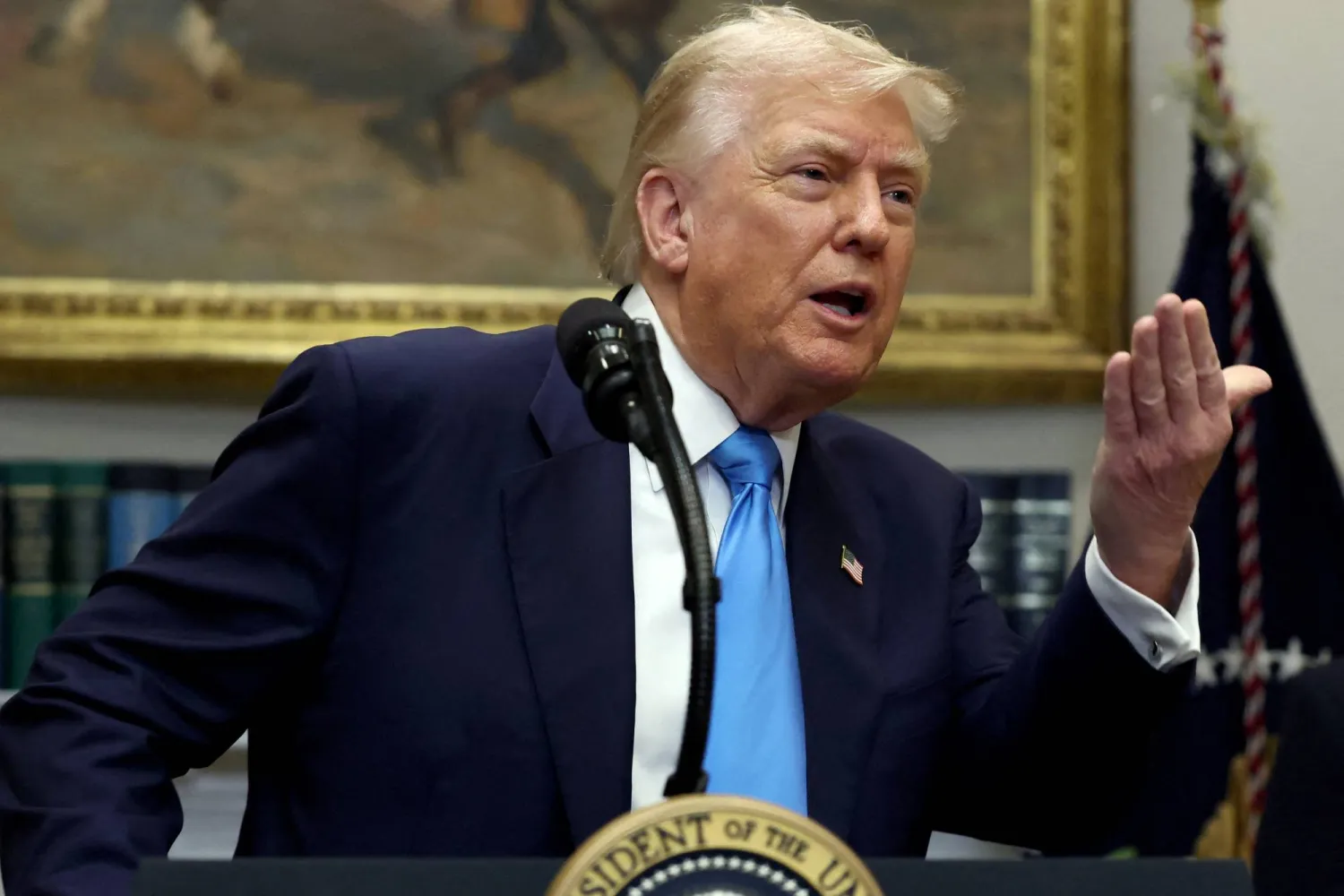
US President Donald Trump speaks after signing the VA Home Loan Program Reform Act at the White House in Washington, D.C., US, July 30, 2025. REUTERS/Evelyn Hockstein
TT

Trump Escalates Trade War with Canada Following Palestine Stance

US President Donald Trump speaks after signing the VA Home Loan Program Reform Act at the White House in Washington, D.C., US, July 30, 2025. REUTERS/Evelyn Hockstein

US President Donald Trump intensified his trade war with Canada a day ahead of his August 1 deadline for a tariff agreement, saying it would be "very hard" to make a deal with Canada after it gave its support to Palestinian statehood.

Trump is set to impose a 35% tariff on all Canadian goods not covered by the US-Mexico-Canada trade agreement if the two countries do not reach an agreement by the deadline, reported Reuters.

"Wow! Canada has just announced that it is backing statehood for Palestine. That will make it very hard for us to make a Trade Deal with them," Trump said on Truth Social.

Canadian Prime Minister Mark Carney previously said tariff negotiations with Washington had been constructive, but the talks may not conclude by the deadline. Talks between the two countries were at an intense phase, he added, but a deal that would remove all US tariffs was unlikely.

Canada is the second-largest US trading partner after Mexico, and the largest buyer of US exports. It bought $349.4 billion of US goods last year and exported $412.7 billion to the US, according to US Census Bureau data.

Canada is also the top supplier of steel and aluminum to the United States, and faces tariffs on both metals as well as on vehicle exports.

Last month, Carney's government scrapped a planned digital services tax targeting US technology firms after Trump abruptly called off trade talks saying the tax was a "blatant attack."

Carney followed France and Britain as he said on Wednesday that his country was planning to recognize the State of Palestine at a meeting of the United Nations in September.

In announcing the decision, Carney spoke of the reality on the ground, including starvation in Gaza.

"Canada condemns the fact that the Israeli government has allowed a catastrophe to unfold in Gaza," he said.

Israel and the United States, Israel's closest ally, both rejected Carney's comments.

Carney's office did not immediately respond to a request for comment on Trump's post.


Gold Rebounds from Five-week Low but Inflation Fears Cap Gains

Gold bars with Chinese characters reading _Fortune Gold_ are seen at a gold shop in Hangzhou. (AFP)
TT

Gold Rebounds from Five-week Low but Inflation Fears Cap Gains

Gold bars with Chinese characters reading _Fortune Gold_ are seen at a gold shop in Hangzhou. (AFP)

Gold prices edged higher on Tuesday from a five-week low hit in the previous session, although gains were limited as elevated crude oil prices kept inflation fears alive and clouded the US interest rate outlook.

Spot gold rose 0.3% to $4,533.40 per ounce by 0417 GMT, after a more than 2% drop on Monday. ‌US gold ‌futures for June delivery inched 0.2% higher to $4,542.50.

"Prices ‌seem ⁠to be digesting ⁠a bit after the return of the 'war trade' across markets sent gold lower Monday," said Ilya Spivak, head of global macro at Tastylive.

However, gains were capped as Treasury "yields and the dollar pushed higher as a rebound in crude oil stoked inflation fears. That weighed against non-interest-bearing and anti-fiat gold," Spivak said.

The ⁠dollar rose and Brent crude hovered above $113 ‌a barrel as the US and ‌Iran continued to work towards a truce while trading blows over ‌the Strait of Hormuz.

The US military said on Monday ‌it destroyed six Iranian small boats and intercepted Iranian cruise missiles and drones as Tehran sought to thwart a new US naval effort to open shipping through the Strait of Hormuz, Reuters reported.

A stronger US currency ‌makes dollar-priced metals more expensive for holders of other currencies.

Meanwhile, higher crude oil prices can ⁠stoke inflation, increasing ⁠the likelihood of higher interest rates. While gold is considered an inflation hedge, high interest rates make yield-bearing assets more attractive, weighing on its appeal.

Traders have largely priced out US interest rate cuts for this year, with markets now seeing a 37% chance of a hike by March 2027, compared with 27% of a reduction a week earlier.

Investors now await a slew of key US data this week, including job openings, the ADP employment report, and the April payrolls report.

Spot silver was steady at $72.73 per ounce, platinum gained 1% to $1,964, and palladium was up 0.8% at $1,492.27.


Syrian Central Bank Allows Dealings With Global Electronic Payment Companies

Key benefits include allowing Syrians entering the country to use their international bank cards domestically (X).
TT

Syrian Central Bank Allows Dealings With Global Electronic Payment Companies

Key benefits include allowing Syrians entering the country to use their international bank cards domestically (X).

The Central Bank of Syria on Monday issued a decision allowing banks and local electronic payment companies to work with global electronic payment companies such as Visa and Mastercard, in a move seen as a step toward modernizing financial infrastructure and expanding digital inclusion.

Central Bank Governor Abdulkader Husrieh said in a statement the decision marks a strategic shift toward a more advanced digital economy and will help facilitate money transfers and payment transactions for Syrians both inside the country and abroad.

He added that the move opens the door to a new phase in the development of electronic payment systems and strengthens Syria’s integration into the global financial system after years of reliance on limited, traditional tools.

Husrieh said the decision enables banks and local electronic payment providers to broaden their services with more advanced and secure payment solutions for individuals and businesses.

Key benefits include allowing Syrians entering the country to use their international bank cards domestically, enabling wider use of Syrian-issued cards abroad, expanding the adoption of electronic payments, reducing reliance on cash, improving user experience, supporting e-commerce and startups, and enhancing the security and reliability of financial transactions.

The governor added that cooperation with global electronic payment companies will help transfer expertise and modern technologies to the local market, improving the efficiency and competitiveness of the financial sector.

The central bank said it continues to implement a package of reforms aimed at rebuilding financial institutions and strengthening monetary policy tools, alongside upgrading electronic payment systems and expanding the digitalization of banking services, in a bid to restore international financial connectivity and create a more efficient and transparent environment to support economic recovery.


Gold Eases as Inflation Jitters, Iran War Cloud US Rate Outlook

AFP: A photo shows gold bangles and necklaces for sale at a gold shop at the Grand Baazar in Istanbul
TT

Gold Eases as Inflation Jitters, Iran War Cloud US Rate Outlook

AFP: A photo shows gold bangles and necklaces for sale at a gold shop at the Grand Baazar in Istanbul

Gold prices nudged lower in thin trade on Monday, weighed down by inflation worries that clouded the US monetary policy outlook, while markets awaited developments in US-Iran peace negotiations.

Spot gold was down 0.5% at $4,588.71 per ounce, as of 0655 GMT. US gold futures for June delivery fell 0.9% to $4,600.60.

Markets in China, Japan and the UK are closed for holidays.

Federal Reserve Chair Jerome Powell closed out eight years as head of the US central bank last Wednesday with interest rates on hold and rising concern about inflation, Reuters reported.

"Gold is still feeling the lingering effects of last week's hawkish Fed messaging, particularly the notable dissenting voices pushing back against further easing," said Tim Waterer, chief market analyst at KCM Trade.

Federal Reserve officials, who dissented against the policy statement last week, said the oil price shock from the Iran war means the US Fed should be clear it can no longer lean towards interest rate cuts, with a rise in borrowing costs possible in the future.

Increasing oil prices could encourage central banks to hold interest rates higher for longer, which would pressure non-yielding assets such as gold.

Oil prices eased but held above $100 a barrel, with the lack of clarity around a potential US-Iran peace deal remaining in focus.

President Donald Trump said the United States would start helping to free ships stranded in the Gulf by the US-Israeli war on Iran from Monday, as a tanker reported being hit by unknown projectiles in the Strait of Hormuz.

Iranian state media reported that Washington conveyed its response to Iran's 14-point proposal via Pakistan, and that Tehran was now reviewing it.

"We see gold largely trading in a $4,400-$5,500 range by year-end. The upper end of that range would require a durable reduction in Middle East tensions and some easing of inflation pressures, while persistent high oil prices would keep the metal toward the lower half of the range," Waterer added.

Spot silver fell 0.6% to $74.91 per ounce, platinum held steady at $1,989, and palladium was down 0.4% at $1,519.78.
