
Trump’s Envoy Meets Putin Ahead of Russia-Ukraine Peace Deadline, Kremlin Says 

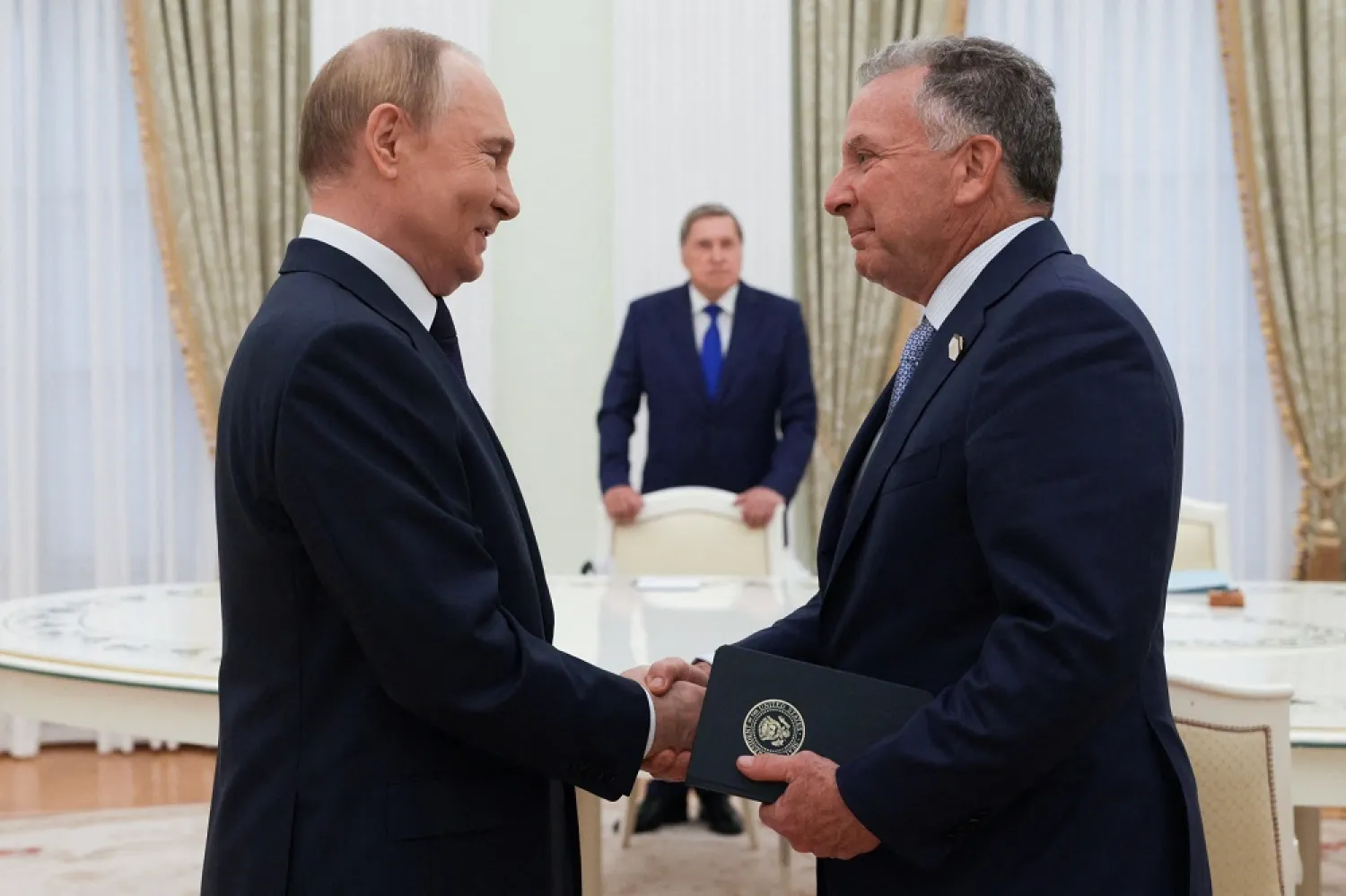
Russian President Vladimir Putin welcomes US President Donald Trump's envoy Steve Witkoff during a meeting in Moscow, Russia August 6, 2025. (Sputnik/Gavriil Grigorov/Pool via Reuters)
TT

Trump’s Envoy Meets Putin Ahead of Russia-Ukraine Peace Deadline, Kremlin Says 

Russian President Vladimir Putin welcomes US President Donald Trump's envoy Steve Witkoff during a meeting in Moscow, Russia August 6, 2025. (Sputnik/Gavriil Grigorov/Pool via Reuters)

Russian President Vladimir Putin held talks with US President Donald Trump’s special envoy Steve Witkoff in Moscow on Wednesday, the Kremlin said, days before the White House’s deadline for Russia to reach a peace deal with Ukraine or potentially face severe economic penalties that could also hit countries buying its oil. 

The Kremlin did not immediately provide more details of the meeting. Earlier, Witkoff took an early morning stroll through Zaryadye Park, a stone's throw from the Kremlin, with Kirill Dmitriev, the Russian president's envoy for investment and economic cooperation, footage aired by TASS showed. 

Dmitriev played a key role in three rounds of direct talks between delegations from Russia and Ukraine in Istanbul in recent months, as well as discussions between Russian and US officials. The negotiations have made no progress on ending the three-year war following Russia's invasion of its neighbor. 

Trump’s deadline for Putin ends on Friday. Washington has threatened “severe tariffs” and other economic penalties if the killing doesn’t stop. 

Trump has expressed increasing frustration with Putin over Russia’s escalating strikes on civilian areas of Ukraine, intended to erode morale and public appetite for the war. The intensified attacks have occurred even as Trump has urged the Russian leader in recent months to relent. 

Overnight from Tuesday to Wednesday, Russian forces hit a recreational center in Ukraine’s southern Zaporizhzhia region, killing two people and injuring 12, including two children, regional Gov. Ivan Fedorov said Wednesday. 

Russian forces launched at least four strikes on the area and initially attacked with powerful glide bombs. 

“There is zero military sense in this strike. Only cruelty to intimidate,” Ukrainian President Volodymyr Zelenskyy said in a post on Telegram. 

Western analysts and Ukrainian officials say Putin is stalling for time and avoiding serious negotiations while Russian forces push to capture more Ukraine land. A Russian offensive that started in the spring and is expected to continue through the fall is advancing faster than last year's push but is making only slow and costly gains and has been unable to take any major cities. 

The situation on the front line is critical for Ukrainian forces but defenses are not about to collapse, analysts say. 

On Tuesday, Trump said “we’ll see what happens” regarding his threat to slap tariffs on nations that buy Russian oil, which could increase import taxes dramatically on China and India. 

“We have a meeting with Russia tomorrow,” Trump said. “We’re going to see what happens. We’ll make that determination at that time.” 

The president said that he has not publicly committed to a specific tariff rate. 

Stepping up diplomatic and economic pressure on the Kremlin risks stoking international tensions amid worsening Russia-US relations. 

The Washington-based Center for European Policy Analysis warned in an assessment this week that there are “clear signs that the Kremlin is preparing for a broader confrontation with NATO,” including a military build-up along Russia’s western flank with alliance countries in recent years. 

Putin has given no hint that he might be ready to make concessions. Instead, the Russian leader and senior Kremlin officials have talked up the country’s military strength. 

Putin announced last week that Russia’s new hypersonic missile, which he says cannot be intercepted by current NATO air defense systems, has entered service. 

Former Russian President Dmitry Medvedev, meantime, warned that the Ukraine war could bring Russia and the US into armed conflict. Trump responded to that by ordering the repositioning of two US nuclear submarines. 

Kremlin spokesman Dmitry Peskov on Monday welcomed Witkoff's visit. “We consider (talks with Witkoff) important, substantive and very useful,” he said. 

Trump initially gave Moscow a 50-day deadline, but later moved up his ultimatum as the Kremlin continued to bomb Ukrainian cities. 

However, Trump himself doubted their effectiveness, saying Sunday that Russia has proven to be “pretty good at avoiding sanctions.” 

“They’re wily characters,” he said of the Russians. 

The Kremlin has insisted that international sanctions imposed since its February 2022 invasion of its neighbor have had a limited impact. 

Ukraine maintains the sanctions are taking their toll on Moscow’s war machine and wants Western allies to ramp them up. 


Macron Urges 'Calm' ahead of Tense Rally for Slain Far-right Activist

French police secure the area after a bomb threat at the headquarters of France's hard-left party La France Insoumise (France Unbowed - LFI) and its evacuation in Paris, France, February 18, 2026. REUTERS/Sarah Meyssonnier
TT

Macron Urges 'Calm' ahead of Tense Rally for Slain Far-right Activist

French police secure the area after a bomb threat at the headquarters of France's hard-left party La France Insoumise (France Unbowed - LFI) and its evacuation in Paris, France, February 18, 2026. REUTERS/Sarah Meyssonnier

French President Emmanuel Macron appealed on Saturday for cooler heads to prevail ahead of a rally for a far-right activist whose killing, blamed on the hard left, has put the country on edge.

Macron also said his government would hold a meeting next week to discuss "violent action groups" in the wake of the fatal beating of Quentin Deranque, which has ignited tensions between the left and right ahead of the 2027 presidential vote.

The 23-year-old died from head injuries following clashes between radical left and far-right supporters on the sidelines of a demonstration against a politician from the left-wing France Unbowed (LFI) party in the southeastern city of Lyon last week.

A rally, widely publicized online by ultra-nationalist and far-right groups, is expected to be attended by 2,000 to 3,000 people, with the authorities fearing further clashes with left-wing protesters.

Speaking at a farming trade fair in Paris, Macron urged "everyone to remain" calm ahead of the rally for Deranque in Lyon, which is set to go ahead under high security later on Saturday despite Lyon's left-wing green mayor asking the state to ban it.

"In the Republic, no violence is legitimate," said Macron, who will be unable to contest next year's election after hitting the two-term limit. "There is no place for militias, no matter where they come from."

- 'Over 1,000 neo-Nazis' -

Ahead of the Lyon rally, some residents living near the march's planned route had barricaded the ground floor windows of their apartments, fearing unrest.

"At my age, I'm not going to play the tough guy. If I have to go out somewhere, I'll avoid the places where they're marching," said Lyon local Jean Echeverria, 87.

"They'll just keep fighting each other, it'll never end. Between the extreme of this and the extreme of that, it's non-stop," he added.

Two friends of Deranque's were behind the official call to march in his honor.

But according to the Deranque family's lawyer, Fabien Rajon, his parents will not take part in the rally, which they have urged to go ahead "without violence" and "without political statements".

Several ultra-right-wing groups, including Deranque's nationalist Allobroges Bourgoin faction, have nonetheless heavily publicized the march on social media.

The authorities fear that far-right and hard-left activists from elsewhere in Europe might travel to France for the event, stoking concerns of further unrest.

Jordan Bardella, the head of the anti-immigration National Rally (RN) party -- which senses its best chance ever of scoring the presidency in next year's vote -- has urged supporters not to go.

"We ask you, except in very specific and strictly supervised local situations not to attend these gatherings nor to associate the National Rally with them," he wrote in a message sent to party officials and seen by AFP.

LFI coordinator Manuel Bompard backed the Lyon mayor's call for a ban, warning on X that the march would be a "fascist demonstration" which "over 1,000 neo-Nazis from all over Europe" were expected to attend.

But Interior Minister Laurent Nunez declined to ban the rally, arguing that he had to "strike a balance between maintaining public order and freedom of expression" and pledging an "extremely large police deployment".

- 'Wound' -

Deranque's death has provoked a reaction from US President Donald Trump's administration, with state department official Sarah Rogers on Friday branding the killing "terrorism" and claiming that "violent radical leftism is on the rise".

Likewise, Italian Prime Minister Giorgia Meloni on Wednesday called Deranque's death "a wound for all Europe", prompting Macron to urge the far-right leader to stay out of French matters.

Six men suspected of involvement in the fatal assault have been charged over the killing, while a parliamentary assistant to a radical left-wing MP has also been charged with complicity.

A far-right collective called Nemesis, which claims to "defend Western women" from the violence allegedly wrought by immigrants, said Deranque had been at the protest in Lyon to protect its members when he was assaulted by "anti-fascist" activists.

Having urged both the far right and hard left to clean up their acts, Macron said his administration would hold a meeting next week "take stock of violent action groups which are active and have links with political parties of any description".


US Military Strikes Another Alleged Drug Boat in Eastern Pacific, Killing 3

A shot of a boat targeted by a US raid in the Caribbean (archive - Reuters)
TT

US Military Strikes Another Alleged Drug Boat in Eastern Pacific, Killing 3

A shot of a boat targeted by a US raid in the Caribbean (archive - Reuters)

The US military said Friday that it has carried out another deadly strike on a vessel accused of trafficking drugs in the Eastern Pacific Ocean.

US Southern Command said on social media that the boat “was transiting along known narco-trafficking routes in the Eastern Pacific and was engaged in narco-trafficking operations.” It said the strike killed three people. A video linked to the post shows a boat floating in the water before bursting into flames.

Friday’s attack raises the death toll from the Trump administration’s strikes on alleged drug boats to at least 148 people in at least 43 attacks carried out since early September in the Caribbean Sea and eastern Pacific Ocean.

President Donald Trump has said the US is in “armed conflict” with cartels in Latin America and has justified the attacks as a necessary escalation to stem the flow of drugs. But his administration has offered little evidence to support its claims of killing “narcoterrorists.”

Critics have questioned the overall legality of the strikes as well as their effectiveness, in part because the fentanyl behind many fatal overdoses is typically trafficked to the US over land from Mexico.


Afghanistan Quake Causes No ‘Serious’ Damage, Injuries, Says Official

Afghan men prepare meals during the holy fasting month of Ramadan in Kabul, Afghanistan, 19 February 2026. (EPA)
TT

Afghanistan Quake Causes No ‘Serious’ Damage, Injuries, Says Official

Afghan men prepare meals during the holy fasting month of Ramadan in Kabul, Afghanistan, 19 February 2026. (EPA)

A 5.8-magnitude earthquake that rocked eastern Afghanistan including the capital Kabul has resulted in only minor damage and one reported injury, a disaster official told AFP on Saturday.

The quake hit on Friday just as people in the Muslim-majority country were sitting down to break their Ramadan fast.

The epicenter was near several remote villages around 130 kilometers (80 miles) northeast of Kabul, the United States Geological Survey said.

"There aren't any serious casualties or damages after yesterday's earthquake," said Mohammad Yousuf Hamad, spokesman for the National Disaster Management Authority.

He added that one person had sustained "a minor injury in Takhar", in Afghanistan's north, "and three houses had minor damage in Laghman" province.

Zilgay Talabi, a resident of Khenj district near the epicenter, said the tremor was "very strong, it went on for almost 30 seconds".

Earthquakes are common in Afghanistan, particularly along the Hindu Kush mountain range, near where the Eurasian and Indian tectonic plates meet.

In August last year, a shallow 6.0-magnitude quake in the country's east wiped out mountainside villages and killed more than 2,200 people.

Weeks later, a 6.3-magnitude quake in northern Afghanistan killed 27 people.

Large tremors in western Herat, near the Iranian border, in 2023, and in Nangarhar province in 2022, killed hundreds and destroyed thousands of homes.

Many homes in the predominantly rural country, which has been devastated by decades of war, are shoddily built.

Poor communication networks and infrastructure in mountainous Afghanistan have hampered disaster responses in the past, preventing authorities from reaching far-flung villages for hours or even days before they could assess the extent of the damage.