Trump: Important that Middle Eastern Countries Join Abraham Accords

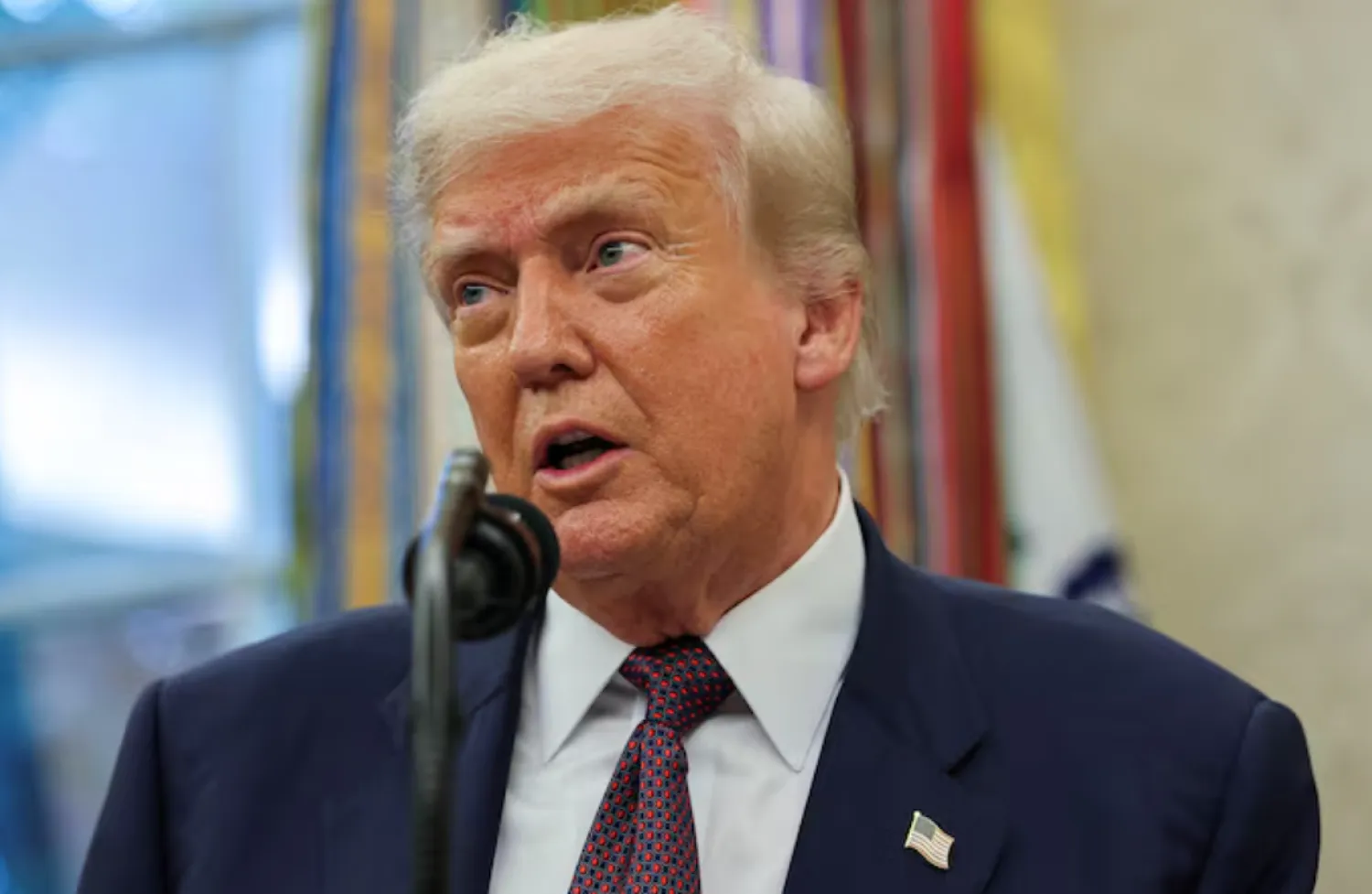
US President Donald Trump speaks, as he and Apple CEO Tim Cook (not pictured) present Apple's announcement of a $100 billion investment in US manufacturing, in the Oval Office at the White House in Washington, DC, US, August 6, 2025. REUTERS/Jonathan Ernst
TT

Trump: Important that Middle Eastern Countries Join Abraham Accords

US President Donald Trump speaks, as he and Apple CEO Tim Cook (not pictured) present Apple's announcement of a $100 billion investment in US manufacturing, in the Oval Office at the White House in Washington, DC, US, August 6, 2025. REUTERS/Jonathan Ernst

US President Donald Trump said on Thursday it was important that Middle Eastern countries join the Abraham Accords, which aim to normalize diplomatic ties with Israel, saying it will ensure peace in the region.

"Now that the nuclear arsenal being 'created' by Iran has been totally OBLITERATED, it is very important to me that all Middle Eastern Countries join the Abraham Accords," Trump wrote in a social media post, Reuters reported.

Efforts to expand the accords have been complicated by a soaring death toll and starvation in Gaza.

The war in Gaza, where local authorities say more than 60,000 people have died, has provoked global anger. Canada, France and the United Kingdom have announced plans in recent days to recognize an independent Palestinian state.

Trump's administration is actively discussing with Azerbaijan the possibility of bringing that nation and some Central Asian allies into the Abraham Accords, hoping to deepen their existing ties with Israel, according to five sources with knowledge of the matter.


Sri Lanka Tracks 11 US-Sanctioned Iranian Tankers off Coast

Vessels near the Strait of Hormuz, as seen from Musandam, Oman, August 24, 2026. (Reuters)
TT

Sri Lanka Tracks 11 US-Sanctioned Iranian Tankers off Coast

Vessels near the Strait of Hormuz, as seen from Musandam, Oman, August 24, 2026. (Reuters)

Sri Lanka's maritime authorities were monitoring a fleet of 11 US-sanctioned Iranian oil tankers just off the island's southern coast, officials said Wednesday.

The vessels are in limbo -- they cannot return to Iran because of a United States blockade on ships using Iranian ports.

The ships were spotted close to the Galle harbor where an Iranian frigate, IRIS Dena, was sunk by a US submarine in March, killing 104 sailors. Sri Lanka's navy rescued 32 Iranian sailors from that frigate.

"We have deployed reconnaissance aircraft and patrol boats to monitor these Iranian vessels outside our 12-nautical-mile territorial waters," a military official told AFP on condition of anonymity.

The vessels had not sought permission to enter Sri Lankan territory and were entitled to freedom of navigation in international waters.

"There is no indication of any ship-to-ship transfer of oil or illegal discharge of pollutants, so there is no basis for Sri Lankan authorities to take action against them," he said.

Many Iranian merchant vessels moved east towards the Strait of Malacca and Singapore after the US sanctions, while several remained near Sri Lankan waters, authorities said.

Sri Lankan officials said Washington had not formally notified Colombo about sanctioned Iranian-flagged vessels.


China's Xi to Attend SCO Summit in Kyrgyzstan, Visit Egypt, Ministry Says

 In this photo released by Xinhua News Agency, Chinese President Xi Jinping delivers an important speech at a grand gathering to commemorate the birth centenary of late leader Jiang Zemin at the Great Hall of the People in Beijing on Monday, Aug. 17, 2026. (Li Xiang/Xinhua via AP)
In this photo released by Xinhua News Agency, Chinese President Xi Jinping delivers an important speech at a grand gathering to commemorate the birth centenary of late leader Jiang Zemin at the Great Hall of the People in Beijing on Monday, Aug. 17, 2026. (Li Xiang/Xinhua via AP)
TT

China's Xi to Attend SCO Summit in Kyrgyzstan, Visit Egypt, Ministry Says

 In this photo released by Xinhua News Agency, Chinese President Xi Jinping delivers an important speech at a grand gathering to commemorate the birth centenary of late leader Jiang Zemin at the Great Hall of the People in Beijing on Monday, Aug. 17, 2026. (Li Xiang/Xinhua via AP)
In this photo released by Xinhua News Agency, Chinese President Xi Jinping delivers an important speech at a grand gathering to commemorate the birth centenary of late leader Jiang Zemin at the Great Hall of the People in Beijing on Monday, Aug. 17, 2026. (Li Xiang/Xinhua via AP)

Chinese President Xi Jinping will attend the Shanghai Cooperation Organization (SCO) summit in Bishkek, Kyrgyzstan, as part of a state visit there and then to Egypt from August 30 to ‌September 3, ‌China's foreign ministry said ‌on ⁠Wednesday.

At the Bishkek ⁠summit, Xi will discuss deepening cooperation as well as major international and regional issues with participating countries and leaders, foreign ⁠ministry spokesperson Lin Jian ‌told a ‌daily press conference.

During the ‌visit, the Chinese president ‌will hold talks with his Kyrgyz counterpart Sadyr Japarov and will attend various state events, ‌Lin said.

Xi's trip to Egypt will be his ⁠first ⁠state visit to the North African country in 10 years, where he will meet President Abdel Fattah al-Sisi and exchange views on bilateral ties and international and regional issues of common concern.


South Korea Says Russian Military Planes Entered Its Air Defense Zone

Seoul's defense ministry said multiple Russian aircraft had entered and then left its air defense identification zone over the East Sea. (Republic of Korea Air Force)
TT

South Korea Says Russian Military Planes Entered Its Air Defense Zone

Seoul's defense ministry said multiple Russian aircraft had entered and then left its air defense identification zone over the East Sea. (Republic of Korea Air Force)

South Korea said on Wednesday it had scrambled fighter jets in response to Russian military aircraft entering its air defense zone, the second such incursion in weeks.

The relationship between the countries has worsened since South Korea joined Western sanctions following Russia's invasion of Ukraine, and since Moscow built stronger ties with North Korea.

Seoul's defense ministry said multiple Russian aircraft had entered and then left its air defense identification zone over the East Sea, also called the Sea of Japan.

"South Korea's military detected the Russian aircraft before they entered the zone and deployed Air Force fighter jets to prepare for any contingency," it said, without giving details.

The Russian aircraft did not violate South Korean airspace, it said.

An air defense identification zone is not sovereign airspace but a buffer area where countries require foreign aircraft to identify themselves for security purposes.

Military aircraft are generally expected to notify the relevant country before entering its zone, although there is no legal obligation to do so.

In late June, more than 10 Chinese and Russian military aircraft entered South Korea's air defense zone.

Beijing's defense ministry said at the time that Chinese and Russian forces had conducted a "strategic air patrol" over the Sea of Japan, the East China Sea and the western Pacific Ocean.

Russia's defense ministry said the patrol was part of normal military cooperation plans and "not directed against third countries".

But South Korea still lodged protests with Beijing and Moscow and demanded measures to prevent a recurrence.