


Trump Announces Peace Agreement Between Azerbaijan and Armenia

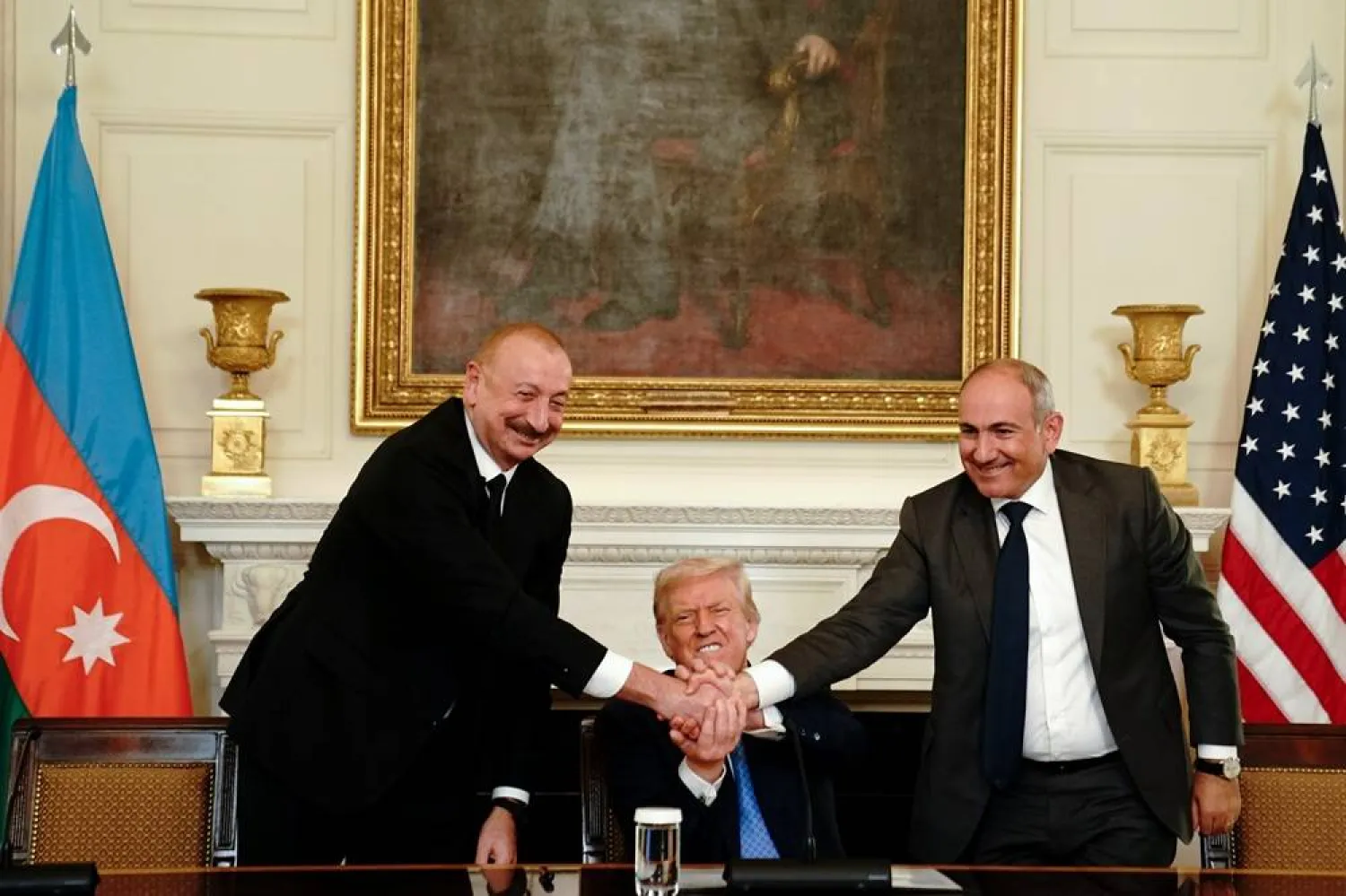
(L-R) Azerbaijan's President Ilham Aliyev, US President Donald Trump, and Armenia's Prime Minister Nikol Pashinyan join hands during a signing ceremony in the State Dining Room of the White House in Washington, DC, USA, 08 August 2025. (EPA)
TT

Trump Announces Peace Agreement Between Azerbaijan and Armenia

(L-R) Azerbaijan's President Ilham Aliyev, US President Donald Trump, and Armenia's Prime Minister Nikol Pashinyan join hands during a signing ceremony in the State Dining Room of the White House in Washington, DC, USA, 08 August 2025. (EPA)

Azerbaijan and Armenia signed a US-brokered peace agreement on Friday during a meeting with US President Donald Trump that would boost bilateral economic ties after decades of conflict and move them toward a full normalization of their relations.

The deal between the South Caucasus rivals - assuming it holds - would be a significant accomplishment for the Trump administration that is sure to rattle Moscow, which sees the region as within its sphere of influence.

"It's a long time - 35 years - they fought and now they're friends, and they're going to be friends for a long time," Trump said at a signing ceremony at the White House, where he was flanked by Azerbaijani President Ilham Aliyev and Armenian Prime Minister Nikol Pashinyan.

Armenia and Azerbaijan have been at odds since the late 1980s when Nagorno-Karabakh, a mountainous Azerbaijani region mostly populated by ethnic Armenians, broke away from Azerbaijan with support from Armenia. Azerbaijan took back full control of the region in 2023, prompting almost all of the territory's 100,000 ethnic Armenians to flee to Armenia.

Trump said the two countries had committed to stop fighting, open up diplomatic relations and respect each other's territorial integrity.

The agreement includes exclusive US development rights to a strategic transit corridor through the South Caucasus that the White House said would facilitate greater exports of energy and other resources.

Trump said the United States signed separate deals with each country to expand cooperation on energy, trade and technology, including artificial intelligence. Details were not released.

He said restrictions had also been lifted on defense cooperation between Azerbaijan and the United States, a development that could also worry Moscow.

Both leaders praised Trump for helping to end the conflict and said they would nominate him for the Nobel Peace Prize.

Trump has tried to present himself as a global peacemaker in the first months of his second term. The White House credits him with brokering a ceasefire between Cambodia and Thailand and sealing peace deals between Rwanda and the Democratic Republic of Congo, and Pakistan and India.

However, he has not managed to end Russia's 3-1/2-year-old war in Ukraine or Israel's conflict with Hamas in Gaza. Trump on Friday said he would meet Russian President Vladimir Putin in Alaska on August 15 to work on ending the war.

ENDING SANCTIONS EVASION BLIND SPOT

US officials said the agreement was hammered out during repeated visits to the region and would provide a basis for working toward a full normalization between the countries.

The peace deal could transform the South Caucasus, an energy-producing region neighboring Russia, Europe, Türkiye and Iran that is criss-crossed by oil and gas pipelines but riven by closed borders and longstanding ethnic conflicts.

Brett Erickson, a sanctions expert and adviser to Loyola University's Chicago School of Law, said the agreement would help the West crack down on Russian efforts to evade sanctions.

"The Caucasus has been a blind spot in sanctions policy," he said. "A formal peace creates a platform for the West to engage Armenia and Azerbaijan ... to shut down the evasion pipelines."

Tina Dolbaia, an associate fellow at the Center for Strategic and International Studies, said Friday's signing was a big symbolic move, but many questions remained, including which US companies might control the new transit corridor and how involved Armenia and Azerbaijan would be in its construction.

She said Russia would likely be irritated by being excluded from the agreement and the US role in the corridor. "Now the fact that ... Armenians are shaking hands with Azerbaijanis, and they are talking about US involvement in this corridor - this is huge for Russia," she said.

Olesya Vartanyan, an independent regional expert, said the deal added greater predictability to the region, but its long-term prospects would depend on continued US engagement.

"Armenia and Azerbaijan ... have a much longer track record of failed negotiations and violent escalations than of peaceful resolutions," she said. "Without proper and continued US involvement, the issue will likely get deadlocked again, increasing the chances of renewed tensions."

Senior administration officials said the agreement marked the end to the first of several frozen conflicts on Russia's periphery since the end of the Cold War, sending a powerful signal to the entire region.

Armenia plans to award the US exclusive special development rights for an extended period on the transit corridor, US officials told Reuters this week. The so-called Trump Route for International Peace and Prosperity has already drawn interest from nine companies, including three US firms, one official said on condition of anonymity.

Daphne Panayotatos, with the Washington-based rights group Freedom Now, said it had urged the Trump administration to use the meeting with Aliyev to demand the release of some 375 political prisoners held in the country.

Azerbaijan, an oil-producing country that hosted the United Nations climate summit last November, has rejected Western criticism of its human rights record, describing it as unacceptable interference.



Iran Says Redirects US-sanctioned Oil Tanker to Its Shores

FILE PHOTO: An aerial view of the Iranian shores and the island of Qeshm in the strait of Hormuz, December 10, 2023. REUTERS/Stringer/File Photo
TT

Iran Says Redirects US-sanctioned Oil Tanker to Its Shores

FILE PHOTO: An aerial view of the Iranian shores and the island of Qeshm in the strait of Hormuz, December 10, 2023. REUTERS/Stringer/File Photo

Iran said on Friday it redirected a US-sanctioned oil tanker carrying Iranian oil back to its shores, though it was unclear from its statement why it would have returned it, reported AFP.

"The Islamic Republic of Iran's navy, through a specially planned operation in the Sea of Oman, seized the offending tanker Ocean Koi," the army said in a statement carried by state television, adding that the oil belonged to Iran.

It said the ship was redirected to Iran's southern shores after it sought "to damage and disrupt Iran's oil exports," without elaborating.


Meloni Meets Rubio as Iran War Strains Italy-US Ties

US Secretary of State Marco Rubio leaves the San Damaso courtyard after meeting Pope Leo XIV at the Vatican, May 7, 2026. REUTERS/Yara Nardi
TT

Meloni Meets Rubio as Iran War Strains Italy-US Ties

US Secretary of State Marco Rubio leaves the San Damaso courtyard after meeting Pope Leo XIV at the Vatican, May 7, 2026. REUTERS/Yara Nardi

Italian Prime Minister Giorgia Meloni met US Secretary of State Marco Rubio on Friday at a moment of unusual strain between her government and President Donald Trump's administration, driven largely by the war with Iran.

Rubio is in Italy for a two-day trip aimed at easing ties with Pope Leo after unprecedented attacks on the pontiff by Trump, while also addressing Washington's frustration over Italy's refusal to support the US-Israeli war on Iran.

Meloni had been one of Trump's firmest supporters in Europe, cultivating close ties with him and presenting herself as a natural ‌bridge between Washington ‌and other EU states that had no natural political ‌affinity ⁠with the Republican ⁠US leader.

But that alignment has come under increasing strain in recent months, as the Iran war has forced her to balance loyalty to the United States against Italian public animosity to the war and the growing economic cost of the conflict.

Before heading to the prime minister's office, Rubio met Italy's Foreign Minister Antonio Tajani, who said the talks had been positive.

"I am convinced ⁠that Europe needs America, Italy needs America, but the United ‌States also needs Europe and Italy," Tajani ‌told reporters.

Meloni and Rubio were expected to discuss the situation in the Gulf, as ‌well as Russia's war on Ukraine, US tariffs on European goods and ‌the outlook for Cuba, which Washington is seeking to isolate both diplomatically and economically.

TRUMP'S ATTACKS ON POPE

The Italians will also be keen for a readout on Rubio's meetings at the Vatican. Trump's recent attacks on Pope Leo crossed a sensitive ‌line in overwhelmingly Catholic Italy and prompted Meloni to call them "unacceptable."

Her criticism in turn drew a sharp rebuke ⁠from Trump, who said ⁠she lacked courage and had let Washington down. He subsequently threatened to withdraw US troops from Italy.

Meloni said on Monday she would not support such a move, but acknowledged that the decision "doesn't depend on me".

Italy last month refused to allow US aircraft to use the Sigonella air base in Sicily for combat operations linked to the Iran conflict. Italian officials have said Washington had not sought prior authorization from Rome for the use of the site.

Defense Minister Guido Crosetto, a close Meloni ally, later warned that the Iran war was putting US global leadership at risk and said he feared the "madness" of nuclear escalation.

Pollsters say Meloni's ties to Trump could prove a potential liability with voters ahead of national elections due next year.


Trump Says Ceasefire Still Holds after Fighting Between the US and Iran Flares

US President Donald Trump looks on as he speaks to reporters near the Lincoln Memorial Reflecting Pool as it undergoes renovations, in Washington, D.C., US, May 7, 2026. REUTERS/Kylie Cooper
TT

Trump Says Ceasefire Still Holds after Fighting Between the US and Iran Flares

US President Donald Trump looks on as he speaks to reporters near the Lincoln Memorial Reflecting Pool as it undergoes renovations, in Washington, D.C., US, May 7, 2026. REUTERS/Kylie Cooper

US and Iranian forces clashed in the Gulf, but President Donald Trump said a ceasefire was still holding despite the flare-up, which dented hopes for a swift diplomatic resolution to the crisis.

The escalation came as Washington awaited Tehran's response to a US proposal to end the war, which began on February 28 when the US and Israel launched airstrikes on Iran.

Trump said on Thursday three US Navy destroyers were attacked as they moved through the Strait of Hormuz, a conduit for around a fifth of the world's oil and liquefied natural gas flows that Iran has all but closed since the conflict began.

"Three World Class American Destroyers just transited, very successfully, out of the Strait of Hormuz, under fire. There was no damage done to the three Destroyers, but great damage done to the Iranian attackers," Trump wrote on Truth Social.

He later told reporters the ceasefire remained in effect and played down the exchange.

"They trifled with us today. We blew them away," Trump said in Washington.

Iran, however, accused the United ⁠States of breaching ⁠the ceasefire, an agreement that has been punctuated by intermittent clashes since it was announced on April 7.

Iran's top joint military command said US forces had targeted an Iranian oil tanker and another ship, and carried out air attacks on civilian areas on Qeshm Island in the Strait of Hormuz and nearby coastal areas. It said Iranian forces responded by attacking US military vessels east of the strait and south of the port of Chabahar.

A spokesperson for Iran's Khatam al-Anbiya Central Headquarters said the Iranian strikes inflicted "significant damage," but US Central Command said none of its assets were hit.

Iranian state media later signaled a de-escalation, with Press TV reporting that, after several hours of exchanges, "the situation on Iranian islands and coastal cities by the Strait of Hormuz is back to normal now."