


Europe Stresses Need to Protect Ukrainian Interests Ahead of Trump-Putin Talks

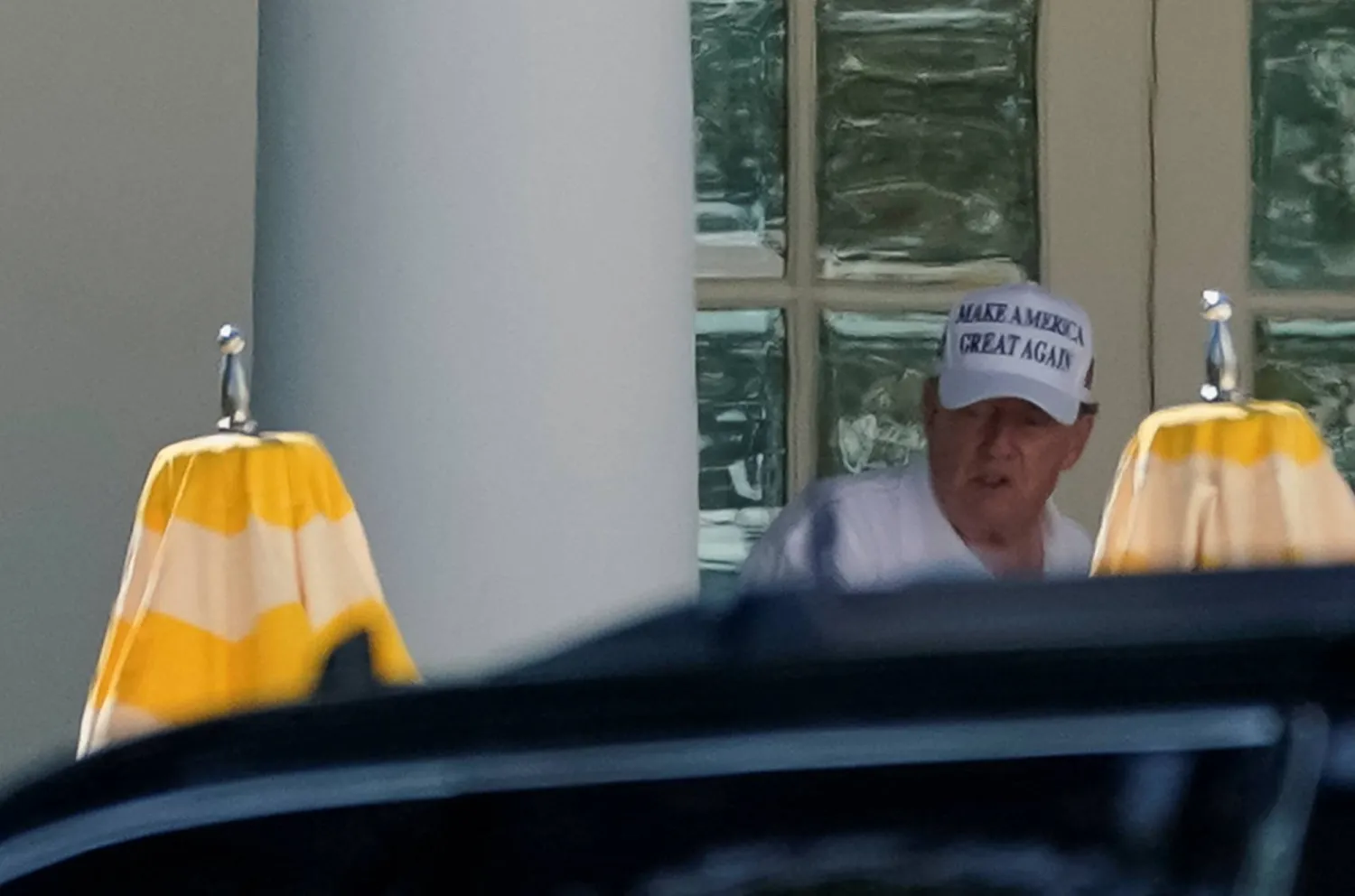
US President Donald Trump, wearing a Make America Great Again hat, walks past the Oval Office at the White House, in Washington, D.C., US, August 9, 2025. REUTERS/Nathan Howard
TT

Europe Stresses Need to Protect Ukrainian Interests Ahead of Trump-Putin Talks

US President Donald Trump, wearing a Make America Great Again hat, walks past the Oval Office at the White House, in Washington, D.C., US, August 9, 2025. REUTERS/Nathan Howard

European leaders on Saturday welcomed US President Donald Trump's plans to meet Russian President Vladimir Putin on ending the war in Ukraine, while stressing the need to keep pressure on Moscow and protect Ukrainian and European security interests.

Trump plans to meet Putin in Alaska on Friday, saying the parties, including Ukrainian President Volodymyr Zelenskiy, were close to a deal that could resolve the three-and-a-half-year-old conflict.

The US president is open to a trilateral summit with Putin and Zelenskiy, but for now the White House is planning a bilateral meeting as requested by Putin, a White House official said. Russian and Ukrainian officials could not immediately be reached for comment on the prospects of a trilateral meeting.

Details of a potential deal have not been announced, but Trump said it would involve "some swapping of territories to the betterment of both". It could require Ukraine to surrender significant parts of its territory, an outcome Zelenskiy and his European allies say would only encourage Russian aggression.

US Vice President JD Vance met British Foreign Secretary David Lammy and representatives of Ukraine and European allies on Saturday at Chevening House, a country mansion southeast of London, to discuss Trump's push for peace.

A joint statement from the French, Italian, German, Polish, British and Finnish leaders and the president of the European Commission welcomed Trump's efforts, while stressing the need to maintain support for Ukraine and pressure on Russia.

"We share the conviction that a diplomatic solution must protect Ukraine's and Europe's vital security interests," they said, according to Reuters.

"We agree that these vital interests include the need for robust and credible security guarantees that enable Ukraine to effectively defend its sovereignty and territorial integrity," the statement said, adding: "The path to peace in Ukraine cannot be decided without Ukraine."

The leaders said "they remain committed to the principle that international borders must not be changed by force", and added: "The current line of contact should be the starting point of negotiations."

They said negotiations could only take place in the context of a ceasefire or reduction of hostilities.

Zelenskiy's chief of staff, Andriy Yermak, who took part in the talks with European leaders and US officials, said Ukraine was grateful for their constructive approach.

"A ceasefire is necessary - but the front line is not a border," Yermak said on X, reiterating Kyiv's position that it will reject any territorial concessions to Russia.

Yermak also thanked Vance for "respecting all points of view" and his efforts toward a "reliable peace".

European representatives put forward a counterproposal, a European official said, declining to provide details.

The Wall Street Journal said the counterproposal included demands that a ceasefire must take place before any other steps are taken and that any territorial exchange must be reciprocal, with firm security guarantees.

"You can't start a process by ceding territory in the middle of fighting," the newspaper quoted a European negotiator as saying.

A US official said hours-long meetings at Chevening "produced significant progress toward President Trump's goal of bringing an end to the war in Ukraine, ahead of President Trump and President Putin’s upcoming meeting in Alaska."

The White House did not immediately respond when asked about the European counterproposals.

British Prime Minister Keir Starmer and French President Emmanuel Macron spoke and pledged to find a "just and lasting peace" in Ukraine and "unwavering support" for Zelenskiy while welcoming Trump's efforts to end the fighting, a Downing Street spokesperson said.

It was not clear what, if anything, had been agreed at Chevening, but Zelenskiy called the meeting constructive.

"The path to peace for Ukraine should be determined together and only together with Ukraine, this is the key principle," he said in his evening address to Ukrainians.

Macron stressed the need for Ukraine to play a role in any negotiations.

"Ukraine's future cannot be decided without the Ukrainians, who have been fighting for their freedom and security for over three years now," he wrote on X after what he said were calls with Zelenskiy, German Chancellor Friedrich Merz and Starmer. "Europeans will also necessarily be part of the solution, as their own security is at stake."

Zelenskiy has made a flurry of calls with Ukraine's allies since Trump envoy Steve Witkoff visited Moscow on Wednesday, where, Trump said, he achieved "great progress".

Ukraine and the EU have pushed back on proposals that they view as ceding too much to Putin, whose troops invaded Ukraine in February 2022. Russia justifies the war on the grounds of what it calls threats to its security from a Ukrainian pivot towards the West.

Kyiv and its Western allies say the invasion is an imperial-style land grab.
Moscow has claimed four Ukrainian regions – Luhansk, Donetsk, Zaporizhzhia and Kherson – as well as the Black Sea peninsula of Crimea, which was annexed in 2014.

Russian forces do not fully control all the territory in the four regions, and Russia has demanded that Ukraine pull out its troops from the parts that they still control.

Ukraine says its troops still have a small foothold in Russia's Kursk region a year after they crossed the border to try to gain leverage in any negotiations. Russia said it had expelled Ukrainian troops from Kursk in April.



Ukraine’s New Defense Minister Reveals Scale of Desertions as Millions Avoid the Draft

Ukraine's newly appointed Defense Minister Mykhailo Fedorov attends a parliamentary session in Kyiv, Ukraine, 14 January 2026. (EPA)
TT

Ukraine’s New Defense Minister Reveals Scale of Desertions as Millions Avoid the Draft

Ukraine's newly appointed Defense Minister Mykhailo Fedorov attends a parliamentary session in Kyiv, Ukraine, 14 January 2026. (EPA)

Wide-scale desertions and 2 million draft-dodgers are among a raft of challenges facing Ukraine's military as Russia presses on with its invasion of its neighbor after almost four years of fighting, the new defense minister said Wednesday.

Mykhailo Fedorov told Ukraine's parliament that other problems facing Ukraine’s armed forces include excessive bureaucracy, a Soviet-style approach to management, and disruptions in the supply of equipment to troops along the about 1,000-kilometer (600-mile) front line.

“We cannot fight a war with new technologies but an old organizational structure,” Fedorov said.

He said the military had faced some 200,000 troop desertions and draft-dodging by around 2 million people.

President Volodymyr Zelenskyy appointed 34-year-old Fedorov at the start of the year. The former head of Ukraine’s digital transformation policies is credited with spearheading the army's drone technology and introducing several successful e-government platforms.

His appointment was part of a broad government reshuffle that the Ukrainian leader said aimed to sharpen the focus on security, defense development and diplomacy amid a new US-led push to find a peace settlement.

Fedorov said the defense ministry is facing a shortfall of 300 billion hryvnia ($6.9 billion) in funding needs.

The European Union will dedicate most of a massive new loan program to help fund Ukraine’s military and economy over the next two years, European Commission President Ursula von der Leyen said Wednesday.

Fedorov said Ukraine’s defense sector has expanded significantly since Russia’s full-scale invasion in February 2022. At the start of the war, he said, the country had seven private drone companies and two firms developing electronic warfare systems. Today, he said, there are nearly 500 drone manufacturers and about 200 electronic warfare companies in Ukraine.

He added that some sectors have emerged from scratch, including private missile producers, which now number about 20, and more than 100 companies manufacturing ground-based robotic systems.


France Explores Sending Eutelsat Terminals to Iran Amid Internet Blackout

 Protesters hold up placards with pictures of victims as they demonstrate in support of anti-government protests in Iran, outside Downing Street, in London, Wednesday, Jan. 14, 2026. (AP)
Protesters hold up placards with pictures of victims as they demonstrate in support of anti-government protests in Iran, outside Downing Street, in London, Wednesday, Jan. 14, 2026. (AP)
TT

France Explores Sending Eutelsat Terminals to Iran Amid Internet Blackout

 Protesters hold up placards with pictures of victims as they demonstrate in support of anti-government protests in Iran, outside Downing Street, in London, Wednesday, Jan. 14, 2026. (AP)
Protesters hold up placards with pictures of victims as they demonstrate in support of anti-government protests in Iran, outside Downing Street, in London, Wednesday, Jan. 14, 2026. (AP)

France is looking into sending Eutelsat satellite terminals to Iran to help citizens after Iranian authorities imposed a blackout of internet services in a bid to quell the country's most violent domestic unrest in decades.

"We are exploring all options, and the one you have mentioned is among them," French Foreign Minister Jean-Noel Barrot said on Wednesday in ‌the lower house ‌after a lawmaker asked whether France ‌would ⁠send Eutelsat ‌gear to Iran.

Backed by the French and British governments, Eutelsat owns OneWeb, the only low Earth orbit constellation, or group of satellites, besides Elon Musk's Starlink.

The satellites are used to beam internet service from space, providing broadband connectivity to businesses, governments and consumers in underserved areas.

Iranian authorities in recent days have ⁠launched a deadly crackdown that has reportedly killed thousands during protests against clerical rule, ‌and imposed a near-complete shutdown of internet ‍service.

Still, some Iranians have ‍managed to connect to Starlink satellite internet service, three people ‍inside the country said.

Even Starlink service appears to be reduced, Alp Toker, founder of internet monitoring group NetBlocks said earlier this week.

Eutelsat declined to comment when asked by Reuters about Barrot's remarks and its activities in Iran.

Starlink’s more than 9,000 satellites allow higher speeds than Eutelsat's fleet of over 600, ⁠and its terminals connecting users to the network are cheaper and easier to install.

Eutelsat also provides internet access to Ukraine's military, which has relied on Starlink to maintain battlefield connectivity throughout the war with Russia.

Independent satellite communications adviser Carlos Placido said OneWeb terminals are bulkier than Starlink’s and easier to jam.

"The sheer scale of the Starlink constellation makes jamming more challenging, though certainly not impossible," Placido said. "With OneWeb it is much easier to predict which satellite will become online over a given ‌location at a given time."


China Says It Opposes Outside Interference in Iran’s Internal Affairs

Iranians walk next to a billboard reading "Iran is our Homeland" at Enqelab Square in Tehran, Iran, 13 January 2026. (EPA)
TT

China Says It Opposes Outside Interference in Iran’s Internal Affairs

Iranians walk next to a billboard reading "Iran is our Homeland" at Enqelab Square in Tehran, Iran, 13 January 2026. (EPA)

China opposes any outside interference in Iran's ​internal affairs, the Chinese foreign ministry said on Wednesday, after US President Donald Trump warned that Washington ‌would take "very ‌strong action" ‌against Tehran.

China ⁠does ​not ‌condone the use or the threat of force in international relations, Mao Ning, spokesperson at ⁠the Chinese foreign ministry, said ‌at a ‍regular ‍news conference when ‍asked about China's position following Trump's comments.

Trump told CBS News in ​an interview that the United States would take "very ⁠strong action" if Iran starts hanging protesters.

Trump also urged protesters to keep protesting and said that help was on the way.