

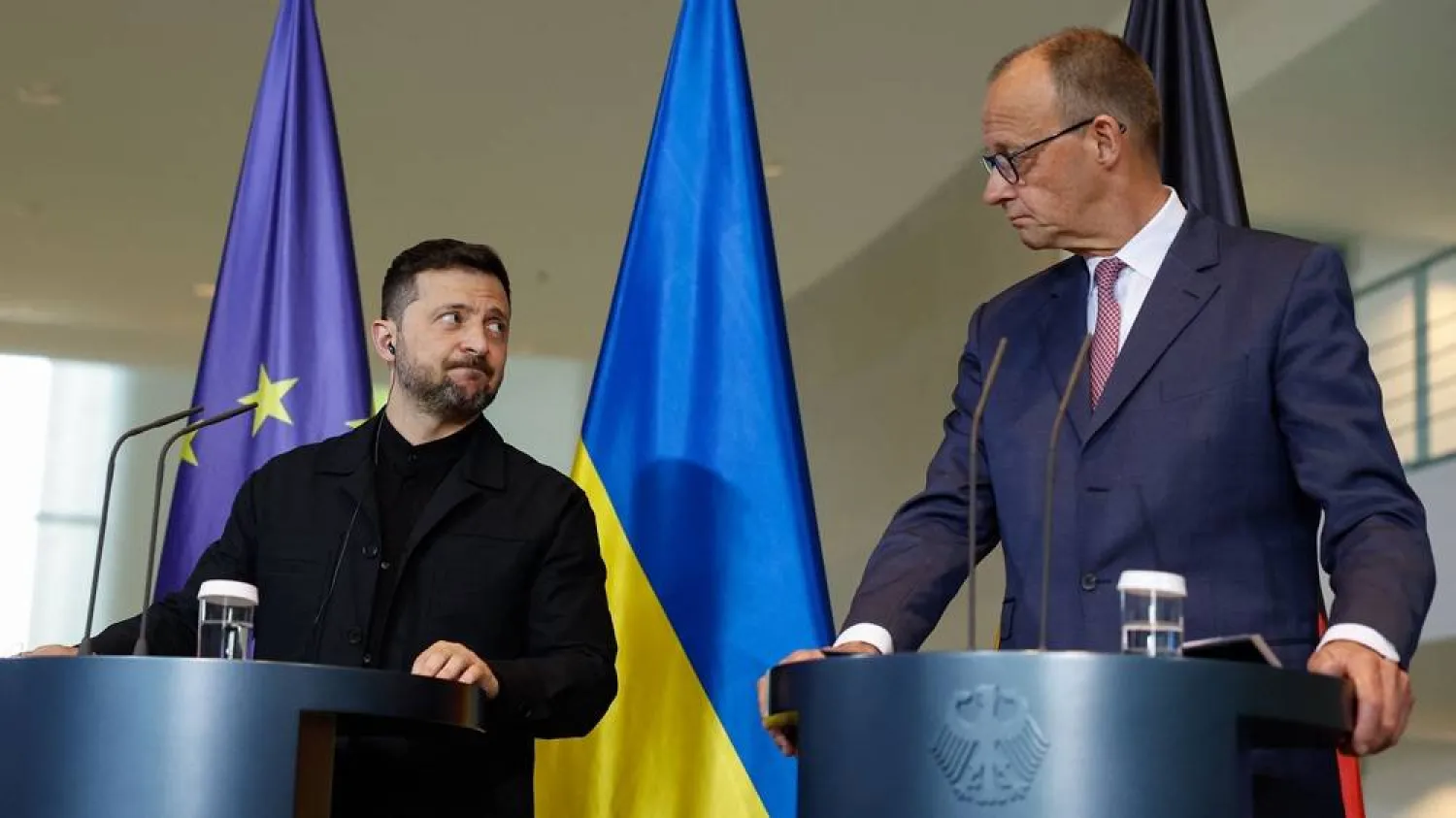

Europe, Ukraine Leaders Seek Talks with Trump to Defend Their Interests ahead of US-Russia Summit

German Chancellor Friedrich Merz (R) and Ukrainian President Volodymyr Zelenskyy give a joint press conference at the Chancellery in Berlin on May 28, 2025. (AFP)
TT

Europe, Ukraine Leaders Seek Talks with Trump to Defend Their Interests ahead of US-Russia Summit

German Chancellor Friedrich Merz (R) and Ukrainian President Volodymyr Zelenskyy give a joint press conference at the Chancellery in Berlin on May 28, 2025. (AFP)

Ukraine and its European backers on Monday sought talks with US President Donald Trump in an effort to protect their security interests ahead of his summit with Russian President Vladimir Putin later this week.

Ukrainian President Volodymyr Zelenskyy has so far been excluded from the US-Russia summit in Alaska on Friday, and the Europeans are unlikely to be invited. All are wary that Putin and Trump might agree, without Ukraine's participation, to land swaps of Ukraine’s territory or other terms that might favor Russia.

German Chancellor Friedrich Merz organized a series of meetings for Wednesday. He invited Trump, US Vice President JD Vance, Zelenskyy, NATO's chief and several European leaders to attend. The chancellery said the talks would focus on “further options for action to put pressure on Russia” as well as “preparations for possible peace negotiations and related issues of territorial claims and security.”

The European Commission confirmed that President Ursula von der Leyen will take part “in the calls organized by Chancellor Merz.” The leaders of Britain, Finland, France, Italy and Poland are also set to join the “various discussion groups,” the chancellery said.

Ukraine and its backers in Europe insist that Trump and Putin cannot decide on land swaps behind their backs at the summit, but the Europeans concede that Moscow is unlikely to give up control of Ukrainian land it holds.

Trump has suggested that a peace deal could include “some swapping of territories,” but the Europeans see no sign that Russia will offer anything to exchange. They are concerned that Putin will try to claim a political victory by portraying Zelenskyy as inflexible.

Nothing about Ukraine without Ukraine

Concerns have mounted in Europe that Kyiv may be pressed to give up land or accept other curbs on its sovereignty. Ukraine and its European allies reject the notion that Putin should lay claim to any territory even before agreeing to a ceasefire. They want a ceasefire first.

“As we work towards a sustainable and just peace, international law is clear: All temporarily occupied territories belong to Ukraine,” EU foreign policy chief Kaja Kallas said. “A sustainable peace also means that aggression cannot be rewarded.”

Polish Prime Minister Donald Tusk said: “It must be obvious to Poland and our European partners — and I hope to all of NATO — that state borders cannot be changed by force.” Any land swaps or peace terms “must be agreed upon with Ukraine’s participation,” he said, according to Polish news agency PAP.

Still, it’s hard to ignore the reality on the ground.

Russia in 2022 illegally annexed the Donetsk and Luhansk regions in Ukraine’s east, and Kherson and Zaporizhzhia in the south, even though it doesn’t fully control them. It also occupies the Crimean Peninsula, which it seized in 2014.

On the 1,000-kilometer (620-mile) front line, Russia’s bigger army has made slow but costly progress with its summer offensive. The relentless pounding of urban areas has killed more than 12,000 Ukrainian civilians, according to UN estimates.

Acknowledging battlefield realities

“In the end, the issue of the fact that the Russians are controlling at this moment, factually, a part of Ukraine has to be on the table" in any peace talks after the Alaska summit, NATO Secretary General Mark Rutte said on CBS on Sunday.

Rutte said Ukraine’s Western backers “can never accept that in a legal sense,” but he suggested that they might tacitly acknowledge Russian control.

He compared it to the way that the US hosted the diplomatic missions of Estonia, Latvia and Lithuania from 1940 to 1991, “acknowledging that the Soviet Union was controlling those territories, but never accepting (it) in a legal sense.”

Giving up any territory, especially without a ceasefire agreement first, would be almost impossible for Zelenskyy to sell at home after thousands of troops have died defending their land.

Ultimately, Putin is seen by some analysts as being not so much interested in land itself, but rather in a more “Russia-friendly” Ukraine with a malleable government unlikely to try to join NATO, just as pro-Russian breakaway regions in Georgia have complicated that country's quest to become a member.

The way ahead

Zelenskyy insists that a halt to fighting on the front line should be the starting point for negotiations, and the Europeans back him. They say that any future land swaps should be for Ukraine to decide and not be a precondition for a ceasefire.

Claims on land could also be part of negotiations on the kind of security guarantees that Ukraine might receive to ensure another war does not break out.

The Europeans believe Kyiv’s best defense is strong armed forces to deter Russia from striking again. They insist there should be no restrictions on the size of Ukraine’s army and the equipment, arms and ammunition it can possess or sell.

Beyond that, they say Ukraine should not be constrained in its choice of joining the EU or being forced to become a neutral country.

The Trump administration has already taken Ukraine's membership of NATO off the table for the foreseeable future.



Israel’s Purchase of ‘Stolen’ Ukrainian Grain Is Not ‘Legitimate’, Zelenskiy Says

Ukraine's President Volodymyr Zelenskiy arrives to attend an informal European leaders' summit in Ayia Napa, Cyprus April 23, 2026. (Reuters)
TT

Israel’s Purchase of ‘Stolen’ Ukrainian Grain Is Not ‘Legitimate’, Zelenskiy Says

Ukraine's President Volodymyr Zelenskiy arrives to attend an informal European leaders' summit in Ayia Napa, Cyprus April 23, 2026. (Reuters)

Ukrainian President Volodymyr Zelenskiy said on Tuesday that Israel's purchase of grain from occupied Ukrainian territory "stolen" by Russia "cannot be legitimate business" and that Kyiv was readying sanctions against those attempting to profit from it.

"Another vessel carrying such grain has arrived at a port in Israel and is preparing to unload," Zelenskiy said on X. "This is ‌not – and cannot ‌be – legitimate business."

"The Israeli ‌authorities ⁠cannot be unaware ⁠of which ships are arriving at the country's ports and what cargo they are carrying," he added.

Ukrainian Foreign Minister Andrii Sybiha said on Monday that Israel's ambassador had been summoned to his ministry over what he ⁠described as Israeli inaction in allowing ‌shipments of grain to ‌enter the country from Russian-occupied Ukraine.

Israeli Foreign ‌Minister Gideon Saar told Sybiha that Ukraine had ‌provided no evidence to support allegations that the grain was "stolen".

Kyiv considers all grain produced in the four regions Russia claimed as its own since ‌invading Ukraine in 2022, and Crimea, annexed by Russia in 2014, ⁠to ⁠have been stolen by Moscow.

Russia refers to the four regions as its "new territories", but they are still internationally recognized as Ukrainian.

"Russia is systematically seizing grain on temporarily occupied Ukrainian land and organizing its export through individuals linked to the occupiers," Zelenskiy said.

"Such schemes violate the laws of the State of Israel itself."

He added that Ukraine expected Israel to respect Ukraine and refrain from actions that undermine bilateral relations.


Iran Says US No Longer in Position to ‘Dictate’ Policy to Other Nations

 Women carry Iranian flags as they cross an intersection to attend a pro-government gathering in Tehran, Iran, Monday, April 27, 2026. (AP)
Women carry Iranian flags as they cross an intersection to attend a pro-government gathering in Tehran, Iran, Monday, April 27, 2026. (AP)
TT

Iran Says US No Longer in Position to ‘Dictate’ Policy to Other Nations

 Women carry Iranian flags as they cross an intersection to attend a pro-government gathering in Tehran, Iran, Monday, April 27, 2026. (AP)
Women carry Iranian flags as they cross an intersection to attend a pro-government gathering in Tehran, Iran, Monday, April 27, 2026. (AP)

Iran said on Tuesday that the United States was no longer able to "dictate" what other countries do, as Washington weighed a new proposal from Tehran on unblocking the Strait of Hormuz.

Iran has effectively sealed off the strategic waterway since early in the war with the United States and Israel, sending shockwaves through global energy markets and putting the strait at the center of negotiations to end the conflict.

"The United States is no longer in a position to dictate its policy to independent nations," defense ministry spokesman Reza Talaei-Nik said, according to state TV, adding Washington would "accept that it must abandon its illegal and irrational demands".

While a ceasefire has halted the fighting between Iran, the US and Israel, talks on bringing a permanent conclusion to the conflict have been inconclusive.

The proposal being considered in Washington would reportedly reopen the Strait of Hormuz -- a vital conduit for global oil and gas shipments -- as broader negotiations on the war continue.

Talaei-Nik, speaking ahead of a Shanghai Cooperation Organization defense ministers' meeting, said Iran was also "ready to share its defensive military capabilities with independent countries, especially the member states" of the SCO.


Philippines Is Not Concerned Iran War Will Distract US from Region, Defense Secretary Says

Troops from New Zealand, the Philippines, US, and Australia pose for a photo with their national flags after participating in counter-landing live fire exercises during Balikatan, the annual joint military exercises between the US and the Philippines, at Long Point Beach, Brgy. Aporawan, Aborlan, Palawan, Philippines, April 27, 2026. (Reuters)
TT

Philippines Is Not Concerned Iran War Will Distract US from Region, Defense Secretary Says

Troops from New Zealand, the Philippines, US, and Australia pose for a photo with their national flags after participating in counter-landing live fire exercises during Balikatan, the annual joint military exercises between the US and the Philippines, at Long Point Beach, Brgy. Aporawan, Aborlan, Palawan, Philippines, April 27, 2026. (Reuters)

The Philippines is not worried about any reduction in US deterrence capabilities in the Indo-Pacific due to the Middle East war, though China would likely try to seize on any perceived opening, the Defense Secretary said ‌on Tuesday.

China's recent ‌actions in the ‌South ⁠China Sea and ⁠the Taiwan Strait were "not surprising", Gilberto Teodoro told Reuters in an interview, saying Beijing looked to take advantage when it thought rival powers were preoccupied ⁠elsewhere.

"It is not surprising ‌that ‌any opportunity they see, perceived opportunity, or ‌with a perceived weakness ‌or a perceived opening, they will take advantage," Teodoro said.

Teodoro said he had full confidence in the ‌Mutual Defense Treaty, the long-standing security pact between Manila ⁠and Washington, ⁠and was not worried by concerns that the Iran war could weaken US strategic bandwidth in Asia.

"I'm not concerned at all about reduced deterrence," he said, pointing to joint military exercises currently underway with the US as a sign of Washington's commitment.