


Australia’s Albanese Says Netanyahu ‘in Denial’ Over Suffering in Gaza 

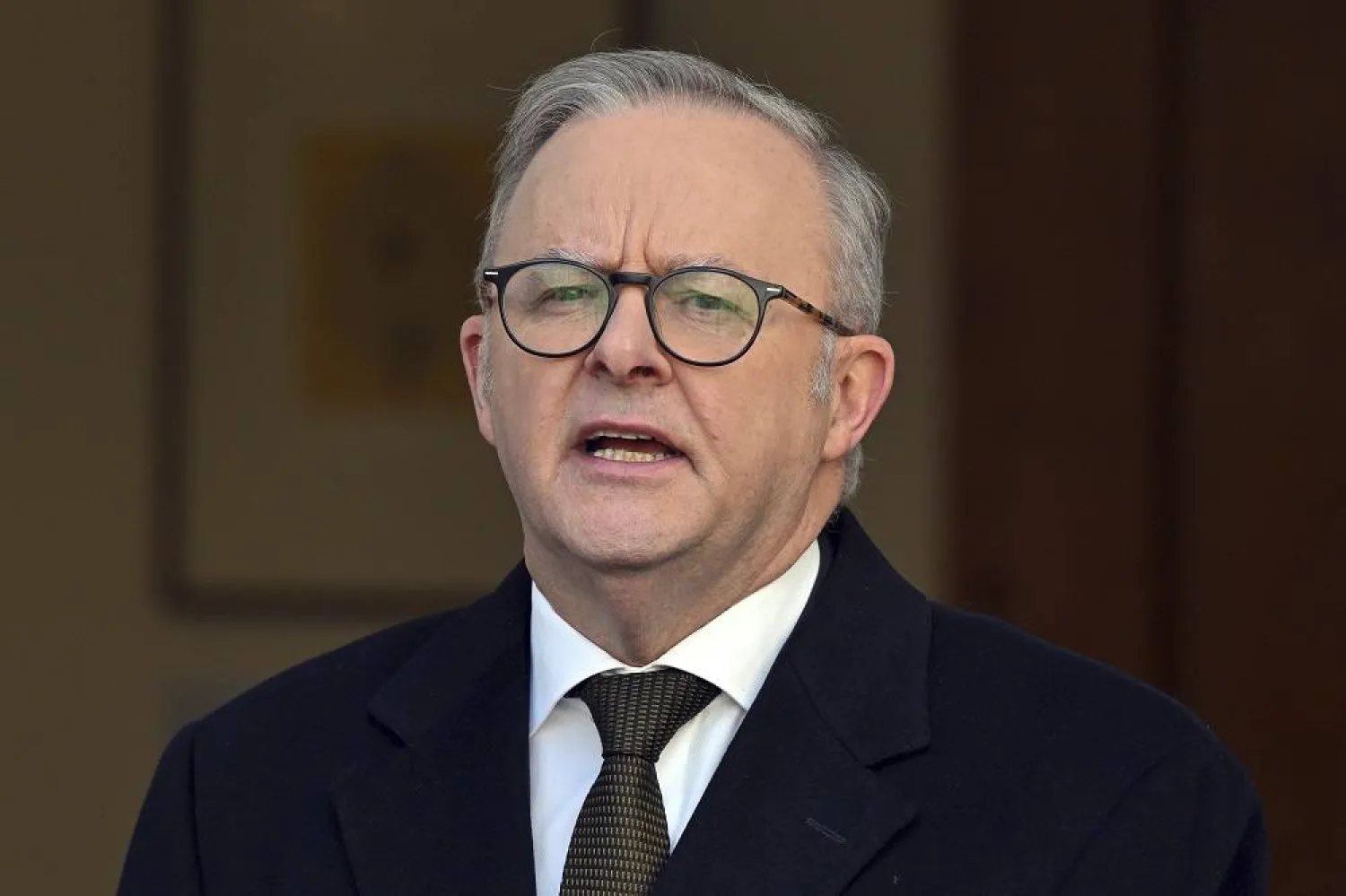
Australian Prime Minister Anthony Albanese announces that Australia will recognize a Palestinian state at a press conference in Canberra, Monday, Aug. 11, 2025. (Mick Tsikas/AAP Image via AP)
TT

Australia’s Albanese Says Netanyahu ‘in Denial’ Over Suffering in Gaza 

Australian Prime Minister Anthony Albanese announces that Australia will recognize a Palestinian state at a press conference in Canberra, Monday, Aug. 11, 2025. (Mick Tsikas/AAP Image via AP)

Australia Prime Minister Anthony Albanese said on Tuesday his Israeli counterpart Benjamin Netanyahu was "in denial" about the humanitarian situation in Gaza, a day after announcing Australia would recognize a Palestinian state for the first time.

Australia will recognize a Palestinian state at next month's United Nations General Assembly, Albanese said on Monday, a move that adds to international pressure on Israel after similar announcements from France, Britain and Canada.

Albanese said on Tuesday the Netanyahu government's reluctance to listen to its allies contributed to Australia's decision to recognize a Palestinian state.

"He again reiterated to me what he has said publicly as well, which is to be in denial about the consequences that are occurring for innocent people," Albanese said in an interview with state broadcaster ABC, recounting a Thursday phone call with Netanyahu discussing the issue.

Australia's decision to recognize a Palestinian state is conditional on commitments received from the Palestinian Authority, including that the group Hamas would have no involvement in any future state.

Right-leaning opposition leader Sussan Ley said the move, which breaks with long-held bipartisan policy over Israel and the Palestinian territories, risked jeopardizing Australia's relationship with the United States.

SENTIMENT SHIFT

Albanese said as little as two weeks ago he would not be drawn on a timeline for recognition of a Palestinian state.

His incumbent center-left Labor Party, which won an increased majority at a general election in May, has previously been wary of dividing public opinion in Australia, which has significant Jewish and Muslim minorities.

But the public mood has shifted sharply after Israel said it planned to take military control of Gaza, amid increasing reports of hunger and malnutrition amongst its people.

Tens of thousands of demonstrators marched across Sydney's Harbor Bridge this month calling for aid deliveries in Gaza as the humanitarian crisis worsened.

"This decision is driven by popular sentiment in Australia which has shifted in recent months, with a majority of Australians wanting to see an imminent end to the humanitarian crisis in Gaza," said Jessica Genauer, a senior lecturer in international relations at Flinders University.

Opposition leader Ley said the decision was "disrespectful" of key ally the United States, which opposes Palestinian statehood.

"We would never have taken this step because this is completely against what our principles are, which is that recognition, the two state solution, comes at the end of the peace process, not before," she said in an interview with radio station 2GB.

Neighboring New Zealand has said it is still considering whether to recognize a Palestinian state, a decision that drew sharp criticism from former prime minister Helen Clark on Tuesday.

"This is a catastrophic situation, and here we are in New Zealand somehow arguing some fine point about whether we should recognize we need to be adding our voice to the need for this catastrophe to stop," she said in an interview with state broadcaster RNZ.

"This is not the New Zealand I've known."


White House to Review Trump’s Security After Gunfire Near Press Dinner

 25 April 2026, US, Washington: US President Donald Trump delivered remarks during a press conference in the Brady Briefing Room at the White House, following the cancellation of the annual White House Correspondents' Association Dinner amid reports of a possible shooting. (dpa)
25 April 2026, US, Washington: US President Donald Trump delivered remarks during a press conference in the Brady Briefing Room at the White House, following the cancellation of the annual White House Correspondents' Association Dinner amid reports of a possible shooting. (dpa)
TT

White House to Review Trump’s Security After Gunfire Near Press Dinner

 25 April 2026, US, Washington: US President Donald Trump delivered remarks during a press conference in the Brady Briefing Room at the White House, following the cancellation of the annual White House Correspondents' Association Dinner amid reports of a possible shooting. (dpa)
25 April 2026, US, Washington: US President Donald Trump delivered remarks during a press conference in the Brady Briefing Room at the White House, following the cancellation of the annual White House Correspondents' Association Dinner amid reports of a possible shooting. (dpa)

White House chief of staff Susie Wiles will meet with law enforcement and homeland security early this week to review security protocols after Saturday's shooting in a Washington hotel where President Donald Trump and top officials were attending a dinner, a senior White House official told Reuters.

The third major security incident targeting Trump in less than two years comes as he prepares for a summer packed with high-profile public events, testing the Secret Service at a moment of high political ‌and global ‌tensions.

Wiles will meet with leaders of the US Secret ‌Service ⁠and the Homeland Security ⁠department to discuss "protocol and practices" for major events involving Trump, the official said.

They said Trump is standing by the Secret Service leadership following the shooting outside the Washington Hilton ballroom where the White House Correspondents' Association dinner was being held.

TRUMP'S SECURITY ALREADY TIGHTENED AFTER INCIDENTS

Acting Attorney General Todd Blanche said in interviews that Trump and other administration officials were the likely intended targets of the suspect, ⁠a California man who was expected in court on Monday ‌to face felony charges.

The 31-year-old is suspected ‌of firing a shotgun at a Secret Service agent at a checkpoint one floor ‌up from the ballroom entrance before being tackled and arrested. Trump and first ‌lady Melania Trump were rushed out of the dinner.

In July 2024, a sniper's bullet skimmed Trump's ear during a campaign rally in Pennsylvania. Two months later, Secret Service agents spotted an armed man hiding in bushes a few hundred yards from where Trump ‌was golfing in Florida. Since then, security around Trump has tightened, and bulletproof glass is used when he speaks ⁠at outdoor events.

Wiles' ⁠meeting will examine Saturday's security response and measures to keep future events safe, the official said.

Trump is expected to attend events this summer for the nation's 250th anniversary and the football World Cup.

Trump told reporters that the first lady had found Saturday's incident traumatic. Nevertheless, the couple was continuing with plans to welcome Britain's King Charles and Queen Camilla on Monday for several days of events.

After the shooting, Trump praised the security response, argued that security concerns were more justification to continue building his East Wing ballroom, and mused to reporters about the risks of being president.

Asked if he was satisfied with his protection, he said: "I'd be up here right now saying they didn't do their job," adding: "Believe me, because, you know, it's my life."


Putin Praises Iranian People for Resistance to US in Talks with Araghchi

27 April 2026, Russia, Saint Petersburg: Russian President Vladimir Putin (R) meets with Iranian Foreign Minister Abbas Araghchi in Saint Petersburg. (Kremlin/dpa)
TT

Putin Praises Iranian People for Resistance to US in Talks with Araghchi

27 April 2026, Russia, Saint Petersburg: Russian President Vladimir Putin (R) meets with Iranian Foreign Minister Abbas Araghchi in Saint Petersburg. (Kremlin/dpa)

Russian President Vladimir Putin on Monday praised the Iranian people for battling to stay independent in the face of US and Israeli pressure and said Moscow would do all it could to help Tehran.

Russia has offered to mediate to try to help restore calm to the Middle East following US and Israeli strikes, which Moscow has strongly condemned. ‌It has ‌also repeatedly offered to store Iran's enriched uranium ‌as ⁠a way of ⁠defusing tensions, a proposal spurned by the United States.

"We see how courageously and heroically the Iranian people are fighting for their independence and sovereignty," Putin told Iranian Foreign Minister Abbas Araghchi, saying he hoped they could get through what he called a "difficult period" and that peace would prevail.

"For our part, we will do everything that serves your interests and the interests ⁠of all the peoples of the region to ensure ‌that peace is achieved as ‌quickly as possible," said Putin.

Putin received Araghchi in the presidential library in Russia's former ‌imperial capital St Petersburg as sources from mediator Pakistan said work ‌had not halted to bridge gaps between the United States and Iran.

Putin said he received a message from Iran’s new Supreme Leader, Mojtaba Khamenei, last week, and asked Araghchi to convey to him that Russia intended to ‌continue its strategic partnership with Tehran.

That 20-year agreement was sealed last year. Russia is building two new ⁠nuclear units at ⁠Bushehr - the site of Iran's only nuclear power plant - and Iran has supplied Russia with Shahed drones for use against Ukraine, the production of which Moscow has since localized.

Araghchi, who said he wanted to brief Putin on the situation around his country, thanked Putin for Moscow's support.

"It has also been proven to all that Iran has friends and allies, such as the Russian Federation, who stand by Iran precisely in difficult times," he said.

Dmitry Peskov, Putin's spokesman, said that Moscow wanted to see the US and Iran continue negotiations. There should be no return to military action, he added, something he said was not in anyone's interests.


UN Maritime Agency Rejects Iran’s Demand for Hormuz Tolls

A woman walks past a billboard with a graphic design about the Strait of Hormuz on a building, amid a ceasefire between US and Iran, in Tehran, Iran, April 27, 2026. Majid Asgaripour/WANA (West Asia News Agency) via Reuters
TT

UN Maritime Agency Rejects Iran’s Demand for Hormuz Tolls

A woman walks past a billboard with a graphic design about the Strait of Hormuz on a building, amid a ceasefire between US and Iran, in Tehran, Iran, April 27, 2026. Majid Asgaripour/WANA (West Asia News Agency) via Reuters

The head of the UN's maritime agency said Monday there was "no legal basis" for imposing any fees for ships to pass through the Strait of Hormuz.

Shipping through the narrow strait has been strangled since the US and Israel attacked Iran in late February.

Iran has sealed off the passage, sharply cutting oil and gas flows and sending prices soaring, while the US has blockaded Iranian ports. Tehran has also said it wants to impose transit fees as part of any lasting peace deal.

"There's no legal basis for the introduction of any tax, any customs, or any fees for on straits for international navigation," IMO Secretary-General Arsenio Dominguez said at a press conference.

Iran's armed forces would have authority over the key shipping lane under the country's proposed law for managing the waterway, a top official said Monday.

Ebrahim Azizi, head of the national security commission in Iran's parliament, told state TV the armed forces were already in control of the strait and were seeking to prohibit the passage of "hostile vessels".

The bill also provides that financial gains from the strait would be paid in Iran's rial currency.

Speaking on the sidelines of an IMO maritime protection committee meeting, Dominguez said he was in contact with "all the countries of the region", including Iran.

He firmly rejected the idea that reopening the waterway could involve payment of any fees.

Dominguez also said a planned evacuation operation for around 20,000 seafarers currently stranded on vessels in the Gulf could only go ahead once the strait was fully secure.

The shipping lane remains a key sticking point in negotiations between Washington and Tehran, even as a fragile April 8 ceasefire continues to hold.
