
Iran's President Mocks Netanyahu over Pledge of Help in Water Crisis

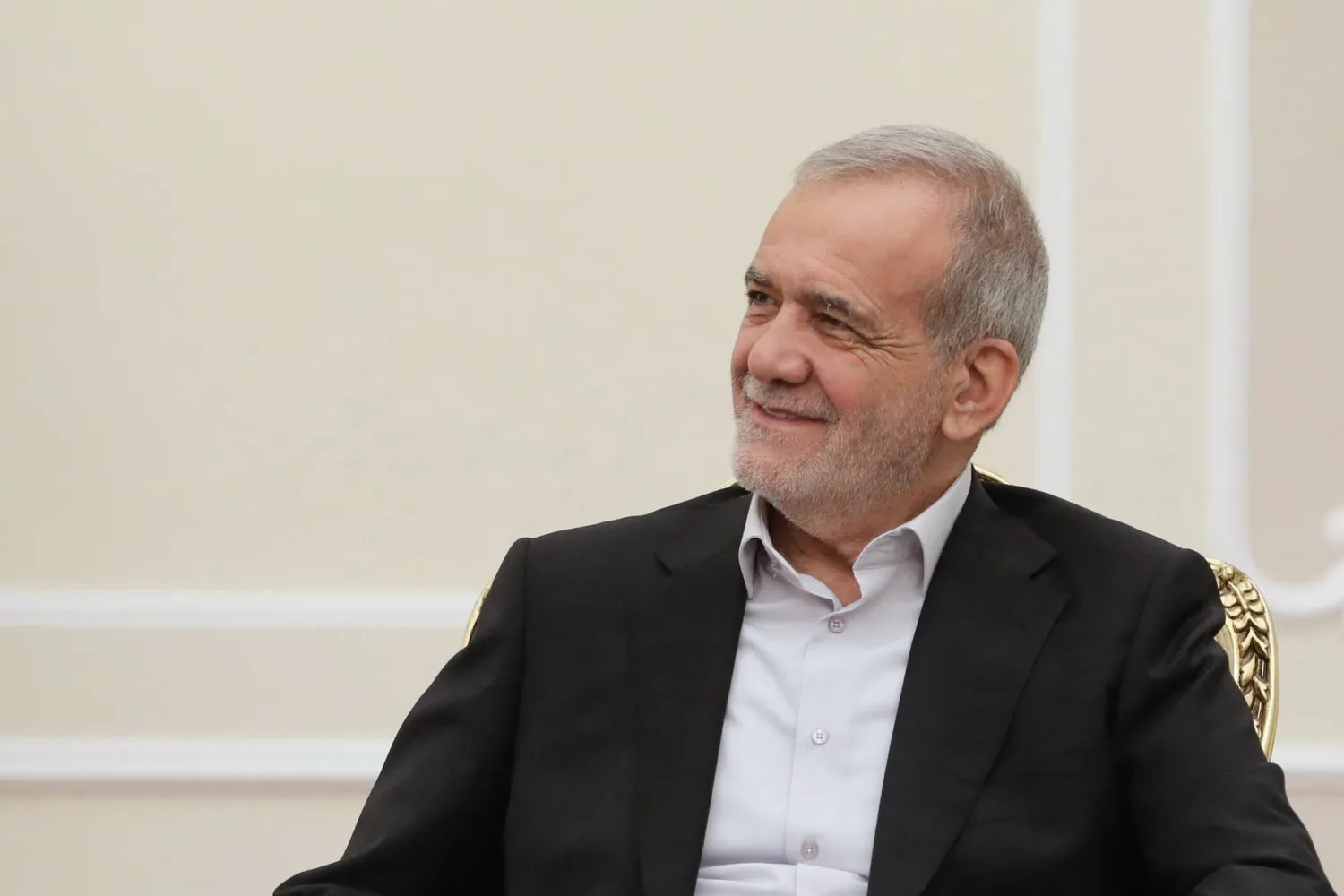
30 July 2024, Iran, Tehran: Iran's President Masoud Pezeshkian meets Hamas chief Ismaeil Haniyeh (not pictured) in Tehran. (Iranian Presidency/dpa)
TT

Iran's President Mocks Netanyahu over Pledge of Help in Water Crisis

30 July 2024, Iran, Tehran: Iran's President Masoud Pezeshkian meets Hamas chief Ismaeil Haniyeh (not pictured) in Tehran. (Iranian Presidency/dpa)

Iranian President Masoud Pezeshkian on Wednesday mocked Israeli Prime Minister Benjamin Netanyahu's offer to help with Iran's water crisis.

Pezeshkian said on X that Israel has denied Palestinians access to water and food, so can't be trusted.

“A regime that deprives people of Gaza from water and food says it will bring water to Iran? A MIRAGE, NOTHING MORE," he said.

Pezeshkian also said during a Cabinet meeting in Tehran that “those with a deceptive appearance are falsely claiming compassion for the people of Iran, The Associated Press said.

"First look at the difficult situation of Gaza and (their) defenseless people, especially children who are struggling ... because of hunger, lack of access to potable water and medicine, because of a siege by the brutal regime.”

Netanyahu addressed Iranians in a video message on Tuesday, pledging that Israel would help solve the country’s severe water shortages once Iran is “free” from the current government, according to Israeli media, including The Jerusalem Post.

The remarks represent a transformation from a state of a war to political spats. In June, Israel carried out waves of airstrikes on Iran, killing nearly 1,100 people, including many military commanders. Retaliatory Iranian strikes killed 28 people in Israel.

On Sunday, Pezeshkian told a group of officials that “we do not have water, we do not have water under our feet and we do not have water behind our dams, so you tell me what do we do? Someone comes and tells me what do I have to do?”

He said that “we are in a serious and unimaginable crisis,” and added that his administration is in touch with experts who are trying to find a solution to the problem.

Experts say years of drought and water mismanagement led to the crisis.


Iran Guards Say Preparing Plan for New Order in Strait of Hormuz

A woman holds Iran’s national flag while standing near a billboard with a sentence reading ‘The Strait of Hormuz remains closed’ at the Enqelab Square in Tehran, on April 5, 2026. (Photo by AFP)
TT

Iran Guards Say Preparing Plan for New Order in Strait of Hormuz

A woman holds Iran’s national flag while standing near a billboard with a sentence reading ‘The Strait of Hormuz remains closed’ at the Enqelab Square in Tehran, on April 5, 2026. (Photo by AFP)

Iran's Revolutionary Guards said they are completing preparations to enforce new operating conditions in the Strait of Hormuz, which has been all but shut since the war with the United States and Israel began.

The Guards naval forces said in a post on X Sunday that the IRGC naval force is completing operational preparations for the Iranian authorities' “declared_plan” for the new Arabian Gulf order.

They warned conditions in the strait "will never return to its former status, especially for the US and Israel."

Their statement came after US President Donald Trump renewed threats to strike Iran's power plants and bridges if the vital shipping route is not reopened.

Iran has allowed only limited traffic through the waterway since the war began on February 28, disrupting the flow of roughly 20 percent of global oil and gas.

Oman's state news agency said on Sunday that Iran and Oman had held talks on easing passage through the strait, which remains effectively closed due to the conflict.

Iranian lawmakers have in recent weeks proposed imposing tolls and taxes on vessels passing through the waterway.


Another Turkish-Owned Ship Has Crossed Hormuz Strait, Says Minister

A man walks along the shore as oil tankers and cargo ships line up in the Strait of Hormuz, seen from Khor Fakkan, United Arab Emirates, March 11, 2026. (AP)
TT

Another Turkish-Owned Ship Has Crossed Hormuz Strait, Says Minister

A man walks along the shore as oil tankers and cargo ships line up in the Strait of Hormuz, seen from Khor Fakkan, United Arab Emirates, March 11, 2026. (AP)

A third Turkish-owned ship has crossed the war-torn Strait of Hormuz, Türkiye’s Transport Minister Abdulkadir Uraloglu said on Monday.

Iran has closed the Strait of Hormuz, a key global waterway, since the US-Israeli strikes on Iran started on February 28 set off the Middle East conflict and sent global oil and gas prices soaring.

"The Turkish-owned vessel 'Ocean Thunder' which was en route carrying crude oil loaded from Iraq to Malaysia, safely passed through the Strait of Hormuz last night," Uraloglu said on X.

According to the global ship tracking intelligence Marine Traffic, it was coming from the port of Basra in Iraq.

This is the third vessel that safely departed the strait after two made an exit at the weekend.

"With this passage, the number of Turkish-owned vessels in the vicinity of the Strait of Hormuz has decreased to 12, and the number of vessels requesting exit has decreased to eight," the minister said.

He added efforts were under way to ensure the safe transfer of the eight ships that wish to depart from the region and the 156 personnel serving on these vessels.


Ukraine Regains Control of Frontline Areas in Southeast and East, Army Chief Says

 A serviceman of the 154th Brigade of the Ukrainian Armed Forces attends a military exercise between combat missions, amid Russia's attack on Ukraine, in Zaporizhzhia region, Ukraine April 4, 2026. (Reuters)
A serviceman of the 154th Brigade of the Ukrainian Armed Forces attends a military exercise between combat missions, amid Russia's attack on Ukraine, in Zaporizhzhia region, Ukraine April 4, 2026. (Reuters)
TT

Ukraine Regains Control of Frontline Areas in Southeast and East, Army Chief Says

 A serviceman of the 154th Brigade of the Ukrainian Armed Forces attends a military exercise between combat missions, amid Russia's attack on Ukraine, in Zaporizhzhia region, Ukraine April 4, 2026. (Reuters)
A serviceman of the 154th Brigade of the Ukrainian Armed Forces attends a military exercise between combat missions, amid Russia's attack on Ukraine, in Zaporizhzhia region, Ukraine April 4, 2026. (Reuters)

Ukraine has regained control of ‌480 sq. km (185 sq. miles) of territory in the southeastern and eastern parts of the front since late January, its army chief Oleksandr Syrskyi said, adding that Russia was continuing its spring offensive.

After visiting the frontline, Syrskyi said that Ukraine had returned control over eight settlements in the Dnipropetrovsk region in the east and four settlements in the southeastern Zaporizhzhia region.

Despite Ukraine's successes, Russian troops were pressing ahead with a spring offensive, he said.

"Russian troops are not abandoning their plans for further offensive operations and are ‌regrouping their available ‌forces and equipment," Syrskyi said on the Telegram ‌app ⁠late on Sunday. "Despite ⁠significant losses in personnel and military equipment, the invaders aim to seize more Ukrainian territory and establish a ‘buffer zone’ in the Dnipropetrovsk region."

The Ukrainian troops maintained defense lines, he said.

Ukrainian President Volodymyr Zelenskiy said last week that the frontline situation for Ukraine was the best since the middle of last year.

KYIV COUNTER ATTACKS ⁠DISRUPT RUSSIAN PLANS

Military analysts said that Ukrainian ‌counter attacks in the southeast of ‌the country were helping to disrupt Russian efforts around Pokrovsk in the ‌eastern Donetsk region, and overall, the Russian spring offensive along ‌more than 1,200 kilometers of the frontline.

"Ukrainian counter attacks in the Hulyaipole and Oleksandrivka directions continue to present the Russian military command with dilemmas that overstretched Russian forces appear challenged to meet," the Washington-based non-profit Institute for ‌the Study of War said in a daily report on Monday.

Russian troops continued to gain ⁠ground in ⁠the eastern Donetsk region, pressing on in the north of Pokrovsk, a key logistics hub, Russian state media quoted Russia's defense ministry as saying last week.

The battle for Pokrovsk has raged on since mid-2024 as Russia seeks to consolidate its control of the Donetsk region.

Syrskyi said he also visited the Pokrovsk area and ordered additional ammunition and other supplies to strengthen the Ukrainian troops there.

With the diplomatic efforts to end the war stalled, Ukraine has also intensified its long-range strike campaign against Russian oil infrastructure. Over the past two weeks, Ukrainian troops targeted Russian Baltic sea ports and oil infrastructure in the Leningrad region.