


From Drought to Floods, Water Extremes Drive Displacement in Afghanistan

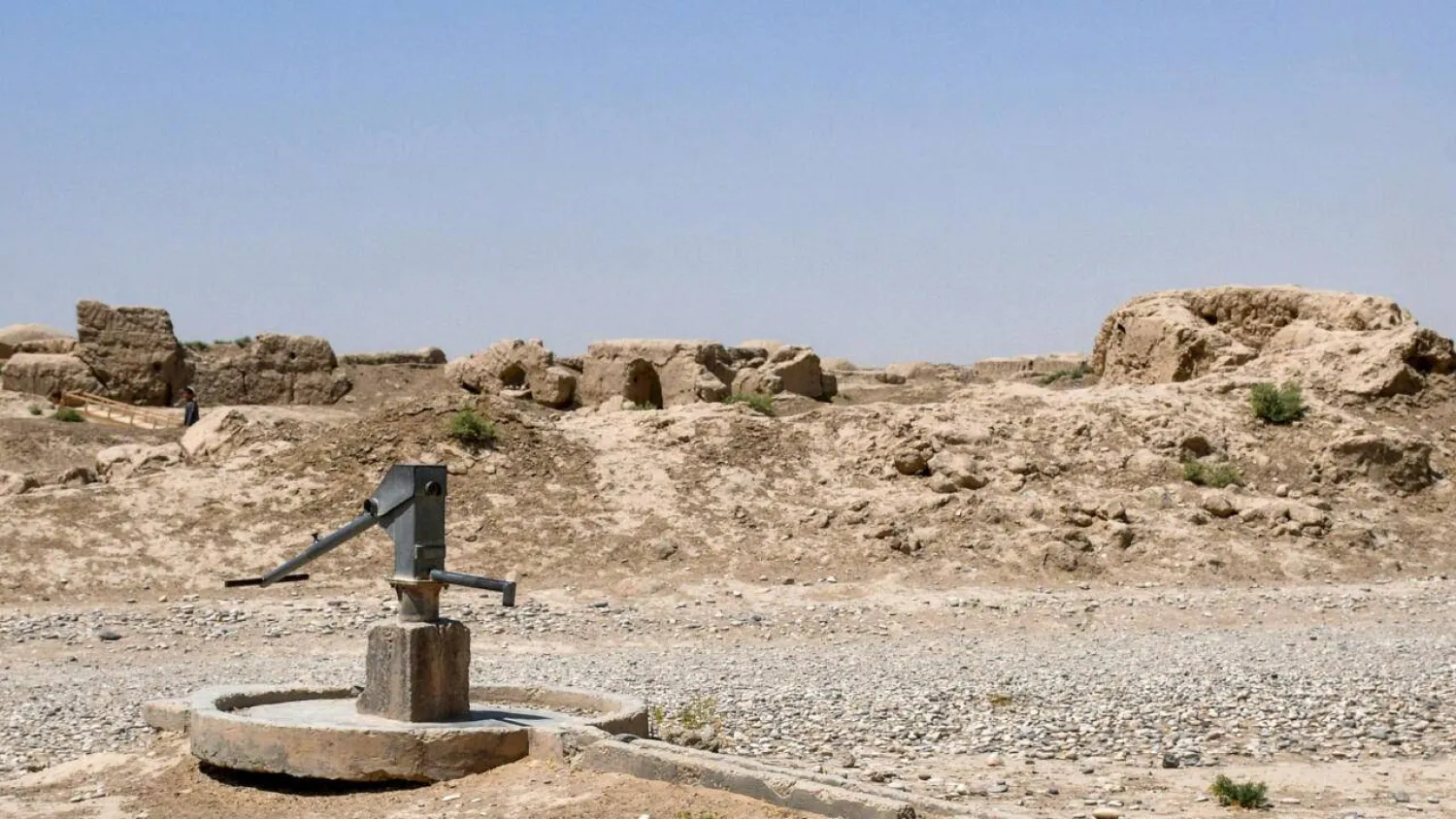
A hand pump stands on a deserted street as chronic water scarcity stalks the drought-ridden village of Bolak in Afghanistan's Balkh province. Atif Aryan / AFP
TT

From Drought to Floods, Water Extremes Drive Displacement in Afghanistan

A hand pump stands on a deserted street as chronic water scarcity stalks the drought-ridden village of Bolak in Afghanistan's Balkh province. Atif Aryan / AFP

Next to small bundles of belongings, Maruf waited for a car to take him and his family away from their village in northern Afghanistan, where drought-ridden land had yielded nothing for years.

"When you have children and are responsible for their needs, then tell me, what are you still doing in this ruin?" said the 50-year-old.

Many of the mud homes around him are already empty, he said, his neighbors having abandoned the village, fleeing "thirst, hunger and a life with no future".

Successive wars displaced Afghans over 40 years, but peace has not brought total reprieve, as climate change-fulled shocks drive people from their homes and strain livelihoods, reported AFP.

Since the war ended between the now-ruling Taliban and US-led forces in 2021, floods, droughts and other climate change-driven environmental hazards have become the main cause of displacement in the country, according to the UN's International Organization for Migration (IOM).

In early 2025, nearly five million people across the country were impacted and nearly 400,000 people were displaced, the IOM said in July, citing its Climate Vulnerability Assessment.

The majority of Afghans live in mud homes and depend heavily on agriculture and livestock, making them particularly exposed to environmental changes.

The water cycle has been sharply impacted, with Afghanistan again in the grip of drought for the fourth time in five years and flash floods devastating land, homes and livelihoods.

"Crop failure, dry pastures and vanishing water sources are pushing rural communities to the edge," the UN Food and Agriculture Organization said in July.

"It's getting harder for families to grow food, earn income or stay where they are."

Experts and Taliban officials have repeatedly warned of escalating climate risks as temperatures rise, extreme weather events intensify and precipitation patterns shift.

The country's limited infrastructure, endemic poverty and international isolation leave Afghans with few resources to adapt and recover -- while already facing one of the world's worst humanitarian crises worsened by severe aid cuts.

Too little

Abdul Jalil Rasooli's village in the drought-hit north has watched their way of life wither with their crops.

Drought already drove many from his village to Pakistan and Iran a decade ago.

Now they've returned, forced back over the border along with more than four million others from the two neighboring countries since late 2023 -- but to work odd jobs, not the land.

"Everything comes down to water," said the 64-year-old, retreating from the day's heat in the only home in the village still shaded by leafy trees.

"Water scarcity ruins everything, it destroys farming, the trees are drying up, and there's no planting anymore," he told AFP.

Rasooli holds out hope that the nearby Qosh Tepa canal will bring irrigation from the Amu Darya river. Diggers are carving out the last section of the waterway, but its completion is more than a year away, officials told AFP.

It's one of the water infrastructure projects the Taliban authorities have undertaken since ousting the foreign-backed government four years ago.

But the theocratic government, largely isolated on the global stage over its restrictions on women, has limited resources to address a crisis long exacerbated by poor environmental, infrastructure and resource management during 40 years of conflict.

"The measures we have taken so far are not enough," Energy and Water Minister Abdul Latif Mansoor told journalists in July, rattling off a list of dam and canal projects in the pipeline.

"There are a lot of droughts... this is Allah's will, first we must turn to Allah."

Hamayoun Amiri left for Iran when he was a young man and drought struck his father's small plot of land in western Herat province.

Forced to return in a June deportation campaign, he found himself back where he started 14 years ago -- with nothing to farm and his father's well water "getting lower and lower every day".

The Harirud river was a dry bed in July as it neared the border with downstream Iran, following a road lined with empty mud buildings pummeled back to dust by the province's summer gales.

Too much

Taliban authorities often hold prayers for rain, but while the lack of water has parched the land in some parts of the country, changes in precipitation patterns mean rains can be more of a threat than a blessing.

This year, rains have come earlier and heavier amid above-average temperatures, increasing flood risks, the UN said.

A warmer atmosphere holds more water, so rain often comes in massive, destructive quantities.

"The weather has changed," said Mohammad Qasim, a community leader of several villages in central Maidan Wardak battered by flash floods in June.

"I'm around 54 years old, and we have never experienced problems like this before," he told AFP in the riverbed full of boulders and cracked mud.

Eighteen-year-old Wahidullah's family was displaced after their home was damaged beyond repair and all their livestock were drowned.

The family of 11 slept in or near a rudimentary tent on high ground, with no plans or means to rebuild.

"We're worried that if another flood comes, then there will be nothing left and nowhere to go."



Ghana Begins Repatriating Citizens from South Africa due to Anti-immigration Tensions

A man draped in a Ghana flag stands among other Ghanaians as Ghana repatriates hundreds of its citizens from South Africa following instances of violence against migrants from other sub-Saharan African countries, amid a wave ‌of protests against illegal immigration, at O.R. Tambo International Airport in Kempton Park, South Africa. REUTERS/Siphiwe Sibeko
TT

Ghana Begins Repatriating Citizens from South Africa due to Anti-immigration Tensions

A man draped in a Ghana flag stands among other Ghanaians as Ghana repatriates hundreds of its citizens from South Africa following instances of violence against migrants from other sub-Saharan African countries, amid a wave ‌of protests against illegal immigration, at O.R. Tambo International Airport in Kempton Park, South Africa. REUTERS/Siphiwe Sibeko

The first group of around 300 Ghanaian nationals flew to their country on Wednesday as their government started a voluntary repatriation program for its citizens in response to anti-immigration tensions in South Africa.

Families and travelers gathered at the Tambo International Airport in Johannesburg with their luggage as officials and police coordinated the departure process.

The repatriation follows renewed demonstrations over illegal immigration in parts of South Africa, where frustrations over unemployment, crime and access to services have fueled tensions, The AP news reported.

Ghana’s High Commissioner to South Africa, Benjamin Quashie, told reporters at the airport that more people than those on the registered list turned up to the airport.

He said their registration would be processed ahead of the next flight to Ghana, expected to depart Sunday.

Ghana recently summoned South Africa's ambassador over reported attacks on Ghanaians, before announcing it would evacuate its affected citizens.

Loren Landau, a migration expert and political analyst at the University of the Witwatersrand, said the move by the Ghanaian government was a message to South Africa about their unhappiness over recent events.

“I think in this case, it’s less about Ghana trying to protect its citizens per se, or these 300. This is a symbolic move to try to send a message to their sort of bigger counterpart, South Africa, that this is politically unacceptable,” said Landau.

Some of those repatriated had been held at the Lindela Repatriation Centre for immigration-related matters.

More than 800 Ghanaians registered with the Ghana High Commission in Pretoria for evacuation following weeks of protests and rising fears among foreign nationals.

Ghanaian authorities said the repatriation effort was being carried out in coordination with South African officials after concerns over the safety and well-being of migrants.

South African authorities have condemned violence against foreign nationals while acknowledging concerns about illegal immigration.

Nigeria also voiced its disapproval at the treatment of some of its citizens and said it was also considering evacuating some of its citizens.


Iran Could Open Strait of Hormuz within a Month if Terms Agreed

Ships anchored in the Strait of Hormuz, May 25, 2026 (Reuters)
TT

Iran Could Open Strait of Hormuz within a Month if Terms Agreed

Ships anchored in the Strait of Hormuz, May 25, 2026 (Reuters)

Tehran would restore shipping through the Strait of Hormuz to pre-war levels within a month in a framework deal with the US to also include withdrawing US forces from Iran's vicinity, Iranian state television reported on Wednesday. The report said the US would end a naval blockade of Iranian shipping, citing a memorandum of understanding being negotiated between the two sides to end the war which has choked global energy supplies through the strategic waterway.

Iranian state TV said it had obtained an unofficial draft of the MOU though it was not final and may not be agreed. The US denied the report, saying it was "complete fabrication" in a White House statement on social media.

Iran's government did not comment. The issue of US troops in the region also needs further discussion, the TV report said without being more specific.

There was no mention of Iran's nuclear program which the US wants disbanded.

The state TV report was the latest signal of possible progress towards a deal, although publicly Tehran and Washington have outlined positions starkly at odds and the potential terms outlined by the broadcaster did not appease all US demands.

US Secretary of State Marco Rubio said on Tuesday it may take a few more days, after President Donald Trump had raised hopes over the weekend for an imminent end to the war.

Key sticking points have included reopening and management of the waterway through which a fifth of the world's oil and liquefied natural gas flowed before the conflict and the dismantling of Iran's nuclear capacity.

Oil prices fell more than 5% on Wednesday after the Iranian TV report.

It was not immediately clear what a US military pullback as described by Iranian state television would look like.

US naval vessels, some with thousands of sailors and Marines aboard, regularly transit the region, stopping in ports including in Oman.


Starmer Cites Russian Threat as UK, Poland Seal Defense Pact

Britain’s Prime Minister Keir Starmer visits a children’s activity center in Essex, Britain, Thursday, May 21, 2026. Kin Cheung/Pool via REUTERS
TT

Starmer Cites Russian Threat as UK, Poland Seal Defense Pact

Britain’s Prime Minister Keir Starmer visits a children’s activity center in Essex, Britain, Thursday, May 21, 2026. Kin Cheung/Pool via REUTERS

UK Prime Minister Keir Starmer hailed Wednesday a defense pact with Poland, arguing the European allies faced "no greater challenge" than "Russian aggression" as he welcomed Polish counterpart Donald Tusk to Britain.

The new security treaty signed by the NATO allies aims to allow the two countries to combine their armed forces' expertise and industrial capability, including developing and manufacturing "next-generation complex weapons", according to the UK government.

It paves the way for large?scale joint exercises by land forces and for London and Warsaw to boost the use of uncrewed systems to reinforce NATO's eastern flank, it said.

The agreement's security elements will also bolster information-sharing and other cooperation to tackle organised crime and aid joint work on cyber, migration and health security.

It follows Britain signing similar defense pacts with Germany and France in recent years.

Poland -- an EU and NATO member that shares its eastern border with Russia, Belarus and Ukraine -- also recently inked a deal in Paris to ramp up joint defense ties.

"There's no greater challenge for either of our countries than the challenge of Russian aggression," Starmer, flanking Tusk, said after signing the treaty at a World War II-era bunker on a former military base in northwest London.

"And we see that not just in Ukraine itself, but beyond Ukraine, impacting on our own countries," he added, calling the treaty "a generational uplift" in the allies' security and defense relationship.

Tusk thanked Starmer for his commitment to defending "shared values" like the rule of law, democracy and human rights, saying they were "important for us and for our nations".

"That is the foundation of the treaty," he noted, speaking through an interpreter.

The pair had earlier held bilateral talks at the Royal Air Force's nearby base at Northolt.

They were expected to discuss the uptick in allegedly Russian-ordered arson attacks in London and elsewhere across Europe, as well as other malign threats, Starmer's office said in advance.

The signing came on the same day as the head of the UK's top-secret electronic eavesdropping agency GCHQ accused Russia of "relentlessly" targeting critical infrastructure, democratic processes, supply chains and public trust in Britain and Europe.

Delivering an inaugural annual lecture, Anne Keast-Butler detailed how Moscow has been increasing its hybrid activity against some European countries, as she urged the public and businesses to make cyber security "10 times more urgent".

Keast-Butler -- appointed GCHQ's first woman chief in 2023 -- noted her agency's work focused on "disrupting Russia's efforts to smuggle western tech, fending off cyber attacks, and countering reckless sabotage and assassination attempts".