


Israel’s Growing Frustration over the War in Gaza Explodes in Nationwide Protests

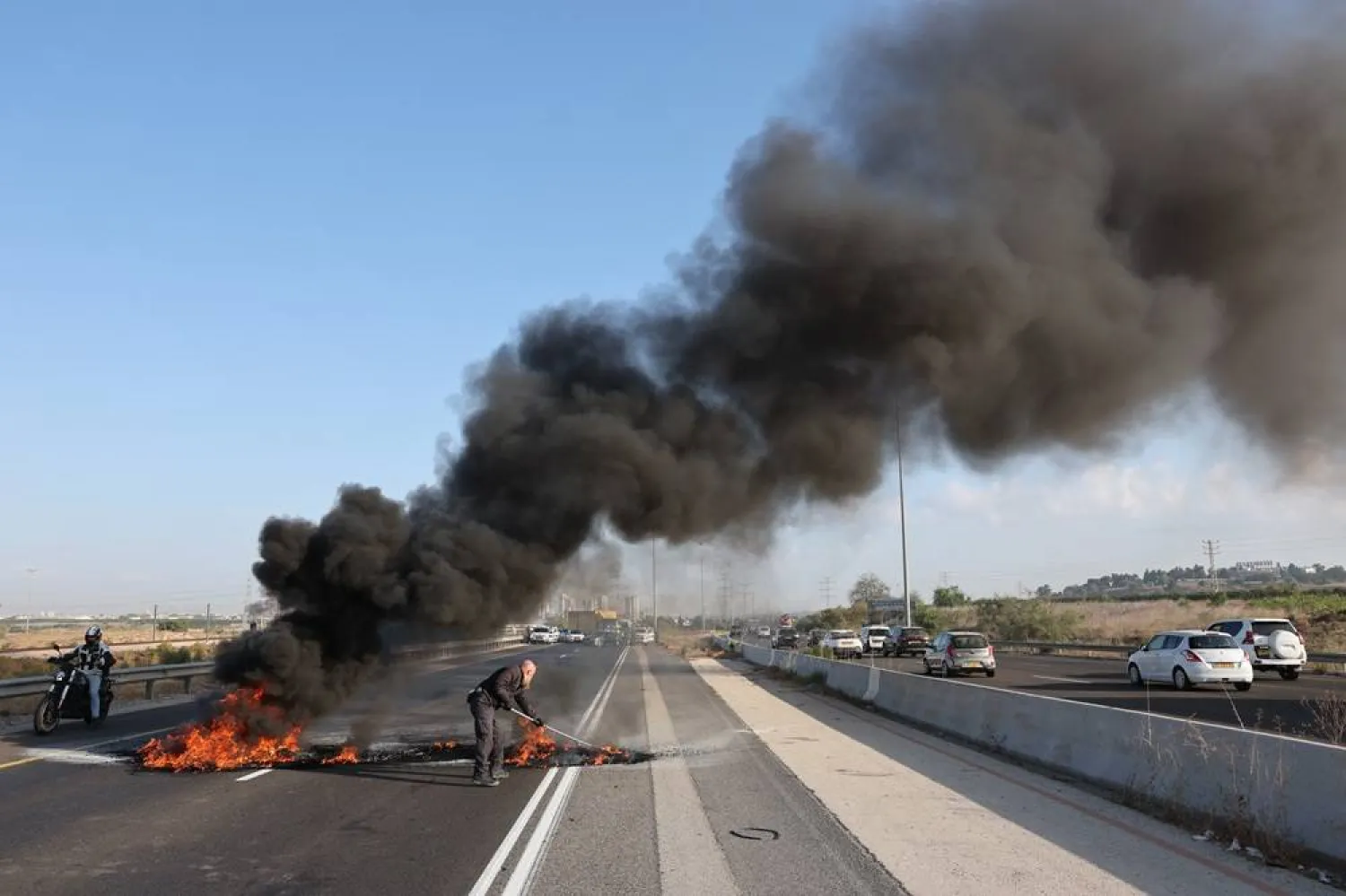
Israeli police officers work to extinguish burning tires set on fire by protesters on the main road connecting Tel Aviv and Jerusalem, Israel, 17 August 2025. (EPA)
TT

Israel’s Growing Frustration over the War in Gaza Explodes in Nationwide Protests

Israeli police officers work to extinguish burning tires set on fire by protesters on the main road connecting Tel Aviv and Jerusalem, Israel, 17 August 2025. (EPA)

Israeli police blasted crowds with water cannons and made dozens of arrests on Sunday as thousands of protesters demanding a deal to free hostages in Gaza aimed to shut down the country with a one-day strike that blocked roads and closed businesses. 

Groups representing families of hostages organized the demonstrations as frustration grows in Israel over plans for a new military offensive in some of Gaza's most populated areas, which many fear could further endanger the remaining hostages. Fifty hostages remain, and 20 of them are believed to still be alive. 

"We don’t win a war over the bodies of hostages," protesters chanted in one of the largest and fiercest protests in 22 months of war. Even some former Israeli army and intelligence chiefs now call for a deal to end the fighting. 

Protesters gathered at dozens of places including outside politicians’ homes, military headquarters and on major highways. They blocked lanes and lit bonfires. Some restaurants and theaters closed in solidarity. Police said they arrested 38 people. 

"The only way to bring (hostages) back is through a deal, all at once, without games," former hostage Arbel Yehoud said at a demonstration in Tel Aviv. Her boyfriend Ariel Cunio is still being held by Hamas. 

One protester carried a photo of an emaciated Palestinian child from Gaza. Such images were once rare at Israeli demonstrations but now appear more often as outrage grows over conditions there for civilians after more than 250 malnutrition-related deaths. 

An end to the conflict does not seem near. Israeli Prime Minister Benjamin Netanyahu is balancing competing pressures including the potential for mutiny within his coalition. 

"Those who today call for an end to the war without defeating Hamas are not only hardening Hamas’ position and delaying the release of our hostages, they are also ensuring that the horrors of Oct. 7 will be repeated," Netanyahu said, referencing the Hamas-led attack in 2023 that killed some 1,200 people and sparked the war. 

The last time Israel agreed to a ceasefire that released hostages earlier this year, far-right members of his cabinet threatened to topple Netanyahu's government. 

Finance Minister Bezalel Smotrich on Sunday called the demonstrations "a bad and harmful campaign that plays into Hamas’ hands, buries the hostages in the tunnels and attempts to get Israel to surrender to its enemies and jeopardize its security and future." 

The new offensive would require the call-up of thousands of reservists, another concern for many Israelis. 


WHO Chief Says Turmoil Creates Chance for Reset

WHO Director-General Tedros Adhanom Ghebreyesus looks on during a press conference with the Association of Accredited Correspondents at the United Nations (ACANU) at the World Health Organization's headquarters in Geneva, on December 10, 2024. (AFP)
TT

WHO Chief Says Turmoil Creates Chance for Reset

WHO Director-General Tedros Adhanom Ghebreyesus looks on during a press conference with the Association of Accredited Correspondents at the United Nations (ACANU) at the World Health Organization's headquarters in Geneva, on December 10, 2024. (AFP)

The head of the World Health Organization said Monday that the dramatic cuts of 2025 as the United States headed for the exit created the chance to build a leaner, re-focused WHO.

Washington, traditionally the UN health agency's biggest donor, has slashed foreign aid spending under President Donald Trump, who on his first day back in office in January 2025 handed the WHO his country's one-year notice of withdrawal.

WHO chief Tedros Adhanom Ghebreyesus told the agency's annual executive board meeting that 2025 was "undeniably one of the most difficult years in our organization's history", with many donors tightening their belts.

"Significant cuts to our funding left us with no choice but to reduce the size of our workforce," he said.

More than a thousand staff have departed but Tedros said such a shock was something the WHO had seen coming, having tried to pivot away from over-reliance on major donors.
And its reorientation was all but finalized, he said.

"We have now largely completed the prioritization and realignment. We have reached a position of stability and we are moving forward," Tedros insisted.

"Although we have faced a significant crisis in the past year, we have also viewed it as an opportunity. It's an opportunity for a leaner WHO to become more focused on its core mission."

He urged member states to keep gradually increasing their membership fees, to reduce the WHO's reliance on voluntary contributions.

The aim is for membership fees to eventually cover 50 percent of the agency's budget, to secure its "long-term stability, sustainability and independence".

"I don't mean independence from member states. Of course, WHO belongs to you and always will," he stressed.

"I mean non-dependence on a handful of donors; I mean non-dependence on inflexible, unpredictable funding; I mean a WHO that's no longer a contractor to the biggest donors.

"I mean an impartial, science-based organization that's free to say what the evidence says, without fear or favor."

The executive board meeting, which opened Monday and runs until Saturday, will discuss the withdrawal notifications of the United States and Argentina.

Unlike any other member state, the United States reserved the right to withdraw when it joined the organization in 1948 -- on condition of one year's notice, and meeting its financial obligations in full for that fiscal year.

While the notice is now up, Washington has not paid its 2024 or 2025 dues, owing around $260 million.


Iran President Orders Start of Talks with US

 Iranians walk in a street in Tehran, Iran, 02 February 2026. (EPA)
Iranians walk in a street in Tehran, Iran, 02 February 2026. (EPA)
TT

Iran President Orders Start of Talks with US

 Iranians walk in a street in Tehran, Iran, 02 February 2026. (EPA)
Iranians walk in a street in Tehran, Iran, 02 February 2026. (EPA)

Iranian President Masoud Pezeshkian has ordered the start of nuclear talks with the United States, the news agency Fars reported on Monday, after US President Donald Trump said he was hopeful of a deal to avert military action.

"President Pezeshkian has ordered the opening of talks with the United States," Fars reported, citing an unnamed government source.

"Iran and the United States will hold talks on the nuclear file," Fars said, without specifying a date. The report was also carried by the government newspaper Iran and the reformist daily Shargh.

Tensions are running high ​amid a military buildup by the US Navy near Iran, following a violent crackdown against anti-government demonstrations last month, the deadliest domestic unrest in Iran since its 1979 revolution.

Trump, who stopped short of carrying out threats to intervene during the crackdown, has since demanded Iran make nuclear concessions and sent a flotilla to its coast. He said last week Iran was "seriously talking", while Tehran's top security official Ali Larijani said on X that arrangements for negotiations were underway.

Iranian sources told Reuters last week that Trump had demanded three preconditions for resumption of talks: Zero enrichment of ‌uranium in Iran, ‌limits on Tehran's ballistic missile program and ending its support ‌for ⁠regional ​proxies.

Iran has ‌long rejected all three demands as unacceptable infringements of its sovereignty, but two Iranian officials told Reuters its clerical rulers see the ballistic missile program, rather than uranium enrichment, as the bigger obstacle.

Foreign Ministry spokesperson Esmaeil Baghaei said Tehran was considering "the various dimensions and aspects of the talks", adding that "time is of the essence for Iran as it wants lifting of unjust sanctions sooner."

A senior Iranian official and a Western diplomat told Reuters that US Special Envoy Steve Witkoff and Iranian Foreign Minister Abbas Araghchi could meet ⁠in Türkiye in the coming day.

A Turkish ruling party official told Reuters that Tehran and Washington had agreed that this week's talks ‌would be focused on diplomacy, a potential reprieve for possible US strikes.

The ‍Iranian official said "diplomacy is ongoing. For talks to ‍resume, Iran says there should not be preconditions and that it is ready to show ‍flexibility on uranium enrichment, including handing over 400 kg of highly enriched uranium (HEU), accepting zero enrichment under a consortium arrangement as a solution".

However, he added, for the start of talks, Tehran wants US military assets moved away from Iran.

"Now the ball is in Trump's court," he said.

Tehran's regional sway has been weakened by Israel's attacks ​on its proxies - from Hamas in Gaza to Hezbollah in Lebanon, the Houthis in Yemen and militias in Iraq - as well as by the ousting of Iran's ⁠close ally, Syrian President Bashar al-Assad.

Last year the United States struck Iranian nuclear targets, joining in at the close of a 12-day Israeli bombing campaign.

TEHRAN DEMANDS LIFTING OF SANCTIONS

After five rounds of talks that have stalled since May 2023, several hard-to-bridge issues remained between Tehran and Washington, including Iran's insistence on maintaining uranium enrichment on its soil and refusal to ship abroad its entire existing stockpile of highly enriched uranium.

Since the US strikes on Iran's three nuclear sites in June, Tehran says its uranium enrichment work has stopped. The UN nuclear watchdog has called on Iran repeatedly to say what happened to the HEU stock since the June attacks.

Western countries fear Iran's uranium enrichment could yield material for a warhead. Iran says its nuclear program is only for electricity generation and other civilian uses.

The Iranian sources said Tehran ‌could ship its highly enriched uranium abroad and pause enrichment in a deal that should also include lifting economic sanctions.


Russia Is Trying to De-Escalate Iran Tensions, the Kremlin Says

26 July 2023, Russia, Saint Petersburg: Kremlin spokesman Dmitry Peskov attends a meeting at the Konstantinovsky Palace. (Vladimir Smirnov/Kremlin/dpa)
TT

Russia Is Trying to De-Escalate Iran Tensions, the Kremlin Says

26 July 2023, Russia, Saint Petersburg: Kremlin spokesman Dmitry Peskov attends a meeting at the Konstantinovsky Palace. (Vladimir Smirnov/Kremlin/dpa)

The Kremlin said on ​Monday that Russia was still trying to de-escalate tensions around Iran, and that it had long ago offered its services to process or store ‌Iran's enriched ‌uranium.

Asked ‌if ⁠Russia ​was ‌discussing with Iran and the United States the possibility of taking Iranian enriched uranium, Kremlin spokesman Dmitry Peskov said: "This topic has ⁠been on the agenda for a ‌long time."

"Russia has ‍been ‍offering its services for ‍quite a long time as a possible option that would lead to the removal ​of certain irritants for a number of countries," ⁠Peskov said.

"Right now, Russia is continuing its efforts, continuing its contacts with all interested parties, and maintains its readiness to de-escalate tensions around Iran to the best of its ability," he said.
