

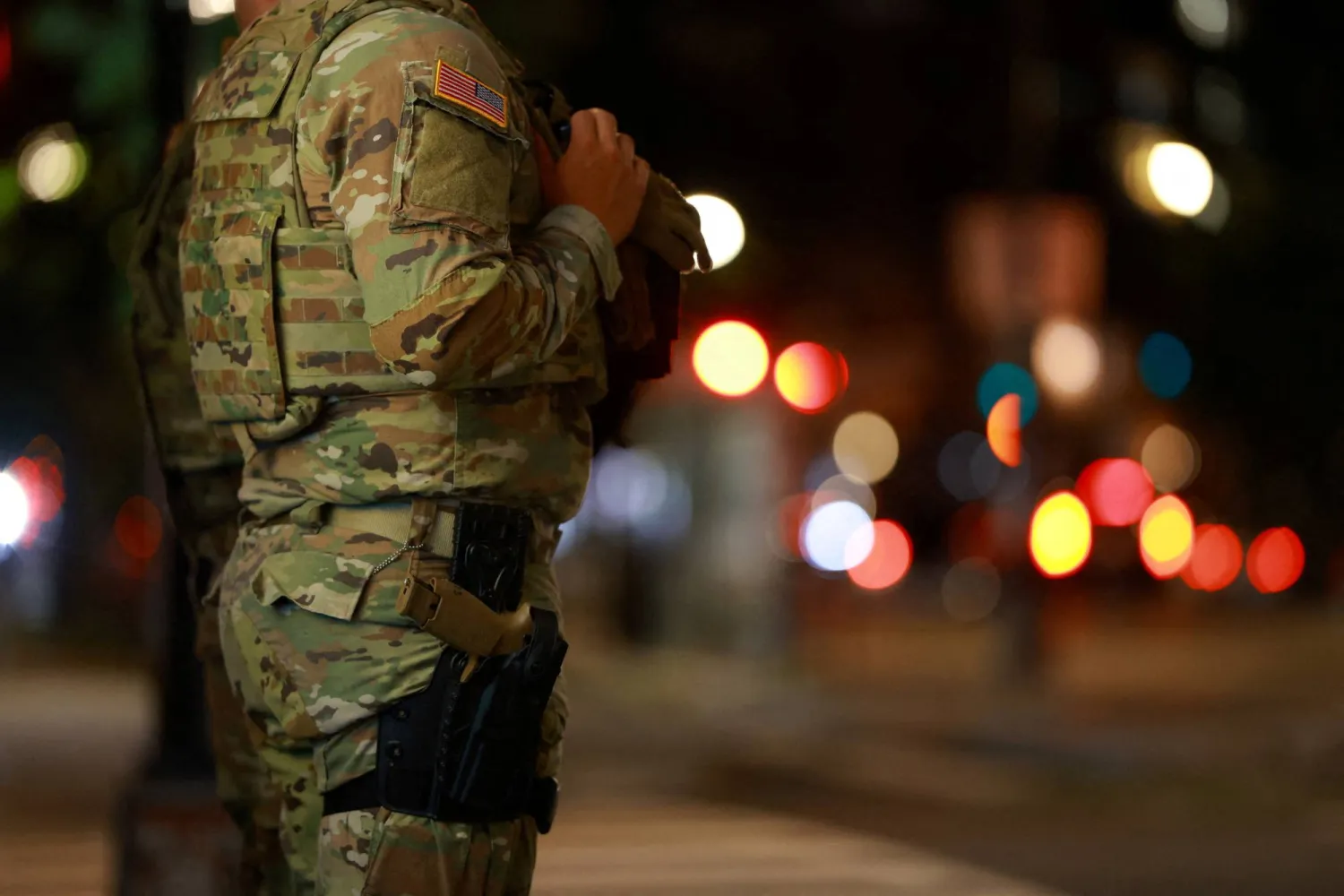

Some National Guard Units in Washington are Now Carrying Firearms in Escalation of Trump Deployment

A member of the Ohio National Guard wears his sidearm while patrolling in the Logan Circle neighborhood, weeks after US President Donald Trump ordered National Guard and law enforcement to patrol the nation’s capital to assist in crime prevention, in Washington, D.C., US, August 24, 2025. REUTERS/Jose Luis Gonzalez
TT

Some National Guard Units in Washington are Now Carrying Firearms in Escalation of Trump Deployment

A member of the Ohio National Guard wears his sidearm while patrolling in the Logan Circle neighborhood, weeks after US President Donald Trump ordered National Guard and law enforcement to patrol the nation’s capital to assist in crime prevention, in Washington, D.C., US, August 24, 2025. REUTERS/Jose Luis Gonzalez

Some National Guard units patrolling the nation’s capital at the direction of President Donald Trump have started carrying firearms, an escalation of his military deployment that makes good on a directive issued late last week by his defense secretary.

A Defense Department official who was not authorized to speak publicly said some units on certain missions would be armed — some with handguns and others with rifles. The spokesperson said that all units with firearms have been trained and are operating under strict rules for use of force.

An Associated Press photographer on Sunday saw members of the South Carolina National Guard outside Union Station with holstered handguns.

A statement from the joint task force that has taken over policing in the nation’s capital said units began carrying their service weapons on Sunday and that the military's rules say force should be used “only as a last resort and solely in response to an imminent threat of death or serious bodily harm.” It said the force is committed to protecting “the safety and wellbeing” of Washington's residents.

The defense official who spoke to The Associated Press said only troops on certain missions would carry guns, and that would include those patrolling to establish a law enforcement presence throughout the capital. Those working in transportation or administration would likely remain unarmed.

Thousands of National Guard and federal law enforcement officers are now patrolling the district’s streets, drawing sporadic protests from local residents.

The development in Trump’s extraordinary effort to override the law enforcement authority of state and local governments comes as he is considering expanding the deployments to other Democratic-led cities, including Baltimore, Chicago and New York.

Earlier Sunday, the president responded to an offer by Maryland’s governor to join him in a tour of Baltimore by saying he might instead “send in the ‘troops.’”

Gov. Wes Moore, a Democrat, has criticized Trump's unprecedented flex of federal power aimed at combatting crime and homelessness in Washington. Moore last week invited Trump to visit his state to discuss public safety and walk the streets.

In a Truth Social post on Sunday, Trump said Moore asked “in a rather nasty and provocative tone,” and then raised the specter of repeating the National Guard deployment he made in Los Angeles over the objections of California's Democratic governor, Gavin Newsom.

"Wes Moore’s record on Crime is a very bad one, unless he fudges his figures on crime like many of the other ‘Blue States’ are doing," Trump wrote, as he cited a pejorative nickname he uses frequently for the California governor. “But if Wes Moore needs help, like Gavin Newscum did in L.A., I will send in the ‘troops,’ which is being done in nearby DC, and quickly clean up the Crime.”

Moore said he invited Trump to Maryland “because he seems to enjoy living in this blissful ignorance" about improving crime rates in Baltimore. After a spike during the pandemic that matched nationwide trends, Baltimore's violent crime rate has fallen. The 200 homicides reported last year were down 24% from the prior year and 42% since 2021, according to city data. Between 2023 and 2024, overall violent crime was down nearly 8% and property crimes down 20%.

“The president is spending all of his time talking about me,” Moore said on CBS's “Face the Nation” on Sunday. “I'm spending my time talking about the people I serve.”

Trump is “spouting off a bunch of lies about public safety in Maryland,” Moore said in a fundraising email.

In Washington, where Trump has surged National Guard troops and federal law enforcement officers, a patchwork of protests popped up throughout the city over the weekend, while some normally bustling corners were noticeably quiet. In some of the most populated areas, residents walked by small groups of national guardsmen, often talking among themselves. Videos of arrests and detainments circulated on social media.

Trump has said Chicago and New York are most likely his next targets, eliciting strong pushback from Democratic leaders in both states. The Washington Post reported Saturday that the Pentagon has spent weeks preparing for an operation in Chicago that would include National Guard troops and potentially active-duty forces.

Asked about the Post report, the White House pointed to Trump's earlier comments discussing his desire to expand his use of military forces to target local crime.

“I think Chicago will be our next,” Trump told reporters at the White House on Friday, adding, “And then we’ll help with New York.”

Trump has repeatedly described some of the nation’s largest cities — run by Democrats, with Black mayors and majority-minority populations — as dangerous and filthy. Baltimore Mayor Brandon Scott is Black, as is Moore. The District of Columbia and New York also have Black mayors.

The Rev. Al Sharpton, speaking during a religious event Sunday at Howard University in Washington, said the Guard's presence in the nation's capital was not about crime: "This is about profiling us.”

“This is laced with bigotry and racism,” he later elaborated to reporters. "Not one white mayor has been designated. And I think this is a civil rights issue, a race issue, and an issue of D.C. statehood.”

Illinois Gov. JB Pritzker, a Democrat, said there is no emergency warranting the deployment of National Guard troops in Chicago.

“Donald Trump is attempting to manufacture a crisis, politicize Americans who serve in uniform, and continue abusing his power to distract from the pain he’s causing families,” Pritzker wrote on X. “We’ll continue to follow the law, stand up for the sovereignty of our state, and protect Illinoisans.”

Chicago Mayor Brandon Johnson said the city doesn't need “a military occupation" and would sue to block one. He said there has been no communication from the White House about a possible military deployment.

“We’re not going to surrender our humanity to this tyrant," Johnson said Sunday on MSNBC. “I can tell you this, the city of Chicago has a long history of standing up against tyranny, resisting those who wish to undermine the interests of working people.”



Venezuela's Maduro Back in US Court after Stunning Capture

(FILES) Venezuela's President Nicolas Maduro looks on during a meeting at the National Assembly in Caracas on August 22, 2025. (Photo by Juan BARRETO / AFP)
TT

Venezuela's Maduro Back in US Court after Stunning Capture

(FILES) Venezuela's President Nicolas Maduro looks on during a meeting at the National Assembly in Caracas on August 22, 2025. (Photo by Juan BARRETO / AFP)

Ousted Venezuelan president Nicolas Maduro will appear Thursday in a New York court for the second time since his capture by US forces in an extraordinary nighttime raid.

Maduro, 63, and wife Cilia Flores have been held in a Brooklyn jail for almost three months after American commandos snatched the pair from their compound in Caracas in early January, said AFP.

The stunning operation deposed the strongman who had led Venezuela since 2013 and has since forced the oil-rich country to largely bend to the will of US President Donald Trump.

Maduro has declared himself a "prisoner of war" and pleaded not guilty to the four counts of "narco-terrorism" conspiracy, cocaine importation conspiracy, possession of machine guns and destructive devices, and conspiracy to possess machine guns and destructive devices.

Thursday's hearing at 11:00 am (1500 GMT) will likely see Maduro push for the dismissal of his case as lawyers tussle over who will pay the former leader's legal fees.

Venezuela's government is seeking to cover the costs, but because of Washington's sanctions, his lawyer Barry Pollack must obtain a US license that has not been issued.

Pollack argued in a court submission that the license requirement violated Maduro's constitutional right to legal representation and demanded the case be thrown out on procedural grounds.

- Deadly raid -

Detained in Brooklyn's Metropolitan Detention Center, a federal prison known for unsanitary conditions, Maduro is reportedly alone in a cell with no access to the internet or newspapers.

A source close to the Venezuelan government said the incarcerated Maduro reads the Bible and is referred to as "president" by some of his fellow detainees.

He is only allowed to communicate by phone with his family and lawyers for a maximum of 15 minutes per call, the source added.

"The lawyers told us he is strong. He said we must not be sad," said his son, Nicolas Maduro Guerra, adding his father told him: "We are fine, we are fighters."

Maduro and his wife were forcibly taken by US commandos in the early hours of January 3 in airstrikes on the Venezuelan capital backed by warplanes and a heavy naval deployment.

At least 83 people died and more than 112 people were injured in the assault, according to Venezuelan officials. No US service members were killed.

- US pressure -

At his first US court appearance in January, Maduro struck a defiant tone as he identified himself the president of Venezuela despite being captured.

The South American country is now led by Delcy Rodriguez, who had been Maduro's vice president since 2018.

Under US pressure, she is grappling with leading a country saddled with the world's largest proven oil reserves but an economy in shambles.

Rodriguez has since enacted a historic amnesty law to free political prisoners jailed under Maduro and reformed oil and mining regulations in line with US demands for access to her country's vast natural wealth.

This month, the State Department said it was restoring diplomatic ties with Venezuela in a sign of thawing relations.

Security is expected to be heightened around the New York courthouse for Thursday's hearing.

Presiding over the case is Alvin Hellerstein, a 92-year-old judge credited with overseeing several high-profile trials during his decades on the bench.


Bus Sinks in Bangladesh River, Many Killed

Rescue teams conduct search operations and look for victims, a day after a bus plunged into the Padma River while boarding a ferry in Rajbari district, 84 km from Dhaka, Bangladesh, 26 March 2026. EPA/STR
TT

Bus Sinks in Bangladesh River, Many Killed

Rescue teams conduct search operations and look for victims, a day after a bus plunged into the Padma River while boarding a ferry in Rajbari district, 84 km from Dhaka, Bangladesh, 26 March 2026. EPA/STR

A bus carrying about 50 people plunged into a major river in central Bangladesh as it was driving onto a ferry, leaving at least 18 people dead, authorities said Thursday.

The bus plunged into the Padma River on Wednesday afternoon in Rajbari district, about 84 kilometers (52 miles) from the capital, Dhaka, said fire official Dewan Sohel Rana.

The bus was traveling to the capital from the southwestern district of Kushtia as people return to work after the Islamic festival of Eid al-Fitr, The Associated Press said.

Rana said many of the passengers swam to safety after the accident but others got trapped.

A rescue vessel joined the operation late Wednesday and lifted the bus, he said, and rescuers worked overnight to recover bodies, finding 18 by Thursday morning.

Strong currents and rains disrupted the rescue operations overnight, he said.

It was not clear if there was still anyone missing.

Ten women and two children were among the dead, according to the Fire Service and Civil Defense Department.


US Activists Work to Connect Iranians Via Starlink

Iranian women walk at Pardisan Park, amid the US-Israeli conflict with Iran, in Tehran, Iran, March 25, 2026. Majid Asgaripour/WANA (West Asia News Agency) via REUTERS
TT

US Activists Work to Connect Iranians Via Starlink

Iranian women walk at Pardisan Park, amid the US-Israeli conflict with Iran, in Tehran, Iran, March 25, 2026. Majid Asgaripour/WANA (West Asia News Agency) via REUTERS

With the war in Iran leading to a near-total internet blackout in the country, activists around the world -- especially in the United States -- are mobilizing to help Iranians stay connected via Starlink.

Despite being banned, billionaire Elon Musk's satellite internet system has gained ground in Iran thanks to a network of international activists, multiple people involved in these efforts told AFP.

The digital activists' efforts began in 2022, when mass protests broke out following the death of Mahsa Amini, who was being held by Iran's police for violating the country's strict dress code for women.

- Smuggling networks -

"As of this year, we have more than 300 devices that we have delivered to the country," said Emilia James of the US-based organization NetFreedom Pioneers. She declined to go into further detail to protect the operation and the users, said AFP.

Ahmad Ahmadian, executive director of Holistic Resilience, explained that his organization purchased Starlink devices in European countries or elsewhere, before moving them into Iran via "neighboring countries."

The government cracked down hard on the Starlink terminals in 2025, and those caught using them face imprisonment.

Charges may be enhanced if the device is found to have been sent by a US organization, Ahmadian pointed out.

His group has supplied "up to 200" antennas to individuals in Iran, and has facilitated the sale of "more than 5,000 Starlink devices" by connecting ordinary citizens with underground resellers, he said.

This approach is less risky for both the activists and for the users.

For these reasons, Holistic Resilience taps smuggling networks and provides security tips and usage instructions remotely.

- Astronomical costs -

To get a Starlink antenna on the black market, Iranians previously had to shell out around "$800 or $1,000" at the end of 2025, Ahmadian recalled, a prohibitive amount for many.

Then there's the issue of paying for usage.

The devices can -- theoretically, at least -- provide internet to an entire family or apartment building.

But in practice, usage remains "limited" because "the costs are still prohibitive for most users," according to NetFreedom Pioneers' Emilia James.

For those that can afford the fees, Visa and Mastercard payments do not work in Iran, forcing users to find workarounds.

Since the bloody crackdown on protesters in January, free usage has been granted for new subscribers. However, the cost of terminals has skyrocketed to some $4,000, according to Ahmadian.

Demand is not the only factor driving up costs.

Many of the terminals were brought into Iran through the "southern borders and through the waterways," Ahmadian said.

The closure of the Straight of Hormuz due to the war "suppresses the supply" of the devices.

- 'More than 50,000' -

While the number of terminals within Iran is not publicly known, Ahmadian estimates that "there are more than 50,000 Starlink terminals in Iran, for sure."

For her part, James estimates that there are "tens of thousands" of Starlink devices in the country of 92 million.

Starlink did not respond to AFP requests for details.

James said that she has heard reports of Iranian authorities searching rooftops and balconies for the antennas since the start of the war.

And earlier this month, a man described as the head of a network that sold internet access via Starlink was arrested by Iranian authorities.