


From Kabul to England … Afghan Women Refugees Find Freedom, Voice Through Football

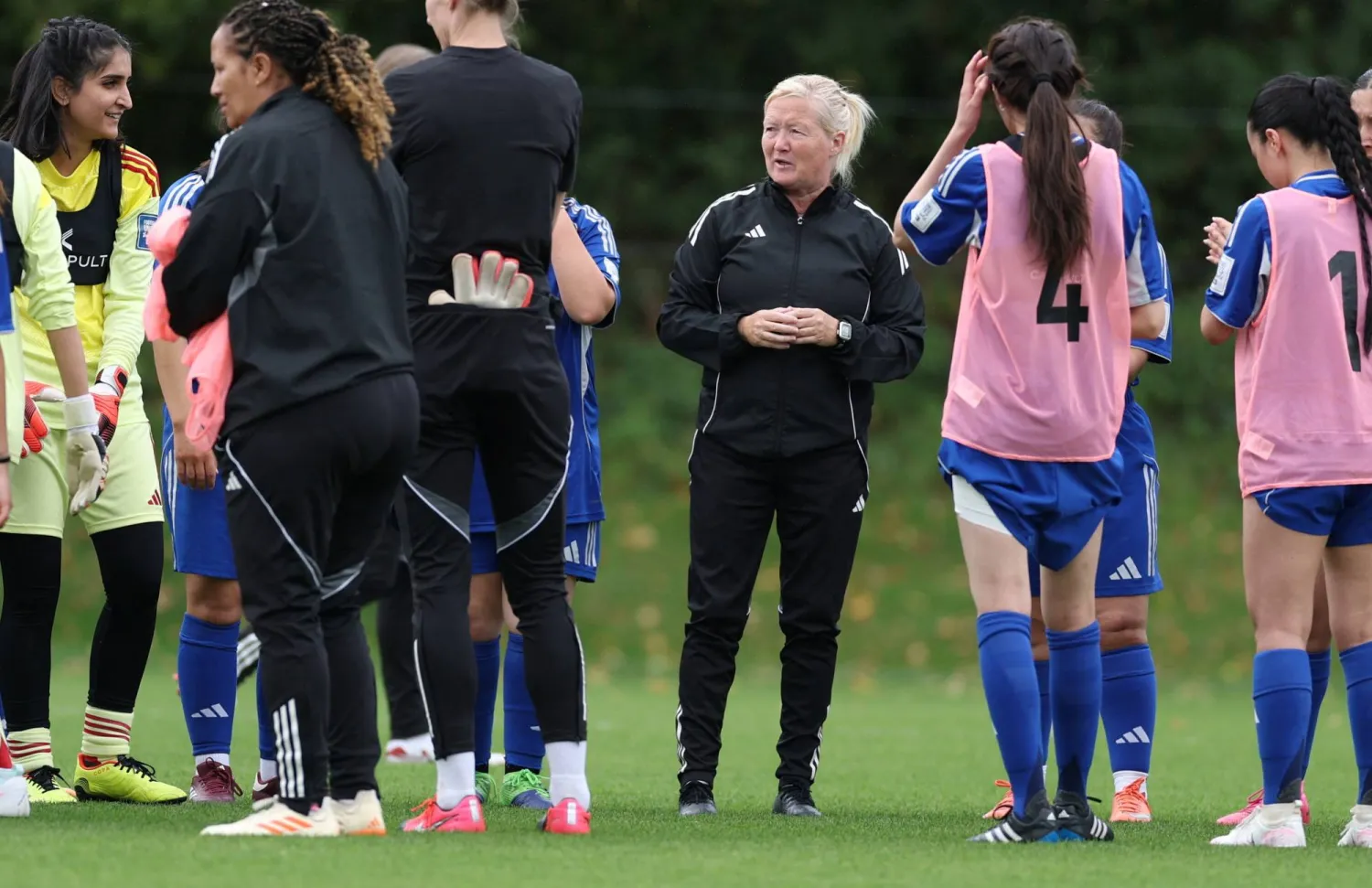
Soccer Football - Head coach Pauline Hamill coaches the Afghan Women's refugee team during a selection camp at St. George's Park, Burton upon Trent, Britain - August 26, 2025 REUTERS/John Sibley
TT

From Kabul to England … Afghan Women Refugees Find Freedom, Voice Through Football

Soccer Football - Head coach Pauline Hamill coaches the Afghan Women's refugee team during a selection camp at St. George's Park, Burton upon Trent, Britain - August 26, 2025 REUTERS/John Sibley

Elaha Safdari was 17 and had just earned her maiden call-up as a goalkeeper for Afghanistan's women's football team when she was forced to flee Kabul during the Taliban takeover in 2021.

Safdari was given chilling instructions to burn her kit and trophies, and erase her social media profile -- anything that could link her to playing football.

"Because it might put you at a high risk (with) the Taliban, because in Afghanistan, women cannot play football," Safdari told Reuters, fighting back tears.

Four years later, the sound of laughter and the thud of footballs echoed across a pitch tucked away at St. George's Park in west-central England this week, as world soccer's governing body FIFA held an ID camp for an Afghan refugee team.

Safdari said the week was "emotional, full of love and joy."

The camp was a chance to reconnect with teammates who share not just a love of the game, but a history of heartbreak and resilience. It was also a declaration of resistance.

"We want to use football as a powerful platform to represent the girls in Afghanistan, that we are not forgetting them," said defender Najma Arefi, who was 18 when she fled Kabul.

"A dog on the street has more rights than a woman in Afghanistan. It makes me so emotional to talk about (female friends and family still there), the fact that they lost their dreams, they lost everything.

"We want to show the world that even if you're closing your eyes, we're still here. We're still going to speak about them. We are not afraid."

The global ID camp, the last of three led by coach Pauline Hamill, was part of FIFA’s efforts to build a 23-player squad for international friendly tournaments.

While FIFA President Gianni Infantino called the initiative an "important step in the right direction," Safdari said Afghan women will not stop fighting for full international status.

"I was so close to my dream, and the Taliban took my dream away," Safdari said. "It's a wonderful step from FIFA that they (are organizing) these tournaments, but our aim is bigger. We are asking FIFA to allow us to be recognized and play on the international stage and represent our country in exile."

Unlike Afghanistan's men's team who continue to play under the national banner, the Taliban-controlled Afghan Football Federation has banned women's sports.

While Safdari and Arefi found safety in Doncaster, England, their move was fraught with isolation and language barriers. Neither spoke English when they arrived.

"It was a tough journey," said Safdari, who lives with siblings as her parents are still in Afghanistan.

"Being a refugee in England wasn't easy. I couldn't speak the language, it was a new society, and I felt like I had no one to support me.

"But, little by little, football gave me the strength and power to build up again."

Arefi, who hopes to be a human rights lawyer, said she had always found solace in football.

"It was a way to feel free, leaving every struggle that we had in our life behind," added Arefi, who won a national championship in 2021 with Herat City. "On the pitch, there was passion, joy and freedom that was keeping us going."



Spain Removes Ambassador to Israel

Spanish Prime Minister Pedro Sanchez delivers a speech during the opening ceremony of the first International Forum Against Hatred in Madrid, Spain, 11 March 2026.  EPA/Chema Moya
Spanish Prime Minister Pedro Sanchez delivers a speech during the opening ceremony of the first International Forum Against Hatred in Madrid, Spain, 11 March 2026. EPA/Chema Moya
TT

Spain Removes Ambassador to Israel

Spanish Prime Minister Pedro Sanchez delivers a speech during the opening ceremony of the first International Forum Against Hatred in Madrid, Spain, 11 March 2026.  EPA/Chema Moya
Spanish Prime Minister Pedro Sanchez delivers a speech during the opening ceremony of the first International Forum Against Hatred in Madrid, Spain, 11 March 2026. EPA/Chema Moya

Spain’s government decided to remove its ambassador to Israel, according ⁠to the official state ⁠gazette published on Wednesday.

Spain's ⁠embassy in Tel Aviv will be led by a charge d'affaires, a source at ⁠the ⁠Foreign Ministry said.

Relations between Spain and the United States are "operating normally" despite US President Donald Trump's threats to cut trade with Madrid over its opposition to the US-Israeli war on Iran, the Spanish foreign minister said on Tuesday.

The leftist government of Prime Minister Pedro Sanchez drew Trump's ire last week after rejecting the war as reckless and illegal while banning US aircraft from using jointly operated bases in southern Spain in the offensive against Tehran.

Foreign Minister Jose Manuel Albares told reporters both Spain's embassy in Washington and the US ⁠embassy in Madrid were ⁠operating with "absolute normalcy”

"Our embassy in Washington is operating normally and has all the contacts it should have as usual," he said, adding that the same applied to the US embassy in Madrid.

Trump threatened on March 3 to impose a full trade embargo on Madrid, also citing the latter's ⁠refusal to meet NATO's new defense spending target of 5% of national output.


Kremlin Says It Is in Constant Touch with Iranian Leaders

05 March 2026, Russia, Moscow: Kremlin Spokesman Dmitry Peskov attends a meeting between Russian President Vladimir Putin and President of the Central African Republic Faustin-Archange Touadera at the Kremlin. (Kremlin/dpa)
TT

Kremlin Says It Is in Constant Touch with Iranian Leaders

05 March 2026, Russia, Moscow: Kremlin Spokesman Dmitry Peskov attends a meeting between Russian President Vladimir Putin and President of the Central African Republic Faustin-Archange Touadera at the Kremlin. (Kremlin/dpa)

Russia is constantly in touch with the Iranian leadership and willing to contribute to efforts to stabilize the region, the Kremlin said ‌on Wednesday.

"Here ‌I can ‌only ⁠say that we are ⁠in constant contact with the Iranian side and with the Iranian leadership," Kremlin spokesman ⁠Dmitry Peskov told reporters.

"As ‌President (Vladimir) ‌Putin has said, ‌Russia is always ready ‌to do what it can to restore peace and stability ‌in the region."

Putin and Foreign Minister Sergei Lavrov ⁠have ⁠spoken with their Iranian counterparts in recent days, while Putin also held a phone call with US President Donald Trump on Monday.


UK Bans Pro-Palestinian March Over Alleged Iran Support

A boy stands at the site of an Israeli strike on a tent sheltering displaced people, in Nuseirat, central Gaza Strip March 9, 2026. REUTERS/Mahmoud Issa
TT

UK Bans Pro-Palestinian March Over Alleged Iran Support

A boy stands at the site of an Israeli strike on a tent sheltering displaced people, in Nuseirat, central Gaza Strip March 9, 2026. REUTERS/Mahmoud Issa

The UK government has banned an annual pro-Palestinian march planned for Sunday which London police claim is organized by a group "supportive of the Iranian regime".

Interior minister Shabana Mahmood said late Tuesday she had approved the rare police request to prevent "serious public disorder" if the Al-Quds Day march and counter-protests had gone ahead.

It is the first time a protest march has been banned since 2012 but a static demonstration will be permitted, according to London's Metropolitan police.

Mahmood said she was "satisfied" a ban was "necessary" due to "the scale of the protest and multiple counter-protests, in the context of the ongoing conflict in the Middle East".

The minister added that she expected to see "the full force of the law applied to anyone spreading hatred and division".

The Islamic Human Rights Commission (IHRC), an NGO which organizes the annual Al-Quds Day march, said it "strongly condemns" the decision, which it called "politically charged".

"We are seeking legal advice and this decision will not go unchallenged," it added, accusing the Met of having "brazenly abandoned their sworn principle of policing without fear or favor".

It said the London force "unashamedly regurgitate Zionist talking points about the IHRC "without a shred of evidence".

The group describes the day and march as an "international demonstration ... in support of Palestinians and all the oppressed around the world".

Al-Quds day, which takes its name from the Arabic for Jerusalem, originated in Iran in 1979 in support of the Palestinian people, and is now marked annually in various countries, notably in the Muslim world. It aims to protest Israel's occupation of east Jerusalem.

But the Met's Assistant Commissioner Ade Adelekan said it was "uniquely contentious having originated in Iran and in London is organized by the Islamic Human Rights Commission".

He claimed that the organization was "supportive of the Iranian regime".

"The threshold to ban a protest is high and we do not take this decision lightly," AFP quoted Adelekan as saying.

He noted the Met has "a proven track record" of permitting free speech and protest rights at dozens of major pro-Palestinian and other demonstrations in recent years.

"But in our assessment this march raises unique risks and challenges," he said.

"We must consider the likely high numbers of protestors and counter protestors coming together and the extreme tensions between different factions.

"We have taken into consideration the likely impact on protests of the volatile situation in the Middle East, with the Iranian regime attacking British allies and military bases overseas."

The ban on the march and any associated counter-protest marches is valid for a month from Wednesday.